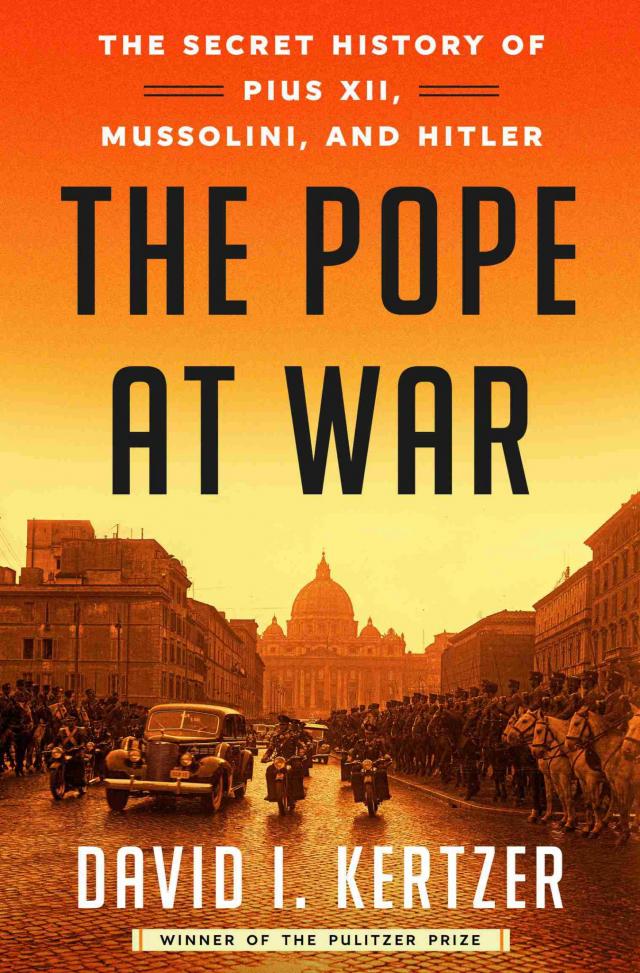
The Pope at War, page 61


Renato Moro (1988, pp. 79–80), one of Italy’s most prominent historians of church-state relations in the twentieth century, stressed the significance of this papal speech in announcing a new “modus vivendi” between the Fascist regime and the nation’s Catholics.
BACK TO NOTE REFERENCE 1
Appunto, DGPS, per il gabinetto, ministro dell’Interno, September 10, 1940, n. 500.25231, ACS, MI, MAT, b. 205; “L’Apostolica orazione di S.S. Pio XII sulla missione religiosa, civile e nazionale dell’Azione Cattolica Italiana,” AR, September 5, 1940, p. 1.
BACK TO NOTE REFERENCE 2
D’Ormesson to French Foreign Ministry, September 13, 1940, MAEC, Guerre Vichy, 553.
BACK TO NOTE REFERENCE 3
Osborne to Foreign Office, London, June 6, 1946, NAK, FO 371, 60812, ZM, 1993, 1946.
BACK TO NOTE REFERENCE 4
Fogarty 1996, pp. 558–59; Spellman to FDR, March 21, 1940, FDR Library, psfc 117, pp. 13–14, clippings pp. 16–23. Spellman had long cultivated friendly relations with Mussolini’s regime, making Farinacci’s attack seem to the Vatican all the more unjustified. Indeed, in 1937 the Italian government had conferred a special honor on Spellman, Grand Official of the Order of the Italian Crown. G. Segre, Italian consul, Boston, to Italian ambassador, Washington, D.C., August 11, 1936, and March 31, 1937, n. 10, ASDMAE, AISS, b. 1993.
BACK TO NOTE REFERENCE 5
“Cinematografia,” RF, September 24, 1940, p. 1. Spellman had also been the first archbishop of New York to preach to Italian immigrants in St. Patrick’s Cathedral in their own language. Now, in the wake of Mussolini’s decision to marry his cause to Hitler’s, Spellman, like much of the American church hierarchy that had earlier shown sympathy for the Fascist regime, was fast losing it. But as Italy’s ambassador in Washington noted, there were still some pro-Fascist and even more numerous anti-British currents in the Catholic Church in the United States, for the clergy was dominated by the Irish. Indeed, Spellman himself was the child of Irish immigrants. No friends of Britain, the Irish Americans were, wrote the ambassador, “predominantly isolationists and in large part not dragged down by anti-totalitarian currents.” The attacks on Spellman, he advised, were counterproductive, producing “a painful impression on that part of the Catholic clergy who are favorable to us and…exploited to our detriment by those elements of the clergy who are hostile to us.” The ambassador’s original report to the Foreign Ministry, dated September 8, 1940, as well as its reproduction in a message sent by the Foreign Ministry to the Ministry of Popular Culture, are found at ASDMAE, APSS, b. 49. For an extreme example of pro-Nazi currents in the American Catholic church at the time, see Gallagher 2021.
BACK TO NOTE REFERENCE 6
The telegram, dated September 25, 1940, is found at ACS, PCM 1940–43, n. 1783/2.5, b. 2936, F2–5.
BACK TO NOTE REFERENCE 7
Attolico to Ciano, September 23, 1940, n. 2686, ASDMAE, AISS, b. 113. Attached was the clipping from the September 21 issue of Il Popolo di Roma, titled “Civiltà francese.”
BACK TO NOTE REFERENCE 8
Attolico to Ciano, September 28, 1940, n. 2805, ASDMAE, AISS, b. 113.
BACK TO NOTE REFERENCE 9
A. Brucculeri, “Verso l’ordine nuovo,” CC, 91 II, Quaderno 2166 (September 21, 1940), pp. 401–13; Attolico to Ciano, October 7, 1940, n. 2889/1329, ASDMAE, AISS, b. 164.
BACK TO NOTE REFERENCE 10
r.m. [Raimondo Manzini], “Giovane Europa,” AI, October 11, 1940, p. 1; r.m., “Volti del tempo,” AI, October 27, 1940, p. 1. For an analysis of the role of Italy’s Catholic daily press in promoting popular support for the war, see Kertzer and Benedetti 2020.
BACK TO NOTE REFERENCE 11
Weizsäcker memo, Berlin, September 30, 1940, DGFP, series D, vol. 11, n. 135; De Felice 1996a, pp. 189–90; Ciano 1980, p. 471, diary entries for October 17 and 18. Ciano’s push to invade Greece is also known from Mackensen’s contemporaneous reports. Mackensen to Foreign Ministry, Berlin, October 18, 1940, DGFP, series D, vol. 11, n. 191, and Bastianini 2005, p. 287.
BACK TO NOTE REFERENCE 12
Metaxas was also not regarded at the time as a friend of the Roman Catholic Church. Since Metaxas had established his “totalitarian regime,” the father general of the order of the Cappuccini reported from Athens to the Vatican, Metaxas, who had previously been seen as kindly disposed to the Catholic Church, had “changed completely.” Now that he had become a dictator, his regime relied on support from the Orthodox Church. The Orthodox Metropolitan of Athens, described by the father general as “our enemy,” along with his predecessor, were responsible for “all of the anti-Catholic legislation” that the government had recently imposed. Padre Riccardo, relazione, March 22, 1941, ASRS, AA.EE.SS., Pio XII, parte 1, Grecia, posiz. 45, ff. 12r–25r.
BACK TO NOTE REFERENCE 13
Ciano 1980, p. 472, diary entry for October 24, 1940; Pirelli 1984, p. 280, diary entry for October 25, 1940; Bismarck, chargé d’affaires, to German Foreign Ministry, October 27, 1940, DGFP, series D, vol. 11, n. 242; Record of conversation Hitler, Duce, October 28, 1940, DGFP, series D, vol. 11, n. 246; Corvaja 2008, pp. 142–44.
BACK TO NOTE REFERENCE 14
Chapter 18: The Greek Fiasco
Gedeon 1997; Morris 2015.
BACK TO NOTE REFERENCE 1
Hitler to Mussolini, November 20, 1940, DGFP, series D, vol. 11, n. 369; Mussolini to Hitler, November 22, 1940, DGFP, series D, vol. 11, n. 383.
BACK TO NOTE REFERENCE 2
Cardinal Maglione suggested to the French chargé d’affaires that there was a brighter side to Italy’s military debacle. “Not knowing how to make war at times like this,” he remarked, “may be a sign of civilization.” His comment is recorded in a memo dated November 22, 1940, written by the French chargé d’affaires to the Vatican but intercepted by the Italian censors. ACS, MI, MAT, b. 263.
BACK TO NOTE REFERENCE 3
De Felice 1996a, pp. 308–9, 1966b, p. 728; Goeschel 2018, p. 197.
BACK TO NOTE REFERENCE 4
D’Ormesson, final report, October 28, 1940, MAEC, Guerre Vichy, 550.
BACK TO NOTE REFERENCE 5
Corvaja 2008, pp. 142–45.
BACK TO NOTE REFERENCE 6
D’Ormesson to French Foreign Ministry, October 30, 1940, MAEC, Guerre Vichy, 551; Attolico to Ciano, October 30, 1940, n. 3117/1419, ASDMAE, AISS, b. 164. The pope’s blessing of the Italian soldiers and his words to them on the day after the Greek invasion triggered protests from both the British and the Australians. Maglione to Apostolic Delegate Panico, Sydney, November 6, 1940; and Maglione to Apostolic Delegate Godfrey, London, November 19, 1940, ADSS, vol. 4, nn. 152, 171.
BACK TO NOTE REFERENCE 7
A copy of the memo from Kazimierz Papée to Cardinal Maglione, dated November 8, 1940, was sent to Myron Taylor on November 23. Taylor in turn sent it to FDR on February 4, 1941. FDR Library, psfa 394, pp. 21–29. The pope was similarly being pressured by the British to speak out. “It is beyond doubt,” a memo prepared by the British envoy to the Vatican charged, “that the Nazis are leading a deliberate campaign to make Catholics believe, as much in the occupied countries as elsewhere, that a new agreement between the Vatican and the Reich is in the process of being put into force, and that the new order of the Axis will satisfy the conditions the Pope enunciated as essential for the establishment of a just and durable peace.” Osborne went on to complain, “One must unfortunately recognize that few eminent Catholics in the occupied countries have distinguished themselves in the struggle to oppose Nazi doctrine or to support the spirit of independence in the face of a brutal aggression.” November 14, 1940, ADSS, vol. 4, n. 165. Osborne, at the urging of London, returned later in November to ask the pope to speak out against the Germans’ indiscriminate massacre of civilians in their daily bombings of London and other British cities. “I spoke strongly on the subject,” he reported back to the Foreign Office, “but I am not sanguine of results.” Osborne to Halifax, November 21, 1940, n. 50, NAK, FO 380/61.
BACK TO NOTE REFERENCE 8
As they all reflected on the pope’s inspiring words, said the bishop, they should think with pride of Italy’s many Catholic Action members who had died in the wars in Ethiopia and Spain, in the conquest of Albania, and in the current war. Each of them had answered the pope’s patriotic call with their own enthusiastic (Fascist) shout of “Presente!” Attolico to Ministero degli Affari Esteri, PCM, and PNF, November 21, 1940, tel. 14/00670/c, ACS, PCM 1940–43, b. 2936, F2–5. The event received major coverage in both the Fascist and Catholic press: “L’udienza del Papa a circa 5000 Giovani cattolici,” PI, November 11, 1940, p. 3; “La parola di Pio XII ai giovani d’Italia” and “S.E. Mons. Colli esalta nella Basilica Vaticana le glorie religiose e nazionali dei Giovani Cattolici d’Italia,” AR, November 12, 1940, pp. 1–2.
BACK TO NOTE REFERENCE 9
“Le solenni onoranze funebri alla Salma del Capo della Polizia Italiana,” AR, November 22, 1940, p. 4.
BACK TO NOTE REFERENCE 10
“L’omelia di Sua Santità,” OR, November 25, 1940, p. 1.
BACK TO NOTE REFERENCE 11
Attolico to Ciano, November 24, 1940, tel. 136, ASDMAE, AISS, b. 194; the copy sent on to Mussolini on November 26, tel. 000671, is found at ASDMAE, APSS, b. 48. “La Messa papale in suffragio dei caduti in guerra,” PI, November 25, 1940, p. 3; “Pio XII celebra in San Pietro una Messa per i caduti in guerra,” RF, November 26, 1940, p. 2.
BACK TO NOTE REFERENCE 12
Osborne to Halifax, November 30, 1940, with English translation of papal address of November 24, NAK, FO 371, 24962.
BACK TO NOTE REFERENCE 13
Chapter 19: A New World Order
Sarfatti 2006, pp. 138–41; Impagliazzo 1997. For the impact of the racial laws on Jewish children in Italy, see Maida 2013.
BACK TO NOTE REFERENCE 1
“L’allontanamento degli ebrei,” OR, March 17, 1939, p. 6; “La cancellazione dagli albi dei professionisti considerati di razza ebraica,” OR, March 2, 1940, p. 4.
BACK TO NOTE REFERENCE 2
Sarfatti 2006, pp. 141–43; Capogreco 2004.
BACK TO NOTE REFERENCE 3
Phillips reported on the confining of foreign Jews to concentration camps in Italy as early as June 21, 1940, in his report to the U.S. State Department. NARA, RG 84, box 74, Phillips Correspondence 1940, 840.1, p. 44. On the mixed marriage case, see Cardinal Lauri to Montini, August 20, 1940, and Mons. Lombardi, handwritten notes, August 23, 1940, AAV, Segr. Stato, 1940, Varie, posiz. 1120, ff. 5r–8r. See also Dell’Era 2018.
BACK TO NOTE REFERENCE 4
The original documents are found at ASRS, AA.EE.SS., Pio XII, Parte Asterisco, Serie Stati Ecclesiastici, posiz. 575*, ff. 732–50. The underlining is in the original. The reproduction of the (edited) documents is found in ADSS, vol. 6, n. 341. The editors also cut from their presentation of the document Tardini’s typed note that referred to the gift as coming from “rich American Jews.”
BACK TO NOTE REFERENCE 5
Attolico to Alessandro Pavolini, November 26, 1940, ASDMAE, AISS, b. 116.
BACK TO NOTE REFERENCE 6
To cite only a couple of such articles appearing in Il Regime Fascista in December: “Pio Nono per il razzismo fascista,” RF, December 5, 1940, p. 3; “La Chiesa cattolica contro i Giudei,” RF, December 8, 1940, p. 3. As Semelein (2018, p. 200) has recently noted, referring to the new French anti-Jewish laws under Pétain, “the Catholic hierarchy broadly accepted the status of Jews as second-class citizens.” For more on the use, by both the Fascist and the Catholic press, of church authority in support of the antisemitic campaign, see Kertzer and Mokosch 2019, 2020, and Kertzer and Benedetti 2021. On La Croix, see Cointet 1998, pp. 187–88. On the French Catholic reaction to the new anti-Jewish laws, see also Bernay 2012, pp. 149–50; Duquesne 1966, pp. 265–69; and Paxton 1972, p. 174. On French reaction more generally, see Marrus and Paxton 2019.
BACK TO NOTE REFERENCE 7
Goeschel 2018, pp. 197–200; Di Rienzo 2018, p. 345; Ciano 1980, pp. 484–85, 487, diary entries for December 4 and 11, 1940.
BACK TO NOTE REFERENCE 8
The U.S. military attaché’s December 16 report is found at NARA, RG 165, 2062, 5–6, color 125.
BACK TO NOTE REFERENCE 9
“Text of Prime Minister Winston Churchill’s speech to the Italian People, December 23rd, 1940,” https://www.churchillbookcollector.com/pages/books/000462/winston-s-churchill/text-of-prime-minister-winston-churchills-speech-to-the-italian-people-december-23rd-1940.
BACK TO NOTE REFERENCE 10
Informativa Città del Vaticano, December 28, 1940, ACS, SPD, CR, b. 324.
BACK TO NOTE REFERENCE 11
A draft of the pope’s Christmas speech, showing his revisions of the earlier draft, is found at AAV, Carte Pio XII, Discorsi, b. 3, 1940, fasc. 38, ff. 1r–15r.
BACK TO NOTE REFERENCE 12
Attolico to Ciano, December 24, 1940, n. 3699/1646, ASDMAE, AISS, b. 194; Informativa, Città del Vaticano, December 28, 1940, ACS, SPD, CR, b. 324 (underlining in the original). For the text and for church coverage of the talk, see ISACEM, Bolletino 19, n.1 (1941), pp. 1–9; “Il Sommo Pontefice nell’auspicio e nella visione di una pace giusta e duratura,” OR, December 25, 1940, pp. 1–2. For the coverage given by Mussolini’s paper: “Discorso di Pio XII al Collegio cardinalizio,” PI, November 25, 1940, p. 6.
BACK TO NOTE REFERENCE 13
For some biographical background, see Chassard 2015, pp. 11–19, 99–101.
BACK TO NOTE REFERENCE 14
Bérard to French Foreign Ministry, December 9, 1940, MAEC, Guerre Vichy, 544; Bérard to French Foreign Ministry, December 24, 1940, MAEC, Guerre Vichy, 551.
BACK TO NOTE REFERENCE 15
Attolico to Ciano, December 28, 1940, n. 147, ASDMAE, AISS, b. 164.
BACK TO NOTE REFERENCE 16
Borgongini to Maglione, December 31, 1940, AAV, Arch. Nunz. Italia, b. 18, fasc. 4, ff. 82r–85r.
BACK TO NOTE REFERENCE 17
Chapter 20: Hitler to the Rescue
General Rintelen report to Wehrmacht High Command, January 2, 1941, DGFP, series D, vol. 11, n. 597; Bosworth 2002, p. 376; U.S. consul, Palermo, report, February 1941, NARA, RG 165, 2062–72, color 126, 9.
BACK TO NOTE REFERENCE 1
Harvey 1985.
BACK TO NOTE REFERENCE 2
It would be best, the pope decided, to have an appropriate message delivered through Evasio Colli, the bishop heading Italian Catholic Action, whose patriotic message at the beginning of the war the government had so appreciated. On January 9, 1941, Monsignor Colli issued the new appeal: “If there is a circumstance in which Catholics worthy of this name must honor the Gospel and behave as loyal, perfect citizens, obedient to Authority…such is the present.” Merging Fascist and church watchwords, Colli declared, “The Catholics, for whom obedience, devotion, and sacrifice are transcendent values, must not remain second to anyone in this cooperation.” The Vatican newspaper published the bishop’s appeal and Rome’s Catholic newspaper featured it as well. Attolico to Ciano, January 8, 1941, tel. 78/25, ASDMAE, APSS, b. 55; Mons. Colli, “Comunicati per la Patria nell’ora presente,” January 9, 1940, in ISACEM, Bollettino 19, n. 2 (February 1941); “Un indirizzo di Mons. Colli all’Azione Cattolica Italiana,” OR, January 13, 1941, p. 2. Rome’s Catholic newspaper aptly titled its coverage of Colli’s address “Italian Catholic Action for the Fatherland in Arms.” In an editorial immediately below the text, the paper’s director praised the words of the “great bishop” as offering “clarity of Catholic doctrine and practice.” Enveloping the Fascist cause in a papal blanket, he concluded: “Rome is still today the seat of the Successor of Peter, in which Christ perpetuates his Romanità. In the Cross that always dominates Rome’s sky we are certain of winning. In the watchword ‘pray and work’ we remain committed to be worthy of Victory.” “L’Azione Cattolica Italiana per la Patria in armi,” AR, January 11, 1941, p. 1.