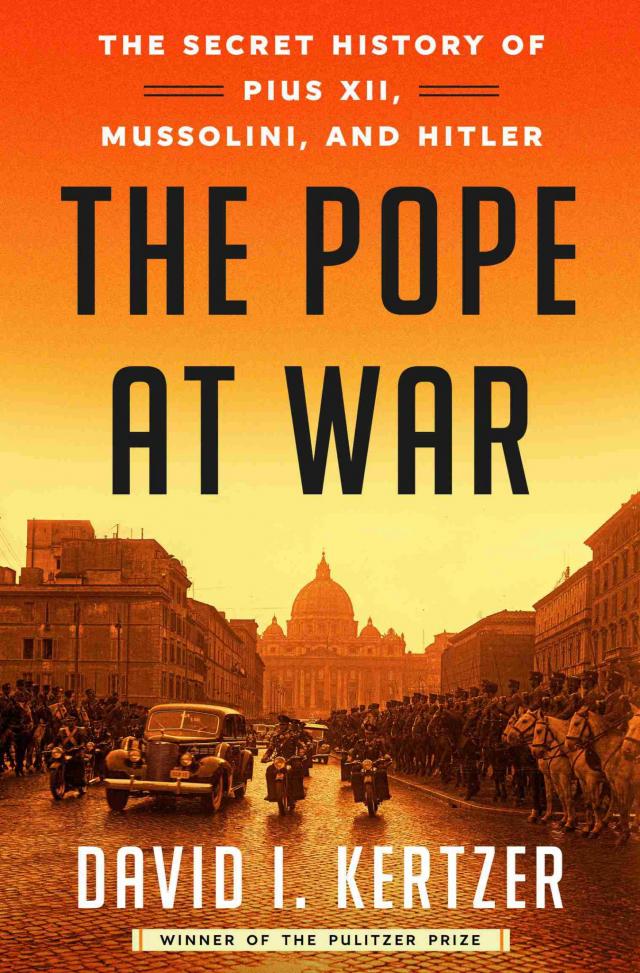
The Pope at War, page 26


The Fascist press meanwhile continued to publish articles justifying the anti-Jewish measures as simply carrying out the same policy that the Catholic Church itself had long championed. A July article in Mussolini’s Popolo d’Italia gave prominent coverage to a recent speech by Farinacci in Milan, in which he read aloud what he identified as “maxims” from the Talmud. “Italy and Germany,” the paper reported “were able to be inspired by an ancient anti-Jewish tradition…nourished by the Catholic Church itself, through the words of its popes and the decisions of its Councils.” The accompanying photo showed Farinacci speaking to a packed hall decorated with both Nazi and Japanese flags. A week later, in his own newspaper, Il Regime Fascista, Farinacci repeated what had become his constant refrain: “We, Fascist Catholics, are anti-Jewish because we have learned to combat these enemies of Christian civilization from the Doctors and Saints of the Church.”[8]
Roberto Farinacci
Italy’s Catholic press meanwhile reported the recent roundup in Paris—by French police—of twenty thousand Jews destined for concentration camps and death in Poland. A few days later an assembly of French cardinals and archbishops met to discuss the situation, but the minority calling for a public protest was overruled. Instead, the archbishop of Paris wrote Marshal Pétain a private letter expressing their concern.[9]
* * *
—
With the success of the new Axis offensive in North Africa and regular reports of the sinking of Allied merchant ships by German U-boats in the Atlantic, the summer of ’42 brought Mussolini a raft of good news. Following months of widespread pessimism, his spies were reporting an improvement in public morale. If the Germans now took Egypt, President Roosevelt observed at the time, the Nazis and their Japanese allies would control a vast stretch of land and sea extending from the Atlantic to the Pacific.[10]
Along with reports of the Germans’ military advances in North Africa came new accounts of their mass murder of civilians in central and eastern Europe. D’Arcy Osborne, Britain’s envoy to the Vatican, renewed his pleas for the pope to speak out, but as he reported to London on July 12, his efforts were proving futile. There was no point in having the pope protest the atrocities, said Cardinal Maglione, as the Germans would simply deny that the charges were true. But Osborne sensed the cardinal was himself uncomfortable with the pope’s silence: “He has to defend the policy of the Pope, whether he approves of it or not.” On the text of Osborne’s report, a London Foreign Office official added a handwritten note: “Papal timidity becomes ever more blatantly despicable.”[11]
If Cardinal Maglione was becoming embarrassed, his deputy, Monsignor Tardini, was growing ever more irritated, but not with the pope. The constant parade of diplomats complaining about Pius XII’s failure to denounce the Nazi crimes was beginning to wear on him. The Polish ambassador came again to see Tardini, asking, in the monsignor’s words, “for the umpteenth time that the Holy See say a word publicly in favor of the Poles and against the terrible persecution they are being subjected to.” The next day Osborne came “to say more or less the same thing.” To both, Tardini replied the same way: the Holy See found it most effective to act privately, discreetly. To speak out publicly risked compromising that valuable work.[12]
Tardini’s irritation was no doubt heightened when Osborne handed him a letter he said a “friend” at the Foreign Office had written him but that reflected the Foreign Office’s views. It was a rather curious subterfuge, avoiding representing the letter as an official message from the Foreign Office. “Ever since the entry of Italy into the war,” it argued:
the Pope has more and more assimilated himself to the status of a sovereign of a small neutral State in the geographical neighbourhood of Axis Powers, and, for worldly rather than spiritual reasons, has allowed himself, like others, to be bullied. In short, we feel that His Holiness is not putting up a very good fight to retain his moral and spiritual leadership, when he should realise that in Hitler’s new world there will be no room for the Catholic religion and that if the Papacy remains silent, the free nations may find that they have little power to arrest the anticlericalism which may follow the war.
A handwritten note made on the text the following day reads “Seen by the Holy Father.”[13]
A week later, Osborne took the unusual step of writing directly to the pope. Again, he used the tack of presenting his harshest language in the form of a text written by someone else. Marking his letter “personal and confidential,” he told the pope he wanted to pass on an extract from a letter he had received “from a great friend of mine in England,” whom he described as “a devout Catholic, the mother of six children.”
I think that the Vatican is very poorly thought of indeed in this country at the moment, and not only by Protestants!…What no one understands is why His Holiness goes on talking about what people ought to do, instead of giving some kind of lead in condemning what they are actually doing. Why does He not speak out, with names attached, about the really appalling fate of Poles, Jews, Czechs, etc. under the Germans?
There is no indication the pope responded to Osborne’s letter, but a penciled note written in the margin, perhaps by Tardini, consigned it to a now rapidly growing pile, labeling it simply, “Pressures for the Holy Father to speak out against German barbarism.”[14]
The evening before he sent his letter, Osborne was walking in the Vatican Gardens, as he did most evenings, when he encountered a strange sight. The band of the Palatine Guard was marching around and around a little path on the top of the hill that overlooked the back of St. Peter’s Basilica. Puzzled, it dawned on him that this was part of the shooting of the pope’s Pastor Angelicus movie. “I find this very regrettable,” Osborne wrote in his diary, “and much too reminiscent of Hollywood publicity.” With the pope feeling under such great pressure to speak out, “I fear his holiness sublimates his frustration in overdoing the Pastor Angelicus…. Only why then does he not denounce the German atrocities against the populations of the occupied countries?”[15]
* * *
—
Tall, slender, attractive, her photographs gracing countless Italian magazines, the thirty-six-year-old Princess Maria José could not fail to attract attention when she appeared by herself in the Apostolic Palace, leaving her driver to wait outside. She had come to make an urgent, secret request. Perhaps it was appropriate that in those halls entirely dominated by men, it was she, wife of Umberto, the king’s son and heir, who would first come to ask for the pope’s support in ridding Italy of Mussolini and extracting the country from the war.
It was especially ironic that Maria José would play this role, as it was her sister-in-law, Mafalda, who was married to the Nazi prince Philipp von Hessen, Hitler’s secret emissary to the pope. Maria José’s husband, Umberto, the prince of Piedmont, had followed the long tradition of intermarriage of Europe’s royalty in marrying her, daughter of the former king of Belgium and sister of its current king, now a hostage of the Germans. A patron of the arts and especially archaeology, she had a strong interest in politics too, something neither the pope nor the king appreciated in a woman. The princess had also developed a thick network of contacts among intellectuals unsympathetic to Mussolini and to his alliance with Hitler, and she had close ties as well to several of the Italian military command. “She hates the Germans with all her soul,” Ciano had noted after one of her visits in late 1939.[16]
Princess Maria José and Prince Umberto, heir to the Italian throne, 1939
A few months after Hitler’s forces occupied Belgium in 1940, Maria José had gone to Germany on her brother’s behalf to plead with the German dictator for better treatment of her native country.[17] In her account of that meeting, the Führer took her hand and said, “You know that you are the perfect model of an Aryan Princess? Your eyes are the color of the German sky.” But he was not so smitten as to accede to her request. She returned to Italy ever more repelled by the Nazi regime and more eager to see Italy remove itself from the war. For those of the upper classes and upper regions of the military in Italy who viewed the monarchy as their only hope for deposing Mussolini and were unhappy that the king and his son Umberto were unwilling to countenance any such talk, she had become the center of a loose network. Resented by her father-in-law for inappropriately mixing herself in political affairs, she was the first to admit how little influence she had over him. She likely kept her husband informed of her activities, but he would do nothing to challenge his father.
The princess’s visit to the Vatican was prompted by news that Myron Taylor, President Roosevelt’s envoy to the pope, would soon return to Rome. She wanted to get a message to the pope and decided to do so by meeting Monsignor Montini, known to be the man closest to him. She told Montini she had come on her own initiative, eager to have Pius XII tell the American envoy that Italians wanted to get out of the war and were willing to support a new leader for that purpose. She warned that in negotiating Italy’s exit, the Americans should not deal with those in the Duce’s inner circle. There were other men, men with links to the military, who could take over. She named various people she thought the Allies could deal with, and who, with the church’s support, could win Italians’ confidence. The alternative, said the princess, was not only continued war and suffering but the likelihood it would lead one day to what she called an “anarchical revolution.” It would be in the interest both of the royal family and of the church to prevent any such popular uprising and its unpredictable consequences.
It isn’t clear if Prince Umberto knew in advance of his wife’s trip to the Vatican, although his father certainly did not. Subsequently informed of her attempt to enlist the pope’s help, Victor Emmanuel, who came from a long line of anticlerics, replied in Piedmontese dialect, “I don’t want priests underfoot.” He need not have worried. Pius XII, although not happy about Italy’s continuing involvement in the war, showed no inclination to act on the princess’s suggestion that he help bring about Mussolini’s fall. But Montini did keep in touch with her, and over the next months, they arranged a series of secret meetings, something he is unlikely to have done without the pope’s blessing. Those meetings were held not at the Vatican, where it would be difficult to keep them from the eyes of informants, but at private residences in Rome. In the princess’s telling, she arrived at such rendezvous incognito in an unmarked car, wearing large sunglasses with a kerchief covering her hair. Montini’s accounts of these meetings, if they exist, have yet to be found.[18]
* * *
—
The pope would enjoy no respite from the continued pressures to speak out against the mounting scale of German atrocities. Shortly after the princess’s visit, Monsignor Montini tried to deflect the British envoy’s complaints by referring him to a recently published article in a Swiss newspaper, titled “Vatican Policy in the Second War.” The monsignor’s clear implication, reported the British envoy, was that it represented an accurate statement of the course charted by the pope. Its theme was, as Osborne reported,
insistence on the political and moral neutrality of the Vatican in the interests of “the preservation of the freedom of the Church and her hierarchy, of her members and their profession of faith.” Thus it is stated that the exercise of the right to take a moral stand will be subordinated to political exigencies…. We have here the admission that the moral leadership of the Papacy is conditioned by considerations of opportunism and expedience. This means, for instance, that the Pope does not condemn Nazi religious persecution because, if he did so, the lot of the Catholics concerned might be worsened…. (This is a favourite argument at the Vatican.)
Osborne, who over the next years would wax hot and cold on the pope, concluded his report with a sharp rebuke: “But a moral leadership the exercise of which is governed by practical expediency must lose its validity, and this is what has happened…. I have often pointed out here, and shall continue to do so, that the Pope’s policy of silence and neutrality at all costs is destroying the moral authority of the Vatican.”[19]
The pope meanwhile continued to receive new reports of the mass murder of Europe’s Jews, including one from a particularly reliable source, the archbishop of the Ukrainian Greek Catholic Church, who wrote the pope directly in late August 1942 describing the German occupiers’ “diabolical” depredations in Ukraine:
The Jews are the first victims of it. The number of Jews killed in our little area has certainly exceeded two hundred thousand. As the army advances eastward, the number of victims grows. At Kiev, in just a few days, as many as a hundred thirty thousand men, women and children were executed. All the small towns of Ukraine have seen similar massacres…. As time has passed, they have begun to kill the Jews in the streets, in view of the entire population and without any shame.[20]
Reports were also coming to the Vatican from Italy’s own concentration camps, into which foreign Jews had been herded since the imposition of the country’s racial laws four years earlier. On September 10 a Franciscan friar reported to the Vatican on his recent visit to the concentration camp at Ferramonti, in Calabria. Fourteen hundred foreign Jews were confined there, scattered among scores of barracks. They had created a certain degree of self-governance, regulating religious life and setting up a school for the children. Now news of the recent mass deportation of German Jews living in France to Polish death camps was creating panic. The visiting priest had unsuccessfully tried to calm the Jews at Ferramonti, telling them there was no immediate danger they would meet the same fate. But, he thought, their fears were understandable. They knew that deportation meant an unspeakable death.[21]
At that time, too, the pope received another firsthand account of the fate of Poland’s Jews when a prominent Italian Catholic, Giovanni Malvezzi, came to see Monsignor Montini. As part of his duties as vice director of the Italian government’s giant holding company, which controlled a good part of Italy’s economy, Malvezzi had recently traveled to Poland. “The massacres of Jews,” the future pope noted after the meeting, “have reached horrifying proportions and horrifying forms. Incredible slaughters are carried out every day.”[22]
Two months earlier the Brazilian ambassador to the Holy See, frustrated by Pius XII’s refusal to condemn the Nazi crimes, proposed a coordinated effort by like-minded colleagues to put pressure on him. After the foreign diplomats received authorization from their governments, their pleas began to pour in.[23] On September 12, 1942, the Belgian and Polish ambassadors came to the Apostolic Palace to bring their joint appeal. Meeting with Monsignor Tardini, they told him that the representatives of the other German-occupied nations—the Netherlands, Norway, Czechoslovakia, and Yugoslavia—had all subscribed to their message as well.[24]
Two days later it was Osborne’s turn. He sent the British plea in the form of a letter to Cardinal Maglione: “I have been instructed by my Government to urge that His Holiness the Pope should carefully consider the expediency of a public and specific denunciation of Nazi treatment of the populations of the countries in German occupation.” After dismissing the pope’s generic words denouncing the crimes of war as of little use, Osborne warned, “A policy of silence in regard to such offences against the conscience of the world must necessarily involve a renunciation of moral leadership and a consequent atrophy of the influence and authority of the Vatican.” That same day the American envoy, Harold Tittmann, sent a similar appeal on behalf of the American government.[25]
“Even Peru!” wrote the disconsolate Tardini as the last of these pleas came in at the end of the month. A separate handwritten note in the bulging Secretariat of State file observed, “Almost no one is lacking from the chorus.”[26]
* * *
—
On September 19 Roosevelt’s envoy, Myron Taylor, met with Pius XII. It was his first visit since the United States entered the war nine months earlier, and the audience lasted almost two hours. Taylor thought the pope appeared to be in good health, albeit thinner, “heightening his ascetic appearance.” He devoted this first audience to impressing on the pontiff his country’s confidence that it would win the war, pointing out that America had an abundance of material resources, while its enemies’ resources were steadily dwindling. He argued as well that if the Axis were to triumph, it “would destroy all semblance of Christian Europe.” But he took care to distinguish between American attitudes toward Germany and Italy. In the United States, popular anger focused almost entirely on Germany and Japan. One seldom heard any harsh words aimed at Italy. If Italy were now to renounce its alliance with Hitler, it might yet escape the fate that would one day befall the defeated Axis powers.
Roosevelt had another message for Pius XII as well, which Taylor handed him in the form of a ten-page document. As the memo put it, there was reason to believe “our Axis enemies will attempt, through devious channels, to urge the Holy See to endorse in the near future proposals of peace without victory. In the present position of the belligerents, we can readily understand how strong a pressure the Axis powers may bring to bear upon the Vatican.” With German troops occupying much of Europe, such a peace conference would only end up ratifying Hitler’s conquests. Roosevelt wanted to be sure the pope resisted those pressures.[27]
Three days later, Taylor met again with the pope, this time handing him a report documenting German atrocities. “It is widely believed,” Taylor told him, “that Your word of condemnation would hearten all others who are working to save these thousands from suffering and death.”[28] He coupled this appeal with a long memo, addressed to Cardinal Maglione, containing reports of the ongoing slaughter of Poland’s Jews. It painted a horrifying picture: