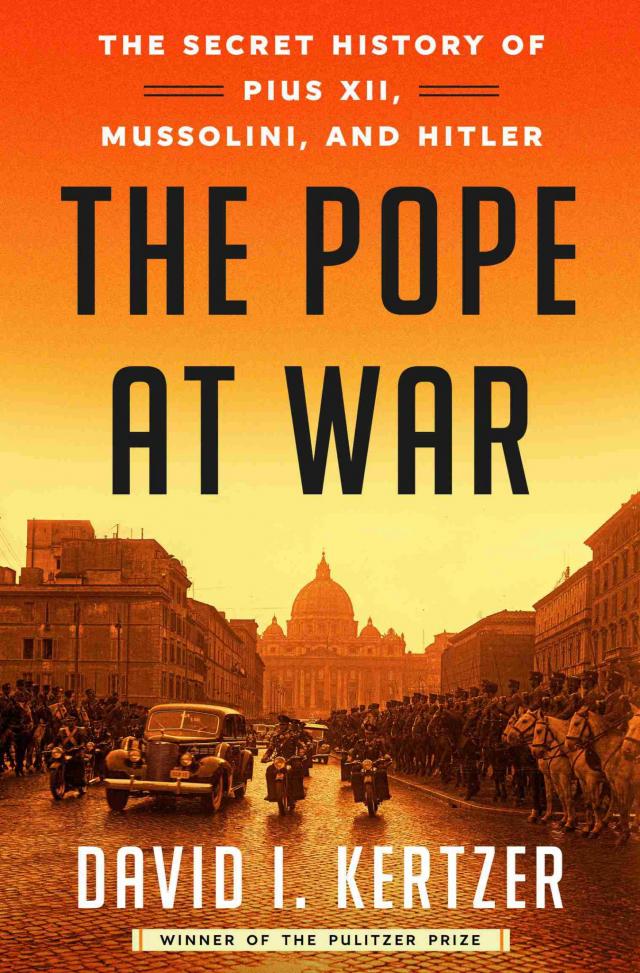
The Pope at War, page 12


Official portrait of Pius XII at his desk, ca. 1940
* * *
—
With his conquest of Poland now complete, Hitler let the pope know he was ready to resume their secret negotiations through Prince von Hessen.[14] The next meeting took place on October 24, 1939. Again, we find in the newly opened Vatican Secretariat of State archives a quasi-transcript of their German-language conversation. The record makes clear that, even after the invasion of Poland and the start of the larger war, the pope was eager to reach an understanding with Hitler. At the same time, the pope wanted the Führer to know that any agreement depended on a change of those German policies that had harmed the church. The record offers a precious and long-sought-after insight into the pope’s thinking at the time.
As von Hessen sat down, the pope asked how Hitler was doing.
“He is doing very well, the considerable tensions notwithstanding,” replied the prince. Unfortunately, the Poles had brought disaster on themselves, their stubborn refusal to recognize their defeat having had tragic consequences. The Polish Military Command’s decision to continue the pointless resistance, said von Hessen, had needlessly sacrificed many lives.
But, replied the pope, even the Germans had to recognize the bravery of the Polish soldiers.
All in all, said von Hessen, passing over the pope’s remark, the Führer was very pleased with the military and political progress he had made in Poland.
How, asked the pope, were the German people faring?
“They are doing well. Food ration cards have been introduced. But the people are optimistic.”
The pope acknowledged that there did now seem to be calm on the military side.
Indeed, replied the prince. Perhaps he was being overly optimistic, he said, but he saw signs that peace might now be returning to Europe. He added that he had recently shared these views with Ciano, Mussolini’s son-in-law.
As Ciano’s thirty-three-year-old sister, Maria, had died only two days earlier, the mention of his name led the pope to express his sympathy for the family and ask the prince for details about Maria’s illness and the last days of her life.
As it happened, said von Hessen, he had seen Ciano the day before his sister’s death and had used the occasion to discuss how to go about bringing peace between the Third Reich and the Vatican. Ciano had been enthusiastic, believing that an end to the tensions would be beneficial not only for the German government but for Italy’s as well. Here von Hessen added that following his previous meeting with the pope, he had returned to Germany and discussed with the Führer what the pope had told him about the importance of coming to an understanding. “He was in complete agreement,” said the prince, but he was then regrettably distracted with the many other urgent issues he had to address. Still, the prince assured the pope, “the intention remains.”
They had finally gotten around to the issue the pope was most eager to discuss. Unfortunately, said Pius XII, the news from Germany was not such as to encourage a rapprochement with the church. Even those who preferred an authoritarian regime were concerned about the way religious institutions were being treated.
At this point the pope decided to bring up an argument he thought might appeal to Hitler. Germany’s enemies were making ample use of the Reich’s poor treatment of the churches. All this, added the pope, alluding to the pressures on him to speak out against Hitler’s anti-church measures, was making his own position and that of the Vatican difficult. The Germans’ systematic attack on the church had to stop. If Hitler were to give a signal and the situation were to improve, it would pave the way for productive negotiations. “I understand other tasks require the Führer’s energy right now,” said the pope. “But such a signal, such a ‘Stop!’ is possible and most important. That is because, and there is no doubt about it, the persecutions go on. Deliberately and systematically.”
Perhaps, suggested the prince, it might be best to begin by holding preliminary negotiations in Berlin, where the Führer spent most of the time. There the papal nuncio could preside over the talks. “So many countries have joined the Reich,” added von Hessen, that clearly a new concordat with the Vatican was needed.
Did he have in mind forming a committee to organize such talks? asked the pope.
No, he had been given no such instructions. He was simply thinking out loud. On the German side, the prince suggested, the talks would need to involve the Foreign Ministry along with the Reich minister for church affairs. “If His Holiness would agree in principle, then—”
The pope interrupted. What was important for any such talks to be fruitful was the creation of a propitious atmosphere by means of a signal from the Führer.
“I will gladly advocate this.”
“I have always desired peace between Church and State and continue to do so,” said Pius XII.
Von Hessen repeated a point he had made at their earlier meeting: While he was among the many in the National Socialist Party who favored coming to an understanding with the church, another faction of the party, an anti-Christian faction, opposed it. But it was the Führer alone, he added, who made all important decisions.[15]
Realizing that this might raise in the pope’s mind the question of Hitler’s responsibility for Germany’s recent nonaggression pact with the Soviet Union, von Hessen launched into a preemptive defense. Hitler had made that agreement, he explained, out of political necessity, designed “to cover our back.” It certainly would lead to no inroads of Communism in Germany. Russia had agreed not to engage in propaganda activity in Germany, as the Germans had in Russia.
So, said the pope, no propaganda on either side….
Naturally, said von Hessen, Germany’s police were very strict. Under no circumstances would the Führer be willing to countenance the revival of Communism in any part of the Reich.
“It would be a blessing for everyone,” said the pope, if the “moral conflicts” now faced by Germans loyal to the church were eliminated. The Reich’s Catholics would then no longer feel any conflict in their dual loyalties to church and state.
As Pius XII rose to bring their meeting to an end, he told the prince how much he appreciated his visit and asked that he bring Hitler his warm greetings.[16]
Over the course of the fall of 1939, Italians’ fears of being dragged into an unwanted war began to ebb. The press devoted little attention to the Rome-Berlin Axis, and even a visit to Rome by Heinrich Himmler attracted little notice. “While the Government is not ready to declare its neutrality and the officially inspired press still maintains its pro-German tendencies in order not to incur German hostility,” wrote the American ambassador, offering Roosevelt advice he would soon regret, “I believe that Italy will avoid at all cost any trouble with the Allies.”[1]
Mussolini himself was unsure of the best path forward. Hitler, he remarked to Clara, should have listened to what he had told him: “Don’t fool yourself that this time England and France won’t intervene: it’s crazy to think so.” The Führer was delusional, a fanatic, a visionary, Mussolini said. He refused to listen. “In short, Hitler has made a mistake, he has committed serious errors. Now he has to either arrive in Paris or go into exile!” Conquering France, said the Duce, wouldn’t be easy, predicting that at least a million Germans would die. But this wouldn’t be an entirely bad thing, he added, for having an overbearing Germany weakened was not without its advantages for Italy.[2]
Further signs that the Duce might be slowly drawing back from his embrace of Hitler came at the end of October, when he fired the Fascist Party head along with a number of government ministers known for their enthusiasm for the Nazi alliance. These were the same men most identified with the anti-church, antimonarchical wing of the Fascist Party, “eaters of priests and Jews” in the words of Dino Grandi, minister of justice and one of the most prominent anti-Nazi Fascists. Vatican secretary of state Cardinal Maglione expressed satisfaction at the ministerial changes, judging them a victory for Ciano and the government’s pro-church forces.[3]
* * *
—
Pius XII’s refusal to condemn the Nazis was becoming more uncomfortable for him as reports mounted of the horrors they were inflicting in the lands they had seized. In late November, he learned that all Vatican efforts to send relief supplies to German-occupied Poland were being rebuffed. Meanwhile, the Germans’ brutal campaign against Poland’s Catholic clergy, along with its nobility and intelligentsia, continued in an effort to throttle any Polish patriotic resistance. In the large slice of western Poland that the Germans had annexed in early October, many priests had been deported or imprisoned. A later Vatican report described the situation: “The churches, which are only permitted to open for two hours, once per week, remain closed because of the lack of officiants. No sacraments, no preaching, no religious instruction. Absolute destruction of the once flourishing Catholic press…. No seminaries. No convents.”[4]
A mid-November Osservatore Romano article recounted without editorial comment how the Jews of Poland were being separated from the rest of the population and made to wear a “yellow cloth triangle” stitched to their clothes to distinguish them from what the Vatican paper termed the “Aryan” population. Later in the month a second article described the Nazis’ creation of a “reserve” in Poland into which all Jews from the German-occupied countries were being sent, under the authority of Hans Frank, the German minister in charge of the occupied territories. Earlier that month, on learning that Hitler had escaped unharmed from an assassination attempt, the pope had sent the German dictator his congratulations.[5]
Pius XII now worried what would happen if the war were to last into the spring and the Germans mounted their threatened campaign against France. Meeting with the French ambassador, the pope pressed him on the solidity of the Maginot Line, the string of large fortresses, blockhouses, and bunkers that the French had built along their border with Germany over the previous decade to prevent invasion. It was, the ambassador assured him, “impenetrable.”[6]
If the pope had any worries at the time about Mussolini’s intentions, they would not have been apparent to Italians. On December 7, in a colorful and widely reported ceremony at the Apostolic Palace, Dino Alfieri presented his credentials as the new Italian ambassador to the Holy See, replacing Pignatti, who had reached retirement age. Met at the Vatican by a phalanx of Palatine Guards who offered their honors, Alfieri responded by raising his arm in Fascist salute. He was then led through the halls of the Apostolic Palace as Swiss Guards and other pontifical gendarmes added their ceremonial tributes. The pope, seated upon his throne, awaited him in the Throne Room, surrounded by his ornately dressed noble court. “It was the glory of Your Venerated Predecessor,” said the new ambassador in his remarks to the pope, “to bring about new relations between church and state in Fascist Italy.” The pope ended his own remarks by invoking God’s blessing on Italy’s royal family and on Mussolini. The Vatican newspaper coverage included a warm profile of Alfieri, one of the major figures of the Fascist regime and a man with no previous diplomatic experience. Lest anyone miss the message, the arch-Fascist Farinacci dedicated a front-page editorial to the event in his Il Regime Fascista: “The Pope’s words do not admit of any doubt. He blessed Italy which is Fascist, and our Duce.” The pope also, Farinacci wrote, blessed the new ambassador, who, he pointed out, had been minister of popular culture when a year earlier the government “put the same racist laws into effect that various [church] councils had instituted over the centuries.”[7]
The following day, in another event attracting major newspaper coverage, Pius XII traveled across the Tiber to Santa Maria Maggiore to give his annual “Urbi et Orbi” Christmas blessing addressed to the city of Rome and to the whole world. One of Rome’s four major basilicas, tracing its origins to the fifth century, the massive Santa Maria Maggiore boasts rich mosaics dating from that early period and a cornucopia of artistic splendors added over the following centuries. Riding to the basilica from the Vatican in a black sedan with the convertible top covering the back seat folded down, the pope kept his right hand raised as he nodded repeatedly to acknowledge the enthusiastic crowd greeting him along the way. Men waved their hats, while awestruck nuns, recognizable in their white headcoverings, ran alongside his slow-moving car. As the car pulled up to the basilica, an Italian military unit saluted the pontiff while a band played the papal hymn. After blessing the soldiers, the pope entered the basilica, where he quickly changed from his simple white robe into an elaborate white embroidered one and replaced the broad-brimmed black clerical hat he had worn in the car with his impressively tall white miter. Emerging from the church borne aloft in his sedia gestatoria, with attendants on either side holding a white ostrich plume over his head, he waved again at the huge crowd. Italian troops, standing at attention along the basilica stairs, presented arms as a military band again struck up the papal hymn, which they followed with the Fascist anthem “Giovinezza.” It was in many ways a typical mix of papal and Fascist symbolism that Italians had by now come to take for granted.[8]
Dino Alfieri with Rudolf Hess and Joseph Goebbels, Germany, July 19, 1939
* * *
—
As 1939 was drawing to a close, Italians learned of plans for an even more dramatic display of papal friendship with the government. The pope and the king would mark the holiday season with an unprecedented exchange of visits. The highly publicized events began with the royal family’s intricately choreographed visit to the pope on December 21. A dozen black limousines set out from the king’s Quirinal Palace for the procession across the city to the Vatican. Troops lined the streets as Romans crowded behind them, cheering as the royal family passed through. The French ambassador described the scene at the Vatican as the royal couple stepped out of their car: his tunic covered with a jumble of ribbons and medallions, “the puny, stunted king, in his general’s uniform,” emerged and stood next to the large “Queen Helen, imposing, in white dress and mantilla.” Joining them was Mussolini’s son-in-law, Galeazzo Ciano, wearing his embroidered ministerial jacket.
At the pope’s private meeting with the royal couple in the Small Throne Room of the Apostolic Palace, he complained about Germany’s treatment of the church, a message that found a welcome audience in the viscerally anti-German king. Following their brief conversation, the pope invited the rest of the king’s large retinue to enter. Ciano led the way.[9]
“There is no doubt,” the French ambassador reported the next day, “that King Victor Emmanuel III’s visit yesterday to the new pope furnished new proof of the desire for détente and collaboration between the two powers that share Rome.” With the fast-moving developments in Europe, the veteran French ambassador offered a new theory of what Fascist Italy hoped to achieve by further strengthening its ties with the Vatican. Less than a month earlier, the Soviet army had invaded Finland and speculation was rife as to what its next victim would be. With the Germans now in league with the Soviets, “Fascist Italy intends to create a united bloc with the Catholic Church.” Casting itself as the defender of the Faith, the Fascist government “hopes to be able to count on the Holy See’s collaboration when the right moment comes to propose a compromise peace to the belligerents in the name of Christianity and in the higher interests of European civilization.”[10]
If the king’s visit to the Vatican provoked public excitement, the pope’s decision to reciprocate produced an even greater impression. The last time a pope had set foot in the Quirinal Palace, it had been his own property, for the Quirinal had long been home to the popes. When the troops of the present king’s grandfather and namesake, Victor Emmanuel II, had deposed Pius IX as ruler of the papal states and occupied the papal palace in 1870, the pope had excommunicated him. Indeed, it was believed that on that day the pope had put a curse on the Italian monarch’s presence in the Quirinal. In any case, the vast edifice was anything but cozy, its 110,000 square meters making it one of the largest palaces in the world. The royal family, in fact, lived elsewhere, using the Quirinal for ceremonial occasions.[11]
In Milan, Cardinal Schuster, archbishop of Italy’s most important archdiocese, characterized by some as a “convinced fascist,” was overjoyed by news of the visit. Vicariously sharing in the historic event, the cardinal arranged his own ceremonial exchange of visits with the head of Milan’s provincial Fascist Party branch. The local Catholic newspaper featured a photo of Cardinal Schuster arriving at Fascist headquarters, surrounded by black-shirted men giving him a Fascist salute. He proceeded through a Fascist honor guard to meet the federale, the provincial Fascist Party head, with whom, the paper recounted, he had a “long and cordial conversation.”[12]
The papal cortege that made its way to the royal palace in Rome on that gray December day included an impressive number of cardinals and other church dignitaries, traveling between two lines of Italian troops along a route decorated with a mix of Italian flags and papal banners. Pius XII, as had now become his practice, traveled in the lone uncovered limousine so that the crowd could see him and, undaunted by the rain, raised his arm in benediction. Met by an Italian battalion in the huge piazza outside the Quirinal Palace, the pope and his retinue were escorted to the ceremonial stairway, at the top of which the king waited to greet him. Colorfully uniformed royal guards, chosen for their height, stood on either side of the monarch, making the king seem all the smaller.[13]
Victor Emmanuel and the pontiff made an odd pair, but despite their obvious differences, they were similar in certain ways, both high strung and neither one wholly comfortable around other people. Following family tradition, the king was more anticlerical than religious, while in the Vatican, resentment for the royal conquest of the papal states and occupation of Rome seven decades earlier still simmered, albeit at a low boil. But as Pius XII explained to the French ambassador the next day, he was eager to do his part to shore up the king’s popularity. In the king, thought the pope, he had an ally in ensuring that Italy stayed out of the war.[14]