The Pope at War, page 17
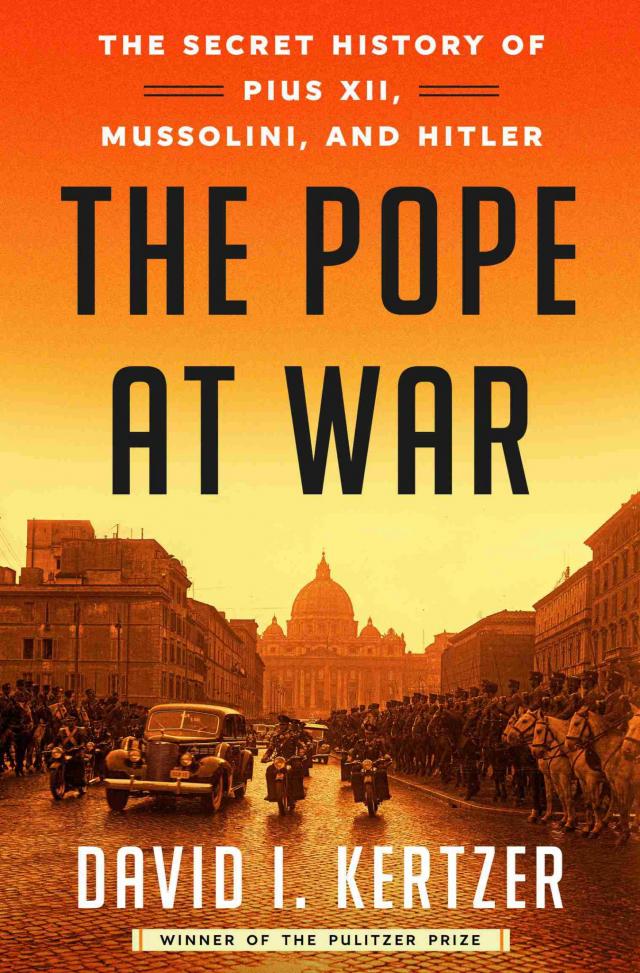


Mussolini had decided to throw Italy into the war without convening either the Grand Council of Fascism or his own cabinet ministers. Only after making his decision did he summon the heads of the military to inform them. None voiced opposition, perhaps intimidated by the experience Marshal Pietro Badoglio, supreme commander of the military, had had when he voiced his objections a few days earlier. Badoglio argued that, given their limited number of planes and tanks, entering the war would amount to national suicide. “You, Signor Marshal,” replied Mussolini, who was rapidly losing faith in his military head, “haven’t the calm necessary for an accurate evaluation of the situation. I tell you that by September all will be over, and I need only a few thousand dead to be able to sit at the peace table as a belligerent.”[11]
Tens of thousands of Romans streamed into Piazza Venezia on the afternoon of June 10, 1940, waiting for Mussolini to appear at his office balcony. In the central piazzas of towns and villages throughout the country, loudspeakers attached to radios were set up to broadcast the Duce’s speech to crowds mixing enthusiastic Blackshirts with others herded in by earnest Fascist officials.
Earlier that afternoon Ciano had summoned the French and British ambassadors to read them the king’s proclamation.
“I imagine you know what I have to say,” remarked an ill-at-ease Ciano, dressed for the occasion in his air force commander uniform, when André François-Poncet, France’s ambassador to Italy, arrived.
“One need not be very intelligent to understand,” replied the ambassador. “Your uniform is eloquent enough.”
After Ciano read the king’s war declaration, the Frenchman, unable to hold his temper in check, lashed out: “You have waited until we were face down in the ground to then stab us in the back. In your place I would be very proud!”
Ciano’s cheeks reddened. “My dear Poncet,” he responded, “all this won’t last long.” Surely, they would soon meet again in more pleasant circumstances.
“On the condition,” replied the ambassador, “that you haven’t been killed!”[1]
The Duce was filled with nervous excitement that day, worried that if he failed to act quickly, the war would be over before he fired a shot. His only doubt was whether the British would agree to make peace once France was conquered; if they did not, the Axis would have to attack the British Isles as well. He spent the morning at home working on his speech, which he wanted to memorize, but paused three times to phone Clara, telling her to be at Palazzo Venezia by midafternoon. Groups of youths in their black Fascist uniforms, carrying banners and signs, were already streaming into the piazza when she arrived. She found Mussolini in a state of great agitation. “The time for poetry is over!” he said by way of greeting.
At six p.m. Italy’s dictator stepped out onto his small balcony. Wearing a dark militia uniform and cap, he stood with his hands perched over the thick black belt on his hips, his chin jutting out, his chest puffed up. Chants of doo-chay, doo-chay greeted him. The immense crowd flowed well beyond the capacious piazza down the broad Via dell’Impero, which led on a straight line to the nearby Colosseum. When the crowd quieted, he delivered his speech, his gaze fixed in the indeterminate distance. He spoke in his characteristic pugnacious, staccato bursts, pausing for the oceanic shouts of enthusiasm that greeted each pithy phrase:
Combatants on land, on sea, and in the air! Black shirts of the revolution and of the legions! Men and women of Italy, of the empire and of the Kingdom of Albania! Listen!
An hour marked by destiny strikes in the sky of our fatherland. The hour of irrevocable decisions. The declaration of war has already been delivered to the ambassadors of Great Britain and France. We enter the battle against the plutocratic and reactionary democracies of the West….
This gigantic struggle is…the struggle of the poor, numerous people against the exploiters who ferociously hold onto the monopoly of all the world’s riches and all its gold. It is the struggle of the fertile, young peoples against the sterile people who are facing their decline….
The watchword is one alone, categorical and incumbent on all…. Victory! And we will win in order to finally give a long period of peace with justice to Italy, to Europe, to the world.
People of Italy! Run to take up arms, and show your tenacity, your courage, your valor![2]
The roaring crowd called him back to the balcony time and again. Finally, his nervous energy spent, Mussolini returned to greet Clara. He now showed his tender side, and Clara’s gray-green eyes clouded with tears. Life would never be the same, he told her, but he would always love her, he would never leave her. When, later that evening, it was time for her to go, he held their parting kiss for what, she wrote in her diary, seemed a long time. That night he would phone her at home three more times to hear her voice and reassure her of his devotion.[3]
In London, Prime Minister Churchill was awakened from a nap to be told the news. “People who go to Italy to look at ruins,” he snapped, “won’t have to go as far as Naples and Pompeii in future.” In Paris, there would be little time to react, as the members of the government were hastily fleeing from the capital as the German army approached.[4]
In Washington, the news of Mussolini’s declaration of war was not unexpected, but it came as a blow to President Roosevelt, whose pleas to the Duce had been dramatically rebuffed.[5] Much less bothered by the new development was the pope’s nuncio to Germany. Indeed, if Monsignor Orsenigo was unhappy about Italy’s entrance into the war at Hitler’s side, it was not apparent to the German undersecretary of state, with whom he happened to be meeting at the time. “In the conversation,” the German official recalled, the nuncio “gave very cordial expression to his pleasure at the German victories. It seemed as if he could not wait for Italy to enter the War and he remarked jokingly that he hoped the Germans would march into Paris by way of Versailles.”[6]
Mussolini had expected Rome’s church bells to ring to offer a festive conclusion to his speech, but they remained silent. Alerted in advance of the government’s plans, the pope insisted he could never countenance sounding Rome’s bells to celebrate a declaration of war. If the Fascists wanted to have them ring, they would be able to do so only by force. In the end, no one made such an attempt. This was not a time to antagonize the pope.[7]
For his part, the pontiff was not inclined to risk antagonizing either the Duce or Hitler. A week earlier he had given a highly publicized address at St. Peter’s to mark St. Eugenius I’s Day, his namesake holiday. The speech was vintage Pius XII: written with great care, memorized, and delivered in a monotonous tone devoid of any hint of spontaneity. As Europe was being ravaged by the rapidly advancing German army, and as hundreds of thousands of British troops were being evacuated at Dunkirk, the pope sought above all to avoid saying anything that could be deemed offensive by either side.[8]
Italian press coverage of the pope’s remarks that day emphasized his use of the same phrase Mussolini had continually repeated: “peace with justice.” Indeed, the Duce used the words again in his declaration of war. It was a peace that Mussolini contrasted with the peace that had prevailed in Europe since the end of the Great War, a peace that in the Fascist view was unjust, a product of the much-vilified Versailles Treaty.[9]
* * *
—
As Charles-Roux, France’s ambassador to the Holy See, was called back to France to help deal with the crisis there, a new French ambassador came to Rome. On June 9 he met the pope for the first time amid circumstances that could hardly have been worse for his country. Fifty-one-year-old Vladimir d’Ormesson came from an illustrious French family, his first name deriving from the fact that his father, a prominent diplomat, had been serving in the French embassy in Russia when he was born. Badly wounded in the Great War, he had become one of France’s most prominent Catholic journalists, and although in the past he had occasionally been tapped for brief diplomatic missions, he was not a diplomat by profession. The Italian government viewed him with suspicion, aware of his critical writings about Mussolini. His hatred of Nazi Germany could hardly have been greater, for his son, in the French army, had been killed by the Germans only weeks before. He was “a man of exceptional ability, courage, and charm,” thought the British envoy to the Vatican. The new French ambassador’s detailed reports over the next months would offer clear-eyed insight into the murky world of papal politics.[10]
After an initial ceremony in the papal Throne Room, d’Ormesson followed the pope into his study for a private conversation. “Given the tragic circumstances in which our country finds itself,” the ambassador would later remark, “one would have thought the Holy Father would have avoided taking advantage of this occasion to give us a ‘moral’ lesson.” Rather than castigate the Germans for their invasion of his country, the pope, while expressing sympathy for the trials that the church’s “elder son” was undergoing, told d’Ormesson that France’s problems were self-inflicted. It was the result of its de-Christianization, the country’s strict policy of separation of church and state.
The pope could also not refrain from voicing his amazement at the rapid disintegration of the Maginot Line, which the French had characterized as an impregnable barrier to German attack. “Where,” Pius XII asked him, “was the France of Verdun,” which had held off the German army for years in the Great War? While the pope expressed sympathy for France, observed d’Ormesson, “the Holy Father is a little too easily resigned to playing only a passive role in the drama that is ravaging Christianity.” The pope, he thought, was not a man of action. His head was too high in the heavens.[11]
* * *
—
It did not take long after Mussolini’s proclamation of war for him to apply new pressure on the pope. Two days after his announcement, British warplanes bombed both Turin and Savona, a fact reported in the French media but not in Italy. The new Italian ambassador rushed to the Apostolic Palace to urge that the Vatican paper not print news of the attack or any other stories on the war not found in official Italian press releases.[12]
Following the ambassador’s visit, the pope turned to his most trusted adviser, Monsignor Montini, the future Pope Paul VI, to help frame his options. In his hastily scribbled memo, Montini outlined the possibilities. The Vatican daily could publish official war communiqués from both sides of the conflict, but this would mean having the paper banned in Italy and antagonizing Mussolini. It could confine itself to publishing only Axis war communiqués, but that would damage the Vatican’s prestige abroad. Publication of the paper could simply be suspended, but that, judged the monsignor, would be “catastrophic today and extremely dangerous for the future.” This left only one realistic option, having the paper focus entirely on church business and religious life.[13]
The matter was urgent for the pope, as that day’s edition of the Vatican paper was about to go to press, and following recent practice, it contained without comment not only the Italian and German war bulletins but those from France and elsewhere as well. Although he could often be indecisive, on this day the pope acted quickly. He ordered the immediate suspension of the day’s printing.[14]
But as it happened, copies of that evening’s edition of the paper had already been printed. Perhaps, Cardinal Maglione told the Italian ambassador in explaining what the pope had decided, they could allow this one last issue to appear uncensored. This Attolico would not tolerate. The pope ordered all copies pulped, and word was sent to the country’s newsstands that due to “broken machinery,” L’Osservatore Romano would not be appearing that day. “The question,” Attolico concluded in his report to Ciano, “has therefore been definitively resolved.”[15]
* * *
—
Following Mussolini’s declaration of war, the headline in Italy’s leading Catholic daily, L’Avvenire d’Italia, screamed “VICTORY!” followed by a front-page editorial by the paper’s director, which began “Today the duty is but one: TO SERVE. Wherever. However.” The next day the paper featured the message that Bologna’s archbishop had directed all clergy of his archdiocese to read from the pulpit: “The one who has high government authority has taken the decision and our Italy has entered into war. To the Sovereign’s Majesty and to Those who share with Him the supreme responsibility of national life we all owe, following the law of our Faith, the most complete, fullest obedience.”[16]
L’Avvenire d’Italia, June 11, 1940
The directors of Italy’s Catholic papers—who would not print any editorial they thought displeasing to the pope—filled their pages with heroic portraits of the Duce and enthusiastic calls by Italian clergy for Catholics to answer the nation’s summons to war. At the same time, the Vatican newspaper remained quiet. “It is certain,” remarked the new French ambassador, “that the Holy See’s newspaper is going to reduce itself little by little to the proportions of a ‘Parish Bulletin.’ ”[17]
With his government in flight and German troops advancing rapidly on Paris, d’Ormesson tried to persuade the pope to speak out, but without success. “It is infinitely probable,” the ambassador observed, “that the Holy Father will say nothing for the moment and will only take advantage of the first occasion he has to speak publicly to emit some pious and expertly balanced moans.”
D’Ormesson did find one ally in the Vatican, the physically imposing, bushy-bearded Cardinal Tisserant. The lone non-Italian cardinal in Rome, who dined with the ambassador’s family each week, was secretary of the Curia’s Congregation for the Oriental Churches. He “seems to me,” the ambassador confided to his diary, “the elephant in the china shop.” The cardinal’s propensity to say what he thought came as a breath of fresh air in a Vatican full of secrets, where obfuscation was a way of life. Indeed, he would soon acquire the nickname Cardinal De Gaulle, in reference to the French resistance leader. D’Ormesson worried that the Fascist authorities would find a way to throttle the outspoken cardinal, and Tisserant’s bulging political police files offer testimony to the often hapless efforts made to tail him whenever he left Vatican City, as he often did. But the pope himself had little sympathy for the French cardinal, never forgiving him for his all-too-well-known opposition to his election.[18]
Shortly after Mussolini’s declaration of war, Cardinal Tisserant lashed out at the pope’s inaction in a letter to the archbishop of Paris. Several months earlier, he recalled, he had unsuccessfully pressed the pope to issue an encyclical on the individual’s duty to obey his conscience, the hallmark, he argued, of Christianity. “I fear that history will have much to reproach the Holy See for in having adopted a policy of convenience for itself and not much more…. It is sad in the extreme, above all when one has lived under Pius XI.”[19]
The day after Tisserant wrote his letter, Roberto Farinacci, former secretary of the Fascist Party, editor of that most Fascist of Italy’s newspapers, Il Regime Fascista, and strident critic of the Vatican, sent the Duce a warning about the French cardinal. He enclosed a typed, unsigned letter that he identified as written by the head of the Vatican police, whom he described as “our most faithful comrade.” The passage dealing with the cardinal was written all in capital letters: “It is necessary for Italy to keep an eye on all movements into and out of the Vatican. IT IS NECESSARY TO PUT THE MOVEMENTS AND THE CONTACTS OF CARDINAL TISSERANT UNDER STRICT SURVEILLANCE.” The Vatican police head’s letter—if it was indeed written by the head of one of the Vatican police forces—concluded with the Fascist cry: “ALALA.”[20]
Cardinal Eugène Tisserant
Arturo Bocchini, Italy’s skilled national chief of police, who reported each morning to Mussolini, had no need to wait for Farinacci’s message before putting the Vatican under surveillance, and he did not particularly appreciate the gratuitous advice. Nor was the surveillance a secret to the French and British diplomats who were in the process of settling into their modest quarters in Vatican City. Mussolini’s spies, it seemed, were everywhere.[21]
* * *
—
The Italian clergy and the country’s Catholic institutions, which all came under the pope’s authority as bishop of Rome, continued to proclaim their strong support for Italy’s entrance into the war at Hitler’s side. Attracting special attention in both the Catholic and the Fascist press was the patriotic message by Bishop Evasio Colli, national director of Italian Catholic Action: “In this grave, solemn hour in which the Fatherland calls upon all its children, the members of Italian Catholic Action respond to this appeal with that sense of profound duty and generosity that is the fruit of their Christian education.” Leaders of the various subgroups of Catholic Action added their own calls urging members to support the war. Typical was the letter of the national president of Catholic Men: “Italy has entered the war. The Head of the Government has proclaimed it to all of Italy…. We, Men of Catholic Action, leap to our feet and shout our ‘Presente!’ ”[22]
Mussolini’s Vatican embassy kept track not only of these national church appeals but also of the many messages of support for the war that the nation’s archbishops and bishops were sending their flocks.[23] Meanwhile the Catholic and Fascist press was giving special prominence to the call to arms by one of Italy’s most esteemed churchmen, Father Agostino Gemelli, founder and head of the Catholic University of Milan. “We must all prepare for the victory,” Gemelli urged. “May God hear our prayers, may the Holy Virgin protect us, and may she be the star that guides our Fatherland to victory.”[24]