The Pope at War, page 30
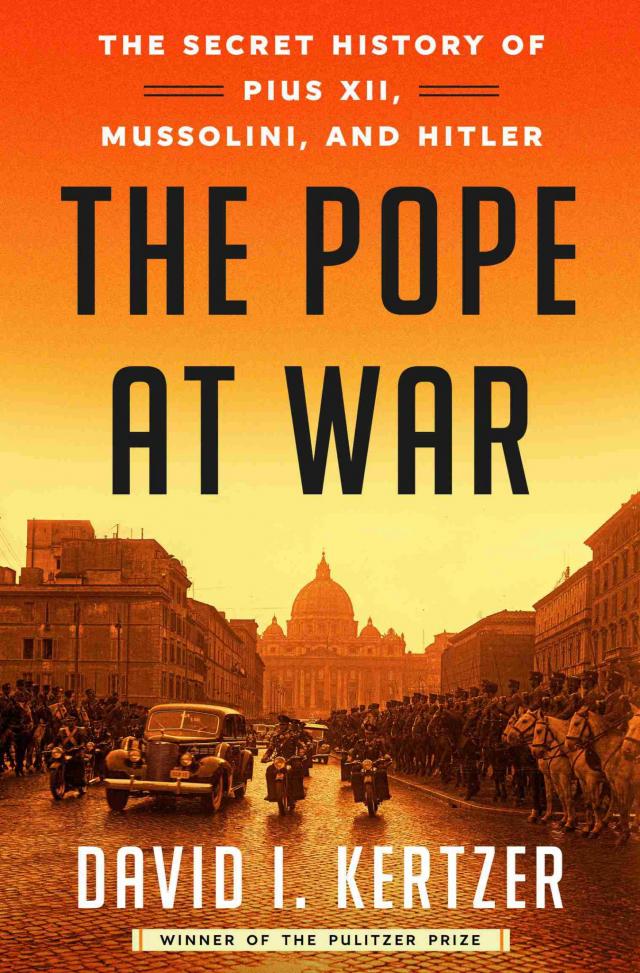


Francis D’Arcy Osborne, Britain’s envoy to the Vatican, during visit to London, April 14, 1943
In early April the pope, having heard that Osborne, the British envoy, was about to go to London for consultations with the Foreign Office, asked to meet with him. He had a request to make. Would Osborne convey to his government the pope’s wish that the Allies not invade Italy? Such an invasion, said the pope, would not be in the interest of future good relations between the two countries. Knowing the rude welcome such a request would meet in the British capital, which had suffered months of murderous Axis bombardment, Osborne apparently judged it best not to mention the papal plea on his subsequent visit to London.[22]
In mid-March 1943 Angelo Roncalli, then papal delegate in Istanbul, sent a coded telegram to the Vatican; fifteen years later Roncalli would succeed the current pope and take the name of John XXIII. Once the text came back from the Vatican decrypting office, it presented the pope with a particularly delicate dilemma. The twenty thousand Jews still remaining in Slovakia, reported Roncalli, “run the risk of deportation to Poland at the end of the month. They beg the Holy Father to intervene with that government…so that one thousand Jewish children can emigrate to Palestine, with English authorization…and be permitted to transit through Turkey.” The Jews were turning to the pope in hopes that he would use his influence with the head of the Slovakian government, the Roman Catholic priest Jozef Tiso.[1]
The problem for the pope was that, following the policy his predecessors had adopted ever since the Zionist movement began, he opposed the creation of a Jewish state in Palestine and was not eager to see more Jews living there. As we now know from the recently opened Vatican archives, Roncalli’s request was turned over for evaluation to Monsignor Giuseppe Di Meglio, on the staff of the Secretariat of State. Di Meglio’s lengthy report, “Palestine and the Jews?” would eventually be sent to the pope.[2]
Reviewing the history of the Zionist movement, Di Meglio observed that until recently Jews had not been eager to go to Palestine. He explained why he thought this was so:
Now it is known that most Jews are mainly dedicated to industry and, for the most part, commerce. This commerce remains quite profitable for them when they find themselves living among Christians. If, on the contrary, all and only the Jews come together, one has an enormous gathering in of…swindlers, while lacking those to be swindled. Therefore, most Jews had no desire to migrate to Palestine.[3]
Di Meglio added that in the past a further obstacle to the success of the Zionist plan had been the Holy See’s steadfast opposition. He saw no reason for the Vatican to change its policy, for “to give Palestine now to the Jews in dominion and absolute predominance would mean offending the religious sentiment of all Catholics and all those who…call themselves Christians.”
If in the past Europe’s Jews showed no great desire to go to Palestine, now, amid the threat of annihilation, wrote Di Meglio, they were eager to do so, with backing from England. The request for Vatican assistance in helping Jews escape to Palestine put the Holy See in an awkward position. “The Holy See, for its part…cannot easily in the present stage of the war raise questions and voice protests…. The Holy See is being beseeched to help this emigration only in order to save thousands of people (especially children) from certain death.”
Cardinal Maglione brought the monsignor’s report to the pope, who decided to use it to have his staff draft a response to Monsignor Roncalli’s message. Monsignor Tardini’s resulting brief advised that the Holy See should “continue to follow the same line of conduct, endeavoring, that is, as in the past, to prevent the creation of the feared Jewish supremacy in Palestine.” At the same time, the Vatican should tread carefully, for given the persecution Europe’s Jews were facing, “it would make a bad impression if the Holy See now appeared to refuse…an act of humanity.”[4]
In early May, the pope sent a telegram containing his decision to Monsignor Roncalli in Istanbul: The Holy See “has repeatedly intervened with the Slovakian Government in favor of non-Aryans with special regard to youths. It is still interesting itself in trying to get all transfer of Jewish residents in Slovakia suspended.” The response made no mention of Palestine.[5]
Roncalli renewed his plea later in May, asking to help fifteen hundred Jewish children from Slovakia obtain transit permission from the Hungarian government to escape to Palestine. This time Roncalli’s note was given to the Secretariat of State’s expert on Jews, Monsignor Dell’Acqua. He advised that they first try to find out from the priest-president of Slovakia whether the “transfer of Jews” was being suspended, “because it seems more opportune for the Holy See to insist that the Slovakian Jews remain in Slovakia and not be transferred to Palestine.” If Tiso were to inform them that the deportations had in fact been suspended, concluded Dell’Acqua, “a telegram could be sent with this news to Roncalli,” adding “he should not give too much support to the emigration of the Jews to Palestine.”[6]
* * *
—
Pius XII was well aware of the fate that awaited the Jews being deported to the Nazi death camps, but he continued to resist pressures to intervene publicly, arguing that his words would hold little sway with the Germans and any papal criticism risked provoking a backlash against the church in German-occupied Europe.[7] Among the many pleas he received at the time was a lengthy telegram from Generoso Pope, the influential publisher of America’s most prominent Italian-American newspaper, Il Progresso Italo-Americano:
In the name of Christianity and human decency I humbly implore you to once again lift your sacred universal voice against intensified unchristian persecution being perpetrated by Nazi regime against Jewish people. Americans of all faiths and racial origin are filled with horror and shocked by brutalities against millions of Jews. Savage Nazi national cult is cruel travesty on Christian conscience and human spirit…. I pray and hope that intercession by Holy See ever a seat of racial spiritual tolerance and justice will arouse world conscience and help halt Nazis’ orgy of savagery.
Following what had by now become standard practice, a brief response was drafted calling on the apostolic delegate in Washington to “confidentially” assure the American publisher that the Holy See was doing all it could. A note at the bottom of the suggested reply from the plainspoken Monsignor Tardini, who drafted the telegram, explained: “I thought to add ‘confidentially’ because, as [Generoso] Pope is the proprietor of the daily newspaper ‘Il Progresso Italo-Americano,’ he would easily publish the Holy See’s response. On the one hand this would be a good thing, but on the other….” Here, the ellipsis at the end tells the story. Beneath this Maglione added a handwritten note: “sta bene,” that’s good.[8]
Monsignor Cicognani, the pope’s delegate in Washington, was himself besieged with pleas to get the pope to speak out publicly against the ongoing extermination of Europe’s Jews. His correspondence with the Vatican soon took on a defensive tone, as he realized that his transmission of a continuing stream of complaints about the pope’s silence was not appreciated. A telegram he sent Cardinal Maglione in late March makes this clear. After receiving the cardinal’s latest three messages, he explained,
I ought not dare present new appeals, but three Rabbis representing various of their associations, in the face of alarming news coming especially from London of the systematic, rapid extermination that is said to have been recently decreed by Hitler and inexorably begun, especially in Poland, came to me today tearfully begging for the Holy Father to make a public appeal and prayer to stop the massacre and the deportation.
Cicognani ended his telegram with a further apologetic note: “I had to promise them this transmission.”[9]
If Pius XII could argue that his influence over the German government was limited, he could not say the same for his influence in Italy. In April, Jewish organizations informed him of the German request for the deportation of the Jews from Italian-controlled areas of France and the Dalmatian coast. The pope decided to act, instructing his Jesuit envoy to raise the matter with Italy’s new undersecretary of foreign affairs, Giuseppe Bastianini.[10]
Bastianini assured the pope’s envoy that Italy would not hand the Jews over to the Germans. Mussolini’s maxim, he said, was “with the Jews, separation, not persecution.” The Jews in the Italian-occupied territories would be confined to Italian concentration camps. He explained, “We don’t want to be executioners…. The Church too always called for separation from the synagogue.”[11]
* * *
—
In early April 1943, Hitler again summoned Mussolini to discuss the war. Having missed his previous appointment with the Führer because of his ills, Mussolini, although still sick, reluctantly boarded a special train. Sharp stomach pains forced him to order it stopped periodically along the way so that, with an aide supporting him on either side, he could make his way down the steps and take deep breaths of fresh air. On the Duce’s arrival at Salzburg, Hitler, shocked by his ally’s sickly appearance, begged him to allow German doctors to examine him, but Mussolini refused.
Although weak and ill, Mussolini did muster the strength to urge the Führer to make peace with Russia and so free the Luftwaffe to defend Italy from Allied assault. Hitler remained unmoved.
Once back in Rome, the Duce remained bedridden with excruciating stomach pain for another month. “In his yellowed face,” observed a visitor, “one sees the mark of his suffering.” Italy’s dictator would do his best to keep up his pugnacious front, but the note of defensiveness that now crept into his voice was hard to miss. “They say that I’m finished, out of it, done for,” he said. “Well, they’ll see!”[12]
Leaving his sickbed on May 5, 1943, Mussolini made what would be his final address from the balcony of Piazza Venezia. His appearance came following a meeting of the Fascist chiefs. There the newly appointed head of the party, Carlo Scorza, offered his own blend of Fascism and Catholicism: “The Fascist people,” he told the black-shirted bigwigs, “will win the war and the peace, because they possess the three elements that guarantee eternity: their belief in the Catholic religion, their recognition of the House of Savoy as the symbol of continuity and glory, their obedience to and faith in the genius of the Duce.” In short, Fascism’s holy trinity: the church, the monarchy, and the Duce. Stepping onto the small balcony outside his window, Mussolini echoed Scorza’s words. “I, like you,” he told the hastily assembled crowd, “am certain that the bloody sacrifices of these difficult times will be compensated by victory, if it is true, and this is true, that God is just and Italy immortal.”[1]
With Italians ever wearier of a war that most had not wanted, Italy’s press continued to invoke the words of church leaders to boost morale. The May 9 issue of Rome’s Catholic daily was typical in featuring the patriarch of Venice’s recent blessing of the troops. “All Italy,” said the patriarch, “is proud of you. It knows with what vehemence you stand as a barrier to the enemy’s great power, it knows that, from a sense of duty, you do not shrink from making supreme sacrifices.” That barrier was in fact rapidly crumbling.[2]
* * *
—
While the Duce’s star was falling, the pope’s was rising, and Vatican efforts to cast Pius XII as heroic prince of peace were growing ever more intense. The pope’s name day, June 2, the feast of Saint Eugene, offered the latest opportunity. Following words of homage by the nineteen cardinals present in Rome, the pope gave a speech, broadcast by radio, that would be widely—albeit selectively—quoted in Italy’s press. The banner headline in L’Osservatore Romano proclaimed “The Supreme Pastor’s Incessant Activity to Soothe the Sufferings of War and His Appeal for the Return of True Peace in the World.” Reprising a theme he had briefly introduced in his radio broadcast the previous Christmas, the pope expressed his desire to respond to those who had asked for words of comfort, “troubled as they are,” as the pope put it, “by reason of their nationality and their descent.” He went on to express his affection for those “minor Nations” that, due to their geographical position, were exposed to problems as a result of the struggles between the Great Powers and had suffered terrible horrors. This he followed with an expression of sympathy for all the pain suffered by the Polish people. The pontiff concluded his remarks with the wish that peace soon descend on earth.[3]
Once again both sides were able to point to signs of support in the pope’s words. The British envoy, emphasizing the pope’s expression of sympathy for those who were persecuted due to their ancestry and for the Polish people, referred to his address as “the most outspoken speech to be made by him since the outbreak of the war.”[4] Il Regime Fascista, the newspaper of the arch-Fascist Roberto Farinacci, offered its own lengthy, respectful paraphrase of the speech, while Ciano prepared a long analysis for Mussolini’s benefit. The pope, said Ciano, felt he had to say something “to dispel the impression of the political passivity of the Holy See that has been spreading through Catholic circles.” The pope had been very careful in dealing with the two “particularly delicate points” he felt compelled to address. By pairing his expression of concern for the peoples of the occupied countries with his lamentations about the cruelties of the air war, it was “almost an effort to equally divide the blame and the responsibilities of the two groups of belligerents and thereby to emphasize the universality and impartiality of the Holy See.” Clearly, by his reference to the occupied peoples, the pontiff had been referring to those occupied by the Axis, but it was significant that even there the only place he singled out was Poland. “Evidently, he wanted to choose a country that, after the [recent] revelations of the massacre of Katyn [where in 1940 the Soviets had executed thousands of Polish military officers and intelligentsia], no one could say whether they suffered more from the hardship of the German occupation or from the wickedness of the USSR.” On the other hand, claimed Ciano, the pope’s call for a return to the principles of basic humanity in the way the war was being waged was an implicit rebuke of the Americans and the British for their brutal air war.[5]
* * *
—
The pope’s speech had come in the wake of the collapse of the Axis army on the Russian front. Italy’s own expeditionary army in Russia had been smashed, and those not captured or killed desperately retreated through the terrible cold and deep snow. One survivor recalled seeing the sides of the road “dotted with these grotesque, immobile figures, human statuary marbleized with snow and ice.” In all, over 87,000 Italians soldiers there were dead or missing, and thousands more wounded and frostbitten. The remnants of the army that returned to Italy that spring spread horrifying details of what had happened.
To add to the Italians’ miseries, food shortages were worsening, British and American air attacks on their cities were intensifying, and an Allied landing on Italian soil seemed near.[6] In early May British bombers flew over Rome, dropping flares and leaflets that threatened Italians with destruction if they did not renounce the Axis alliance. It was the first time Allied planes had appeared in the skies over Rome since the war began.[7] The pope felt he had to do something. He was, after all, not only supreme pastor of all the faithful but also head of the Italian church.
On May 10 Monsignor Tardini prepared notes on the challenges they faced. Mussolini cared for nothing other than holding on to power, while amid the destruction and privation the germs of Communism were spreading. Tardini put his next point delicately, although he underlined it for emphasis: “In the face of this sad spectacle one might ask if an intervention by the Holy See is not advisable.”
In setting out the pope’s options, Tardini acknowledged there were arguments for the pope to continue to say nothing other than periodically lament the war’s miseries. But given the Vatican’s location, its close historical ties to Italy, and the fact that the Italian people looked to the pope for help in this hour of need, he suggested, “it would be useful to be able in the future to demonstrate that the Holy See had seen things as they were and had done what was possible on behalf of Italy.” Here the monsignor added parenthetically, “One should not forget that all the anticlerics and many antifascists are accusing the Holy See of having supported fascism!” Any papal action would need to meet certain criteria. First, it would have to remain secret. Publicity might come later, “when one can and should demonstrate all the good work done by the Holy See.” In any case, “It would be necessary to studiously avoid all that could be interpreted as an ‘invitation’ to make a separate peace, or as a proposal of mediation.”
The monsignor proposed two possible forms this expression of papal concern could take: a letter the pope could write directly to Mussolini, or an informal verbal message transmitted via Cardinal Maglione to Ciano, then from him to the Duce. Given that many people were now looking to the king to bring an end to Mussolini’s reign, thought Tardini, it would not be a good idea for the pope to send a similar communication to the monarch, for “it is necessary to avoid having the Holy Father appear, in one way or another, as a supporter of that plan.”[8]