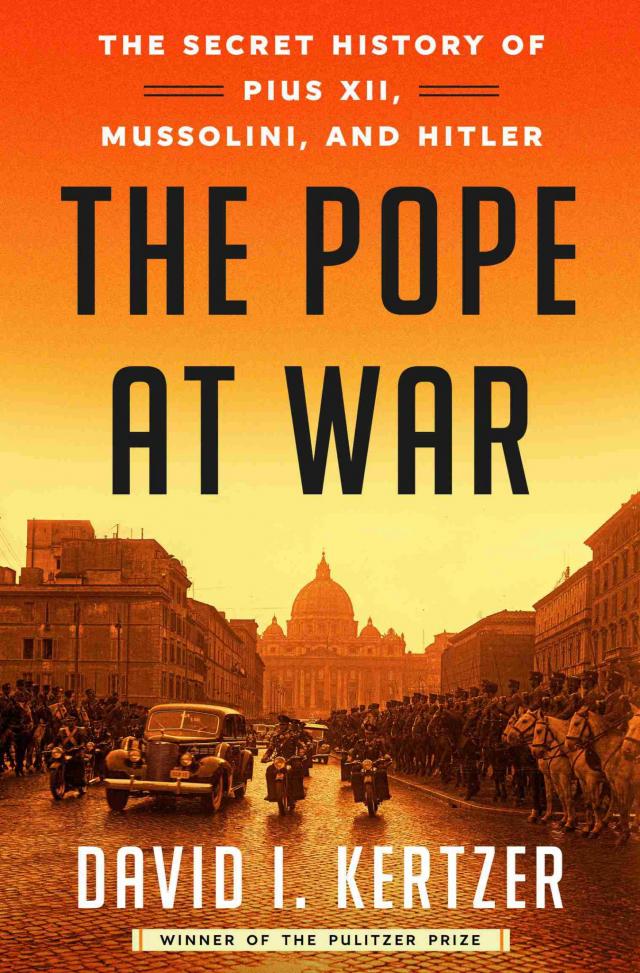
The Pope at War, page 6


Those laypeople who were granted the privilege of private audiences were required to dress formally, women wearing black dresses and covering their heads with long black veils. For larger audiences, the pope often chose Clementine Hall, its towering walls covered in Renaissance frescoes and friezes, its ceiling decorated with Giovanni Alberti’s Apotheosis of St. Clement, its floor patterned marble. When a trumpet blast announced the pope’s arrival, all knelt. The pope passed, extending his hand so that visitors might kiss his ring. He then took his place on a modest throne raised on a short platform. After offering his remarks, he blessed his visitors’ rosaries before moving on to the next group.
Following these audiences, the pope ate his modest lunch, often rice soup, along with fish or eggs, and vegetables and fruit. At lunch, too, his secretary sat nearby, reading cablegrams and important reports, or taking the pope’s dictation while a radio broadcast the news. A couple of small saucers sat on the table, where his uncaged birds pecked at the food laid out for them. Gretchen, a white canary, the pope’s favorite, sometimes seemed to tease him, or so Sister Pascalina thought, as the bird sat atop his head and pulled with her beak at the thin strands of dark hair that crossed his bald head.
After lunch, the pope rested briefly before his afternoon stroll. As secretary of state, he had been in the habit of taking long walks in the Villa Borghese, across the Tiber. Giving them up was one of the sacrifices he would have to make as pope. Now each afternoon a black sedan awaited him outside the Apostolic Palace for the two-minute drive to the Vatican Gardens. There the pope walked briskly, circling the gardens six times over the course of an hour, trailed at a respectful distance by one of the Noble Guards. He then stepped into the waiting car for the short drive back.
After returning to the chapel to recite the breviary, the pope met in the late afternoon with his two secretaries, both German Jesuits, or with others having urgent business. Unlike his predecessor, who refused to use a telephone, Pius XII did not hesitate to use his, and while sitting at his large walnut desk, decorated with a white statue of Jesus and a crucifix, he often pecked away on his American-made typewriter. Before dinner, he would summon one of the two deputy secretaries of state, giving them instructions and handing them the documents he had signed, having carefully lifted the white sleeve of his cassock before dipping his pen in the black inkwell. At eight p.m. the pope took his frugal supper alone, scanning news reports as he ate and listened to the radio. He drank wine with his meal rarely, a little glass of Bordeaux on the doctor’s orders when ill. After returning to his private chapel for evening prayers, he worked late into the night in his private suite, drafting in his careful, elegant script the speeches he planned to give in coming days.[7]
* * *
—
Although the beginning of the Second World War is typically dated to September 1, 1939, when the German army moved into Poland, it could just as well be said to have begun two days after Pius XII’s coronation, when, on March 14, German forces entered Czechoslovakia, occupying Prague a day later. Less than half a year earlier, at a conference in Munich where Mussolini cast himself as the principal broker, it seemed that peace had been saved for Europe. In exchange for Hitler’s pledge of no further aggression, Britain and France agreed to the German seizure of the Sudetenland, the largely German-speaking region of western Czechoslovakia. Now, with Germany’s march through the rest of that country, it was clear Hitler’s word meant nothing.[8]
All this was happening while the new pope was making overtures to the Führer in an effort to relax pressures on the church in Germany. The German assault on Czechoslovakia would be Pius XII’s first test and in many ways presaged what was to come. Hitler’s ambassador to the Vatican alerted Berlin to the pressure the pope was facing to protest the invasion. Thankfully, he wrote, “the Pope has declined these requests very firmly. He has given those around him to understand that he sees no reason to interfere in historic processes in which, from the political point of view, the Church is not interested.”[9]
From the first days of his papacy, Pius XII decided it was best to tread a careful path. He was committed to maintaining the church’s mutually beneficial collaboration with Italy’s Fascist government and was eager to reach an understanding with Nazi Germany. But at the same time he had to avoid antagonizing the Catholic faithful elsewhere, especially in the United States, on whose financial support the Vatican depended.[10] Above all, his aim was to safeguard the church and thereby protect its God-given mission of saving souls.
At the heart of the pope’s strategy was a decision to allow wide latitude to each country’s church hierarchy in supporting its nation’s rulers and policies, including making war. In this way, the church could enjoy good relations with governments anywhere in the world, regardless of their political nature, as long as they in turn supported the church’s institutional interests. But as events would soon show, this approach had its drawbacks, putting the pope in an awkward position as he tried to cast himself as a moral leader and not simply the head of a huge international organization. His approach was particularly uncomfortable in dealing with Italy, for there it was the pope himself who was not only supreme pontiff of all the world’s faithful but head of the nation’s episcopate.
As war erupted in the months following his election, the pontiff carefully crafted his remarks to allow both sides to see them as supporting their cause. This was on display in his first speech, a widely reported address given in the Sistine Chapel the day after his election. Casting himself as an apostle of peace in a world threatened by war, he hailed peace as a “sublime Heavenly gift that is the desire of all good souls” and the “fruit of charity and justice.” The coupling of his calls for peace with the caveat that true peace was one accompanied by justice would become a constant feature of his speeches in the coming months and years. It was a view heavily identified with Hitler and Mussolini, who had long complained that the Versailles Treaty ending the Great War could never be a true peace, for, they argued, it was unjust.
In reporting the pope’s remarks, Italy’s newspapers, from the hyper-Fascist Il Regime Fascista to the mainstream Corriere della Sera, assured readers that the new pontiff’s idea of “peace with justice” reflected the same one the Duce had expressed from the balcony of Palazzo Venezia, “a concept that constitutes the essence of the policy of Fascist, Catholic Italy and that is the opposite of the peace of intimidation of the plutocratic Powers.”[11]
* * *
—
On March 18, three days after the German invasion of Czechoslovakia, a limousine carrying Italy’s foreign minister entered the side gate of Vatican City and drove into the San Damaso Courtyard. As Galeazzo Ciano emerged from his car, the Vatican’s Palatine honor guard greeted him, prompting him to raise his arm in Fascist salute. The pope’s maestro di camera and a gaggle of Swiss Guards then accompanied Ciano up the stairway to Pius XII’s private library, where the two men spent a half hour in conversation. They had last met on the day of Pius XI’s death, when they had knelt side by side in prayer before the pontiff’s corpse.
Romans had disparagingly dubbed Ciano “il Ducellino,” the little Duce, and it did seem that Ciano was often trying to imitate his father-in-law. He was prone to posing with hands on hips, thrusting out his jaw, and speaking in staccato bursts. But the pose was rendered faintly ridiculous by his soft, boyish looks, his high-pitched nasal voice, and his peculiar flat-footed walk.
Despite these sporadic efforts to imitate Mussolini, Ciano could hardly have been more different, showing all the signs of his elite bourgeois upbringing and his inexperience with thuggery. The French ambassador to Italy saw the young foreign minister as the incarnation of moderate Fascism, a man who detested the violent, anticlerical “ultras” of the movement famous for the beatings they administered with their cudgels and the delight they took in humiliating their enemies by pouring castor oil down their throats. For Ciano, Fascism’s great merit was in bringing the country’s major power centers, the industrialists, the church, the military, and the monarchy into one harmonious whole. It was the brand of Fascism with which the pope, too, would feel most comfortable.[12]
On meeting Ciano that day at the Apostolic Palace, the pope had a matter he was eager to raise. Italian Catholic Action, the church’s vast capillary organization of the laity, had long been a bone of contention between his predecessor and Mussolini. Divided into separate organizations of boys and girls, university students, and men and women, it had chapters in parishes throughout the country, each under control of the local clergy. “You have only to follow the advice and the instructions that come from above,” Pius XI had once explained to a group of Catholic Action leaders. No church organization had been dearer to him, for he saw it as providing the lay ground troops for re-Christianizing Italian society. The Duce, having outlawed all popular organizations outside Fascist control, was never comfortable with these groups and suspicious that they hid opponents of the regime. He had focused much of his anger on Catholic Action’s Vatican coordinator, Cardinal Giuseppe Pizzardo, but had never been able to convince Pius XI to sack him. Now, eager to overcome the tensions of his predecessor’s last months, the new pontiff told Ciano he would remove Pizzardo from his post and issue strict instructions to ensure that Catholic Action limit itself to the purely religious realm. Ciano could not have had better news to bring back to his father-in-law.[13]
* * *
—
Mussolini’s summons came as a surprise to Father Pietro Tacchi Venturi. Under Pius XI, the seventy-seven-year-old Jesuit had served as the pope’s personal emissary to the Duce, shuttling back and forth between the two men over a hundred times, carrying the pope’s requests to the dictator. With his wide network of contacts among key government ministers and police officials, he had been an invaluable resource for the pope. An editorial of the time in a Fascist daily, mixing grudging praise with sarcasm, marveled at Tacchi Venturi’s ubiquity: “He is a phenomenon, a super-phenomenon. For him the day has sixty hours. He is involved in everything…. Now you see him in the waiting room of a government minister, now he is going up the stairs of the military offices, now concentrating at his desk writing letters of recommendation left and right…. His fame in Italy now exceeds all limits.”[14] But after the tensions arose between the Duce and Pius XI in the last months of his papal reign, Mussolini’s enthusiasm for seeing the Jesuit had diminished, and their regular meetings had stopped.
Mussolini now summoned Tacchi Venturi, hoping to renew the Jesuit’s role as intermediary with the pontiff.[15] First on the Duce’s list of requests for the new pope was help in dealing with Spain. While Franco was wrapping up his successful war to overthrow Spain’s leftist government, it was crucial, said Mussolini, that Spain’s Catholic clergy offer him their strong backing. Next on the Duce’s list was Croatia, which he feared Hitler might have in his sights. It was important, he told the Jesuit, for the pope to have Croatia’s Catholic clergy make clear that their sympathies lay with Italy, not with Germany. Third on his list was Latin America, where Mussolini said the United States was trying to weaken the “Latin Catholic mentality” by “Protestant penetration.” It would be important for Latin America’s clergy to combat American influence and urge their governments to have closer ties with Fascist Italy.
Finally, Mussolini wanted to let the pope know how much he appreciated his decision to reorganize Italian Catholic Action. Once this was accomplished, he said, harmony between the Vatican and the regime could be fully restored.
Having outlined what he wanted from Pius XII, Mussolini asked whether there was anything the new pope might want from him. Indeed, replied Tacchi Venturi, there was. The Jesuit then showed the Duce a document whose text the pontiff had approved in their meeting several days earlier.[16] The pope was unhappy that the antisemitic racial laws that had been promulgated over the previous months were being used against those the church regarded as Catholics, not as Jews. He wanted “to see that all the descendants of mixed marriages, baptized in infancy, and brought up as Christians, be recognized as Aryans.” The Jesuit explained to the Duce that such converts had, through their baptism, “become children of the Church no less than any others of Aryan descent.”
The pope’s emissary then reviewed the ways the pope proposed amending the racial laws. As the Duce read the list, he commented on each of the pope’s points. Perhaps something could be done about the prohibition on baptized Jews employing Christians for domestic help, he suggested, and perhaps something might be done about allowing baptized Jews who had been engaged to marry Catholics before the laws had gone into effect to go through with the marriage. As for the rest of the pope’s proposals, said Mussolini as he folded the pages and put them in a file on his desk, he would refer them to the commission he had established to oversee the racial laws.
The meeting, thought Tacchi Venturi, had gone rather well. It seemed, he reported, that the “period of diffidence characterized by constant jabs and pin pricks that made the last months of the glorious papacy of Pius XI of holy memory so bitter was about to end.”[17]
Eager to begin his relations with the Italian dictator on a positive note, the pope acted quickly. He immediately responded to Mussolini’s most pressing request, sending a personal telegram to General Franco to confer his blessing on him and to voice his gratitude to God for “Catholic Spain’s victory.” Franco replied by expressing his pleasure at the pope’s words in praise of what he termed “the complete victory accomplished by our arms in the heroic crusade against the enemies of Religion, of the Fatherland, and of Christian civilization.” Both messages drew extensive coverage in the Catholic press. Two weeks later the pope followed up by going on Vatican Radio to personally deliver a message to the Spanish people hailing Franco’s victory and praising the Spanish dictator’s “very noble Christian sentiment.” Arrangements were also made to hold a special mass of thanksgiving for Franco’s victory at Rome’s historic Jesuit church, the Church of the Most Holy Name of Jesus, with the new Vatican secretary of state, Cardinal Maglione, prominently in attendance.[18]
* * *
—
The Fascist regime’s campaign against Italy’s Jews, initiated the previous year, was never far from the pope’s mind. Indeed, if he were ever tempted to forget it, Father Tacchi Venturi would bring it up again. It had been Mussolini’s announcement of his “racial” campaign in July 1938 that had caused the sharp escalation in tension between the Duce and Pius XI. In the months that followed, Italy’s government instituted a series of harsh anti-Jewish measures. Non-Italian Jews were ordered to leave the country. All Jewish children were barred from the nation’s schools, and all Jewish schoolteachers and university professors were dismissed. Jews were thrown out of the country’s military and civil service, barred from working in banks or insurance companies, forbidden from owning large businesses or farms, and forbidden from employing Christian household help.
To sell the anti-Jewish campaign to Italians, for whom it smelled suspiciously like an effort by the Duce to ingratiate himself with Hitler, the regime was counting heavily on the striking similarity between the new laws and the measures the popes had for centuries imposed on Jews in the Papal States.[19] Indeed, the Fascists boasted they were being softer on the Jews than the popes had been. After all, they were not herding Jews into ghettoes; nor were they imitating the earlier popes in requiring Jews to wear special marks on their clothes.
In the early months of Pius XII’s papacy, laws barring Jewish professionals—doctors, lawyers, and others—from having Christian clients or patients were further tightened. Italy’s tiny but flourishing Jewish population, not much more than forty thousand strong, and heavily located in a handful of large cities of the center and north of the country, was being reduced to penury. Perhaps worse, the government’s propaganda branding Jews the scourge of Christians and enemies of the state was leading to their social isolation. Many Christians now stopped greeting their Jewish friends and neighbors.
Pius XII did nothing to disavow, much less express regret for, the church’s long-standing demonization of Jews. The April 1939 lead story in the Jesuit journal La Civiltà Cattolica, whose pages had to be approved prior to publication by the Vatican secretary of state, offers some insight into views prevailing in the Vatican at the time. As Easter approached, the article explained, it was important to remember that “the Jews who mask their hatred for Jesus…are not simply actors in a drama limited to the obscurity of earlier times. They live again and reappear on the scene in all the persecutions aimed from time to time against the Church, faithful imitators of all the emissaries of the anti-Church and of the most disparate synagogues of Satan.” The article went on to brand Jews avaricious, lust-filled traitors and cowards.[20]
Given the church’s view of Jews who were baptized as Christians, and the Fascist state’s use of Catholic documentation in determining who was an “Aryan,” many Jews saw baptism as their best hope for avoiding ruin.[21] Some of these were Jews who were married to Catholics. Such was the case of Emilio Foà, an executive in Turin. In the summer of 1938, following the announcement of the regime’s new racial policy, and fearing, with good reason, the draconian anti-Jewish laws to come, he decided to seek baptism. “My dearest,” he wrote Lina, his Catholic wife, “the papers bring you the news of what is happening. No one knows what will happen tomorrow as far as religion is concerned. For that reason, I have decided on conversion. I have the duty to defend your future and that of our children.” As in many such cases, though, Foà’s last-minute conversion did not save him from being dismissed from his job and left penniless. In May 1939, less than a year after Emilio’s baptism, his eighteen-year-old son, Giorgio, found him lying in a pool of blood in his study, a gun in his hand and a bullet in his head. He had left a note for Lina: “My dear wife, I leave you. In that way I save my family. It would have been a life of poverty. With the insurance policies…you will have a sufficient income…. Do not condemn me. Love one another and remember me.”[22]