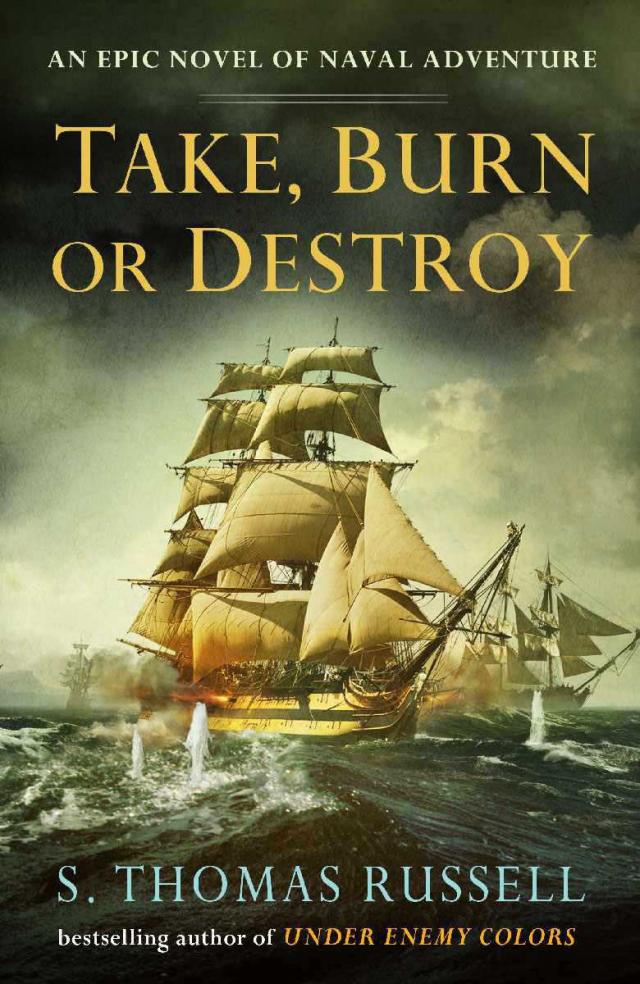
Take, Burn or Destroy, page 9


“Have you ever been in a duel, Beacher?”
“You know I have not.”
“Then I should not be in a hurry to walk out with a man who has been in many an action and has actually aimed a pistol at a man’s heart before and knows whether he is capable of firing or no.”
“Well, I did not actually mean I would challenge the blackguard.” He looked very sad suddenly. “It takes some time for women to grow beyond this idea of the handsome stranger and realise that love can flourish with the familiar. Henrietta and I are perfectly suited to one another, always content in each other’s company, never a moment of awkwardness or searching about for something of which we might speak. We find amusement in the same things, enjoy the same books and make almost identical observations about the people around us. These things will outlast the foolish romantic notions common to young women.”
“Did you not tell me that Miss Henrietta’s aunt expressed this exact same opinion?”
“Well, perhaps not exact.”
“So you are of one mind with a ninety-year-old dowager on the matter of romance?” He raised an eyebrow, but Beacher did not know how to answer this. “Unfortunate you are not courting Henrietta’s ageing aunt, you seem to have much in common.”
“You do see my problem, Wilder, do you not? I am too familiar, to Henri. But I believe she will feel differently about this in time. Once she has recovered from her recent disappointment, she might very well see how foolish her ideas were.”
“All the more reason for you to confess your own feelings. Then she may weigh up the handsome rogue against the faithful confidant and decide where to entrust her heart. But if you do not speak, she might never suspect that your feelings are anything but brotherly. Only the brave deserve the fair.”
“‘None but the brave . . .’”
“Sorry . . . ?”
“‘None but the brave deserve the fair.’ Dryden.”
“Was it Dryden? I thought it was Shakespeare.”
“Perhaps. Everyone seems to have said it at one time or another. I think the Lord said it to Adam.”
“Well, there you have it. If the Lord said it to Adam and Shakespeare said it, or very likely so, it is undeniable—perhaps even Gospel—truth. Miss Henrietta is fair, so you must be brave. If it were the other way round and you were fair, then she would have to be brave—but I can assure you, Beacher, you are not fair, therefore the part of being brave falls upon you.”
“Thank you, Wilder. It is the kindest thing you have ever said about me.”
“You are most welcome. Did I also say that you are timid, shy, fainthearted, and without a spine? No? Well, so you are. If you cannot work up your courage to tell Miss Henrietta Carthew how you feel, then she will most likely marry some handsome stranger and live unhappily ever after. And it will be your fault, too.”
Beacher stood and paced across the room, lighting a pipe from a candle. “Any such declaration I might make must be timed to perfection. Too soon and she will rebuff my suit, because she is still awaiting her handsome stranger, too late and . . . well, it will be too late, clearly. But how to know when the exact moment has arrived . . . ?”
“Aye, there’s the rub.”
“Shakespeare.”
“Not God?”
Four
He was wakened, by his own order, two hours before dawn, breakfasted sparsely, washed and dressed himself with his usual care but a lack of conscious attention. He cut himself shaving and could not staunch the bleeding for some half an hour, which did nothing to improve his mood.
As Hayden donned his coat, a peal of thunder penetrated dully through the wooden hull followed immediately by a crashing in the rigging. He ran for the ladder that led up to the main deck. His marine sentry, standing more or less where the door would have been had his cabin been assembled, looked at him with alarm.
“Are we being fired upon, sir?” he said, almost all the air sucked out of his words.
“We are.” Hayden went up the ladder two steps to a time and made the deck just as the mizzen top-gallant mast carried away, toppling to leeward, an array of shrouds, stays, and halliards stopping it from going into the sea.
“Cut that away!” Hayden called. “It will take the mizzen with it.”
It was a long moment while axes were produced. Both Barthe and Franks appeared and began calling instructions of where to cut. Chettle, the carpenter, and his mates climbed up to the mizzen top and began cutting away the rigging, the ship swaying and rain teeming down and pouring off the sails like rain off a roof. Under any other circumstances, Hayden would have long since ordered the upper yards sent down and the top-gallant masts housed, but they had carried them instead, knowing they might be the difference between escaping and being brought to.
Before his own crew could man their guns, the French ship to weather had fired her own guns several times. Bar and chain whirred up into the Themis’ rigging, tearing away shrouds and ripping gaping holes in sails.
The British guns spoke back, and in a moment their enemy withdrew into the darkness, her guns falling silent. Only the sound of the gale persisted, the dull chopping of the men aloft cutting away the fallen top-gallant mast and yard. These spars tumbled into the sea, suddenly, and were swept astern into the darkness.
Everyone strained to peer through the night and driving rain, trying to find their adversary, but nothing could be seen.
“I dare say that Frenchman is not shy,” Hawthorne announced, appearing at Hayden’s elbow.
“Nor is he a poor seaman—just to find us on this night and catch us sleeping was not easily accomplished.” Hayden turned to Archer and asked, “How is it, Mr Archer, that this Frenchman could come upon us and catch us unawares? What, pray, were our lookouts about?”
Archer appeared abashed in the poor light. “We had so often lost sight of them this night that we thought nothing of it when it happened again. Never for a moment did we imagine they would come at us before daylight. I-I apologise, Captain. I was officer of the watch; it is my failing.”
“I would never have believed they would try such a thing myself, but perhaps I should have. These ships have been raiding our commerce by night for several months. They are well used to such manoeuvres, apparently, though it is difficult to imagine they are commonly this daring in such foul weather.”
Hayden went to the rail and stared out into the night, trying, with one hand, to shield his eyes from the driving rain. His servant carried up his oilskins and a sou-wester, which Hayden donned over his already soaking uniform.
“I dare say, that was rather enterprising of this Frenchman, was it not, Captain?” Hawthorne was attempting to part the darkness to Hayden’s left.
“More than enterprising. I do hate to be outwitted, but I have been this night. We will see what the damage is soon enough—less than the French captain hoped, I suspect. I admire his audacity all the same. If he could have disabled us or caused enough damage to our rig—for that was his sole intention—then he might have produced a tangible advantage come daylight.”
“Is he finished for now, do you think?”
“So I believe. He will not have the element of surprise again so will wait for morning and see what profit his gunnery might have gained him.” Hayden turned away and looked up into the rigging—the sails curving apparitions in the blackness.
A very long half of the hour brought Barthe to the quarterdeck.
“How have we fared, Mr Barthe?” Hayden asked.
“Better than I hoped, Captain. The mizzen top-gallant was the worst of it. Oh, that Frenchman shot away some stays and shrouds forward and tore some holes in our sails. We’ll have all the rigging put to rights in an hour. The mainsail received the worst injuries, sir. I am not sure it will stand this night—not if the wind keeps making.”
The main should have been taken in hours ago, Hayden knew.
“We shall have to hand it and send it down, Mr Barthe. No easy thing in this wind. But it must be done. Our old main shall have to go in its place, for we may be in need of it come daylight.”
“Aye, sir. McGowan patched and resewed our old main, sir, but even so, I would rather take my chances on the new one, even damaged as it is.”
Barthe knew his trade thoroughly, and Hayden trusted his judgement in such matters. “Then hand the main, Mr Barthe, and we will set it reefed if needed.”
The sailing master waddled forward quickly, leaving Hayden to wallow in chagrin. He had been taken unawares by this French captain. The man was clearly more formidable than Hayden had imagined. Or was it merely that Hayden’s own mind was so clouded by his difficulties he had made poor decisions? He vowed silently to bear down and push all thoughts of Henrietta and his recent troubles from his mind. To let this Frenchman outwit him once was embarrassing, to let him do so a second time might prove their undoing.
The single hour remaining until daylight seemed to have quadrupled in length, but then light, when it finally arrived, could barely penetrate the low, dense cloud. The wind was making yet and the seas were steeper and more threatening, sweeping down on the frigate and tossing her about like a jolly boat.
Hayden, however, was not unhappy to see the weather worsening. It would be a great risk to open gunports in such a sea, and deck guns would be unwieldy if not dangerous. The chances of hitting any target smaller than a first-rate at more than a hundred yards would be very small. The French would not bring him to battle this morning despite their superiority in numbers. He prayed the weather would not moderate.
Standing by the leeward rail clutching the mizzen shrouds, Hayden called for the sailing master, who quickly appeared.
“Captain?” he called over the sound of wind and sea.
“Mr Barthe, what would our course be back to the Isle of Guernsey?”
“Let me give it to you exact, sir. A moment, if I may.” He hurried off to consult his chart.
Hayden stood watching the seas roll away towards France, their crests blowing off into long, white streaks upon the gunmetal water. If he wore ship at that moment and stood in towards Guernsey, he did not think there would be much the French could do about it. Certainly, they would attempt to close with him and bring him to battle, but under these conditions he thought he might risk it. Gunports could not be opened and he was willing to gamble that he could inflict as much damage on the French as they would manage on his ship. Boarding under such circumstances would be impossible. The Channel Isles were under threat, as the Admiralty well knew, and Hayden hoped there would be ships of war there that could aid him in his return to England or by driving off the French frigates.
“East-south-east, sir,” Barthe announced as he reappeared.
Hayden nodded. “Well, Mr Barthe, previously I spoke against it, but I now believe a sojourn on the fair Isle of Guernsey should do us all a world of good. We might find entertainment and acquire some French wines of excellent vintage. Would you concur?”
“Indeed, sir. I believe it is a risk well worth taking. We have already seen that our rate of fire is double that of these Frenchmen, and as there are but two of them that should answer.”
“Then we will wear ship, Mr Barthe, before the men are called to breakfast.” Hayden turned and waved towards his first lieutenant. “Mr Archer. We shall wear ship and shape our course towards Guernsey.”
“Aye, sir. Mr Barthe . . .”
Barthe and Archer went hurrying off, calling out orders as they went.
Hayden gazed towards the enemy ships, wondering if he was making the right decision. If luck turned against him, his ship might be disabled and lost . . .
“On deck!” came a call from above. “Sail, dead astern, sir.”
Hayden started immediately along the sloping deck towards the stern rail, finding his way around the carronades. “Can you make it out?” he shouted to the lookout.
“I cannot, sir. It isn’t a chase mary, sir. . . . Maybe a coaster, Captain. Two-master, I think . . . No, three, sir.”
Hayden cursed under his breath. “Where is Mr Wickham? Hobson! Find Mr Wickham and send him aloft with a glass.”
“Here, Captain.” Wickham shot out of the companionway, almost lost his balance on the slanting deck, rescued his hat as the wind took it. Under one arm was tucked a glass, and his coat luffed like a sail without a sheet. In a trice he was climbing the mizzen shrouds, his unbuttoned coat flailing around him like the wings of a bat.
Hayden waited until he reached the tops, watching as he lodged himself in a secure place and fixed his glass upon the sea astern. The silence among the crew was profound, every soul awaiting Mr Wickham’s verdict.
“A ship, Captain,” Wickham called down. “Maybe a frigate, and making good speed, I should say, sir.”
“Is she one of ours, Wickham?”
“I cannot tell, Captain.”
Hayden took his eyes away from the midshipman and found Archer and Barthe staring at him, the same unspoken question in their eyes.
“We dare not wear now, Mr Archer. Not until we know the nationality of this ship. Where is my glass?”
The two officers saluted and began calling out orders, bringing men down from aloft. Hayden’s glass was carried up from below and he fixed it on the distant sail, just visible in their wake. The hull of the ship appeared and disappeared upon the swell, making it all but impossible to learn anything about her. They would have to wait . . . and hope it was a British ship.
Archer cleared his throat. “Shall I send the men to their breakfast, sir?”
Hayden nodded. “I believe you should, Mr Archer.”
“Aye, sir.” But Archer did not turn to go. “What does she look like, sir?”
Hayden offered the glass to the lieutenant, who came and braced himself against the rail. After a moment of intense scrutiny, made difficult by the pitching and rolling ship, he lowered the glass and shook his head. “I could not even say with certainty that it is a frigate, Captain Hayden.”
“She is a mystery for the time being.”
His servant appeared then. “You have been invited to breakfast in the gunroom, Captain.”
“An invitation I shall accept with gratitude. You have the deck, Mr Archer. Send for me if any of these ships do anything the least unexpected.”
“I shall, sir—immediately.”
Hayden went down to the gunroom, where he found the officers not required on deck during this watch. Ransome was there, as were the doctor, Hawthorne, Smosh. Hayden took the place set for him—the place of honour—and everyone took their seats.
“I am told a third ship has joined our little squadron,” Smosh offered, allowing a servant to serve him a generous portion of “eggs Themis,” with onions and pease. He glanced over at Hayden.
“Yes, Reverend, but as of yet we do not know if she will join our side or the enemy’s. Noon shall bring an answer to this question.”
Though the gunroom was situated in one of the more comfortable parts of the ship when in a seaway—aft and on the lower deck—the motion of the ship was such that there was no truly comfortable place. A quick hand was often required to preserve a plate or piece of cutlery from sliding off to leeward. Great care was taken of glasses and their contents. Hawthorne commented that these were of less value now that Guernsey—and smuggled French wine—seemed unlikely.
“Is it not the oddest thing that our government does everything within its power to prevent the smuggling,” Smosh said, “yet I doubt there is a Member of Parliament or a government official in possession of the means who does not drink smuggled French wine and perhaps garb his wife in smuggled lace.”
“It is but part of human nature, Reverend Smosh,” Hawthorne assured him. “I am familiar myself with many a man who mouths pieties at every opportunity yet when out of sight of his wife and family lives as debauched a life as any rogue. Why, I would not doubt some of these men are the said same government officials and Members of Parliament, too. We are not an admirable race, I do not think . . . present company excepted, of course.”
“We are just at sea too much of our lives,” the doctor observed dryly. “Debauchery takes time and study to be properly accomplished, like any other endeavour.”
“I dare say, Dr Griffiths, there are some men upon the lower deck who are fairly depraved when opportunity presents itself.”
“So there are, but these are but the common depravities, Reverend. For the truly refined variety, I believe, one must dedicate one’s self, body and soul—not that I am any authority, I should add.”
“I am greatly relieved to hear it,” Smosh said. “Hypocrisy, though, if I may return to our earlier subject, is as common as Mr Hawthorne says, though I do not know why.”
“We know the doctor is free of this sin,” Hawthorne enjoined. “He has taken the Hypocritic Oath.”
This engendered much laughter—more than the jest deserved—but the tension aboard ship was very great and any relief offered was not to be missed.
The meal was quickly disposed of, and officers excused themselves to be about their business. Hayden and the surgeon were left alone over coffee. Once Hayden had enquired after the sick and hurt, and the doctor’s own health, the conversation, uncharacteristically for these two, withered away to an uncomfortable silence. Hayden had his own problems to consider, and the doctor . . . well, Hayden was not sure what might be on his mind.
After a moment, Griffiths seemed about to speak but then perhaps thought better of it or was not sure how to begin. Finally, he said, “You may have heard a rumour, Captain, that I have sent for my charge from Gibraltar—Miss Brentwood?”
“I did not realise she was your charge or that you were in any way responsible for her.”
The doctor sat back in his chair, looking embarrassed though trying not to. “I suppose I have taken on that responsibility, Captain. We have exchanged letters, Miss Brentwood and I, and I am convinced that she would choose death over dishonour, which I simply cannot allow.”