Take, Burn or Destroy, page 3


Hayden paced the breadth of the deck, and then back and forth along the larboard rail, the length of the quarterdeck. The moon, though it appeared to be speeding from the cloud flying before it, actually traversed the sky at a pace so languid that Hayden began to wonder if the world no longer spun at its accustomed pace.
Hayden was about to tell Barthe that the moment Ransome was aboard they would make sail for Portsmouth when there was a soft call from aloft.
“Captain Hayden, sir!” came Wickham’s voice, urgently, from up among the rigging. “I believe there is a ship in the offing—almost perfectly abeam, sir.”
Hayden crossed quickly to the starboard rail and peered into the murk. A dull black sea, lifting and easing, low, scudding cloud, and perhaps a shroud of rain not so far off.
Archer appeared at the rail beside him.
“Shall we beat to quarters, sir?” the lieutenant asked, peering out towards the dark Channel, both hands tightly on the rail-cap.
Although Hayden could see no ship, he would not take the chance that Wickham was wrong. “But quietly, Mr Archer. No shouting, no drum.”
“Aye, sir.” Archer was off at a run.
In a moment, men streamed out of the hatches fore and aft and, at an order from Hayden, cast loose their guns. Below, on the gun-deck, Hayden could hear the same being done, a little buzz of excitement and fear rising up out of the hatches.
Barthe hastened over to stand near Hayden. After a moment of staring intently into the night, his hand shot up. “Is that a light, Captain?”
Hayden swept the area with his night glass. “It is a ship, Mr Barthe. A frigate, if I am not mistaken. Let us hope they have not yet perceived us.” Hayden looked about the deck. “Douse these lanterns, Mr Madison,” Hayden ordered the midshipman. “And hang a lamp in the larboard quarter-gallery; Mr Ransome might find us yet.”
Immediately, the lanterns were extinguished, faint moonlight descrying uncertain shapes upon the deck.
Hayden felt his muscles almost rigid with indecision. Certainly he must let this ship pass, as tempting a prize as it might be. He was more concerned that the French would discover the Themis. Would they run their ship under the guns of the shore batteries, or would they make shift to take him?
“I believe this ship will pass astern of us, Captain . . . About three cable lengths.” Barthe was shifting from foot to foot in agitation. “If we can discern them, Captain . . .”
“Yes, Mr Barthe, it is almost certain they shall discover us.”
What had Mr Stephens’ orders read? If this task conflicts with previous orders given to you by me, meeting Monsieur Benoît and reporting his intelligence to the Admiralty shall take precedence.
There was no lack of clarity in that sentence, yet . . . to let an enemy ship pass so near and make no attempt to engage her . . . It brought to mind his former captain, Hart, who shied from every action and never without an excuse.
“If they comprehend that we are a British ship, Captain, they might rake us from astern . . .”
“You are correct in every way, Mr Barthe. Just before she draws astern, I wish to put the helm up and shape our course to parallel her own.”
“Aye, sir. Shall we close with them, sir?” the sailing master asked expectantly.
Hayden’s honour and sense of duty wrestled over this but a few seconds. “That will not be necessary, Mr Barthe. We shall be nearer than I want to be as it is.”
“Aye, sir. I shall have the men at their stations ready to brace our yards in a trice.” He waved a hand at the darkness. “This Frenchman shall be afforded no opportunity to rake our ship.”
Hayden called softly up into the tops. “Mr Wickham? On deck, if you please.”
Hayden turned his attention back to the approaching ship. In the dark it was near to impossible to gauge her speed. For some moments he watched.
“There you are, Wickham,” Hayden observed as the acting lieutenant reached the deck but a few feet off. “How distant is that ship, do you think?”
“Half a mile, sir, no more,” Wickham replied with a gratifying certainty. “And she is carrying the wind with her, Captain. I think she is closing rather faster than we might realise.”
Hayden touched a sailor on the shoulder. “Find Gilhooly and have him snuff the light in my quarter-gallery the moment we begin to turn.”
The man went off at a run.
“Mr Wickham, stand watch to larboard, if you please, and alert me the instant Mr Ransome heaves into sight.”
“He is some hours late, sir,” Wickham said hesitantly.
“Yes, but let us not give up hope.” Where was that damned fool lieutenant? If the man had not been a protégé of Lord Hood’s Hayden would have been happily shut of him, but good men accompanied him—among them Childers, Hayden’s coxswain.
Rain reached them, carried on the making wind, and for a moment the French vessel dissolved into the blur. As the gun captains fumbled their lock covers into place, a gust struck the Themis, heeling her sharply to larboard.
Hayden took hold of the rail to steady himself, closing his eyes against the battering rain and wind. A moment the gust mauled them, pressing the sails and wailing in the rigging. Just as suddenly, the wind eased and the ship regained her feet.
“Where is the Frenchman?” Hayden whispered. “Can any man see?”
The question was met by a silence that grew deeper and more disconcerting by the moment.
“I see ’er, sir!” One of the men at the gun pointed. “Starboard quarter. ’Alf a league. A mite less.”
“I see nothing,” Barthe complained. “That gust should have pushed her past us.”
“I have found her as well, Captain!” Wickham stood upon his tiptoe. “There away. Not quite where I would have expected, but the current must be setting us inshore.”
“This bloody night,” Barthe grumbled. “Can’t see naught for nothing, Captain Hayden, and that is giving the truth a little pull and a stretch.”
“Are you ready to brace yards and ease sheets, Mr Barthe?”
“In every way, sir.”
Some part of Hayden felt a vague sense of disquiet with their present situation. Despite the darkness and veiling rain, he had been certain this ship had been nearer before the squall struck. “Helmsman, what is our heading?”
“East by nor’east, Captain.”
Unchanged, Hayden realised, so the slant of this approaching ship should not be different, even though it appeared to be.
“May I order the helm put up, Captain?” the sailing master asked.
“You may, Mr Barthe.”
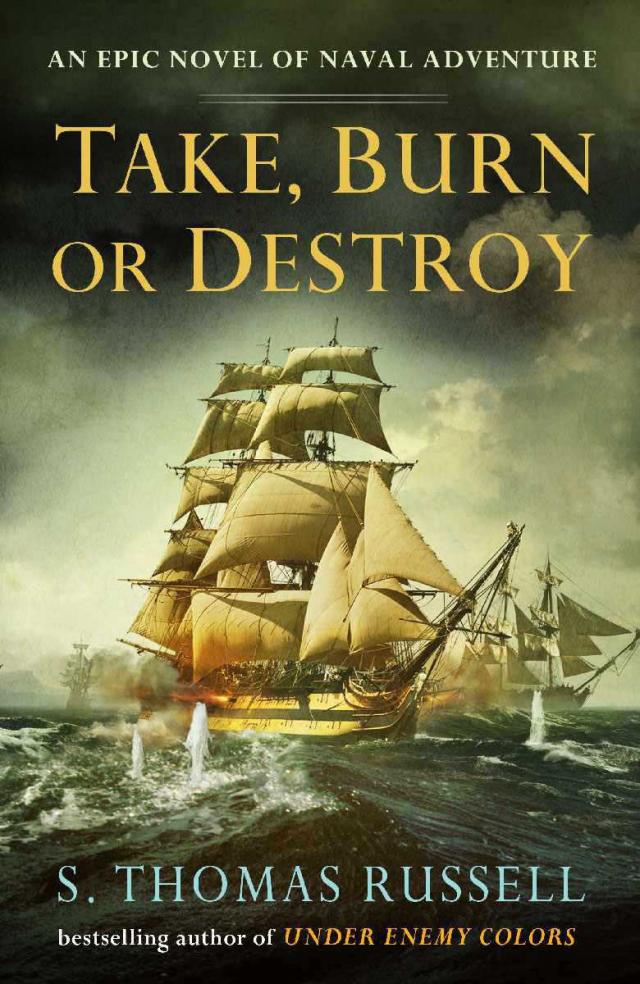
The helm was put over, sails sheeted, and slowly the head paid off until the backed topsail fluttered, then filled. More quickly now, the wind was brought aft. This evolution, timed to a nicety, set the Themis on a parallel course to the ghostly frigate, whose lights winked and flickered through the drizzle.
“Mr Gould! Have Mr Archer stand ready to open larboard gunports. Caution him not to let any man do so until I have given the order.”
“Aye, sir,” and the midshipman went off at a run.
If the French captain discovered them and decided they were a British ship, Hayden wanted to be certain his guns fired first.
The human silence upon the decks was covered by the sounds of wind, of the bow parting waves as the ship pitched in the small sea. Slowly the moon revealed the frigate, her sails and spars, the wide, pale stripe upon her topsides.
“They must see us, Captain Hayden,” Wickham observed in a whisper. “I can make them out most clearly.”
“As can I.”
Nearer the ships drew to one another. Hayden could distinguish figures moving on the deck.
“Shall we not fire into them, Captain?” the sailing master hissed.
“Mr Barthe, if you please!” Hayden replied, not taking his eyes from the enemy ship. He was not adverse to suggestions or questions from his officers—but a man of Barthe’s experience should display better judgement than that.
Even through the blear, Hayden could discern an officer, leaning upon the rail and staring intently at the Themis. Perhaps he beckoned another, who appeared out of the darkness, affixing his attention upon the British ship with equal intensity. Suddenly, that man turned and ran for the companionway.
Hayden did the same; at the head of the companionway he looked down to find Archer standing on the ladder’s bottom step.
“Mr Archer! Open gunports and fire our entire larboard battery.”
“Aye, sir.”
The bump and screech of gunports hinging up stole a little of Hayden’s breath. Apprehending the gunports opening, the French officers turned to shout the alarm, but their calls were lost in the shattering report of British eighteen-pounders. There was no reply from the Frenchman. Musket fire cracked from the tops as Hawthorne’s marines began firing at the men scurrying about the enemy’s deck.
Immediately, to both left and right, the gun crews went coolly about reloading their carronades. Many were seasoned hands at this now, after their convoy to the Mediterranean. There was no hesitation or confusion, but only a well-greased axle, turning with precision and regularity. The balls and wadding were pushed in together. At the same time, the gun captain uncovered his lock, ran his pricker into the touch-hole, poured a measure into the pan, closed the lock, and pulled back the cock with two thumbs. The carronades were run out on wooden slides, and the gun captain made certain of his target and yanked the firing lanyard with a quick jerk.
Hayden had stepped back from the rail, turned away, and covered his ears just in time. A tremendous explosion tore open the darkness, with the muzzle flash, and smoke plumed forth, blossoming up into a weeping night.
In the ensuing silence, Hayden heard officers shouting orders in French. Gunports began to open on the enemy ship. As his own crews were running out their guns, an irregular fire erupted from the French frigate. The always horrifying sound of iron balls rending the air was immediately followed by the crash and splintering of wood reverberating through the Themis’ deck. A sheet carried away, and sail began to shake and snap.
As was ever the case, the English gun crews fired thrice for every two times the French fired; some crews doubled the enemy’s pace. Rate of fire, at short range, trumped accuracy, a fact that Hayden knew well and had led him to manoeuvre his ship so near.
The next quarter of an hour saw an unrelenting fire kept up between the two ships, breaching the oak planking, tearing away shrouds and stays, and ripping through sails. Smoke mixed with rain and low mist to obscure the vessels from one another and hide the true damage being inflicted.
In the midst of this, Hayden glanced shoreward, fearing that they would carry on this battle until they came beneath the enemy’s batteries. He must finish this frigate before that could happen. He might yet be forced to lay his ship alongside and board.
Around him, men fell and were carried below or slipped over the side if death was certain. To his surprise, Hayden realised he could now distinguish action upon the forecastle of his ship—dawn was not so far off.
“Captain Hayden . . .” came a call from somewhere forward. “A boat, sir. A cutter, it looks.”
“Not a gunboat?” Hayden shouted to be heard above the din.
“I don’t believe so, sir.”
Ransome would return at this moment!—when it would be worth his life to even approach the ship.
Gould, who had conveyed Hayden’s orders forward, came running back along the gangway. “It is our cutter, sir,” he called out. “They are pulling for us like madmen and shouting and waving.” The boy was flushed and speaking almost too rapidly to comprehend.
“What do they say, Mr Gould?”
“We do not know, sir.”
No more explanation was required—the noise of battle was deafening.
“Signal them to stand clear; they will gamble their lives to draw near now.”
“I will, sir.” And the boy went hurrying forward, apparently oblivious to the cannon balls that hummed over the deck and the musket balls lodging in planking with ominous cracks.
Dawn was still some time off, but morning twilight was beginning to reveal a few shadowy shapes across the deck. From the quarterdeck, the cutter was not yet visible.
Smoke burned Hayden’s eyes, and his ears rang from the constant explosions. The French captain, despite being surprised, was putting up a spirited defence and Hayden feared he might yet make the cover of the shore batteries.
As if the French commander had been thinking the same thing, a hoist of signals jerked aloft, the flags mostly obscured by sails. The French officers were hoping there would be light enough for the shore gunners to make out their signals.
“Where is Mr Gould?” Hayden called out.
“Forward, sir.”
“Have him run up the French naval ensign and a hoist of flags to starboard. Let us confuse the enemy if we can.”
“Captain!” Gould came running along the deck. “Mr Ransome is ignoring our signal to stand clear, sir.”
“Well, then he must look to himself. A hoist of signals to starboard, Mr Gould, and the French ensign aft.”
“Aye, sir.”
A young sailor came dashing up, making a knuckle. A blast of carronade fire completely smothered his words.
“Why are you upon my quarterdeck and not at your station?” Hayden demanded.
“If you please, Captain,” the young man began, looking more frightened of Hayden than the French, “Mr Barthe has sent me. Mr Ransome is yelling somewhat about a French frigate, sir.”
“‘Somewhat’? Whatever do you mean?”
The boy shrugged. “Those were Mr Barthe’s words, sir.”
Hayden hesitated a second, then made up his mind. “Mr Gould! I am on the forecastle.”
He hastened forward in the wake of the running sailor. “What is this about, Mr Barthe?” he demanded as he reached the bow.
Only thirty yards off, Hayden could make out their cutter, the men pulling like they were running from gunfire, not into it. Hayden leaned out over the barricade, half hidden by smoke, no doubt, and waved Ransome away. Spotting his captain, Ransome leapt upon a thwart and began gesturing frantically towards the shore. Hayden’s eye was drawn towards France. Out of the mist and morning twilight the sails of a ship materialized, and then beneath these a jib-boom penetrated through the fog.
For the briefest second Hayden’s mind went utterly blank, and then he turned to the sailing master.
“Sail handlers to their stations, Mr Barthe,” he shouted almost in the master’s ear. “The instant Mr Ransome is aboard, we will bring the wind onto our starboard beam, gain way, then shape our course to the nor’west—hard on the wind, Mr Barthe. Do you understand?”
Barthe looked as though he did anything but. “W-We are going to run, sir?”
“Yes, of course we are going to run. Two French thirty-six-gun frigates, sir. What else are we to do? With all haste, Mr Barthe.”
Barthe seemed to come suddenly awake to their situation. “Aye, sir.” He went trundling off with a rolling run, shouting for Mr Franks to call the sail handlers.
Hayden cursed himself for not slipping off the minute the French ship had been spotted. Ransome could make England in the cutter. Men had gone much further. He cursed himself again.
Hawthorne appeared beside him at that moment, hat gone, face powder-stained, a musket in hand. “Will the Frenchman not rake us, Captain?”
“We are half hidden by smoke and mist. If we are quick, we will have braced our yards and put over our helm before he comprehends what we are about.”
Men came running onto the deck and began coiling down ropes as quickly as hands could move.
“With all speed! With all speed!” Hayden called as he hastened down the larboard gangway.
Upon reaching the quarterdeck, Hayden positioned himself a yard from the helmsman. Even though Hayden could see the crew working as quickly as human hands were able, and racing aloft at a dangerous speed, it still seemed that morning light would find them before the helm could be put over.
Defying his captain, the French gunners, and all common sense, Ransome brought his cutter alongside and the men scrambled up to the deck. The first man over the rail staggered back into the man behind, and then fell on his side, bleeding from his chest. The others took him up and bore him quickly below to the doctor. Immediately, Ransome hastened to the quarterdeck, calling out orders to stream the cutter.
Almost out of breath, he touched his hat and began, “I apologise, Captain, for disregarding your orders, but we were trying to warn you, sir, about the frigate.”
Hayden nodded. “Yes. I see what you were about. But we must now run, sir, if we are to preserve our ship. Wickham and Archer are overseeing the guns. You will be the lieutenant of the watch until I order you relieved.”
“Aye, sir.”
Mr Barthe’s voice came hollowly through a speaking trumpet. “Ready to brace our yards, Captain.”
“Port your helm,” Hayden ordered the two men at the wheel—one standing by in case his mate was felled.
The Themis was a handy ship and answered her helm readily. Hayden realised that the second frigate would be within range of his eighteen-pounders as they made the turn.
“Mr Gould. Jump down to Mr Archer and instruct him to fire upon the second frigate as she bears.”
“Aye, sir.”
Hayden turned to watch the French frigate and was gratified to see that he had caught them unawares. They might yet bring guns to bear upon Hayden’s stern, but there would be no devastating broadside raking his ship.