Take, Burn or Destroy, page 19


“Which is why I wish I could speak to them now before they have had time to compose such a story.” Hayden paused a moment. “I cannot quite comprehend why Ransome would misrepresent what occurred . . . It would be more in his character, as I have come to know it, for him to cast all of the blame on Carlson and Braithwaite.”
“He did give the order to silence Greenfield. Others heard him say it. Certainly, he must apprehend that some of the blame might be attached to him.”
“Yes, I suppose that is true.”
Griffiths pitched his voice so low that Hayden could barely make out his words.
“Lacrosse questioned me—quite intently—about your parentage. Specifically, your mother. Of course, I told him I knew only that your father was a post captain in the His Majesty’s Navy. Nothing more.”
“He knows of my mother’s origins. Others were not as circumspect as you. And he has my mother’s letters—all written to me in French, of course. Do you know the French believe I am some royalist sea officer who has enlisted in the Royal Navy! I believe I have convinced Lacrosse that this is not the case.”
“He has your mother’s letters . . .” Griffiths looked even more grave than common. “Does this put her family in danger?”
“Under the present circumstances in France? Yes, certainly. Lacrosse has promised to burn the letters. Did you know he was a baron before the revolution?”
“It is a wonder he still has a command. It is a wonder he is alive.”
“Precisely. I believe he is an honourable man who does not want to see my mother’s family persecuted without cause.”
“He should beware of aiding you. Were it to come to the attention of the Committee of Public Safety—well, who knows how they would interpret it.”
“Indeed. The man has put himself at great risk on my behalf.”
The doctor fixed his gaze on Hayden a moment. “What will he ask in return, I wonder?”
“If he is truly honourable, nothing.”
“It is his duty to keep his men safe and his ship out of enemy hands. If either of these comes into doubt, I believe he will consider it more honourable to perform his duty than to aid a family he knows not at all.”
“Yes. I wish I could know if he had destroyed the letters, as he said he would. I do, however, think there is a good chance Les Droits de l’Homme will be a British prize before the night is out. And then the letters will be mine again . . . if they have not been burned.”
“Let us hope. I for one do not relish the idea of a French gaol. Officers they will quickly exchange . . . Surgeons? I am not so certain.”
“Do not be concerned, Dr Griffiths. There are French surgeons aplenty among our prisoners. You shall be exchanged along with the rest of us.” Hayden almost patted the doctor on the shoulder but stopped himself. “I believe we should rejoin the others.”
The two men went out to take their place among the other Themises, and for a moment this caused an awkward silence, but Hawthorne soon swept that away and speculation began about the British ships whose guns could be heard firing now at regular intervals.
“Were there but two British ships, Captain?” Wickham asked.
“When I was on the deck that was the case. We might hope others have joined them, but if not I think two can manage perfectly well, do you not?”
“Certainly, sir, but I am worried that this ship might make Brest before she can be taken. Mr Barthe was just speculating that we might not be so far off the coast.”
“Do you think so, Mr Barthe?” Hayden asked.
“I cannot say for certain, sir. We had seen neither land nor the sun these three days past. My dead-reckoning put our position south of Brest and about four leagues distant from the French coast, but I would not bet a farthing on it, sir, nor even a ha’penny.”
“Where are we steering, then?” Smosh asked.
“We were steering west by north-west, more or less,” Hayden told him, “though I could see neither sun nor compass, so I cannot be certain. Since then, Lacrosse has put the ship before the wind and we are flying east by south.”
The sound of a ball finding wood crashed through the ship above, causing a moment of silence.
“Banish every thought of a huzzah, Mr Hobson,” Hayden ordered the midshipman, who seemed about to jump up and cheer. “If our own cruisers free us, you may cheer as much as you wish. Until then, we shall cheer only in the quiet of our own minds.”
The men all nodded, clearly requiring no more explanation than that.
“Mr Wickham, do the French realise that you speak their tongue?”
“I do not believe so, sir. Lacrosse spoke to me in quite acceptable English.”
“In that case, I should not give it away if I were you. It is quite well known that I speak their tongue, but they might feel free to speak French out of my hearing if they believed no one else understood. This might give us some small information we do not have. The same applies to you, Mr Archer, or anyone else who has a smattering of French. Keep it to yourselves; you might hear something of value.”
The men ate in near silence, the sounds of firing guns, both on Les Droits de l’Homme and from the distant ships, chiming like slightly irregular clocks. It was too early to sling hammocks, and the men sat about after their meal talking quietly. A few fell asleep leaning against a bulkhead. Hayden’s watch had not been taken, and he consulted it after a while, wondering how long until dark—half an hour, more or less.
Voices were heard outside the door and the lock turned. A dull thud of a wooden bar being removed and then the door slowly opened, a face appearing in the dim lamplight, peering in to be certain there was no ambush.
“Capitaine Hayden? Capitaine Lacrosse requests your presence.”
“Mr Archer,” Hayden said to his senior lieutenant. “In the event that I do not return. You are in command.”
“Aye, sir.”
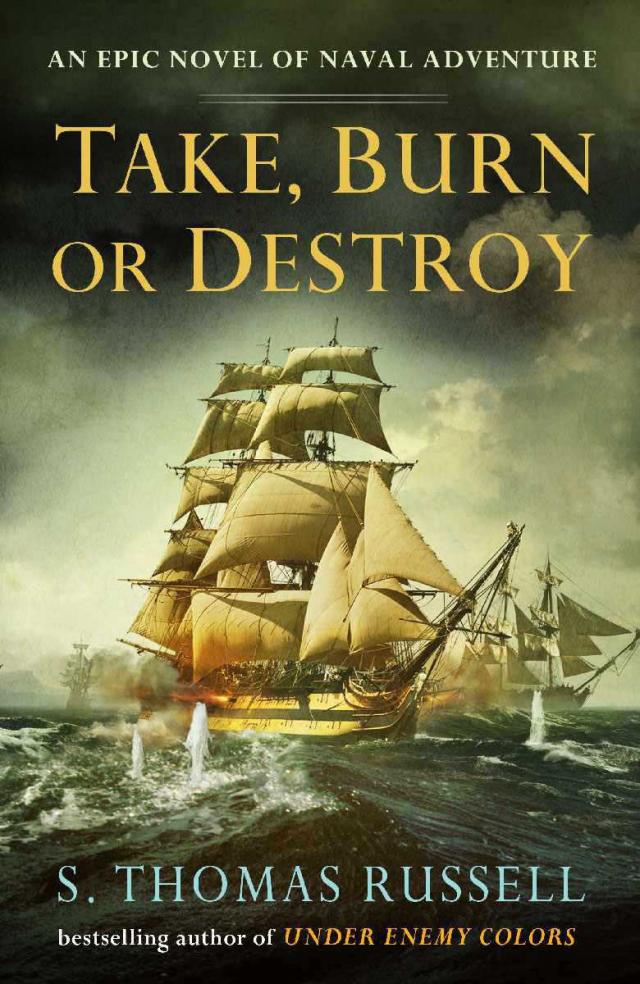
Hayden followed the Frenchman out and two seamen armed with muskets fell in behind. In a moment they were upon the lower gun-deck. The gunports were closed here and the gun crews had not been mustered, though in every other way the deck appeared to have been cleared for action. The upper gun-deck had all the gun crews mustered—both the larboard battery and starboard—though they stood idle at that moment and the ports were yet closed. The firing came from the upper deck and Hayden went quickly up into a late afternoon, wind making and seas quickly mounting. Darkness appeared to be gathering its forces just beyond the limited horizon and streams of rain could be seen all around. The two British ships were not distant, and the larger, Hayden could now see, was undoubtedly a razee. Pellew was the most determined captain in the Royal Navy, Hayden thought, and he did not expect him to give up this chase until the French ship had hauled down her colours. Indefatigable was certainly the right weapon for the job, and in the right hands, too. Both British ships were firing their chase guns, and Lacrosse’s crews on the quarterdeck were engaged in this same exercise.
Hayden was quite certain that the French seventy-four would be neither as handy nor as swift as the smaller British ships, and though Lacrosse might have some advantage in weight of broadside, one English ship could engage him while the other manoeuvred to rake his ship. The sea was already running so that Les Droits de l’Homme did not dare open her lower gunports, meaning that the weight of broadside would favour the British. At least that was Hayden’s assessment of the situation in the first moment he was on deck.
Lacrosse noticed him and motioned for Hayden to be brought forward.
“Capitaine Hayden.” He gave a slight bow. “If I may have a word with you . . .”
Despite the guns being fired but a few yards away and the sound of British shot tearing into the air, the two officers retreated to an empty patch of deck to converse. Hayden admired Lacrosse’s composure. He might have been out enjoying his garden, for all the fear evident in the man’s demeanour. For his part, Hayden thought it would be ironic if he were killed by a British gun.
“There is a disagreement among my officers, Capitaine Hayden,” Lacrosse began, “regarding our exact position. Many sections of the coast in this region are very dangerous. The disagreement is over how close to the coast we might be.”
Clearly, Lacrosse wanted the greatest possible value for the favour he had promised Hayden, and given the situation of his mother’s family, Hayden wondered how he could refuse.
“You do realise, Capitaine Lacrosse, that giving you such information would be seen as aiding the enemy, for which I could be court-martialled and executed?”
“I assure you, Capitaine, that no one beyond myself would ever know that you offered any aid to me at all. I might also say that if we were to go ashore your men would be in as much danger as my own. Certainly, you consider it your duty to preserve the lives of your own men?”
“Indeed. Unfortunately, we had seen neither land nor sun for three days running and my sailing master was uncertain of our own position when we surrendered our ship. That is God’s truth.”
Hayden could not read Lacrosse’s response to this. For a moment he said nothing. “Unfortunate,” he said at last and, excusing himself, rejoined his officers. Hayden was left standing on the quarterdeck, sharing the danger with the French officers. He even wondered if Lacrosse had done it a-purpose to demonstrate his own indifference to danger and death and to put the Anglais at risk. Hayden leaned his hip against the rail, crossed his arms, and fixed his attention on the chasing ships. Although the sea was getting up, they maintained a regular fire, perhaps every fourth shot finding Les Droits de l’Homme, though usually passing through the sails and doing little more harm. The scream of the iron ball parting the air was something felt in the chest. It demanded fear—like putting your hand on a viper in the dark. For Hayden, there was no possibility of not feeling apprehension, it was simply a matter of keeping it locked up. The pounding heart, the knife of fear awakening every nerve, the growling stomach where the fear went to prowl.
But he had become something of a master at this. And a fatalist as well. He truly believed that when one’s time came there was nowhere one could hide. Better to die standing than grovelling—that was his belief. Die with the deck beneath one’s feet, not one’s knees.
So he stood, staring down the British guns, damned if he would show the least sign of fear before these Frenchmen. And it appeared they were equally determined to demonstrate their sang-froid before the Anglais.
The running sea raised the stern and then rolled along beneath until finally the stern sank into the trough and the bow was cast up—the motion of a seventy-four-gun ship so different from his own frigate. This thought of the Themis reminded him that she was now in enemy hands—a prize of war. He might not have been the first British captain to lose his ship, but, even so, the thought of it caused both distress and humiliation. For some reason, he imagined the Themis’ former captain—the notoriously shy Hart—gloating and spreading it about that Hayden was a reckless pup who knew neither ships, nor men, nor war.
Lacrosse and his two senior officers huddled by the binnacle in whispered but heated debate. Clearly, they were not of one opinion, and Hayden was quite certain it was their present position that was the subject of this dispute. Perhaps it was not even their position that was debated but the uncertainty of their whereabouts.
Les Droits de l’Homme was sailing more or less east, Hayden thought, with the wind now behind them. If the coast was near and no bay or harbour offered shelter and the protection of shore batteries . . . they could be trapped against the French coast or worse. Visibility was very poor even by daylight, and darkness would reduce it to a musket shot or little more. Had he been Lacrosse, he would be more than concerned.
Lacrosse suddenly drew himself up and declared to his officers, “I shall not surrender my ship to any two frigates. The English will have to board my ship and tear down the flag with their own hands!”
A ball crashed into the stern just beneath the level of the quarterdeck. Hayden was glad his own men were being held forward and below the water line. The French gunners fired back, their own shot striking even less frequently than the British, though it must be admitted that a seventy-four-gun ship did offer the larger target.
After only the briefest period of observation, it was apparent to Hayden that the British ships were gaining, ranging up on either quarter. He could very clearly make out the gun crews, bent over their guns, swabbing and ramming home powder. Of course, Hayden had been aboard a French ship fighting a British ship before—although the French ship was a prize and the British vessel crewed by mutineers. Even so, he had fought the English and risked being killed by them. Standing on the quarterdeck in his French captain’s coat, the present situation felt oddly familiar—as though he actually had once been a French officer just as the French believed.
An eruption of fire and smoke at the bow of the chasing razee sent an iron ball screaming overhead. It tore a hole in the mizzen but did no other damage. Hayden estimated that the ball had missed him by fewer than a dozen feet.
Upon the nearer British ship—the razee—Hayden could see marines climbing up to the foremast tops, muskets slung over their backs, red coats standing out against the dark sky. The quarterdeck of the French ship was about to become an even more dangerous place to be. Lacrosse responded by sending his own sharp-shooters up the mizzen.
Another ball found the stern of the French ship with a crash that Hayden felt through the soles of his boots. There was a part of him that felt a great deal of pride in this display of British gunnery—and a part of him that wished they could be a good deal less accurate.
The hands began to carry up weapons—pikes and cutlasses, pistols and tomahawks—and these were distributed to men who were ordered to sit upon the deck amidships hidden from the view of the enemy. Two young officers were put in command of the boarding party and the ropes for the grappling hooks coiled down and ready to throw.
Hayden thought that boarding with such a sea running would be difficult if not impossible. The British snipers began firing at that moment, and at least one thing was not in doubt—they had smoked the French boarding party because the British marines were shooting as often at them as at the men upon the quarterdeck.
Lacrosse appeared to have forgotten about Hayden and went about his business very coolly. It was clear to Hayden, however, that the spirit of liberté had spread among the crew and they did not take orders from those above them readily. Although he saw little open defiance, compliance was grudging and dilatory, and the execution of orders would certainly have been unacceptable aboard his own ship.
French sailors were not in open mutiny, but very clearly they, like Lacrosse, could hear the sound of the guillotine, though for them the sound was the heads of their oppressors tumbling into the basket. Lacrosse, they knew, could be disposed of in the blink of an eye. They neither feared nor respected him. He was an officer’s coat stuffed with straw.
Hayden had been in command of an untrustworthy crew and he felt some pity for Lacrosse—but not too much, as he knew this situation would make it easier for the British ships chasing. Musket balls began smacking into the wooden deck and one of the men at the wheel fell in a swoon, a ball in the back of his skull. A young aspirant—a boy whose voice had not yet begun to change—was shot through the leg, and then, as he fell, through the bowels.
He dug his fingers into the shoulder of another aspirant who bent over him. “Les Anglais,” he said, “they have killed me . . .” His eyes, so innocent but an instant ago, filled with a terrible knowledge. “They have killed me.” And then he released his friend, closed his eyes, and fainted away, his limbs thrown out like a sleeping child’s.
A grumbling began among the boarding party crouching in the waist, with many a dark look cast back towards Lacrosse and his officers. Then, to Hayden’s utter and complete surprise, these men rose as a mass and, in open defiance of shouting lieutenants, streamed below out of the gunfire.
Hayden turned back to find Lacrosse standing motionless beside the helmsmen. He called no orders, nor did he protest in any way. Everything about him, his face, his posture, revealed that he knew there was nothing he could do. At that moment, Hayden realised that if Lacrosse could not get his ship into a French port or under the protection of shore guns, it was lost, and despite his declared defiance, Lacrosse knew this full well.
The French officer turned away, back to the chasing enemy.
Well, Hayden thought, one hardly need look further for an explanation of why the war at sea is being largely won by the British.
The Royal Navy ships ranged nearer, and Hayden thought they might soon be in a position to bring their broadsides to bear. At that point, Hayden thought he would volunteer to go below. Facing enemy guns was one thing; being killed by British guns to prove his aplomb was just bloody foolish.
A squall overtook all of the ships, pressing them on, stretching the canvas so that it looked about to tear out its clews. The seventy-four appeared to surge ahead, picked up and carried by a wave. At the same moment, Indefatigable tore her mainsail to ribbons, and she fell back almost immediately.
Hayden wondered if Les Droits de l’Homme’s sails would hold, given that many had been holed several times, but a glance showed them all bearing up to the gust so far. For perhaps ten minutes the gust held, and Hayden wondered if it was a gust at all or a general increase in the wind, when suddenly it fell away and the ship began to slow.
From the forecastle the cry “Land! Land ahead!” came with such a tone of panic that everyone turned towards the bow. Out of the grey, cliffs loomed, and before the bow breakers foamed white.
Lacrosse jumped to the wheel and wrenched it to starboard.
Not heeding the danger, Hayden leapt up onto the rail, grasping the mizzen shrouds, and screamed at the top of his lungs in English, “Land! Land dead ahead!”