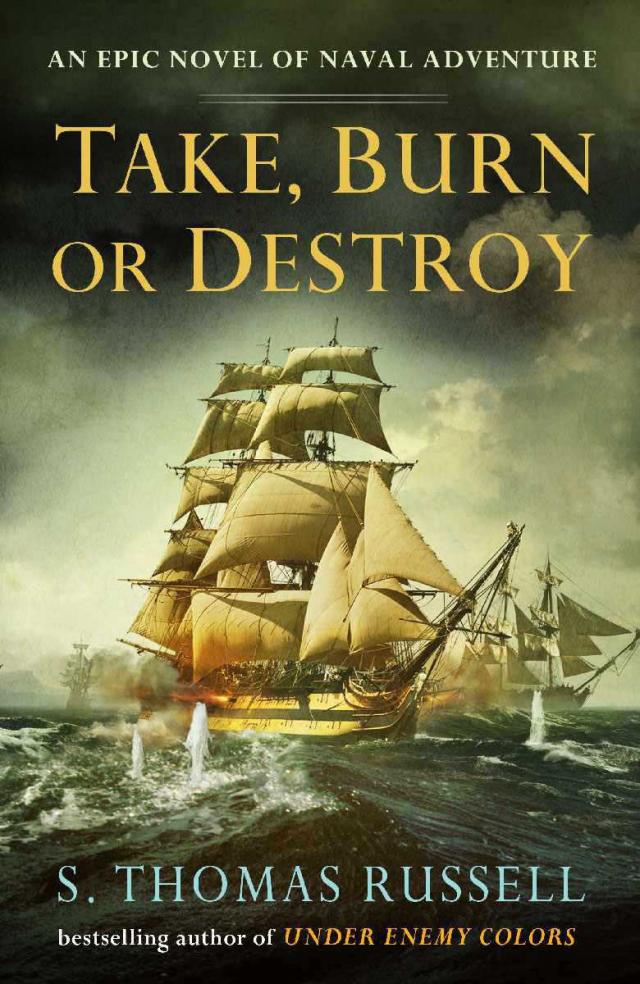
Take, Burn or Destroy, page 35


Lieutenant Huxley approached at that moment. “Mr Archer?” and then, realizing whom Archer spoke with, “Captain Hayden, sir. I did not realise it was you.”
“What is it, Mr Huxley?”
“A ship, sir. About a league distant. Two points off our lee bow and on about the same heading. Shall we alter our course to come up to her by first light?”
Archer glanced at Hayden, deferring to him in this matter.
“Commonly I should answer, ‘yes,’ Mr Huxley, but as we are delivering urgent dispatches to Lord Howe I shall not slow our pace to take prizes or to risk our purpose by meeting a ship with a greater weight of broadside. Keep to our course and have the lookouts put a glass on this ship as soon as there is the least light in the sky.”
“Aye, sir.” Huxley made a knuckle and went off.
Neither he nor Archer spoke a moment but went to the larboard rail to search the dark sea for a light. In a moment they had found it, and Hayden sent for his newly purchased night glass, his old one having been left aboard the Themis.
“Can you make her out, Captain?” Archer asked after Hayden had been staring for a moment at the sea and sky reversed.
“Three masts, Mr Archer. Nothing more.” He passed the glass to Archer, who held it up to his eye and steadied himself against the rail.
“I imagine I can perceive gunports and then I am quite certain there are none. Lost her . . .” Archer took the glass away from his eye a scant inch, found the lights again, and put the glass back to his eye. “Is she altering course to the south, Captain?” He returned the glass to Hayden.
“She has seen us, I have no doubt.” Hayden lowered the glass. “I shall try my cot again, Mr Archer.”
Archer turned to him quickly, touching his hat, but then said, “Have you spoken to the doctor at all, sir?”
“But briefly, Mr Archer, and that to do with his concerns regarding a man in the sick-berth with some puzzling ailment. Has he spoken to you about him as well?”
“No, sir. There might be some subject more pressing, sir.”
“And what, pray, might that be?”
Suddenly, Archer looked terribly embarrassed.
“I shall have a word with the doctor in the morning, Mr Archer, if you think that might be soon enough . . .”
“Perfectly soon enough, sir.”
“Then I will say goodnight to you, Lieutenant.”
Hayden went back down to his barren cabin, undressed, and rolled into his swaying cot. For some time he lay, thinking sleep would not find him. He still could not quite believe he had made his post . . . No doubt due to the efforts of Philip Stephens, though he did wonder if Lord Hood might have made some interest on his behalf. Almost certainly he would never know. How good luck and ill fortune could be so combined in one man’s life he did not understand. One day he lost his beloved Henrietta, and hardly a sennight later he made his post. He fell asleep thinking that he would gladly trade both his newly won coats for the hand of Miss Henrietta Carthew.
Twenty
Four and half days were required for the Raisonnable to raise the Île d’Ouessant, or as the English preferred it, “Ushant.” Hayden did not risk the Four Passage, even with a fair wind. Perhaps the thought of losing his first command as a post captain sent him on the safer course.
The shattered cliffs south of the harbour entrance stood out in the afternoon sunlight like bones bleached and scarred. Even without a glass Hayden could pick out the batteries there, protecting the narrow harbour entrance. A brisk top-gallant breeze swept down from the north, cool but not chill. The green fields of France faded into mist inshore and then disappeared altogether in thickening haze.
“There is a cutter just tacking in the outer water, sir,” Wickham informed Hayden. He lowered his glass and pointed. “Do you see her, Captain?”
“I do, Mr Wickham. Is she one of ours, do you think?”
“It seems very likely, sir. Let us ask Mr Barthe if he recognises her.”
Wickham and Hayden stood at the rail upon the quarterdeck, the coast of France stretching south beyond Pointe de Raz. They were hardly a few hours’ sail from where they had both been so recently wrecked, and the thought of it made Hayden leery of the nearby shore even though the wind did not threaten to take them in that direction.
The sailing master was sent for and appeared a few moments later, waddling up to the rail, colour high, a few strands of brick red hair escaping from beneath a battered hat, which he habitually wore pressed down tight upon his roundish head. His ankle, though still swollen, inconvenienced him less and less—to the point where he had abandoned the doctor’s cane.
“Would you quiz this little cutter for us, Mr Barthe, and tell us if you know her?”
Barthe took the offered glass and fixed it upon the vessel, hardly a league distant. “She does bear a strong resemblance from this far off to the Expedition, sir. Though I should not wager my savings on it—had I any savings.”
“You do think she is British?”
“I should think so, Captain. Holding station here or so it appears.”
“Make the private signal,” Hayden ordered Wickham. “We do not want to chase her off.”
Even as Hayden said this, the cutter tacked and began to beat quickly up towards the rocks at the entrance to the Four Passage, no doubt fearing that Raisonnable was a French ship.
The private signal was made, and immediately the cutter answered and changed course out towards the approaching ship. Hayden ordered Raisonnable hove to and awaited the cutter, which very quickly ranged up to leeward, rounded up sharply, and backed her headsails, proving Mr Barthe right about her identity.
“I am carrying dispatches for Lord Howe,” Hayden called down to the lieutenant in command. “I have orders to deliver them with all possible haste.”
“You have missed him by a day, Captain,” the lieutenant called back. “We had word from Admiral Montagu by the frigate Venus that a French squadron had been dispatched from Brest to meet the American convoy—five ships of the line and two frigates, sir. Lord Howe set out to support Admiral Montagu immediately. The French squadron was believed to be cruising between forty-five and forty-eight degrees north, sir.”
“Then Lord Howe has gone south?”
“Yes, sir. With the Channel Fleet. Yesterday.”
“And what of the rest of the Brest Fleet?”
“It sailed on the sixteenth day of May, sir, or so we believe. We do not know where, sir, but Lord Howe believed it may also be searching for the convoy.”
Hayden turned to Mr Barthe. “Well, that is a bit of ill luck—missing Lord Howe by a single day. It would seem we have no choice but to sail south and trust to sharp eyes and good fortune.”
“Aye, Captain Hayden, and hope Lord Howe has not had reason to shape his course elsewhere.”
Hayden turned back to the lieutenant in his cutter. “We go south after Lord Howe. If His Lordship returns and we are not in his company, you must tell him we sail with important dispatches from the Admiralty.”
“I will, Captain. Good luck to you, sir.”
“And you, Lieutenant.”
Hayden turned to Bowen, who was officer of the watch. “We will make all possible sail and shape our course due south. Lookouts in the tops. And you, Mr Wickham, might take a glass in a few hours and sit astride the main top-gallant yard and tell me what you perceive. The Channel Fleet and the Brest Fleet are both at sea, as well as French and English squadrons and a convoy consisting of over one hundred transports and escorts. If we cannot find some of these ships, then we are either blind or cursed.”
The sixty-four-gun ship Raisonnable passed swiftly south, leaving the great headland that both created and protected the inner water of Brest Harbour in its wake. The wind remained fair and did not falter all through the afternoon, allowing Hayden to cover a good distance. He had almost forgotten what a swift sailer Raisonnable was. There was hardly a frigate that could keep up with her, he thought, and this speed gave him hope. Battle fleets sailed at the speed of the slowest ship, and Hayden had not the least doubt that would be at least two if not three knots slower than he was managing now. As long as Howe did not suddenly change course, Hayden hoped to catch sight of him sometime the next day. Of course, winds did not blow with equal strength over a bay, let alone a vast ocean. Howe might have been becalmed or found a fair wind to speed him on—there was no way of knowing.
Griffiths came up onto the deck sometime before the dinner hour, and Hayden invited him up to the poop, where they might have a conversation in private. Hayden had been admiring the sea—an activity of which he never tired. It had turned all silver-grey beneath the cloud, jagged with ripples. Here and there the sun broke through, illuminating a few acres of water, causing it to glitter and dance so that Hayden could hardly look at it. His mind was ever drawn back and back to his recent visit to Box Hill, still rather amazed by his own lack of action. Was it possible that his attachment to Henrietta was not as great as he had imagined? Or did every man harbour some doubts when it came to asking a woman’s hand?
“Have you come to take the air, Doctor?”
“A rumour has wormed its way down to the sick-berth that the French fleet is abroad, and I have come to see if there is any truth to it.”
“It is entirely true. Passed through the Goulet but four days ago. There is also a powerful French squadron out here somewhere seeking this elusive convoy from the Chesapeake.”
“That does seem like too many French ships by half. Are you concerned?”
“Yes, the French fleet is formidable. But we sail a swift ship, Dr Griffiths. As long as we do not again have the ill fortune to fall in with the French in thick weather, I think we should easily be able to keep our distance.” Hayden wondered if this sounded as false as it felt. The French fleet had slipped out of Brest, and that was profoundly disturbing to him. There could be as many as thirty ships of the line—in all likelihood, more than Howe’s fleet boasted after he had sent Montagu off to intercept the convoy. He desperately wanted to find Lord Howe before the admiral came upon the French fleet, on the chance that the dispatches he carried held vital information the admiral might require to make informed decisions.
There was also the matter of the gathering invasion force across the Channel—a great unknown, for “Monsieur Benoît” had not been able to say when the planned invasion might take place. What if the Brest Fleet had simply gone into the Channel and taken control of it while Howe searched out at sea? Of course, such a large fleet would probably have been seen by Hayden as he left the Channel, but it was not impossible that they had slipped past him at night.
Griffiths gazed out across the seas, rising and falling, at the retreating dark line that was the coast of Brittany.
Hayden suddenly remembered his peculiar conversation with Archer the previous night. “How fare you, Doctor? We have hardly shared a word since the court-martial began.”
“We were all consumed by our own worries throughout that little masquerade. I must say, no matter how often one is court-martialled, one never grows to take pleasure in it.”
Hayden laughed. “I dare say, Doctor, you have spoken God’s truth. Though I did not mind it so much on this occasion as the last.” Hayden was not certain what direction he might take the conversation in, given that Archer had been so utterly vague on the matter. “How fares your patient, Doctor?”
“Poorly. I have been wondering if, when we find Lord Howe, I might consult with the physician of the fleet—Dr Trotter. I might even ask that he take Crowley aboard the hospital ship. Do you think such a thing might be possible?”
“I cannot imagine why it would not be. What other purpose can such a ship serve?”
“Mmm.”
They both gazed at the changing sea for a moment, gulls drawn along in the lee of the sails crying out for scraps.
“I do have one small piece of news,” Griffiths offered, lowering his voice. “It appears I shall soon be wed.”
“My compliments to you, Doctor!” Hayden replied. “I name you a most fortunate man. And who is the lucky bride-to-be?”
“Miss Brentwood,” Griffiths answered.
“The young lady you met in Gibraltar?”
“The very one. You appear surprised?”
“Not in the least,” Hayden lied. “You did tell me that she was of excellent temperament, and if I may be permitted to observe, she is very handsome. I believe you will be very happy together, Dr Griffiths.”
“Thank you, Captain.”
A few more pleasantries passed between them, and then the surgeon excused himself and slipped below, leaving Hayden alone at the rail, feeling somewhat low and a little confused. Hearing Griffiths’ news of his own pending nuptials brought to the fore that Hayden had no such news—in fact, his news was of the opposite, not that he had spoken of this with any man aboard. Although he made a conscious and concerted effort to push all thoughts of Henrietta from his mind, he caught his thoughts returning there often, despite the fact that was rather like pressing on a wound to see if it healed at all.
The distinctively pleasant voice of Mr Hawthorne was heard speaking to the helmsman. In an attempt to set his thoughts upon a different course, Hayden went forward to the rail, leaned over, caught the acting marine captain’s eye, and invited him onto the poop.
Hawthorne fixed an eye on Hayden. “I understand you have been speaking to the doctor, Captain? You have received the joyous news, no doubt?”
“Regarding his coming nuptials? I have.”
“And I am certain you gave him your heartiest endorsement?”
“How could I not?”
“Indeed.” Hawthorne shook his head. He almost looked angry, Hayden thought. “I doubt she will make him happy,” the marine said, “but I do hope she does not make his life a misery.”
“Do you think it as bad as that, Hawthorne?”
“It did not begin propitiously—the doctor rescuing her from a gang of drunken sailors and in the company of whores.”
“That is true. She was down on her luck, as they say.”
“A maid of all work with only one hand, no prospects, no family, and no money at all? She was a step away from whoring herself, if she had not done so already.”
“Though it is easy for us to judge who have never been in such circumstances.”
“I will not throw the first stone, Captain. I am only concerned for the happiness of our friend. No doubt she sees Griffiths as her path out of the straitened circumstance into which she had fallen.”
“Many a marriage has little to do with mutual affection or even respect, and much to do with enlarging one’s fortunes. It is hardly a rare occurrence.”
“It is not. But one does not like to see a friend snared in such a web.”
“Let us hope it is not as it appears and that our friend has attached Miss Brentwood’s affections. Though I do think he might have done better than a servant, even a very comely one.”
One of the new midshipmen stopped on the quarter-ladder at that moment, not daring to place a foot upon the poop. Hayden could see him hovering there, on the edge of his vision, uncertain if he should interrupt his captain.
“Huxley,” Hayden said, saving the boy from indecision. “Is there some matter in need of my attention?”
“It is Mr Hawthorne, sir. One of the marine sentries appears to be ill, sir.”
Hawthorne turned towards the boy. “Does he possess a name?”
“I believe they said Stewart, sir. An Irishman.”
“From Sligo. Let us go see to him.” He touched his hat to Hayden. “If you please, Captain, I have a patient in need of my particular physic.”
“We do have a surgeon, Mr Hawthorne.”
“If my physic proves ineffective, I shall send the man to the sick-berth.”
Hayden watched man and boy make their way forward, Hawthorne almost a foot taller, the child hurrying to stay abreast.
Hayden remembered his first few days aboard ship—knowing nothing. He had been practised upon and bullyragged, made to look the fool and had also been the beneficiary of great kindness. It was not an easy life. These boys were lucky to have Wickham as the most senior midshipman; he would set them on the right course and aid them at every turn. Gould, who was only a few months ahead of them, was also looking out for them, Hayden noticed. He could hardly ask for a more likely group of young gentlemen.
Hayden searched the horizon in all directions for sails—nothing. He felt a distinct lowering of his mood, as though some oppressive weight settled upon him and pressed him down. His last meeting with Henrietta seemed fixed in his mind, like an echo that never faded away entirely but sounded over and over. He had turned her words over so many times that they had begun to lose all meaning, as though they had been spoken in some other language that he did not comprehend—the language of a woman’s heart.
Hayden retreated to his cabin, finally, though he found it so unwelcoming he could barely remain there. He so longed for the companionship of the gunroom—the “wardroom” on a sixty-four-gun ship. Companionship was the physic he required. To sit alone with his wounds in an empty cabin was the most effective way to see them go septic, and he knew it. The wardroom door was no longer open to him without an invitation. Certainly, he could go there on some excuse—to speak with an officer about some matter—but he resisted this perceivable urge. The captain should not appear so weak. Solitude was his natural world, and Hayden would just have to make his peace with it.
For an hour he wrote in his personal journal. Outside his gallery windows the sun plunged into the distant sea, setting the horizon aflame, and then the smoke of night drifted over the sea. Stars flickered into being and overspread the high vault.
Hayden ate a solitary meal, read in a book loaned to him by Mr Huxley, and then rolled into his cot. Despite a deep, aching fatigue, sleep remained just out of reach for some hours. And then some of his fancy twisted off into nonsense and dream swept him away on its own currents.