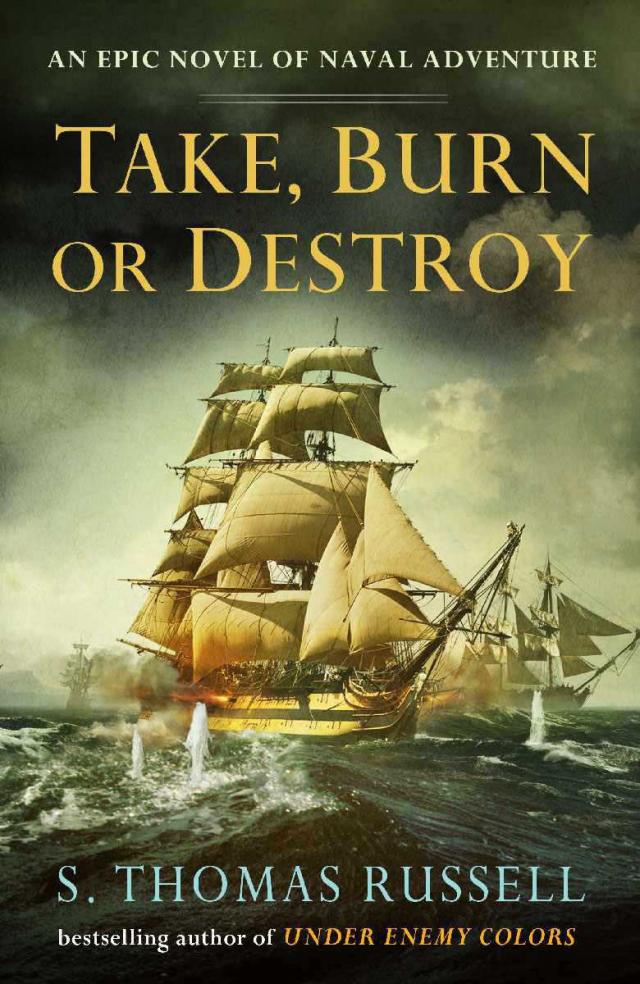
Take, Burn or Destroy, page 17


“I am very sorry to hear of your mother’s misfortune, Capitaine. My condolences. You are aware, Capitaine Hayden, that certain factions within France are causing . . . a hysteria within our borders?”
“I am, yes.”
“You might be accused of being a Frenchman and a royalist. In short, a traitor.”
“But I am neither.”
Lacrosse shrugged, pressing his ample lips into an inverted U. “That may be so, but you might have need to prove this, and rather quickly, too. The Committee of Public Safety does not require a great deal of evidence to send a man to the guillotine. Have you anyone in France who might identify you? Preferably someone of influence . . .”
“No—no one,” Hayden said, hardly able to draw breath. Was it not enough that he had lost his ship? Now he would be accused of being a traitor . . . to France! “You must know, Capitaine Lacrosse, that we have so many British officers awaiting promotion. We have no need of French sea officers at this time.” Hayden did not want to say that British sailors would be shot before they would take orders from a Frenchman, but thought better of it.
“May I trust you not to repeat what I am about to say, Capitaine?” Lacrosse enquired, very quietly and speaking perfectly acceptable English. “I cannot stress enough that private conversations, such as the one we are now engaged in, have been all the evidence required to see a man guillotined.”
“You have my word as an officer.”
Lacrosse nodded. “I am aware that French officers seldom serve in your service, but the Committee of Public Safety, well, I caution you again, Capitaine, all they would require is a single citizen to point a finger at you and say, ‘Yes, I know him. He is le comte de Periger,’ or any such name, and that would be adequate. Men have been executed on less evidence. Far less.”
“But I am an Englishman . . .” Hayden protested, sitting back in his chair, stunned by what this man was suggesting.
“Not if Robespierre decides otherwise.”
Servants brought in the first course, but Hayden felt so ill at that moment he was afraid to eat. Then he decided he must lest he offer insult to Lacrosse, who would have the treatment of Hayden’s crew under his control until France was reached.
“The Admiralty would certainly vouch for my nationality. Admiral Hood knew my father. Philip Stephens, the First Secretary, knows all the details of my parentage and service. I could write to him . . .” Certainly Stephens would have the common sense not to reveal the identity of his mother? The man was brilliant; he would never make such a blunder.
There was a knock upon the door and a whispered conversation between an officer and Lacrosse’s steward.
“Excuse me, Capitaine Hayden.” Lacrosse rose and went out of the door. Hayden could hear his voice beyond but pitched too low for him to comprehend the words.
A moment later he returned and, to Hayden’s horror, set a wooden box upon the table. The box that held Hayden’s letters.
“It would appear, Capitaine Hayden, that there are letters here, addressed to you, that begin, ‘My Darling Son.’ These letters are all written in French.”
“It was a scandal at the time,” Hayden said quickly. “After my mother died, my father married my nursemaid. She was much younger than he, and her family in reduced circumstances. My father was lost at sea. My stepmother removed to Boston, where she married again—a shipowner. An American.”
Lacrosse stared at the open box, the letters so neatly folded and arranged. “These letters represent a very grave danger to you, Capitaine Hayden. A very grave danger.”
Nine
The lockup had been arranged just aft of what Hayden thought might be the sail room. A few low tables with benches, crudely built of poorly dressed planks, were arranged against one bulkhead. How many others might be locked up here with him Hayden could not say. Not that it mattered. On a fair wind, the harbour of Brest was but a few hours distant.
Unable to sit, Hayden rose and tried to pace, but the beams overhead were too low to allow it, so he returned to the hard bench. Sitting still, however, proved difficult. Hayden was now well aware that he would almost certainly be intensely questioned as to his origins once he was on French soil. The letters from his mother—letters that had slipped from his mind in the moment—would be scrutinized for any incriminating evidence.
To an Englishman the idea of a French officer serving as a captain in the British Navy was absurd. If nothing else, English pride would not allow it. From his conversation with Lacrosse, however, he had been made to realise that the French did not perceive this as an impossibility.
There was rattling outside the door, and then Archer was thrust in and the door closed behind him. Hayden heard a bar set in place and a key rasping in a lock.
“Mr Archer. Have you been hurt?”
The lieutenant shook his head, though he did look over his clothing—unlike Hayden, he had changed back to his British uniform—as though he expected to find damage. “No, sir.”
“Please, sit, Lieutenant. What is being done with our crew—can you say?”
Archer braced himself on an overhead beam. His face was ashen and he swayed where he stood. “All of the officers were carried aboard this ship, Captain. The hands were kept aboard the Themis, which I believe from what I overheard is being sailed to Brest.” Archer slumped down on the bench opposite Hayden, put his elbows on the table and a hand to either side of his narrow face. He appeared about to weep but mastered himself almost immediately. “We have lost our ship, sir.” These words, so final and distressing, he whispered from a dry throat so they sounded like a pronouncement from some distant underworld.
“Yes. I have turned it over and over and do not know what else I could have done.”
“It was just the worst luck, Captain. Nothing more. The Admiralty will certainly agree. It is a pity, though, that it befell us.”
Archer did not know what Benoît had told Hayden—his failure to carry this vital information to England would be enough to blast his career. There could be no excuse for this, especially as he had fired first into the French frigate off Le Havre. His enemies, whoever they were, would say he should have let the frigate pass. They might even question his waiting for Ransome to return in the cutter.
Archer appeared not to notice his commander’s distress. “I suppose we have had our share of good fortune, sir,” the lieutenant observed. “Escaping Toulon Harbour on so little wind was nothing short of a miracle. We might have known ill luck would balance this out.”
Hayden made no comment on this and instead asked, “Where are the rest of my officers? You said they were brought aboard?”
“I believe they are being questioned by the captain, one by one. Captain Lacrosse asked me about your parentage, sir, and how you came to speak the French so well. I told him your father was a sea captain, and beyond that I claimed ignorance.” He leaned closer and spoke in a whisper. “I thought your mother’s nationality should not be mentioned, sir.”
“Thank you, Archer. That was very astute. Do you think the others will comprehend that my mother’s family might be in significant danger if the connection became known?”
“I do not know, sir. Certainly, Wickham and Hawthorne would never say a word of it. Mr Barthe . . . well, he speaks before he thinks, on occasion.” Archer’s gaze turned up a moment. “The other reefers . . . I fear they have little comprehension of the situation in France. Ransome . . . I cannot say. The doctor, of course, would never be duped into saying anything; he is private to the point of being secretive with us. He will claim ignorance of anything beyond his own name.”
Despite the circumstances, Hayden almost smiled at this assessment of Griffiths—which he agreed with in every way.
“How long do you think it will take to arrange an exchange, sir?”
“I wish I knew, Mr Archer. Sometimes it is weeks, at other times months. The good news is that we have an abundance of French officers imprisoned in England, so finding officers of equivalent rank to exchange will present no difficulties. The greatest impediment will be the French government—it is in utter disarray, if not chaos. The French Navy, though we dare not say it aloud, is little better.”
The ship creaked audibly at that moment, heeled a little to starboard, and then the unmistakeable burbling of water moving past the planking came to them.
“Wind . . .” Archer said.
“Yes, but from where?”
“I am not certain. Maybe one of our own men will be able to tell us when he is sent down.”
As if on cue, the door was opened noisily and Ransome was let in.
“Mr Ransome,” Hayden greeted him. “They did not mistreat you, I hope?”
“Not in the least, sir, though I was closely questioned. I told them we were cruising and no more.”
Ransome came and took a seat beside Archer—he appeared utterly exhausted in the dim light of the single lamp.
“Did they quiz you about my parentage?” Hayden asked quietly.
Ransome looked startled. “They did, sir, to my surprise. I told them your father was an English sea captain and your mother French.”
Hayden closed his eyes.
“That was a damned fool thing to say!” Archer informed him testily.
Ransome was clearly offended. “Captain Hayden’s French mother is hardly a secret, Mr Archer. And why does it matter? I should think they would be disposed to treat Captain Hayden more kindly on account of his being half French.”
“It might not matter in the least,” Hayden interrupted, “but I have relations in France and they may be . . . in some danger because of their connection to me.”
“How so, sir?”
“They could be accused of being spies or of lacking revolutionary zeal, which will get you an appointment with the guillotine in these times.”
Ransome sat back on the bench. “I am most heartily sorry, Captain. Never for a moment did I comprehend that I was betraying your mother’s family.”
“I should have warned everyone to say nothing. I confess, I never expected us to become prisoners. The captain has my mother’s letters, anyway. I told him she had been my nursemaid and taught me the French language, and then she married my father when my English mother died. That is my story. If they press me for her maiden name, I will tell them it is Mercier—a common enough name. Mercier.”
“They asked your mother’s maiden name, Captain,” Ransome admitted. “Thank God I did not know it. I do apologise for not thinking first.”
“You more than likely will not be the only one to tell them about my French mother, Mr Ransome. Do not let it trouble you.”
“Very kind of you, sir.” Ransome did look as though he felt the fool.
Wickham was let in next—the French captain was questioning the British sailors according to rank, it seemed. He, too, had been asked about Hayden’s parents, but beyond the sea officer father Wickham had claimed ignorance. Like the others, he told Lacrosse only that they had been cruising and happened upon the frigates outside Le Havre, to which place they had gone hoping to intercept some coastal transports.
“I have some other news for you, Captain, and I do not believe it shall prove to be propitious . . .” Wickham informed his captain. “They carried Rosseau aboard and he was closely questioned by the captain, but at too great a distance for me to comprehend what was said. He was led away in manacles.”
“That is not good news. I shall tell Lacrosse that he was a prisoner . . . escaped from a hulk and caught rowing in the Channel.” Even to Hayden’s ear this sounded implausible, but what was he to tell Lacrosse? Rosseau had been serving in the Navy and had been captured. The only explanation for him now being aboard Hayden’s ship was escape and recapture.
One by one the officers and warrant officers were sent down. Barthe, Griffiths, the midshipmen, Hawthorne. Even Franks was taken aboard Les Droits de l’Homme.
They all sat in the faint, orange light that flickered off the deckhead and the bulkheads. They were a melancholy-looking group, that was certain.
“Even with our swords,” Hawthorne observed, “we are too few—by perhaps half a dozen—to take the ship by main force.”
“Three men per deck should prove adequate,” Griffiths replied. “They are only Frenchmen, after all.”
These two were attempting to raise the spirits of their fellows, Hayden could see. It was a duty he should be performing, but he was so devastated by the loss of his ship and by worry over the fate of his crew that he could think of not a single word to say.
Some of the French hands, under the direction of an armed officer—hardly more than a child—carried in bread and wine.
When they had retreated and the door was locked, Hawthorne asked, “Was that one of the ship’s boys? He was rather well turned out.”
“That was a midshipman, Mr Hawthorne. An aspirant he is called in the French Navy.”
“And what is it, pray, that he aspires to,” the marine enquired, “long trousers?”
Despite this being one of Hawthorne’s more common sallies, the others laughed.
The sound of the lock being turned took their attention, and as the door opened they found the butt of their jokes returning.
“Capitaine ’ayden?” the young man said. “Capitaine Lacrosse asks that you attend him?”
Hayden’s officers stood as he did. Leaving Archer in command, against the possibility that he did not return, Hayden followed the young officer out. Two armed men trailed behind. Up through the ship they climbed to the quarterdeck. There he found Lacrosse standing by the larboard rail. Hayden tried to catch a glimpse of the compass as he passed near the binnacle but could not. By the position of the sun—late afternoon—he judged the wind to be nor’west by north and their course to be nor’east by north—perhaps half a point east of that. The Themis was not in view, nor could he see any other ship.
Lacrosse acknowledged him kindly.
“It would appear, Capitaine Hayden, that you have not been entirely truthful with me. Your mother—your birth mother—is French. Her letters would seem to bear this out.”
This was not unexpected, so Hayden had the benefit of some time to consider his answer. “I apologise, Capitaine Lacrosse, for telling you this lie. As you no doubt have learned, I have relations in France. I fear for their safety should the connection between us become known.”
Lacrosse continued to stare out over the ocean towards the western horizon. For some minutes he said nothing. “I have always believed the French to be cultured and humane, but I have been forced to realise that we are a savage people. At the outbreak of the revolution I was a thirty-six-year-old lieutenant, and though I was of a noble family—well, in France there were noble families and there were noble families, if you take my meaning. I did not expect rapid advancement. Now, but five years later, I am a capitaine de vaisseau. Most of our naval officers—a great many of noble birth—were released or fled. I am still here because of friends in Paris and because I have long held eccentric views on government—I thought it should be elected.” He paused but a second. “Can you hear the sound of the guillotine, Capitaine Hayden? No? That is because you are not French—just as you have claimed. I hear it, though it performs its terrible duty many leagues away. Every French citoyen can hear it. In France, even on a French ship, one can never know who might be an informant—who might send you towards the maelstrom that is the guillotine. It is known that I have a box of your correspondence, but no one is aware of its contents but me and a lieutenant I trust utterly. The letters from your mother I shall destroy personally. I regret this, but any other course could put us both in danger. Do you understand?”
“I do, Capitaine Lacrosse. And I am in your debt.”
“So many innocent people have died, Capitaine Hayden, and more every day. It is a stain upon my country that will never be washed away.” He met Hayden’s gaze. “Take a turn around the deck, Capitaine. The day has become most pleasant.”
Hayden was about to thank the Frenchman, for certainly he was now deeply in his debt, but a lookout aloft cried out, “Sail!”
And there it was, just barely visible to the naked eye, emerging from the retreating fog bank, a three-master, Hayden thought. All about there was a buzz of French as the officers went to the rail to see. Lacrosse’s glass was delivered to him and he fixed it on the distant sail. Quietly he spoke to his lieutenants, who all gazed through their own glasses. A shaking of heads.
Lacrosse summoned Hayden, who had removed to a few paces to give the French privacy—he owed Lacrosse every possible consideration.
The Frenchman held out his glass. “We cannot identify this ship, Capitaine Hayden. Perhaps you know it?”
Hayden took the glass, uncertain of how far his gratitude might extend. He fixed the lens upon the distant vessel, trying to hold it in the centre. The ship yawed a little to larboard, perhaps, and the light struck it clearly upon the starboard side. Gunports were unmistakeable, but only a single row. He lowered the glass.
“I cannot be certain,” Hayden said in reply to Lacrosse’s inquisitive gaze. “It appears too small to be a seventy-four-gun ship.”
“British?”
“I cannot say, Capitaine.”
“Of course. Well, we shall see how fast a ship it might be. It is shaping its course to meet us, but I believe we will prove to have the heavier broadside, should it prove to be British.”
“Capitaine . . .” One of the lieutenants gestured towards the ship. “We believe there is a second ship hidden behind the sails of the first.”
Lacrosse raised his glass, stared a moment, and cursed.
“Sail!” the lookout called again. “Astern of the first.”
With his naked eye Hayden could not make this ship out immediately, but then it sailed into the open and the golden light of the late afternoon.