Take, Burn or Destroy, page 18


“Deux frégates,” Hayden heard one of the lieutenants pronounce quietly.
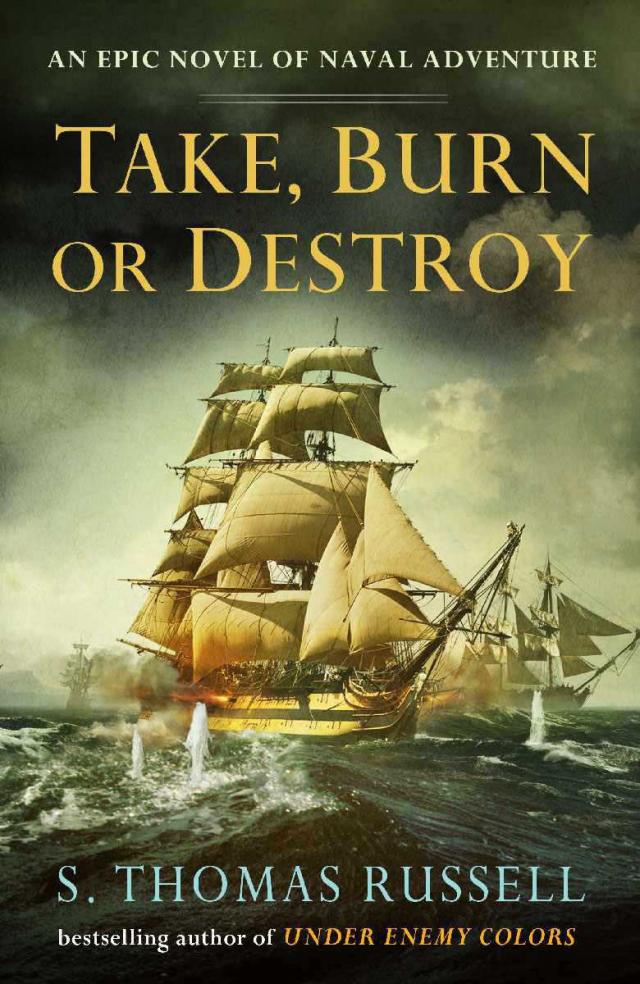
Hayden was of the opinion that the first looked too large to be a frigate, yet only a single row of gunports had been visible to his eye. Certainly, Pellew was cruising these waters with Indefatigable. This caused a marked increase in his pulse. Indefatigable was a razee—a larger ship cut down to make a single-decker—in this case, a sixty-four-gun ship turned into a vessel with a single deck of twenty-four-pounders. He tried to hide his reaction. A little luck and he might not be a prisoner when the day ended. He glanced at the westering sun—two hours of sunlight. And then at the converging ships—not five miles distant. The wind could hardly be called a breeze. and though it was fair for Brest, at that moment there was dark cloud above the horizon in the north. If the wind veered north it would almost certainly strengthen and carry these ships with it.
Hayden could hardly contain his excitement and fought to master himself. He did not want to reveal the truth to Lacrosse or his officers, but he thought it more than possible that these ships were indeed British—the very frigates he had hoped to find lying off Brest. His own officers would have their spirits lifted by such news, but Hayden resolved to remain on deck as long as he was allowed, in hope of knowing beyond a doubt under which flag these ships sailed. How long he might keep the deck before he was escorted below or had imposed too long upon Lacrosse’s goodwill Hayden did not know, but he would find out.
That Lacrosse would destroy his mother’s letters was something of a risk for the Frenchman. Were any of his crew aware of these letters—or the lieutenant who apparently found them to prove untrustworthy—and their existence reported to the authorities, Lacrosse might be sent spinning towards the maelstrom of which he spoke. In the present climate of France it was not good to run afoul of the authorities, especially if you were of noble birth. The immigrants fleeing France brought stories hardly to be believed. A sixteen-year-old boy of very limited understanding was guillotined for shouting, “Vive le Roi!” A woman, though able to prove beyond a doubt that she was not the woman wanted by the authorities, even if she did bear the same name, was guillotined anyway so that they might cross the name off their list.
Hayden thought of the melancholy Sanson who had come aboard his ship as a French prisoner. He had been trying to escape his family—which had been executioners for several generations. In the end, he had escaped by taking his own life. Had he known what would take place in France but a few months later, he might have counted himself fortunate.
Lacrosse, Hayden thought, was an honourable man of the old school. Hayden might be the enemy, but he was also a brother officer, and to see him murdered for no reason was something Lacrosse would not allow if it were within his power to prevent it. Hayden hoped that, were he in a similar position, he would act in the same way, but given the perceivable risks he was not utterly certain that he would.
Taking Lacrosse at his word, Hayden, with his two guards in train, walked the deck. He wanted to stand and stare at the converging ships, for the second, hidden behind the first seen, was now clearly visible, but thought this might prove insulting to his captors, so he managed only a glance in that direction every few moments. There was nothing to distinguish the ships as being from either nation that could be seen with the naked eye.
Perhaps three quarters of an hour later, though, Hayden arrived on the quarterdeck, where he found Lacrosse and his officers in muted conversation. They appeared to reach some agreement, and suddenly the lieutenants began shouting orders. The course was altered and yards shifted. Les Droits de l’Homme was put before the wind. She was flying from the approaching ships.
For a moment Hayden stood transfixed by the nearing vessels as they were brought astern. Without a glass he could not tell that they were British, but clearly the French were more certain.
“Capitaine Hayden,” Lacrosse said, and beckoned him near.
Immediately, Hayden went to the stern rail where the Frenchman stood.
“We believe these are English cruisers—two frigates—though one seems much larger than the other . . . perhaps a razee.” He fixed his glass upon the ships. “Some ships that have been cut down are said to be poor sailers. Others are thought quite swift.” He passed the glass to Hayden.
Hayden stared for some moments to give himself time to consider. As an officer, he was sworn to give no aid to the enemy. Yet this man had his mother’s letters, still intact as far as Hayden knew—though somehow Hayden did not think he would now go back on his promise to destroy them. The question was, could he give any information to Lacrosse that would not compromise the safety or ability of the British cruisers?
Hayden lowered the glass and returned it to its owner. “I regret to say these ships are unknown to me, but they do appear to be sailing quite swiftly, Capitaine, do you not agree?”
Lacrosse nodded, disappointed in the response. “Perhaps you should go below, Capitaine Hayden . . . for your own safety.”
Hayden gave a slight bow in the man’s direction, looked again at the chasing ships attempting to gauge their speed and the speed of Les Droits de l’Homme. He was escorted below, and the two guards at the door of the lockup let him in.
“Have we gone about, Capitaine?” Wickham asked. “The motion of the ship has altered.”
“We are running,” Hayden informed them, “and not just before the wind but from British cruisers, too! A frigate and a razee less than a league and a half in our wake.”
The reaction of the men was almost a cheer, and they were all on their feet in an instant, their looks of dejection and melancholy replaced by grins and glowing faces.
“What ships, sir, do you know?”
“I believe one might be Indefatigable.”
“She should not tire of chasing us, then,” Hawthorne quipped.
“You do realise, Mr Hawthorne,” Barthe said, clearly offended by his light spirits, “that we are on our way to a French prison?”
“I believe we will shortly be freed when this cursed ship is taken, Mr Barthe.” He waved a hand at the surrounding bulkheads. “This is all the French prison we shall ever see.”
Barthe shifted on his bench. “Well, I do hope your prescience proves correct, sir, but do not count your chicks before the cockerel has fucked the damned hen!”
This caused a good deal more laughter than Mr Hawthorne’s observation; even the marine laughed.
“I have been guilty of that a few times in my life,” Hawthorne admitted when he finished laughing.
“Of what,” enquired Wickham, “fucking the damned hen?”
“Gentlemen,” Hayden cautioned, “we are yet prisoners of the French, and I do not think this laughter will endear us to them. There will be time enough for levity if this ship is taken by our cruisers. Until then, we both live and eat at the sufferance of our gaolers. Let us not antagonize them unduly.”
This brought about a semblance of decorum and many a suppressed smile. The material change in the men’s demeanour was unmistakeable—they were animated, smiling, their eyes were no longer dead and staring off into some vague distance. It was as though they had been informed of the death of a loved one and then told it was all a mistake—the person lived yet unharmed.
Hayden beckoned Ransome and the two retired to a table set apart and screened off from the rest by a scrap of sail—a private “cabin” built for Hayden’s use. There was a small table with two benches here and a cot leaning in the corner.
“Mr Ransome, it is my duty to enquire into the death of Mr Greenfield. I understand that one or more men were attempting to make silent his cries of pain by covering his mouth with a shirt or cloth of some kind. Is it possible that he was smothered by this action—even by accident?”
Ransome put two fingers up to the bridge of his nose, closing his eyes for a moment as though collecting his thoughts. “I cannot answer your question with any certainty, Captain. He was grievously wounded—shot through the back.” He touched his breast with a hand and then gestured over his shoulder. “About this level. His breath was bubbling, sir, and he was choking on blood as well. We did not know for certain that there was only a single French boat out in the fog and Greenfield was making a terrible racket, sir. I ordered Braithwaite and Carlson to keep him quiet as best they were able.” Ransome’s gaze became darker by the second and his skin actually appeared to grow blue-grey and dull. “One of them—I disremember which—removed his jacket and tried to silence Greenfield by putting it over his face. He had collapsed, and I couldn’t see what happened clearly even if I had been inclined to look, and I must tell you my attention was engaged elsewhere.”
“How close was Greenfield to you, Mr Ransome?”
“Amidships . . . and I was in the stern-sheets. Mr Hawthorne and his marines were forward.”
“So Braithwaite and Carlson were attempting to muffle Greenfield’s cries with a jacket—and then what happened?”
“We were fired on again—muskets and pistols—and we returned fire. And then Carlson informed me that he believed Greenfield had departed this life.” Ransome touched a hand to his forehead, his gaze far away. “Immediately, I went forward and found Greenfield limp. There was a great deal of blood soaking through his shirt and jacket where he was wounded and also around his mouth and face . . . and about his neck as well. He was not breathing and I could detect no pulse—at either his neck or wrist. As every breath had previously been accompanied by bubbles and gurgling at the wound in his back and now there was none, I ordered him slipped over the side, my reason being that it would be very disturbing to the men to have a corpse there so close by and I had want of their entire attention at that time.”
“Did Braithwaite and Carlson look distressed or guilty in any way?”
“They both appeared very distressed and out of sorts, sir, but one of their comrades had just died. Braithwaite and Greenfield were in the same mess, Captain.”
“So there was no enmity between these two and Greenfield?”
“I do not believe there was, sir. Certainly not of which I was aware.”
“The first opportunity, I will ask Lacrosse for ink and quill so that you might commit your account to paper.”
“Will there be a court-martial, sir?”
“I do not know, Mr Ransome. If I deem Greenfield’s death accidental, I do not believe the Admiralty will pursue the matter. Even so, I must report the possibility that Greenfield’s death was accidental and not necessarily caused by the enemy. I will at this time ask the doctor’s opinion on the matter. He might have questions for you. I must also speak with the others involved, although but for you and Hawthorne all the others are aboard the Themis.”
Ransome nodded. Hayden asked Griffiths to join them and he came and took a seat alongside Ransome.
Hayden explained what transpired and what Ransome had told him, asking the lieutenant to verify that what he said fairly represented his own report.
“Tell me where the wound was,” Griffiths instructed Ransome, turning away from him. “You may touch my back where you believe the ball entered.”
“Here, Doctor,” Ransome said, touching to the left of Griffiths’ spine just below the scapula.
“Was it musket or pistol?”
“I cannot say, as I believe both were fired in our direction.”
“You told Captain Hayden the wound gurgled when he breathed?”
“Yes, sir.”
“Was there a great deal of blood or little?”
“A profusion, Doctor Griffiths. The wound bled terribly and could not be stopped.”
“And how was he lying? On his back or his chest?”
“On his side, Doctor—or so he was when I went to be certain he was not still alive. He was in a pool of blood.”
“Were his lips blue when you went to see him?”
Ransome pursed his own lips together. “I cannot say, Doctor. His mouth was so bloody . . . I do not know.”
“The blood emitting from his wound—did it come in a regular rhythm or did it simply flow in an even stream?”
“I am sorry, Doctor, but I could not see, as Greenfield was down among the men amidships and I was in the stern. Carlson or Braithwaite might be more able to answer that question, sir.”
Griffiths could think of nothing more to ask, and Hayden released Ransome to go back to the others.
“What think you?” he asked Griffiths very quietly.
“I do not know what to think. Mr Ransome could not answer the most relevant questions because he could not see the man, or so he claims. If the blood was pulsing from the wound, then it is likely the aorta artery was damaged or even severed and would have led to death within a few moments. If Greenfield’s lips were blue, then he died from suffocation.”
“Then you cannot say for certain what caused his death?”
“If I could see the body . . . which was rather conveniently disposed of.”
“Let us question Mr Hawthorne.”
Hawthorne took Ransome’s place. At that moment, a distant gun was heard.
All conversation ceased a moment and then a second shot came.
“Not so near yet,” Hayden informed the others. “Let us continue. Mr Hawthorne, you brought this matter to my attention. What made you do so, if I may ask?”
“It appeared to me that Greenfield put up something of a fight, to begin, when Braithwaite and Carlson were asked to keep him quiet. They had him down in the bottom of the boat, sir, one holding him, the other pressing the shirt over his face. Greenfield struggled mightily against them.”
“That is your entire reason, then?”
“Well, no, sir. Greenfield was not well liked, sir. And Braithwaite . . . well, he is a rum bastard, if I may say so.”
“I thought Greenfield and Braithwaite messed together?”
“That may be, sir, but there was no love between them. Wickham might be able to tell you more, sir.”
“What order did Lieutenant Ransome give Braithwaite and Carlson, do you remember?”
Guns sounded again, muffled by the hull and decks above. A gun aboard the French ship spoke in return, the report echoing down through the ship like a great hammer blow.
“He ordered them to keep him quiet if they could. I must say, Captain, Greenfield was crying out and moaning terribly. Certainly, the French could not have been in doubt of our whereabouts, or at least how near we might have been.”
“So Greenfield’s struggle led you to suspect he might not have died of his wounds?”
“Well, he was kicking the planks very hard and flailing. It was all they could do to hold him. I thought he had a good deal of fight in him for a man so close to death.”
“Did you see Greenfield’s wound, Mr Hawthorne?” Griffiths had been listening, his countenance growing more and more grave.
“I did. He had been shot in the back.”
“Where?”
Hawthorne reached over his own shoulder and patted his back.
“Just here, sir.”
“Are you certain, Mr Hawthorne?”
“Most certain. One of the men called out that Greenfield had been shot, and as I was reloading my musket I turned and saw him slumped over his oar. There was blood soaking through his jacket up here, high on his back on the left side.”
Griffiths and Hayden exchanged a glance.
“From the moment he was struck by the ball until he died, how much time passed?” Griffiths asked.
Hawthorne paused to consider this, as though he were running over the sequence of events in his mind. “Not very long, Doctor. Five minutes . . . Certainly not so much as ten.”
Hayden looked to the surgeon, raising his eyebrows, but Griffiths signalled that he had no more questions to ask.
“That will be all, Mr Hawthorne. Thank you.”
Hawthorne, who was taller than Hayden, rose to a stooped position, touched his imaginary hat, and crouched off to join the others.
“There appears to be a notable discrepancy between the two accounts,” Hayden observed.
“Indeed, and it is notable in several ways. It seems very unlikely to me that Greenfield would die so quickly of a wound inflicted so high on his back. If he was not smothered, then I would guess the likely cause of death would be loss of blood. But a wound here . . .” He reached over his shoulder and touched his back . . . but then he frowned. “Unless it was nearer the aorta than Hawthorne indicated . . .”
“But you cannot state with certainty that Greenfield did not die of loss of blood?”
“I cannot state with certainty anything at all. I was not there. The wound was in his back, but where I do not know. A major artery might have been severed, but that is not certain. Did Greenfield die because he was smothered? A man cannot last very long without air, but he can take a damned long time to die of blood loss. If he died in five minutes, he was either smothered or a major artery was severed.”
“Both men stated that there was a great deal of blood in evidence.”
“That is true, but a small amount of blood spread about can appear far greater than it truly is. I should not take that too seriously.”
Both men were silent for a moment, turning over what had been said. Les Droits de l’Homme’s gun fired again.
“It does seem an odd time to be enquiring into the matter of Greenfield’s death,” Griffiths observed.
“The human memory is very fallible. The sooner such matters are brought to light, the better.”
“I am sure you are right. And it does give the men something to contemplate on . . . other than French prisons.”
“There is that as well. I do wish Braithwaite and Carlson were here that I might enquire further into this matter.”
“Certainly, if they are guilty—and not fools—they will contrive to agree upon a single story. One in which Greenfield bled his poor life away while they cradled him in their arms and undertook, in the most gentle manner, to discourage him from crying out.”