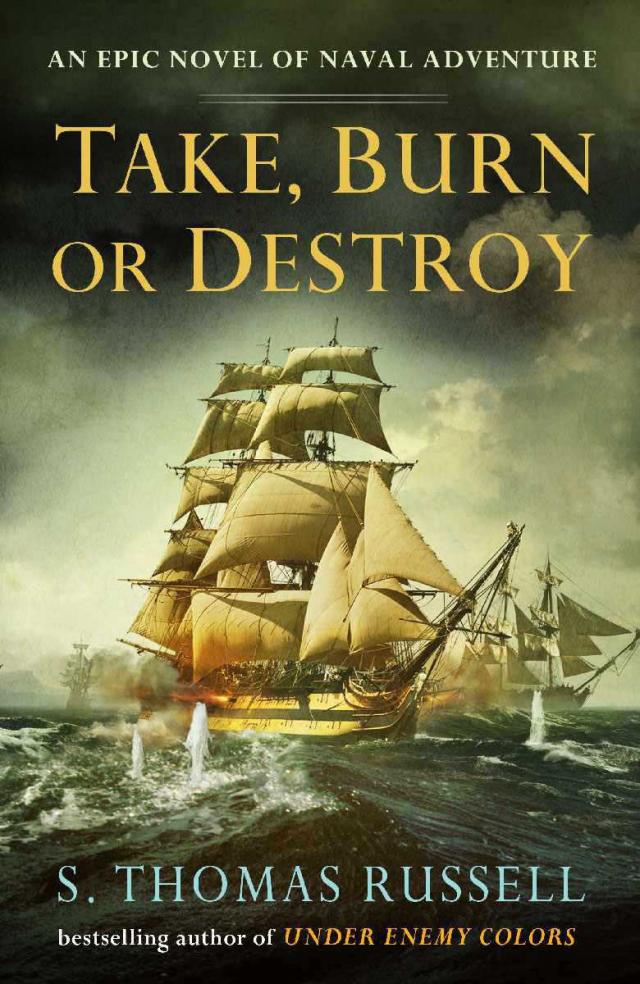
Take, Burn or Destroy, page 21


“Bonfires,” came Griffiths’ voice over the wind. “They were lit some time ago.” The doctor was sitting up, his hands thrust in the front of his jacket. “Have they come to rescue us?” Griffiths asked, struggling to speak; he was shivering as badly as Hayden.
“Perhaps—or they are keeping vigil, waiting for the ship to break up to see what manner of flotsam the sea might carry ashore.” That appeared to give Griffiths pause to think. “How fare you, Doctor?” Hayden asked.
“My very soul is frozen, I think. I have been passing the hours by making mental notes on the process by which the human body is overwhelmed by cold. If I live, it shall make a fascinating study. I might write a pamphlet.”
“I am pleased to see that you have turned this night to profit. Very enterprising of you. I have been lying here in a state of utter numbness of both body and mind. It is a strange kind of delirium, I find, which can be described as neither dream nor wakefulness.”
Barthe sat up at that moment, perhaps wakened by the others. “I can no longer feel my cock, Doctor,” he said. “If I live, I shall never have use of it again.”
“You shall find your manhood as useful as ever, Mr Barthe,” Griffiths assured the sailing master, “once your body’s furnace has begun to burn again.”
“So I pray.”
“As d-do we all,” Griffiths replied.
Hayden lay down but turned a little that he might catch a glimpse of the distant fires now and again. The presence of people on the shore gave him hope somehow.
Sometime before dawn Hayden could bear it no more and stood on the sloping deck and began to stiffly work his arms, certain that if he lay still a moment longer his blood would freeze. There was yet no sign of daylight, but he could feel the approaching morning. The gale blew unappeased, and the sea, steel-cold, ran just as high, although the tide had ebbed and was near low water now. Hayden wondered if the rocks Les Droits de l’Homme was wrecked upon would be visible. Certainly, a boat could not be launched if that was the case. A thought that the tide might ebb so far that all might walk ashore came to him—there were places along this coast where that would be possible—but not near here, he knew.
Around him a whispering blended with the sounds of the gale. The French sailors began to stir. Many began to mutter prayers and cross themselves. Then, like Hayden, a few rose up and tried to restore some warmth through movement. The British sailors forced themselves up as well.
Sunrise did not occur that day, but only a dull, growing illumination that had no discernible source; a kind of twilight that Hayden knew would persist through the day. There were no victuals and no water—nothing to sustain the men but a slim hope of reaching shore.
Hayden made his way aft and soon found Lacrosse speaking with his lieutenants—pleading, actually, was what it appeared to be. But whatever it was, the lieutenants were not giving way, and finally Lacrosse noticed Hayden and took his leave of his officers, making his way awkwardly along the sloping deck.
“How fare your men, Capitaine?” Lacrosse enquired in English. There was no place for the two captains to have a private conversation, so the best they could do was not to speak French.
“They have all lived through the night, but I do not think any man will survive long without water and victuals and shelter.”
Lacrosse shook his head sadly. “Several men perished this night, two by foul play, I fear.”
“Sir?”
“We found a pair, stabbed to death on the gun-deck, apparently over some small scrap of food.”
Hayden could not sit in judgement—there had been a murder on his own ship when he was her first lieutenant, and now this matter of Greenfield. “I do not think this gale will blow itself out this day, nor even on the morrow. Will you still launch a boat?”
“That is my desire, but all of my lieutenants, they do not want it. I have no one but an aspirant to put in command of such a boat.”
“Can you not order one of your lieutenants to take this command?”
“It shames me to say this, Capitaine Hayden, but I believe they would all refuse. If I lose the support of my officers, how are the men to be governed?”
For a moment Hayden hesitated to speak. Clearly, Lacrosse hoped Hayden would offer to take charge of the boat, or perhaps put one of his own officers in command, but Hayden was uncertain. It would take great seamanship and a measure of luck to get a boat ashore in the sea that was running. Hayden was willing to attempt it, but he would not leave his own men. He was also reticent to leave Lacrosse on his own. The man had done him a great favour destroying his mother’s letters. Hayden was loath to leave him now. There was also the possibility—and not a remote one—that a boat would not make it through the surf. Hayden might drown his entire crew on such an enterprise. And there was one other significant problem—no one wanted to be first.
“I would put one of my officers in charge, if that will meet with your approval,” Hayden said at last.
“I see little other choice, Capitaine,” Lacrosse replied, both relieved and shamed.
“Then let me speak with them. We will send the small boat?”
“Yes. I will find reliable men to man the sweeps.”
Hayden went back to his own crew.
“Shall we send a boat, then, sir?” Archer asked as Hayden approached.
“That is Lacrosse’s wish. He has asked that one of us take command of it. As he will supply the men to man the sweeps, it must be someone who speaks French.”
“I will do it, sir,” Archer said immediately.
“I commend you, Mr Archer, but as the officer in charge must take the helm, and you have an injured hand, I shall have to ask another.”
“Then it must be me, sir,” Wickham said before Archer could protest. “No one else speaks their tongue well enough, and I have taken command of many a boat, as you well know.”
“I do, Mr Wickham, but I want you to understand, nothing you have ever done will have prepared you adequately. In truth, I am far from certain that a boat can be got ashore safely.”
“If you please, Captain,” Barthe interjected, “with no disrespect to any man present, to pilot a boat through such waters is not a matter to be taken lightly. I would venture that only yourself, sir, Mr Franks, and I have long enough wakes to even attempt it.” He gave a little bow to Wickham. “No disrespect to you, Mr Wickham, but you have never been in such a sea before in an open boat.”
“I take your point, Mr Barthe,” Wickham replied, “truly I do, but you do not speak French and Captain Hayden requested someone who has command of that tongue.”
“That cannot be denied,” Barthe agreed, “but I would put forward that I should take command of the boat and you should come as my second and translate all my orders upon the instant I call them out. That is the only way we have any hope of success—or so I believe.” Barthe turned to Hayden. “Do you not agree, Captain?”
Hayden did not like any solution, that was the truth of it. Barthe was certainly correct—Wickham had never taken a boat through such a surf and the chances that he would succeed were slim. For that reason, Barthe was certainly the better choice to take command, but the possibility of the oarsmen misunderstanding his translated order, or of the instant it took to make that translation, might be enough to see them all put under. Hayden knew that he was the right man for this endeavour, but Hayden was also certain that Lacrosse would need his assistance if he was to preserve lives.
“Mr Barthe, we shall have to have a perfect understanding between yourself and Mr Wickham, and Wickham and the oarsmen, so that there can be no delay in translating your orders and no delay in their execution. There can be no hesitation on the part of the oarsmen lest it lead to disaster.”
“I agree, sir,” Barthe said.
Lacrosse chose older seamen for boat duty, and Hayden thought, though they all looked apprehensive, they appeared to be steady men. After asking Lacrosse’s permission, he gathered these men together with Wickham and Barthe and made certain that all of the French commands were clearly comprehended by all and that Wickham knew the proper translation for each. He even ran them through a pantomime drill, to be certain that there would be no misunderstanding. Even so, Hayden feared he had forgotten some order that Barthe would call out and Wickham would not know the correct French for it.
Launching the boat was not an easy feat in such a sea. There were no masts standing and no yards to be used to swing the boat out, so it had to be manhandled by the crew, all of the Englishmen involved, including the doctor. Hayden would have liked to have seen the boat manned and oars in place and then slid, bow first, into the sea, but it simply could not be managed with such a weight under these circumstances. The boat would have to go into the sea and be held alongside until the crew was aboard. There was, Hayden knew, a good possibility of the boat capsizing right there next to the ship.
With many a bruise and barked knuckle, the boat was launched, the oarsmen clambering aboard even as the boat lifted wildly then dropped with the surf, banging hard against the ship again and again.
Hayden and Hawthorne steadied the hobbled Mr Barthe and helped him aboard as the cutter surged up, whereupon the master’s ankle gave way and he tumbled down awkwardly into the boat. Hawthorne turned to Hayden in horror, but it was too late to bring the master back now. He pulled himself up painfully and took hold of the tiller, not meeting his captain’s gaze.
“Luck to you, Mr Barthe,” Hayden said, and the sailing master gave a curt nod. Hayden had never seen the old seaman look so grave. Until that instant, Hayden had not realised how little hope Barthe had of the enterprise’s success.
All the men settled in their places, took up their oars, and in a moment Barthe, through Wickham, ordered the boat away, both the Englishmen forcing confidence into their voices that Hayden now knew neither felt.
“Do you think they will manage it?” Hawthorne asked as they watched the French crew ship their oars.
“I am not sure Barthe is confident.”
“You know he cannot swim a stroke?”
“It would not make the least difference, Mr Hawthorne. No swimmer is a match for this sea.”
“God preserve them,” Hawthorne intoned.
“That and good seamanship.”
“I would rather the oars were manned by Englishmen,” Hawthorne said quietly.
“Lacrosse chose steady men. I have no doubt of that.”
“Then you are more confident than Captain Lacrosse.” Hawthorne nodded in the direction of the French captain, who stood with one hand over his mouth, appearing to hold his breath. If his own son had been aboard the boat he could not have looked more distressed, or less confident of the outcome.
Every eye aboard watched with hope and dread. If the boat could be taken ashore safely, then that would mean another boat could do the same. The problem then would be that there was only one other boat and it would bear but thirty souls in this foul sea.
Each wave lifted the little boat up and swept it on, Barthe and Wickham fighting the helm and calling out orders to the oarsmen. A sea broke over the stern and the boat was lost to sight for a moment as it slid into the trough. Hayden fully expected their next view of it would be the boat overturned and all of the hands thrown into the sea, but it lumbered up to the top of the crest, clearly burdened with water and with more than one man bailing to preserve his life.
Again the boat went down into the trough and all the men aboard Les Droits de l’Homme strained to catch sight of it. And yet again the stern was thrown up, caught by the wave, slewed to starboard, and disappeared.
A long, anxious moment was endured aboard the wreck, and then the boat came up again, the helmsmen fighting to keep the stern square to the seas. Again the boat was seen to yaw as the wave took hold of the stern and threw it to starboard. This time Hayden was certain the boat had broached and been swamped or overturned.
If the boat lifted above the sea on the next wave, Hayden could not see, for a larger wave interposed itself. There was a groan from all the men aboard. Some covered their faces, and Hayden thought that not a few wept, for here was their single hope lost.
Hawthorne cursed under his breath.
But then the boat lifted into view. It was deep in the water now, and Hayden feared that if it rolled even a little the water it had shipped would wash to one side and the weight would overturn the boat. The men were pulling for their very lives, Hayden could see, even at this distance, Barthe and Wickham standing in the stern fighting the tiller.
Down again the boat went, and it was lost from view for some moments.
“They were not so far from the beach,” Hawthorne whispered to Hayden. “Do you think they might cling to the boat and be washed ashore?”
“I do not know,” Hayden replied softly. “They might be more distant than we comprehend.”
“I do hope we have not lost our shipmates, sir.”
“God preserve them both,” Smosh said quietly, sidling over to where Hawthorne and Hayden stood, braced against the sloping deck. “Cannot Mr Wickham swim so short a distance?”
“The surf is very great, Mr Smosh, and the sea yet very cold. Twenty minutes in this water and all of a man’s vital energy will have been sapped away. If the boat overturns, I hold little hope for any man to survive.”
“I have prayed to God to preserve their lives—even the papists—but God has his own plans for us and is little influenced by Smosh, I fear.”
A cheer went up around them at that moment, and Hayden could see men from the shore wading into the surf, and then the boat appeared, almost up to its gunwales, the oarsmen all tumbling out. They were helped ashore, staggering through the surf, bracing themselves as it ebbed and then thrown forward onto their knees when a sea swept over them. But they were ashore.
Around Hayden men jumped to their feet and pounded one another on the backs as though somehow they had been responsible for this miracle.
The storm, however, was not so pleased and howled all around as though angered anew. Hayden was nearly pushed off his feet and could lean against the wind with all his weight. Around him men slumped down onto the deck, clinging to one another as the wind screamed and rippled their sodden clothing.
There was no choice but to lie flat on the deck so that the heeled ship provided some small protection. Within moments the sea mounted and began to crash against the hull, shoving the massive ship each time. A splintering and rending of timbers was heard aft and a moment later two shattered sections of the transom floated off into the foaming waters.
“She is breaking up!” Griffiths looked over at Hayden like a man about to be cast into this cold, fearsome sea.
“The stern is the most vulnerable part of a ship, Doctor, and it was much damaged by British gunfire. We have many hours yet before we need worry about her breaking up.”
But even so, all the men aboard stared in horror as the sections of the transom drifted off. Lacrosse scuttled across the deck to Hayden, his wet hair whipped back by the wind.
“We dare not launch a boat in this, Capitaine Hayden,” he called over the wind, his voice hoarse from thirst.
“I agree, Capitaine Lacrosse. We must wait for the sea to moderate and this wind to take off.”
A wave boomed against the hull and shot spray high into the air before it slatted down heavily upon the deck. Hayden and Lacrosse both wiped salt water from their eyes and faces, but Hayden thought the look they shared said all that was needed—getting a twentieth of the men safely off this ship would be the most they could hope for.
All through the morning and then the afternoon the shipwrecked men lay on the deck, their stomachs boiling with hunger, mouths and throats gummy from thirst. As one had no choice but to shout over the wind, conversation was difficult and men soon gave it up. Each lay with his own thoughts, and Hayden believed that there was no more fertile soil for fears and doubts than inactivity. Had he been in command he would have employed the men in making rafts or in some other enterprise.
Waving the doctor near, Hayden leaned near and asked as quietly as the wind would allow, “How long can men go without food and water, Doctor?”
“Commonly, one would say without food, many days, although in this matter every man is different. Water, however, one cannot do without for more than four days, and under these circumstances perhaps as few as three and one half. It is singularly cold for April, Captain, and as we are all wet to our very skins the wind will draw away our reserves more quickly than we realise. I, for one, am shivering without pause.” For a moment Griffiths appeared to consider his answer. “Although this might disgust everyone, Captain, it is possible to drink urine, as it is aseptic and can be imbibed without detriment.”
“Let us hope it does not come to that.”
Griffiths clearly had more to say, so Hayden remained propped up a little on one elbow.
“Sir, there is but one boat remaining and near to six hundred souls aboard this ship. How many might be carried safely ashore?”
“Thirty, more or less,” Hayden said.
“And can it then return to take away more?”
“Not while the storm persists.”
“Then some five hundred seventy shall remain aboard?”
“Yes, but we will make rafts and attempt to reach the shore upon those.”
This proposal did not seem to raise the doctor’s hopes in the least—if anything, he looked more despondent.
“Doctor, if we are able to launch the boat this day, will you go with it?”
Griffiths shook his head. “I believe my knowledge will be required here, Captain. Ashore there are surgeons enough.”