Take, Burn or Destroy, page 11


“Mr Hawthorne . . .” Hayden said, still watching the French ship.
“Aye, sir.”
“Fix your eye to windward. If a rain squall appears, alert me immediately.”
“I will, sir.”
The Frenchman was sixty yards off, then fifty. Hayden could sense the men around him shifting, wondering when he would give the order.
“Mr Dryden?”
“Sir?”
“Begin your turn upon my order. Not before.” Hayden turned his attention away from the Frenchman and began watching the seas, a quick look up at the telltale—wind holding in the north, a little east perhaps. He timed the passing of the sea beneath his hull.
“Port your helm, Mr Dryden.”
He glanced over at Wickham, who stood poised upon the ladder as though ready to leap down to the gun-deck upon the slightest twitch from Hayden. The ship began to turn, heeling to larboard as she rose to the sea. Dryden and another turned the wheel as quickly as they were able, but every inch was a struggle. The frigate rounded up, slowly, her bow rising, up and up then over the crest. Still the ship turned, rolling now to starboard as the sea passed beneath them. Sails began to shake and crack in the heavy winds.
The second crest surged towards them and the Themis began to climb again, her head pushed off a little more than Hayden would have wanted.
The ship was almost upon the crest and seemed to hang there an instant, and then, as the wave passed beneath she rose, freeing her gunports, beginning at the bow.
In that instant, Hayden called out over the winds, “Mr Wickham! Open gunports!”
“Squall coming,” Hawthorne reported, no more than a little apprehension in his voice.
“How distant?”
“Not a hundred yards, sir.”
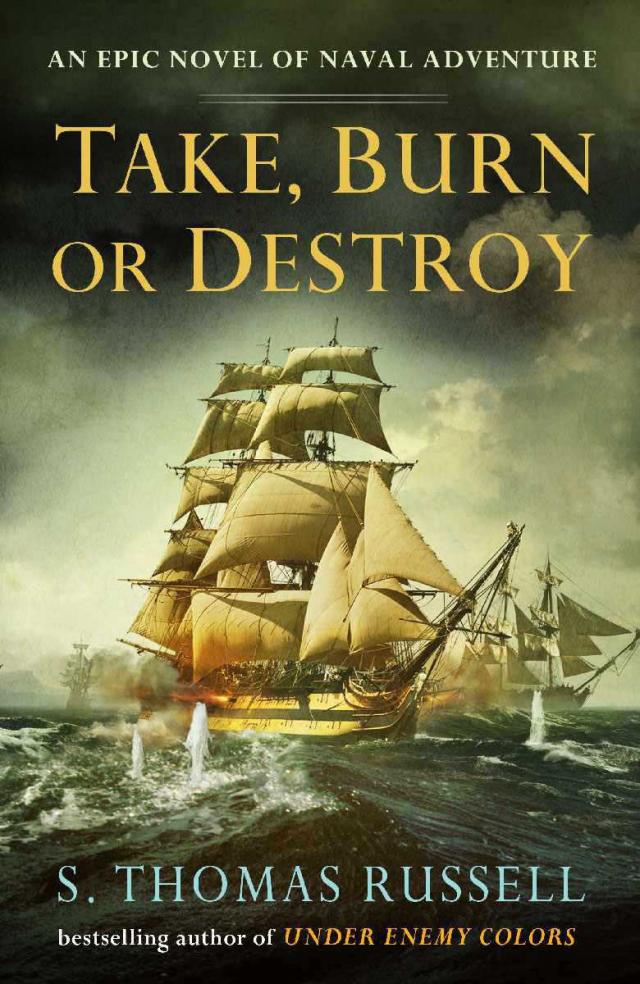
Even over the wind Hayden heard the squeal of hinges as the gunports opened. He turned towards the French ship, which had been caught completely unawares, just as it began to plunge into the trough.
Overhead, sails went mad, vibrating the Themis in their frenzy.
“Fire!” Hayden called over the chaos.
The carronades hissed back on their slides and a deafening blast tore open the air. All was lost in a cloud of acrid smoke, and then that was swept away to leeward. The sound of gunports thudding closed came to him. Just before the bow of the French ship rose on the next sea, Hayden had a vision of her deck. Guns dismounted, men strewn about like shattered dolls. Hardly a soul standing. She was so near, Hayden thought she might ram his ship, but she turned to leeward, stunned Frenchmen picking themselves up. Hayden saw an officer, face bloody and one arm hanging limp, staring at him grimly as the ship passed. It was not a look of reproach so much as a look of terrible understanding. And then the French ship was gone.
“Put us back on our course, Mr Dryden,” Hayden said, just loud enough to be heard.
The men at the wheel began fighting for every spoke, but Hawthorne’s squall reached them at that moment and the ship would not answer.
“Let the mizzen sheet run!” Hayden shouted. Immediately, he went to the wheel, but Wickham and Hawthorne were quicker. All eyes turned aloft to the flailing canvas, rain slatting down like grapeshot. The thrashing canvas went still, pressed back against the masts and rigging, pinned there.
“God-damned . . .” Hayden heard the sailing master say. “Back the fore staysail!” He went running then, stumbling forward, calling out, “Haul the fore staysail sheet to starboard!”
“Mr Dryden,” Hayden said, coming to the wheel. “Port your helm.”
“Sir.”
“She will not fall back onto her course, nor will she come through the wind. Port your helm. The masts will stand or fall. We cannot change that.”
All way was lost, and for a moment the ship wallowed. Hayden looked up at the foremast, which would certainly be the first to go. The ship plunged down into the trough, throwing the sails aback with even greater force. Hayden was certain the masts would go at the instant. And then the ship was forced back, the rudder drawing her stern slowly to starboard. She seemed to hang there a moment as if undecided, in the grip of the howling wind, and then her head fell off to larboard and a moment later the sails filled with a boom. For a moment she did not answer her helm and continued to turn, but then she gathered way and the men at the helm brought her up, near to the wind, then a little nearer.
Hayden felt himself take a breath, the first in several minutes apparently, and the hands cheered. The French ships came back to mind and he made his way aft to the taffrail, where he could see the damaged frigate rolling downwind, officers trying to bring order to her ruined decks. And then she rolled to starboard and Hayden saw a gun slide back from the larboard rail, pick up speed quickly, and then slam into the bulwark opposite, sending splinters flying.
“Was that a cannon?” Hawthorne asked.
“Yes, one of their stern-chasers, I think. It has damaged the wheel, or perhaps that was our gunnery. We shall not need to worry about them for some time, I should think.”
“Luck chose to side with the British that time,” Hawthorne agreed.
“In every possible way. I don’t know how our masts are still standing. It is a miracle, really.”
“I shall inform Mr Smosh; he will be sorry to have missed it.”
The second frigate and the chasing corvette had drawn nearer—nearer than Hayden had hoped, but he had not counted on being caught aback. The squall passed over and the wind reduced a little—it was not buffeting Hayden around so—though the gale was not showing any signs of dwindling.
For a long while Hayden stood at the rail until he was more or less satisfied that the chasing ships were not gaining. Archer and Wickham approached, standing two yards off until he noticed and motioned them to come aft.
“Well done, Mr Archer, Mr Wickham.”
“Thank you, sir,” Archer answered. “We took the top of a sea over the sills but managed to get the ports closed before it became a deluge.”
“I was afraid we might.”
“We will have everything put to rights before long.”
“Very well. I will send word down to my steward. Let us repair below and share a meal. In half an hour?”
“Why, thank you, sir,” the lieutenant said, clearly pleased.
“Do not be too grateful; I plan to offer my hospitality in your gunroom.”
They all laughed, largely from relief at having survived the brief action unharmed.
Hayden took a tour of the gun-deck, which certainly had taken a soaking, and then the main deck, where he found Mr Barthe worriedly examining the larboard foremast shrouds.
“Your fears were well founded, Mr Barthe,” Hayden said quietly. “We were caught aback . . . but we survived it.”
“We did, sir, but our rig has paid a price. He reached out and shook one of the shrouds with both hands. I shall have them all set up taut again, for we stretched stays and shrouds terribly.” He paused and met Hayden’s eye. “It was well done, Captain.”
“Thank you, Mr Barthe.”
Hayden went down to the gunroom, where a meal was soon served. Hayden could not remember breaking his fast, though it was now past noon. His stomach, which had been overcome by nerves earlier, now cried out for sustenance and he ate as though he had not seen food in days.
“We certainly caught that Frenchman by surprise,” Wickham observed rather smugly.
“Yes, and he caught us by surprise last night.” Hayden thought of the carnage aboard the French frigate and the bleeding officer who had stared at him as he passed. His fork stopped en route to his mouth. “There is not a Frenchman aboard that ship that does not hate us with all of his heart and soul at this moment . . . and all of the British nation with us.”
Perhaps the gravity of his tone spoke to them, for the two young officers hid away their smug smiles for a moment.
“What shall we do now, sir?” Wickham asked.
It was the very question Hayden had been asking himself. “We will see what the weather gods bring us, Mr Wickham. If the wind would take off enough for us to tack, I would do it in a trice. Both the undamaged ships are to leeward of us and we could make a board towards the English coast. I do not want to wear, as we shall lose ground to them. If the wind forces us all south, I should hope to round Ushant and find a pair of our frigates cruising off Brest. How we will do that with our chasing ships to leeward I cannot say.” He eyed Wickham. “The weather is making our decisions, Mr Wickham, and we are but a cockle boat blown this way and that awaiting the wind’s pleasure.”
The relative warmth and sanctuary offered by the gunroom could not be long enjoyed on such a day—not by the captain—so Hayden very soon excused himself to return to the deck. His timing, however, could hardly have been worse; a squall swept down on the ship out of the north just as he emerged from the companionway and rain drummed madly upon his oilskins, soaking through almost without pause. Cold knifed through his clothing and the warmth and companionship of the gunroom were leached out of his body and soul in an instant.
The sea was a massive acreage of confused and surging hills, murky and dark, but streaked here and there with startling white. Crests broke and tumbled all around. Hayden thought the sea in such a state might be a home for whales but men did not belong there and the sea suffered them grudgingly.
Ransome, who stood with his shoulders hunched and back to the wind, spotted his captain and straightened.
“How fare our escorts, Mr Ransome?” Hayden asked him, almost shouting over the gale.
“I believed they gained upon us for a time, but now they appear to have fallen back, sir.” He waved a hand towards the larboard quarter. “In the squalls they disappear entirely. But they are always there again when the squalls pass.”
“They are not going to give us up on account of a little foul weather. What of the ship we raked; is she still in sight?”
“We lost all sight of her, Captain, but one can hardly see two miles and often fewer in this weather. She might not be so far off.”
“Yes, we cannot count her out. Where is Mr Barthe?”
“He went down to see the doctor, sir. He slipped on the deck and twisted his ankle. Can hardly stand now, Captain Hayden.”
“That is the worst news!” Hayden said, stifling a curse and genuinely alarmed. In such poor visibility and with the coast of France not very distant to leeward, he wanted his sailing master upon the deck, not lying below in a cot.
“Dryden believes we are due south of Start Point, sir. About fifty-five miles off the French coast. He does think we are being driven south, sir, and the winds have a little more west in them, if I am not mistaken.”
“And the weather glass, Mr Ransome?”
“Steady, sir, or very nearly so.”
Hayden nodded and crossed to the transom and wedged himself against the rail in the corner. His glass was carried to him by a seaman and Hayden steadied himself, fixed his eye upon the French ships, and raised the glass to his eye. Even in calm conditions it was not easy to find an object so small at such a distance in the lens of a long glass. Hayden had seen new midshipmen who could sweep the entire ocean and never find the object they wished. Many years at sea and familiarity with the instrument had taught him all the tricks. It was very rare that he would raise a glass to his eye and not have his object in view.
The two enemy ships were hard on the wind, climbing the seas and sending white water shooting from their bows each time they plunged into a trough. Their position relative to the Themis was largely unchanged; still the same distance to leeward and on the larboard quarter. Hayden scanned the sea in every direction, crossing the deck to sweep his glass to windward. Despite its being perhaps the most traversed area of sea in the world, he could find no other sails. The weather had chased everyone who did not need to be at sea into shelter.
His situation did not seem so terribly bad at this moment. Driving off the ship to windward made reaching England possible if the gale would moderate enough that he dared tack. His decision to attack the frigate off Le Havre did not seem quite so foolish now, given that he believed he could be in an English port in two days or fewer. This engendered a greater sense of relief than he would have imagined.
Ransome came and stood nearby, staring at the chasing ships.
“We must do everything within our power, Mr Ransome, to keep these Frenchmen distant until dark. We will separate ourselves from them this night.” Hayden turned to the young lieutenant. “Has anyone seen to Mr Barthe? Is he still in the sick-berth?”
“He is, sir. Hobson went down to see him but has not yet returned.”
“Then I shall look in on him myself, Mr Ransome.”
Ransome saluted quickly, and Hayden crossed to the companionway, going carefully down the heaving ladder—a stair, really—for tumbling down onto the gun-deck could mean a broken limb.
Upon the lower deck, opposite the midshipmen’s berth, Hayden found Barthe in the surgeon’s domain, seated upon a chair, his foot immersed in a bucket.
“Seawater,” the doctor said from across the enclosed room, where he bent, looking in a seaman’s ear.
“Seawater . . .” Hayden repeated.
“To bring down the swelling. It is cold as snow, or very nearly, and should do nicely.”
“Ah.” Hayden looked over at Mr Barthe, who appeared both sheepish and miserable.
“After all my years at sea, Captain Hayden, I cannot believe I would slip and turn my ankle in nothing more than a gale.”
“It should have taken a tempest, at least,” Hayden agreed, then turned to the doctor. “Is it broken, do you think, Dr Griffiths?”
Griffiths crossed over to a man hidden by the sides of a cot. “I cannot be certain,” the physician replied, “until the swelling has been reduced. Mr Barthe cannot bear weight, which I hope means nothing in this case.” Griffiths completed whatever he had been doing with his patient and turned to Hayden—his patient, Hale, sat up, took one look at Hayden, and collapsed back down into his berth.
“With all respect to the doctor, I am quite certain it is no more than a sprain,” Barthe assured him. “Turned it over clumsily. Damned stupid thing to have done. I’ll be back on my feet in a day, Captain. Until then, the doctor has a cane he is no longer in need of, I think.”
“You will do no such thing,” Griffiths said, standing erect between the beams and fixing an angry look upon the sailing master. “If it is broken, you will make matters worse—perhaps much worse. You will stay off your feet entirely for several days.”
“But, Doctor,” Barthe protested, his face going red, “we are being chased by French cruisers; the captain has need of me.”
“Any assistance you may offer from a chair, Mr Barthe,” the doctor said firmly. “But your usual cruising of the deck cannot be done, or I shall confine you to a cot.”
“Sir . . .” Barthe appealed to Hayden.
“You may provide a great service, Mr Barthe, by overseeing Dryden’s navigation . . . which you may do from a seated position. All of your duties on deck Mr Dryden can perform, and when he cannot be on the deck, Mr Franks and my lieutenants will manage nicely. Do not walk before you are able. I have a hobbled bosun; I shall not have a hobbled sailing master as well. For the moment we have sea room and are very certain of our position, so I think you should remain here under the doctor’s care until we cannot do without you or the doctor has seen fit to have you carried up to your navigation table. That is an order, Mr Barthe, not a request.”
“Aye, sir. But I should be there when Franks sets up the shrouds. He has a great inclination to set them up too tightly, sir.”
“I shall see to it myself that he does not, Mr Barthe. You may rely upon it.”
Hayden spoke briefly with the few men in the sick-berth and then nodded to the doctor, who followed him out. They walked off a few paces where they might speak in private.
“Is it broken, do you think?” Hayden asked.
“I cannot say. Mr Barthe is a large man and yet has rather delicate ankles and small feet. It is not impossible that he has a broken bone, though I am inclined to think that it is a sprain only. I shall know better once the swelling goes down. You must see to it that he is kept off his feet for a few days. If his foot is broken he might bring complications upon himself that he does not want. Some bones in the area of the foot do not readily knit back together—for reasons poorly understood—but I believe walking on an unhealed break can bring that about.” The surgeon paused and regarded Hayden, his look measuring and shrewd. “You have need of him?”
“Dryden is very competent, but we may be forced to go very near some islands or even between the islands and the French coast. It is very demanding navigation, and a mistake might cost all our lives. Yes, I have need of him. Not at this very moment, but soon.”
“I will give him all my attention and send him up the minute I deem him ready.”
“Thank you, Doctor. I am master and commander, so I may have to assume both duties, I suppose.”
“For which you are well trained, I am certain.”
“Well enough, though I will say that Mr Barthe is a better navigator than I shall ever be. When his future as a lieutenant was blasted, the Navy gained an excellent sailing master.”
“I fear Mr Barthe does not see it in quite the same way.”
“I am certain you are correct. I shall look in on Mr Barthe later, if I am able.”
Hayden climbed slowly back to the upper deck, fatigue suddenly washing over him and hindering every movement. As he mounted the ladder to the upper deck, a cry reached him.
“On deck!” the watch called from above. “Sail . . . off our larboard quarter. A league, sir, perhaps half a mile more.”
Hayden bounded up the last few rungs and went immediately to the rail. There was an abrupt lightening off to leeward and aft, the sun piercing down through a hole in the cloud, illuminating the breaking seas so that they stood out against the dark ocean in stark relief. In this irregular patch of light, a sail appeared, reddish brown against a black sky.
“Aye, sir.”
“Fix your eye to windward. If a rain squall appears, alert me immediately.”
“I will, sir.”
The Frenchman was sixty yards off, then fifty. Hayden could sense the men around him shifting, wondering when he would give the order.
“Mr Dryden?”
“Sir?”
“Begin your turn upon my order. Not before.” Hayden turned his attention away from the Frenchman and began watching the seas, a quick look up at the telltale—wind holding in the north, a little east perhaps. He timed the passing of the sea beneath his hull.
“Port your helm, Mr Dryden.”
He glanced over at Wickham, who stood poised upon the ladder as though ready to leap down to the gun-deck upon the slightest twitch from Hayden. The ship began to turn, heeling to larboard as she rose to the sea. Dryden and another turned the wheel as quickly as they were able, but every inch was a struggle. The frigate rounded up, slowly, her bow rising, up and up then over the crest. Still the ship turned, rolling now to starboard as the sea passed beneath them. Sails began to shake and crack in the heavy winds.
The second crest surged towards them and the Themis began to climb again, her head pushed off a little more than Hayden would have wanted.
The ship was almost upon the crest and seemed to hang there an instant, and then, as the wave passed beneath she rose, freeing her gunports, beginning at the bow.
In that instant, Hayden called out over the winds, “Mr Wickham! Open gunports!”
“Squall coming,” Hawthorne reported, no more than a little apprehension in his voice.
“How distant?”
“Not a hundred yards, sir.”
Even over the wind Hayden heard the squeal of hinges as the gunports opened. He turned towards the French ship, which had been caught completely unawares, just as it began to plunge into the trough.
Overhead, sails went mad, vibrating the Themis in their frenzy.
“Fire!” Hayden called over the chaos.
The carronades hissed back on their slides and a deafening blast tore open the air. All was lost in a cloud of acrid smoke, and then that was swept away to leeward. The sound of gunports thudding closed came to him. Just before the bow of the French ship rose on the next sea, Hayden had a vision of her deck. Guns dismounted, men strewn about like shattered dolls. Hardly a soul standing. She was so near, Hayden thought she might ram his ship, but she turned to leeward, stunned Frenchmen picking themselves up. Hayden saw an officer, face bloody and one arm hanging limp, staring at him grimly as the ship passed. It was not a look of reproach so much as a look of terrible understanding. And then the French ship was gone.
“Put us back on our course, Mr Dryden,” Hayden said, just loud enough to be heard.
The men at the wheel began fighting for every spoke, but Hawthorne’s squall reached them at that moment and the ship would not answer.
“Let the mizzen sheet run!” Hayden shouted. Immediately, he went to the wheel, but Wickham and Hawthorne were quicker. All eyes turned aloft to the flailing canvas, rain slatting down like grapeshot. The thrashing canvas went still, pressed back against the masts and rigging, pinned there.
“God-damned . . .” Hayden heard the sailing master say. “Back the fore staysail!” He went running then, stumbling forward, calling out, “Haul the fore staysail sheet to starboard!”
“Mr Dryden,” Hayden said, coming to the wheel. “Port your helm.”
“Sir.”
“She will not fall back onto her course, nor will she come through the wind. Port your helm. The masts will stand or fall. We cannot change that.”
All way was lost, and for a moment the ship wallowed. Hayden looked up at the foremast, which would certainly be the first to go. The ship plunged down into the trough, throwing the sails aback with even greater force. Hayden was certain the masts would go at the instant. And then the ship was forced back, the rudder drawing her stern slowly to starboard. She seemed to hang there a moment as if undecided, in the grip of the howling wind, and then her head fell off to larboard and a moment later the sails filled with a boom. For a moment she did not answer her helm and continued to turn, but then she gathered way and the men at the helm brought her up, near to the wind, then a little nearer.
Hayden felt himself take a breath, the first in several minutes apparently, and the hands cheered. The French ships came back to mind and he made his way aft to the taffrail, where he could see the damaged frigate rolling downwind, officers trying to bring order to her ruined decks. And then she rolled to starboard and Hayden saw a gun slide back from the larboard rail, pick up speed quickly, and then slam into the bulwark opposite, sending splinters flying.
“Was that a cannon?” Hawthorne asked.
“Yes, one of their stern-chasers, I think. It has damaged the wheel, or perhaps that was our gunnery. We shall not need to worry about them for some time, I should think.”
“Luck chose to side with the British that time,” Hawthorne agreed.
“In every possible way. I don’t know how our masts are still standing. It is a miracle, really.”
“I shall inform Mr Smosh; he will be sorry to have missed it.”
The second frigate and the chasing corvette had drawn nearer—nearer than Hayden had hoped, but he had not counted on being caught aback. The squall passed over and the wind reduced a little—it was not buffeting Hayden around so—though the gale was not showing any signs of dwindling.
For a long while Hayden stood at the rail until he was more or less satisfied that the chasing ships were not gaining. Archer and Wickham approached, standing two yards off until he noticed and motioned them to come aft.
“Well done, Mr Archer, Mr Wickham.”
“Thank you, sir,” Archer answered. “We took the top of a sea over the sills but managed to get the ports closed before it became a deluge.”
“I was afraid we might.”
“We will have everything put to rights before long.”
“Very well. I will send word down to my steward. Let us repair below and share a meal. In half an hour?”
“Why, thank you, sir,” the lieutenant said, clearly pleased.
“Do not be too grateful; I plan to offer my hospitality in your gunroom.”
They all laughed, largely from relief at having survived the brief action unharmed.
Hayden took a tour of the gun-deck, which certainly had taken a soaking, and then the main deck, where he found Mr Barthe worriedly examining the larboard foremast shrouds.
“Your fears were well founded, Mr Barthe,” Hayden said quietly. “We were caught aback . . . but we survived it.”
“We did, sir, but our rig has paid a price. He reached out and shook one of the shrouds with both hands. I shall have them all set up taut again, for we stretched stays and shrouds terribly.” He paused and met Hayden’s eye. “It was well done, Captain.”
“Thank you, Mr Barthe.”
Hayden went down to the gunroom, where a meal was soon served. Hayden could not remember breaking his fast, though it was now past noon. His stomach, which had been overcome by nerves earlier, now cried out for sustenance and he ate as though he had not seen food in days.
“We certainly caught that Frenchman by surprise,” Wickham observed rather smugly.
“Yes, and he caught us by surprise last night.” Hayden thought of the carnage aboard the French frigate and the bleeding officer who had stared at him as he passed. His fork stopped en route to his mouth. “There is not a Frenchman aboard that ship that does not hate us with all of his heart and soul at this moment . . . and all of the British nation with us.”
Perhaps the gravity of his tone spoke to them, for the two young officers hid away their smug smiles for a moment.
“What shall we do now, sir?” Wickham asked.
It was the very question Hayden had been asking himself. “We will see what the weather gods bring us, Mr Wickham. If the wind would take off enough for us to tack, I would do it in a trice. Both the undamaged ships are to leeward of us and we could make a board towards the English coast. I do not want to wear, as we shall lose ground to them. If the wind forces us all south, I should hope to round Ushant and find a pair of our frigates cruising off Brest. How we will do that with our chasing ships to leeward I cannot say.” He eyed Wickham. “The weather is making our decisions, Mr Wickham, and we are but a cockle boat blown this way and that awaiting the wind’s pleasure.”
The relative warmth and sanctuary offered by the gunroom could not be long enjoyed on such a day—not by the captain—so Hayden very soon excused himself to return to the deck. His timing, however, could hardly have been worse; a squall swept down on the ship out of the north just as he emerged from the companionway and rain drummed madly upon his oilskins, soaking through almost without pause. Cold knifed through his clothing and the warmth and companionship of the gunroom were leached out of his body and soul in an instant.
The sea was a massive acreage of confused and surging hills, murky and dark, but streaked here and there with startling white. Crests broke and tumbled all around. Hayden thought the sea in such a state might be a home for whales but men did not belong there and the sea suffered them grudgingly.
Ransome, who stood with his shoulders hunched and back to the wind, spotted his captain and straightened.
“How fare our escorts, Mr Ransome?” Hayden asked him, almost shouting over the gale.
“I believed they gained upon us for a time, but now they appear to have fallen back, sir.” He waved a hand towards the larboard quarter. “In the squalls they disappear entirely. But they are always there again when the squalls pass.”
“They are not going to give us up on account of a little foul weather. What of the ship we raked; is she still in sight?”
“We lost all sight of her, Captain, but one can hardly see two miles and often fewer in this weather. She might not be so far off.”
“Yes, we cannot count her out. Where is Mr Barthe?”
“He went down to see the doctor, sir. He slipped on the deck and twisted his ankle. Can hardly stand now, Captain Hayden.”
“That is the worst news!” Hayden said, stifling a curse and genuinely alarmed. In such poor visibility and with the coast of France not very distant to leeward, he wanted his sailing master upon the deck, not lying below in a cot.
“Dryden believes we are due south of Start Point, sir. About fifty-five miles off the French coast. He does think we are being driven south, sir, and the winds have a little more west in them, if I am not mistaken.”
“And the weather glass, Mr Ransome?”
“Steady, sir, or very nearly so.”
Hayden nodded and crossed to the transom and wedged himself against the rail in the corner. His glass was carried to him by a seaman and Hayden steadied himself, fixed his eye upon the French ships, and raised the glass to his eye. Even in calm conditions it was not easy to find an object so small at such a distance in the lens of a long glass. Hayden had seen new midshipmen who could sweep the entire ocean and never find the object they wished. Many years at sea and familiarity with the instrument had taught him all the tricks. It was very rare that he would raise a glass to his eye and not have his object in view.
The two enemy ships were hard on the wind, climbing the seas and sending white water shooting from their bows each time they plunged into a trough. Their position relative to the Themis was largely unchanged; still the same distance to leeward and on the larboard quarter. Hayden scanned the sea in every direction, crossing the deck to sweep his glass to windward. Despite its being perhaps the most traversed area of sea in the world, he could find no other sails. The weather had chased everyone who did not need to be at sea into shelter.
His situation did not seem so terribly bad at this moment. Driving off the ship to windward made reaching England possible if the gale would moderate enough that he dared tack. His decision to attack the frigate off Le Havre did not seem quite so foolish now, given that he believed he could be in an English port in two days or fewer. This engendered a greater sense of relief than he would have imagined.
Ransome came and stood nearby, staring at the chasing ships.
“We must do everything within our power, Mr Ransome, to keep these Frenchmen distant until dark. We will separate ourselves from them this night.” Hayden turned to the young lieutenant. “Has anyone seen to Mr Barthe? Is he still in the sick-berth?”
“He is, sir. Hobson went down to see him but has not yet returned.”
“Then I shall look in on him myself, Mr Ransome.”
Ransome saluted quickly, and Hayden crossed to the companionway, going carefully down the heaving ladder—a stair, really—for tumbling down onto the gun-deck could mean a broken limb.
Upon the lower deck, opposite the midshipmen’s berth, Hayden found Barthe in the surgeon’s domain, seated upon a chair, his foot immersed in a bucket.
“Seawater,” the doctor said from across the enclosed room, where he bent, looking in a seaman’s ear.
“Seawater . . .” Hayden repeated.
“To bring down the swelling. It is cold as snow, or very nearly, and should do nicely.”
“Ah.” Hayden looked over at Mr Barthe, who appeared both sheepish and miserable.
“After all my years at sea, Captain Hayden, I cannot believe I would slip and turn my ankle in nothing more than a gale.”
“It should have taken a tempest, at least,” Hayden agreed, then turned to the doctor. “Is it broken, do you think, Dr Griffiths?”
Griffiths crossed over to a man hidden by the sides of a cot. “I cannot be certain,” the physician replied, “until the swelling has been reduced. Mr Barthe cannot bear weight, which I hope means nothing in this case.” Griffiths completed whatever he had been doing with his patient and turned to Hayden—his patient, Hale, sat up, took one look at Hayden, and collapsed back down into his berth.
“With all respect to the doctor, I am quite certain it is no more than a sprain,” Barthe assured him. “Turned it over clumsily. Damned stupid thing to have done. I’ll be back on my feet in a day, Captain. Until then, the doctor has a cane he is no longer in need of, I think.”
“You will do no such thing,” Griffiths said, standing erect between the beams and fixing an angry look upon the sailing master. “If it is broken, you will make matters worse—perhaps much worse. You will stay off your feet entirely for several days.”
“But, Doctor,” Barthe protested, his face going red, “we are being chased by French cruisers; the captain has need of me.”
“Any assistance you may offer from a chair, Mr Barthe,” the doctor said firmly. “But your usual cruising of the deck cannot be done, or I shall confine you to a cot.”
“Sir . . .” Barthe appealed to Hayden.
“You may provide a great service, Mr Barthe, by overseeing Dryden’s navigation . . . which you may do from a seated position. All of your duties on deck Mr Dryden can perform, and when he cannot be on the deck, Mr Franks and my lieutenants will manage nicely. Do not walk before you are able. I have a hobbled bosun; I shall not have a hobbled sailing master as well. For the moment we have sea room and are very certain of our position, so I think you should remain here under the doctor’s care until we cannot do without you or the doctor has seen fit to have you carried up to your navigation table. That is an order, Mr Barthe, not a request.”
“Aye, sir. But I should be there when Franks sets up the shrouds. He has a great inclination to set them up too tightly, sir.”
“I shall see to it myself that he does not, Mr Barthe. You may rely upon it.”
Hayden spoke briefly with the few men in the sick-berth and then nodded to the doctor, who followed him out. They walked off a few paces where they might speak in private.
“Is it broken, do you think?” Hayden asked.
“I cannot say. Mr Barthe is a large man and yet has rather delicate ankles and small feet. It is not impossible that he has a broken bone, though I am inclined to think that it is a sprain only. I shall know better once the swelling goes down. You must see to it that he is kept off his feet for a few days. If his foot is broken he might bring complications upon himself that he does not want. Some bones in the area of the foot do not readily knit back together—for reasons poorly understood—but I believe walking on an unhealed break can bring that about.” The surgeon paused and regarded Hayden, his look measuring and shrewd. “You have need of him?”
“Dryden is very competent, but we may be forced to go very near some islands or even between the islands and the French coast. It is very demanding navigation, and a mistake might cost all our lives. Yes, I have need of him. Not at this very moment, but soon.”
“I will give him all my attention and send him up the minute I deem him ready.”
“Thank you, Doctor. I am master and commander, so I may have to assume both duties, I suppose.”
“For which you are well trained, I am certain.”
“Well enough, though I will say that Mr Barthe is a better navigator than I shall ever be. When his future as a lieutenant was blasted, the Navy gained an excellent sailing master.”
“I fear Mr Barthe does not see it in quite the same way.”
“I am certain you are correct. I shall look in on Mr Barthe later, if I am able.”
Hayden climbed slowly back to the upper deck, fatigue suddenly washing over him and hindering every movement. As he mounted the ladder to the upper deck, a cry reached him.
“On deck!” the watch called from above. “Sail . . . off our larboard quarter. A league, sir, perhaps half a mile more.”
Hayden bounded up the last few rungs and went immediately to the rail. There was an abrupt lightening off to leeward and aft, the sun piercing down through a hole in the cloud, illuminating the breaking seas so that they stood out against the dark ocean in stark relief. In this irregular patch of light, a sail appeared, reddish brown against a black sky.