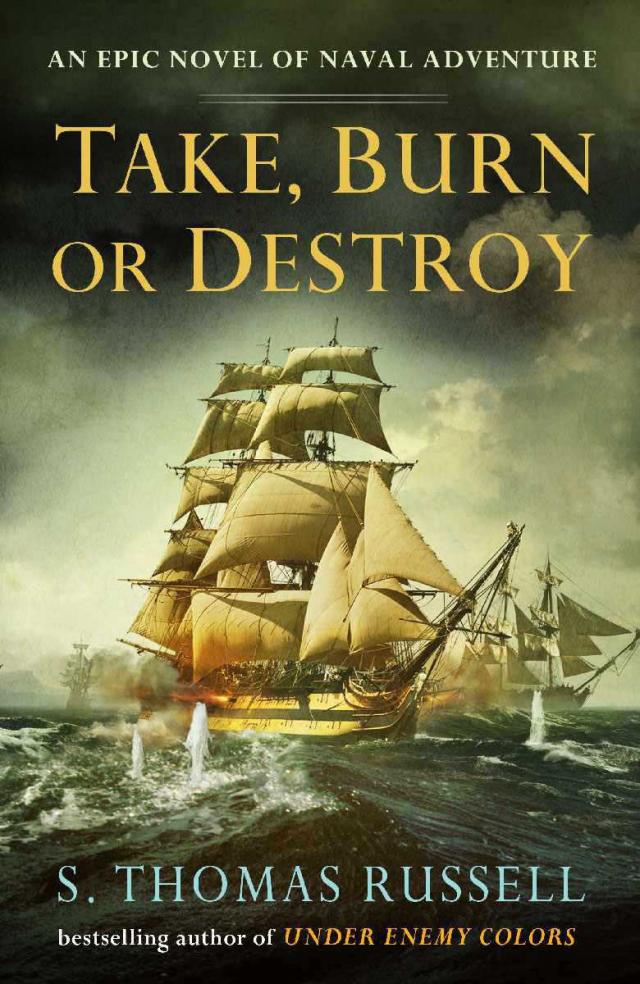
Take, Burn or Destroy, page 41


Hayden hastened to the quarterdeck and crossed to the starboard side. Men bestirred themselves from among the guns, rubbing eyes and massaging shoulders sore from their hard-plank bed. A midshipman hastened up quickly with a glass, and Hayden scanned the horizon.
“Yes,” he said softly, “there—on the larboard tack.” Hayden passed the glass to Griffiths and turned in a slow circle, quizzing the sea at all points of the compass. The eastern horizon grew faintly opalescent; the sun would soon overtake them yet again.
The men separated as Hayden turned away from the rail and went immediately to the quarter-ladder that led to the top of the roundhouse—the poop. As he reached the afterdeck, he realised that Griffiths had followed and now hovered on the top step.
“Come up, Doctor, by all means.”
Griffiths ascended to the short afterdeck, looked around as though to be certain no one was near.
“If I may, Captain . . .” Griffiths almost whispered.
“Speak up, Doctor. You know I value your opinion in all matters.”
“The men have been at their stations four days and five nights. They are all as exhausted as we. They will fight much better upon full bellies.”
“I could not agree more, but I dare not light our stove when we are at stations. The admiral would see me sent ashore for the rest of my days.”
“Can you make a cold meal, then?”
“That I can do, and I will if I must, but Lord Howe is no fool. He will have come to the same conclusion, I believe.”
“I hope your faith is not misplaced. If you will excuse me, Captain, I shall repair to my station.” The doctor turned towards the ladder, then stopped and turned his head back. “Luck to you, Captain Hayden.”
“Luck to all of us this day, Doctor.”
As he watched the surgeon descend the ladder, Hayden gazed out towards the line of sail and felt his pulse quicken. Lord Howe finally had the weather gauge and the sea fog was, if anything, dissipating. The French fleet was but six miles distant and the days would hardly grow longer—they had many hours to catch and engage the French fleet. This would be the day, for good or ill. A great battle would take place, the first of the present hostilities, and he would be part of it. If Lord Howe had decided what Hayden’s part would be in the affair, he had not seen fit to let Hayden know. The thought came to him then—he hoped he would live to tell the story . . . whatever occurred.
Upon the deck of his ship he could see crews mustered at the guns, boys with buckets coming to each bearing water for the men to slake their thirsts. The midshipmen, some of them so green they had been but a fortnight at sea, were gathered on the gangway, gazing off at the great fleet, and fairly bouncing up and down with excitement and fear. The older boys like Wickham, and even Gould, had been in actions before. They had seen the decks slippery with blood, and even their friends killed. They were much more subdued—resolute, but already sorrowful, Hayden thought. Those boys knew what was coming—for the others it would be a terrible shock. For a moment Hayden thought to send them all down to the lowest deck—to shelter them from what was to come. As though they were his own sons. But it could not be done. This was their chosen profession—there was no protecting them from the truth of war.
Archer appeared at the ladder head at that moment and Hayden waved him aft. Archer was pulling on his coat and looked even more dishevelled than usual.
“My apologies, Captain,” he began, his voice still hoarse with sleep. “It was my watch below, and I had fallen into the deepest sleep.”
“A great accomplishment under the circumstances, Mr Archer. I hope you are rested, for I believe we shall finally bring the French to battle this day.”
“We have been ready in every way for this moment for several days, sir, but I shall inspect each deck to be certain that nothing has been forgotten.”
“Take the new midshipmen with you, Lieutenant. They should comprehend all of our preparations.” Hayden looked up. “Order those men to leave off wetting sails. They will be dry long before we meet the French. We shall wet the sails when battle is near—not before.”
“Aye, sir.” Archer went off at a near run.
“Mr Smosh,” Hayden said, perceiving the clergyman upon the quarterdeck. “Come up, sir. The view is better from here.”
“Thank you, Captain.” The corpulent little parson clambered quickly up the ladder.
“I see you are not wearing your ecclesiastical collar, Mr Smosh?”
“I intend to assist Dr Griffiths with the wounded, and you know how superstitious the men are about clergymen in the sick-berth—they feel just as strongly about us in the cockpit, I have no doubt.”
“I did hope you would lead the men of each deck in a short prayer. Many would find it a comfort.”
“Nothing would give me greater pleasure, Captain Hayden. When shall I begin?”
“If now is not inconvenient . . . ?”
“Not in the least. I shall begin upon this very deck, if I may?”
The men on the upper deck were quickly mustered onto the quarterdeck, and standing upon the poop, Smosh led them in a brief but moving prayer. He then explained to the men that it was his custom to aid the surgeon in the cockpit but he would not be there in his clerical capacity, and that he had done so upon his previous ship and the men had all accepted his aid without question or concerns. Hayden was not certain the men of Raisonnable were entirely comfortable with this idea, but he did not believe any would attempt to hide their wounds due to superstitions about parsons in the sick-berth.
The sky continued to brighten as Smosh descended to the upper gun-deck to repeat his prayer.
“On deck! Captain Hayden, sir?” the mizzen top lookout called down.
Hayden gazed up at the man, who stood up grasping a backstay to stare down on his commander, who came out from under the mizzen to see him clearly.
“I’ve counted the French ships three times over, sir. Appears they have repaired all their damaged ships, somehow, sir. I count twenty-six sail of the line, sir.”
“Thank you, Pierce. I will send Mr Wickham up the mainmast.” Hayden turned to find the midshipman. “Mr Wickham . . . ?”
“I am on my way up, Captain,” the boy called back, and Hayden spotted him making his way to the larboard shrouds. In a moment he was in the tops.
Hayden walked forward to the rail, where he could see Wickham with his arm locked around a shroud and his glass screwed into his eye. For a moment he braced himself against the small roll of the ship, then he turned and found his captain on the deck below.
“Pierce is correct, sir,” the sharp-eyed midshipman called down. “But I would wager some of the French ships were too damaged to have been repaired.”
Hayden waved the boy back down to the deck. Lieutenant Huxley stood gazing up at Hayden, quizzically, from the quarterdeck. “It is difficult to imagine,” Hayden said to him, “but there can be no explanation but a French squadron has found the fleet. Ships do not rise out of the depths, after all.”
Huxley nodded.
This observation by the captain was repeated down the deck in a whisper and then circulated below, like a small breeze finding its way down the companionways.
By five the French fleet was fully visible to the naked eye, in an orderly line upon the larboard tack. The wind held true, showing no signs of backing or veering. The afterdeck was now populated by other officers, whom Hayden kept near that he might give them orders. A few midshipmen had also been allowed upon the captain’s private preserve, and they were hanging upon the words of the officers and quizzing both fleets constantly.
“Signals from the flagship, sir,” Gould reported, pointing excitedly. “We are ordered to steer north-west.”
The signal book again proved the midshipman correct, and all and sundry commented upon Gould’s prodigious memory—though the other reefers did exhibit signs of some jealousy.
Men jumped to their places with a zeal Hayden could hardly remember witnessing. Yards were braced, the helm turned, and they were upon the new course in but a moment.
The signals were repeated up and down the line and the fleet performed the same evolution.
“Very smartly done,” young Bowen observed. “Did you not think, Mr Archer?”
“I am gratified to see that you have become an authority in so brief a career,” Archer observed.
The boy coloured noticeably and fell silent thereafter.
“Is that our number?” Gould then asked.
A new hoist of flags jerked aloft aboard Howe’s ship.
“Indeed it is, Mr Gould,” Hayden replied. “Do you know it?”
“Are we ordered . . .” But then the midshipman fell silent, biting his lip. “I do not know it, sir.”
“We are ordered, Mr Gould, to take our place in the line of battle . . . directly astern of Brunswick, I believe.” The words brought with them a distressed silence. “Who has the signal book?” Hayden enquired, hiding his reaction to the order.
Lieutenant Huxley was in possession of this valuable document and quickly confirmed Hayden’s reading.
The young gentlemen glanced one to the other. They had been told the meaning of this, and Hayden could see it frightened them terribly.
“Mr Archer? We will spill wind and allow the fleet to overhaul us. Let us take our place in the line with all speed but no misadventures. The ships aft of us will have to make room, so we dare not barge in until they have made us a place.”
The news travelled the length of the ship and down to the decks below in less than five minutes, and Hayden could see the effect of it.
Barthe came up onto the poop and, after staring a moment at the French line, growled quietly to his captain, “Let us hope we are not placed opposite a first-rate ship.”
Hayden pretended not to hear. But Barthe was right—one broadside from three decks of a hundred-gun ship would put paid to Raisonnable, Hayden was quite certain. Clearly, Lord Howe had decided that even a sixty-four might inflict some damage on the enemy. Oddly, Hayden felt a little as he had as a child when pressed forward to fight some bully twice his size. There was no hope of success, but to gain a reputation of being shy . . . It was unacceptable.
Most of an hour passed before Hayden was able to work his ship into the line by a process of backing and filling, and even then he thought himself too near the seventy-four forward of him.
It was perfectly clear to every man aboard at that point that an action was inevitable that day. The French showed no signs of scudding, which would be their only hope of escape.
Raisonnable had just found her place when the flagship signalled that it would attack the enemy line’s centre. Though the enemy fleet was still three miles distant, perhaps a little more, the ships suddenly loomed very large—larger than Hayden’s sixty-four-gun ship, which he believed the smallest ship in either line of battle. He could see the hands all staring at the French line, and he wondered how many were counting to see which ship would be opposite their own.
“Mr Archer?”
“Sir?” Archer was slightly paler than usual, and very solemn. He was no fool, Benjamin Archer, and knew what lay in store for them as well as any man could.
“I shall make a quick tour of the decks.”
“Aye, sir.”
Stepping quickly down the ladder, Hayden went from gun crew to gun crew.
“It is no secret, boys, that a seventy-four has a greater broadside than we, but we all know that twenty-four-pounders can be fired at twice the rate of thirty-two-pounders, so who will pour in more iron, a Frenchman or our own stout ship?”
It was a speech that contained a small amount of fiction, but it had the desired affect. The odd mention of prize money did not hurt either. After he had passed along the upper deck and then both gun-decks, Hayden ran up the steps to the poop in time to see a hoist of flags go aloft on the now nearby flagship.
“Signal thirty-four, sir,” Gould reported. “Break through the enemy line and engage from leeward.”
“Well, Mr Gould, it is exactly what I expected from His Lordship. There can be no half measures in battle.”
No sooner had this signal been made than the signal to heave to followed, leaving Hayden, and he guessed others, somewhat confused. But Lord Howe quickly followed this with a signal to feed the crews, of which Hayden heartily approved. Mess tables could not be set up, so the gun crews went down to retrieve their food one by one, and food was consumed in any position men found comfortable. The ship’s boys went around collecting wooden plates after, and the men were all fed and mustered to their guns in little more than half the hour. Only minutes after that the entire fleet again got under way, and at eight thirty in the morning Admiral Lord Howe sent aloft another hoist of flags.
“Signal thirty-six,” Midshipman Huxley called out, clearly attempting to best Gould. “‘Each ship is to independently steer for and engage her opponent in the enemy line.’”
“Mr Gould?” Hayden said quietly to the midshipman.
“That is correct, sir. Are we not to pass through the line, then?”
“I believe as long as we place our ship alongside our opposite number in the line and do our utmost to overpower that vessel no fault can be found with us, whether we are to leeward or windward.” Hayden turned to find his senior lieutenant. “Mr Archer? Pass the word for Mr Barthe, the bosun, and all of our lieutenants.”
“Sir.”
Hayden’s senior officers hastened onto the afterdeck a moment later and gathered in a knot, facing their captain. “We all know what we are up against, but I have an idea that will give us half a chance. Here is what I shall attempt.” Hayden pointed at the French line. “Do you see the ship that is our opposite? The second aft of the flagship?”
“The eighty-gun ship, sir?”
“No, Mr Huxley, aft of that—a seventy-four. We will steer for it as though we will engage her to windward, but as we draw near her larboard quarter I will order all of our guns fired at once—even before we can bring them to bear. With this small wind the smoke will not carry away swiftly, so for a moment we shall be utterly concealed, and in that moment I will order the helm put up and we will pass astern of the seventy-four. It is my intention that we will fire both batteries at the ships in the French line as we pass through, so reloading with all haste will be required. Our fire must be concentrated on the enemy’s lower gun-deck to do as much damage to her great guns and their crews as can be managed. We will then come up to leeward of our seventy-four and engage her with our larboard battery. It is an evolution that must be managed with great precision and no hesitation. As we are hidden from them in smoke, so will they be hidden from us. We will make our turn blind so can have no errors in either judgement or execution. Mr Barthe, the mizzen sail must be brailed in with all speed. We dare not do this before we have fired our broadside, or the French captain will comprehend our intentions and turn downwind to stop us from raking him.” He stopped for an instant to see that comprehension was apparent in all of the faces. “Mr Bowen, you must find me a reliable hand of very steady nerve to man the beak-head and call out our distance to the sternpost of the seventy-four. Another man must crouch behind the barricade to take his place in the event that he is wounded.”
“I will do that, sir,” Wickham volunteered.
“You will be in charge of a gun battery, Mr Wickham,” Hayden informed the midshipman. He turned his attention back to Bowen. “We will station men to relay the distance from the enemy back to me on the quarterdeck—in yards, if you please, Mr Bowen.”
“I have just the men, Captain.”
“Does everyone understand their part? We will fire each gun as it bears, but do not begin until you have had the order from me.” Hayden gave everyone a moment to ask any question they might have and then said, “Some few of you have not been in a close action before, but do not be concerned; you will be equal to the test. The men at your guns will not fail you, nor will you fail them. Luck to each and every one of you.”
The men returned to their stations after Hayden ordered Barthe and Mr Archer to attend to the sail handling, while he would give the order to put the helm up. The gun captains stood ready, firing lanyards in hand, all eyes fixed on the French ship, which appeared to grow larger and more formidable by the moment. The man sent out to the beak-head had to be made of very stern stuff, as he would certainly come under musket fire.
As these things often went, closing with the French, who were sailing almost at the speed as the British, took an unbearable hour. It was not until after three bells that the first shot was fired, and that by the French at the leading British vessel—the eighty-gun ship Caesar. Very quickly firing became general, though the British ships held their gun crews in check until they were almost within musket range.
Hayden observed the smoke from each broadside and was given some hope that his plan might answer, as the dark clouds clung to the ships and blew off but slowly. All the while he kept his eye upon the two ships where he must pass through, measuring the distance between them, noting that now they closed and then separated. Hayden realised that if the ships closed as he approached there would be no room for him to break through the line and he would have to go broadside to broadside against a far more powerful ship. An iron ball scraped through the air then, tearing into the mizzen overhead, causing the boom to swing wildly about.
“Mr Archer?”
“Sir?”
“Detail three guns to fire alternately chain or bar and then grape up into the tops of our Frenchmen. Let us sweep the musket men from the rigging.”
The French musketeers were overly effective at killing English crewmen on the exposed upper deck, especially officers, sometimes leaving a raw lieutenant in command, much to the detriment of the ship. Hawthorne had also been ordered to send his marines aloft to shoot their opposite numbers in the tops before any fire should be directed at the French ship’s deck. The failure of other captains to do this, Hayden believed, was an attempt to demonstrate to the hands that the officers would brave all dangers—for the French musket men targeted the officers first. To Hayden’s mind, this was a foolish conceit. He had proven his courage often enough not to believe his men would question his motives for killing the musketeers.