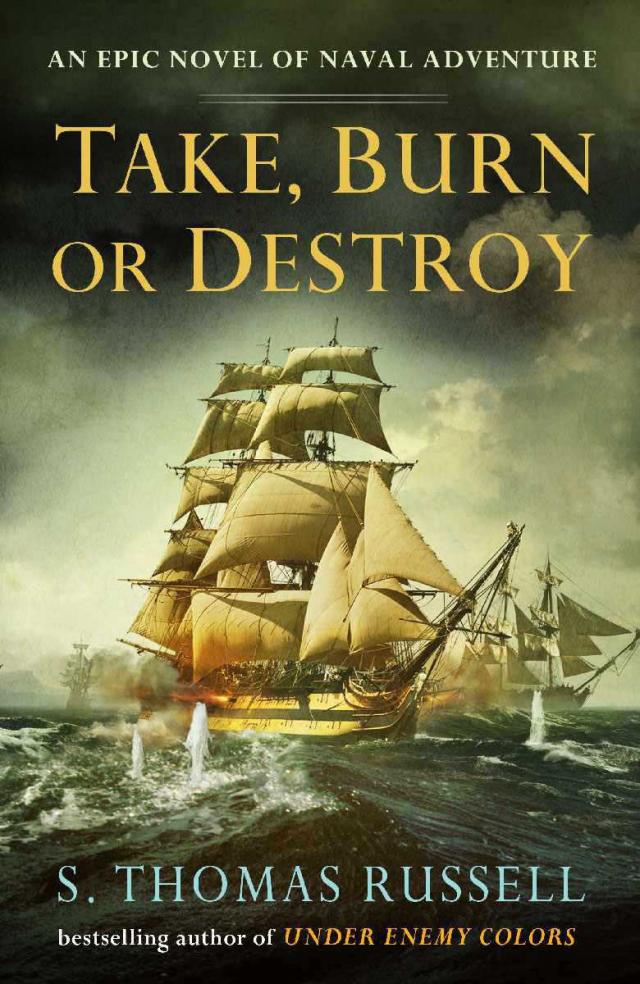
Take, Burn or Destroy, page 10


Hayden considered a moment before speaking, preferring to tread lightly where the subject was so delicate. “I do know, Doctor Griffiths, that you bear a burden of guilt—unwarranted, I might add—at the death of a young woman in similar circumstances. That does not make you the protector of every young woman who has lost the use of a hand and who has run afoul of luck.”
The doctor met his eyes. “If not me, then who?”
“Pardon me . . . ?”
“I am not being entirely facetious. Who would rescue Miss Brentwood if I did not? She would probably be dead or wishing she were dead. I simply cannot allow this poor girl to suffer. I cannot, Captain.”
“It is very noble of you,” Hayden said quickly. “But do you not worry that she might misconstrue your interest in her? She might apprehend your concern for her as something more than charity. There might, in her mind, be a promise of some nature in such kindness to a woman to whom you are no blood relation nor even a family friend.”
The doctor did not answer this but only looked somewhat distressed. “I do worry that such a thing might occur.” He was silent a moment, contemplating the empty table before him. “Or has occurred.”
Hayden shifted a little, sitting back, not wanting to prompt the surgeon to speak, but only to listen if Griffiths so desired.
Hesitation was quickly overcome, apparently, for the doctor went on, looking up at his friend and captain. “In her last letter . . .” He took a quick breath and let it out in something like a sigh. “In her last letter Miss Brentwood did write in a manner . . . so unguarded and familiar as to cause me the greatest possible alarm.” The doctor’s misery seemed to almost overwhelm him. “I have hardly spent three hours in this young lady’s company; is it possible that I have attached her feelings in so short a time? I will tell you, I have failed in similar endeavours when the number of hours I had to perform this miracle was almost without number. Do you think this possible? Could she be so easily won? Not that I determined to win her. Nothing could have been further from my intentions.”
Griffiths looked up at him appealingly. Hayden had seen drowning men look less desperate.
“She is a young woman in difficult circumstances, as we have noted. Along comes a gallant Navy surgeon who has prize money in the offing. This gentleman is clearly kindness personified and rescues her from her plight. How could she not be affected? Even if it is really gratitude confused for true attachment, it is no less strong.”
Griffiths shook his head. “I did not foresee this, I can tell you. I always imagined myself with a woman . . . of greater learning.”
Hayden thought of the woman Hawthorne had met in Bath; the woman upon whom all Griffiths’ hopes had depended, he had been told, though those hopes had been dashed. She was apparently very learned.
“Have you pledged yourself to this lady . . . in word or deed?”
“Not in word, certainly. In deed . . . it would appear she believes so.”
“Well, Dr Griffiths, though it will bruise her feelings, I am sure, you must be entirely forthright about your intentions. There must be no misunderstanding.”
“Yes, of course. I must.” He bit his lip. “Certainly I must.”
Hayden did not feel he could linger. There were two French frigates and an unknown ship within sight. He was needed on deck.
“If you will excuse me, Doctor.”
“Certainly,” Griffiths said, standing. “And thank you for your counsel in this matter.”
“Not at all.”
Leaving the gunroom, Hayden could see Chettle and his mates at work, finishing a new top-gallant mast with smoothing planes. They had this laid out between the rows of tables and were receiving some abuse from the men nearby, who thought their mess should not be turned into a shop for the shipwrights. Hayden stopped a moment to approve the carpenters’ work.
“We shall have a new yard ready in two hours, sir,” the carpenter reported.
“Well done, Mr Chettle.”
A dull and distant thud brought a sudden silence. A gun had been fired.
Hayden climbed quickly up to the main deck, attempting to appear calm the whole while. Here he found his officers gathered at the taffrail, quizzing their newly acquired escort, barely visible through the sheets of rain slatting down into the sea and upon His Majesty’s ship Themis.
“There you are, sir,” Archer said as Hayden approached. “We just sent Hobson to find you. It seems the Frenchman to leeward has reason to believe this new ship is also French. He just sent up his colours and a hoist of signals behind his sails. A gun was fired as well, sir.”
“And has the other ship answered?”
“We cannot be certain, Captain.” Archer handed Hayden his glass.
Archer’s glass was partly fogged inside—not an uncommon occurrence—and the distant ship was doubly obscured. He called for his own glass to be carried up from his cabin, and fixed it upon the distant ship, still small, even in the circle of his glass. She was under storm canvas—but was that a hoist of signal flags behind the topsails?
He lowered his glass. “Where is Mr Wickham?”
“Aloft, sir.”
Hayden craned his neck to look up, a hand preserving his hat. “Mr Wickham! Can you make out a flag upon that ship?”
Wickham leaned over from the tops to call down. “I cannot, sir, but she appears to be answering signals from the other ship, Captain. She is most assuredly French.”
Hayden turned back and found the ship in his glass again. “She has not come up as fast as Wickham predicted,” he observed.
“No, sir,” Archer replied. “We believe she tore out her mainsail clews, sir. We saw it suddenly begin to flog, and then they had the devil of a time to hand it. That has slowed them somewhat.”
Although this was good news, it brought to mind the precarious state of Hayden’s own main. He prayed they would not need to set it that day.
“If you were one of these French captains, Archer, what would you do?”
“Me, sir? I would close with us and open fire, Captain. There are British cruisers in these waters. I would want to take my prize before she could be rescued. Damn the weather. Deck guns can be fired. I would be making every effort to bring us to battle.”
“That is what I would do as well. And now that there appear to be three of them, I believe they will do the same.”
“And we, sir? What shall we do?”
“We shall attempt to hold them off until dark. By then we shall have enough sea room to manoeuvre. Let us pray this gale lasts and even freshens.”
“I shall speak to Mr Smosh about freshening the gale, sir. He has influence in high places, I am given to understand.”
“Very enterprising of you, Archer.”
“Thank you, sir. I do try.”
Half an hour later Wickham appeared on the deck, his oilskins dripping, a glass half protected by a coat.
“You still believe her a corvette, Mr Wickham?”
“I do, sir.”
“Can they catch us before darkness, do you think?”
“The windward ship might, sir. She will have a better slant if she comes after us. The ships to leeward . . . They will not catch us unless the windward ship can slow us.”
“My thoughts exactly. Find Mr Barthe and Archer. I wish to have all your thoughts on a particular matter.”
“Aye, sir.”
Wickham, near frozen as he was, went stiffly off. Hayden crossed to the windward rail and, taking hold of the mizzen shrouds, leaned out over the writhing sea and gazed down at the topsides. His officers gathered a moment later.
“If this windward ship bears down on us, I am wondering if we can luff—not near enough to the wind to chance backing our sails—but as near as we dare, open our gunports as the crest passes and fire a broadside the length of the Frenchman’s deck. If this can be timed to the moment he is bow down and his deck exposed, and we load half our guns with grape and the rest with shot, we will cause a great calamity among his crew, and much damage to his ship. Can it be risked, do you think?”
The two young men and the master all stared out over the high-running sea. Barthe spoke first; indeed, Archer and Wickham appeared to be waiting for him.
“The wind has not held steady to even one point of the compass, Captain,” Barthe began. “It has veered about as much as a point, and even two at times. Should we get a shift to the west as we luff, we might well be caught aback and then . . .” He did not need to finish—they might lose masts, which would leave them at the mercy of the French.
“I am forced to agree, Mr Barthe. The wind is not fixed in direction. Do we dare open ports, do you think?”
“We will certainly roll to starboard when we luff, sir,” Wickham replied smartly. “And then back to larboard. It would have to be timed to a nicety—the ports opened at the exact instant, guns run out and fired. If the Frenchman is bow-up at that exact moment . . . well, we shall put some holes beneath the water with a bit of luck, but his deck will be largely unharmed.”
“I agree. We shall only have one opportunity, and wind and sea might not favour us.”
“I for one think it is worth the chance, Captain,” Archer stated firmly. “If we luff and it is clearly not possible to open the gunports then, although we will have allowed the Frenchman nearer, he will not be able to open his ports either, so it will profit him little. The only danger is being caught aback. Put Dryden on the wheel or Mr Barthe or yourself, sir. But if we can damage this Frenchman the others will not come up with us before darkness, I do not believe. It is our best chance.”
Hayden could see the sailing master listening to this and gazing down at his boots on the streaming deck, a look of disapproval and concern upon his wind-reddened face.
“Mr Barthe, I do not think you are in agreement with Mr Archer?”
“With all respect, sir, I am not. I think we can drive this Frenchman off or keep up a running battle with him until dark. It is a daring plan, Captain, but I fear the wind will betray us at the wrong moment.”
“I share your reservations, Mr Barthe, but sometimes in war it is important to do the unexpected. I do not believe our Frenchman will imagine for a moment that we would luff and rake him. I am determined to attempt it. If gunports cannot be opened safely when we have luffed, we will fire our deck guns and fall back onto our course. If we wait until the precise moment to luff, we may drive our Frenchman down to leeward of us. I would rather have him there than with the weather gauge.”
Archer and Wickham both nodded. Barthe, Hayden was certain, would co-operate completely, no matter how much he objected to doing so. Hayden would have preferred to have Barthe’s enthusiastic support, but it was not required.
“Shall I send Dryden to the wheel, sir?” the master asked quietly.
“If you please, Mr Barthe.” Hayden turned back to quiz the windward ship with his glass. “Now let us see if this Frenchman will co-operate. He was not shy by night. Let us discover if he is so brave by day when he cannot come upon us by stealth.”
Hayden put Archer in charge of the gun-deck. They would have only one opportunity to fire a broadside. Opening gunports, running out the guns, firing, and closing the ports would all have to be done in a blink. There could be no hesitation, no misunderstanding of his intentions. All must happen in one smooth motion, like the throwing of a javelin.
“Mr Wickham, I shall have you stand in the aft companionway, upon the ladder. When I give the order, you must pass it immediately to Mr Archer.” Hayden turned to his first lieutenant. “You comprehend, Mr Archer, that it all must happen upon the instant; ports opened and guns run out all but simultaneously. We will fire our broadside upon your order, whether the Frenchman’s deck is exposed or no, for the ports must be shut the instant the guns are fired. We do not dare to leave them open for a more advantageous shot. Have you any questions at all? Do not hesitate to ask, we can have no confusion.”
Both young men assured him their comprehension was complete. The ship beat to quarters and Hayden toured the gun-deck to assure himself that all was ready. The gun crews listened gravely to his explanation of what was planned, and all nodded their apparent understanding. They were steady men, Hayden knew, and he did not doubt for a moment that they would fulfil their part. Whether he could time the turn and catch the enemy unawares was another matter.
Upon the main deck he found Wickham with a glass fixed on the windward ship.
“I believe she is bearing down on us, sir. It is hardly perceptible in these conditions, but see if you do not think the same.”
Hayden watched the ship for some time and then lowered his glass. “I agree with you, Wickham. An hour will see her near enough for us to put our helm down. When I am ready to luff, we shall give the gun crews warning so they are standing ready. We can have no mistakes.”
“There will be none, sir.” Wickham said this with such youthful confidence that Hayden almost smiled. Innocence that complete was to be wished for, he thought.
The morning wore on. Necessary conversations were reduced to terse whispers with many a quick glance towards the French frigate. On the quarterdeck, the gun crews hunched down behind the barricade so as not to alert the enemy to Hayden’s intentions. Even so, these men popped a head up on occasion and monitored the approaching enemy vessel with a dread-filled fascination. All of them comprehended the risks involved.
The telltale at the masthead was scrutinized by all the experienced sailors, and every time the wind shifted into the west without warning, these men glanced at one another, their anxieties unspoken but almost clearer for it.
After the wind hauled forward it would settle back to blowing from the north, steady for a time, and then, without warning, haul either forward or aft, sometimes as much as two points, just as the master had claimed.
It was unsettling, but Hayden intended to stay with his plan unless the wind began veering about without any periods of settling into the north. He was glad that the howling of the wind hid the sounds of his stomach, which was nervously announcing its reservations about his plan. It was embarrassing that his own body should betray him so, but there was nothing to be done for it.
For a long time the French ship hardly seemed to be gaining at all, but then it began to grow until there was no doubt the distance between them was closing. A chase piece was fired from the Frenchman’s foredeck but was well wide and short of its mark.
“Shall we return fire, sir?” Ransome stood near Hayden, eyes fixed on the chasing ship.
“No. They will not damage us in this sea. Nor are we likely to cause hurt to them.”
A nervous-looking Rosseau appeared on deck, looked over the three chasing ships, and turned very pale. Capture by his own people and execution for siding with the enemy were his greatest fears. “There you are, Rosseau,” Hayden said. “I have instructed the sergeant-at-arms to lock you in leg irons in the event that we should be forced to surrender, though I should not worry; I doubt it will come to such a pass.”
“Merci, Capitaine. I hope the same.” He glanced at the ships again, reached up to touch his face, and Hayden thought he saw the man’s hand trembling.
The gale gave no indication of taking off, and the sky remained heavy and deep with cloud. Rain squalls swept down on them at intervals, obscuring the chasing ships. Out of this blear seas came sliding and hissing to roll the ship to leeward. Wind in the rigging howled up and down a haunted scale.
The chasing ship continued to lob shot at them, and finally, as she came within seventy-five yards, she struck home, sending a shot through the transom and into the empty gunroom, the stern having been thrown high as the bow pitched down into the trough.
Hawthorne went below to assess the damage and returned a moment later. “This Frenchman did not approve of our table wine, apparently,” he reported to Hayden. “Blasted it all over the gunroom.”
A quarter-keg of claret had been shattered, the marine informed him, its contents sprayed crimson over the white-painted walls and deck-head.
“The tiller and tiller ropes were unharmed?”
“Yes, sir, just the wine and the bulkhead before it. The servants are cleaning up and Chettle is seeing to the damage to the hull.”
“Well, the French do tend to be snobs about wine, Mr Hawthorne.”
“That is because they have never tried English wine, sir.”
Hayden laughed despite the situation.
He had not taken his eyes off the pursuing ship the entire time they spoke. “Mr Dryden,” Hayden said to the man at the helm. “Our design remains the same. When I give the order, I want you to port your helm and luff up as close to the wind as you dare. We will open ports, fire a broadside, and fall back on our course immediately. Is that understood?”
“Yes, sir.”
“Mr Wickham, station yourself in the companionway now and have Mr Archer warn his crews to be ready to act with all speed upon my order.”
“Aye, Captain.” Wickham jogged over to the companionway and positioned himself several steps down, passing Hayden’s warning to Archer.
Hayden kept his eye fixed upon the chasing ship. A bloom of white smoke at her bow was immediately swept off by the wind and the screech of an iron ball passed narrowly by. There was no room now for error. No place for panic. He pressed all doubts down and fixed his eye on the heaving French frigate. It was Hayden’s desire to begin his turn as a wave reached them so they were turning into the crest, complete it as they passed over, open ports as the second crest passed, fire, close ports, and bear off. The waves were steep and close together, as they tended to be in the Channel. There would be little time between them.