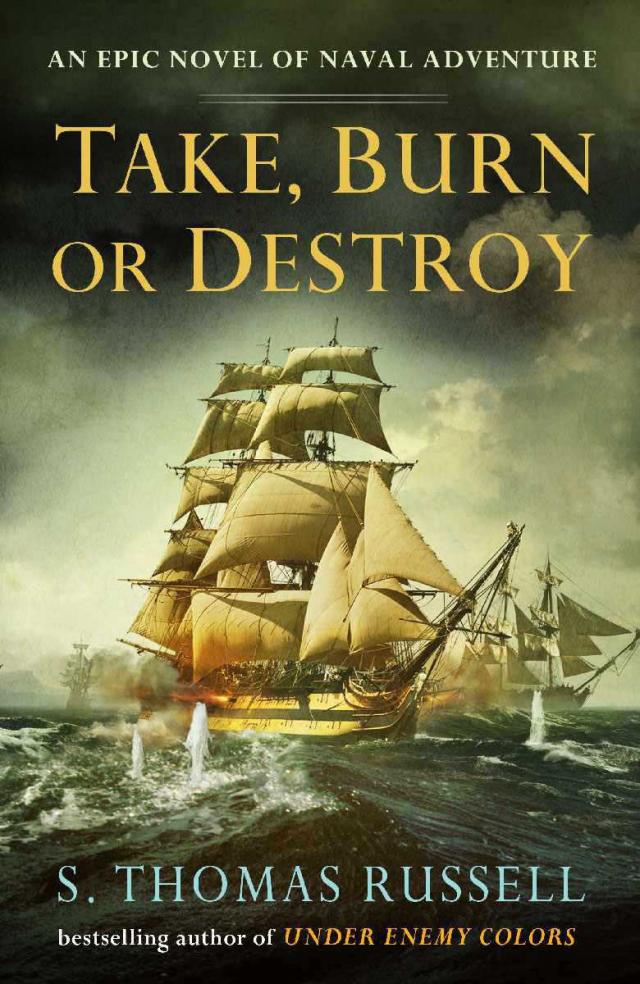
Take, Burn or Destroy, page 39


“So I thought. God preserve us.”
The frustration of watching the French fleet in the offing and the time it was taking to come up with them infected Hayden’s entire crew and her officers. There was among all the men aboard a strong desire to undertake this action and to see it done, at the same moment as there was great apprehension. The great expanse of sea that lay between the two fleets, however, was only reduced by the smallest degree every hour, and even Hayden had begun to wonder if darkness would not fall before a general engagement could commence. All that long forenoon he made his presence felt around the deck, urging the men to remain steady, that the French would not escape, if indeed that was their intention.
The small squadron under the command of Admiral Pasley remained some distance before the British fleet, and just as the French fleet again made sail and tacked, the signal was made to harass the enemy’s rear.
Sail handlers were ordered to their stations, and royals were set and trimmed to the liking of Mr Barthe and the first lieutenant.
The sailing master found Hayden upon the quarterdeck. “Sir, if we are to allow ‘Billy Ruffian’ to take the lead, we shall have to spill some wind; we are much swifter than she.”
“At this point, I believe we may give our mount her head, Mr Barthe. If Bellerophon cannot match our speed, then we shall leave her in our wake. And the same may be said for Marlborough and Russell.”
“Aye, sir!” Barthe replied with obvious approval, and he went about the deck ordering hands to brace yards and trim sails to a nicety, attempting to get every tenth of a knot from his new ship.
Hayden did keep an eye upon Pasley’s ship to see if he would be ordered back into place, but no such signal was seen and Hayden turned his attention to the rearmost ship of the French line. Going to the forward barricade for a better outlook, Hayden found several of his officers gathered there with their glasses rising up to quiz the French ship and then dropping down to allow excited conversation.
“And what ship do we have, Mr Ransome?” Hayden asked.
“A large three-decker, sir, but we cannot yet make out her name. Perhaps Le Montagne or Le Terrible.”
“May we send for Mr Wickham, Captain? He might make her out.”
Hayden raised his glass. “There is no need for Wickham, Mr Huxley. I am quite certain that is Révolutionnaire, of a hundred and ten guns. I have seen her before.”
“Her broadside must be treble our own,” Ransome announced softly.
“More than treble, Mr Ransome,” Hayden took it upon himself to answer, “but if we can slow her progress enough for our seventy-fours to come up, I believe we might earn a huzzah from the fleet.”
“And prize money as well,” someone said, and everyone laughed nervously.
“Mr Ransome,” Hayden said, “let us have the sprit-sail yard sent inboard and all of its gear cleared away so that we may employ our chase guns.”
“Aye, sir.”
The rearmost ship seemed to grow in size as Raisonnable gained on her over the next three quarters of an hour. The fleet, stretched out in a ragged line before her, gradually grew more vivid and detailed and was both a grand and unnerving sight to the crew of Hayden’s ship and to Hayden himself. Twenty-six sail of the line and several frigates and outlying vessels meant the two fleets were almost exactly evenly matched. Everyone aboard sensed that this was a moment of enormous gravity in this young war, though few knew as Hayden did that the preservation of England from imminent invasion might depend on the next few hours and the coolness and judgement of Lord Howe and of every jack who manned a gun.
Even with royals set and drawing, Raisonnable appeared to gain upon the French only to the smallest degree, though she had opened a noticeable lead over the ships of her small squadron that now lay half a mile astern—making Hayden wonder if these ships were gaining on the French at all. Although he did desire the honour of being the first British ship to open fire on the enemy, he did not want to get so far ahead of his squadron that he might end up in danger. A 110-gun ship was a formidable machine of war, and he would have to rely on the handiness of his ship and the skill of his crew to prevent the Révolutionnaire from bringing its broadside to bear upon his own people.
At two-thirty in the afternoon Lord Howe gave the signal for a general chase, and the ships at the fore of the line began to crowd on sail in an effort to catch the advance squadron and get into the action sooner.
A further two hours were required to close the gap sufficiently for Hayden to consider opening fire. He stood by the forward chase guns, attempting to be an example of patience to his eager crew. Wasting shot and powder to no purpose or effect was foolish, and Hayden was well aware that these valuable commodities should be preserved.
The gun captains at the two forward guns, both of which could be brought to bear, were older seamen named Higgenbotham and Hale—who certainly should have been solicitors. They stood by their guns, firing lanyards in sweaty hands, eyes focused intently upon the chase, quietly ordering a gun elevated or lowered or shifted to larboard to account for the changing distance and bearing of the Frenchman.
There was at that moment a loud report to starboard and Hayden turned to see a cloud of black smoke enveloping the bow of Bellerophon.
“They have not a chance of hitting the Frenchman at that distance!” Hale blurted out resentfully.
“Just to be able to claim they fired the first shot . . .” Ransome said with equal indignation.
“At least we shall fire the second,” Hayden said. “Gun captains, fire your guns.”
Both guns boomed at the same instant, bitter smoke blooming out and blinding them for a moment. Hayden looked up the foretop.
“Both shots fell short, Captain,” the lookout called.
“How many yards?”
“One hundred yards about . . . sir.”
The guns were quickly swabbed and reloaded, elevated, aimed and fired again, this time Hayden ordering the starboard fired first and then the larboard so that they might have some chance of knowing which gun’s ball fell where.
“Starboard gun holed the driver, sir,” the lookout called. “Larboard ball a-swim off the larboard quarter—ten yards, mayhap.”
Guns were loaded, shifted by crowbar, and fired again.
A “Huzzah” rippled down the deck as the first ball shattered a gallery rail, though no one was certain where the second ball had gone.
The wind began making and a smoky haze overspread the azure sky. Hayden began to glance aloft frequently, wondering how long they dared carry the royals. He did not want to have to clear away broken royal masts aloft and finally called for Archer, who arrived with a worried-looking Barthe in his wake.
“I believe we should take in these royals and send down the yards,” Hayden informed them. “The wind is making, so I do not think we shall lose much speed.”
“Aye, sir,” Barthe said, eyeing the small square sails high above. “I do not believe we shall lose even half a knot, Captain.” The guns boomed, interrupting conversation. The sailing master winced and then went on. “This wind will make and keep our speed just as it is.”
“I do hope you are correct, Mr Barthe. Let us get these sails off her before we have to clear away a tangle aloft.”
“Aye, sir.”
Men were sent scrambling aloft, and Hayden turned his attention back to the French fleet. Bellerophon had come up somewhat and lay upon Raisonnable’s leeward quarter about three hundred yards distant. She began lobbing shot towards the aftermost French ship, with reasonable success. Astern, the British fleet was drawing near, with the faster ships coming up quickly now that the wind was making.
Hayden glanced at the sun, which was descending towards the west in its ever-returning arc. Light would remain only a few short hours, and it seemed unlikely that Lord Howe could force a general action in that time, which engendered intense feelings of disappointment in Hayden.
“Mr Huxley?”
“Sir?”
“I will leave you to watch over the chase guns. I want them loaded with chain until we are nearer. If we can damage the rig of this Frenchman, we might slow her so our own ships can come up. We might force the French ships of the rear to come to her rescue or cut her off.”
“Aye, sir. Chain.”
Hayden returned to the quarterdeck, where he found Archer.
“When we get the royals off, Mr Archer, I want sail handlers at their stations. We will try to rake this rearmost ship.”
“Will she not smoke what we are about and bring her broadside to bear, sir?”
“I do not think she will, Mr Archer. Her captain knows that he cannot fall back from his fleet or he will be lost. I believe she will hold her course and be forced to take all we give her, but we will see.”
Révolutionnaire began to return fire, though this was concentrated on Bellerophon, which was both a larger target and the more dangerous adversary. Hayden’s sixty-four was largely ignored as the British seventy-fours ranged up from astern. It was Hayden’s hope that he could use this situation to get him near enough to Révolutionnaire that he might inflict some real damage and force her to fall behind the fleet. Then they would see if the French admiral would risk a general action to rescue his 110-gun ship or if he would let her be made a prize.
A cheer went up on the deck as the mizzen top-gallant yard on the French ship suddenly swung down in an arc to larboard, the sail flailing and snapping at the rigging all around and the loose spar battering shrouds and stays. “Was that our doing?” Hayden asked his first lieutenant.
“I do not know, sir, but I do think we should make that claim.”
The crew of a carronade, forward on the quarterdeck, broke into laughter and the bosun and a mate were on them with rattans of an instant. Archer advanced on this scene to take names and to impress upon these men again that silence on deck was imperative.
“What was that about, Mr Bellamy?” Hayden asked the bosun as he passed.
“I cannot say, sir. A bit of drollery, I should wager. Those men well know that they should keep their traps shut. I don’t imagine you’ll be hearing from them again, though, Captain.”
Hayden well knew that a bit of humour relieved the tension as the ship went into danger, but silence on the decks was imperative. Orders must be heard.
Gould came hurrying aft, touching his hat as he came onto the quarterdeck. “Sir, Mr Huxley has asked me to inform you that the Frenchman is mustering musket men on the quarterdeck. He believes they will be sent aloft, sir.”
It was the practise of the French to put marksmen aloft with instructions to concentrate their fire upon the quarterdecks of the enemy, and most especially upon the officers.
“Pass the word for Mr Hawthorne, Mr Huxley, if you please.”
“Aye, sir.”
The acting captain of marines was very quickly found and sent aft.
“I have gathered my best men, sir, in anticipation of them being required,” Hawthorne said as he hurried up.
“Let us have them on the foretops, Mr Hawthorne, and order them to concentrate their fire upon the French musketeers.” Hayden gazed a moment at the distance between ships. “We are five hundred yards yet, Mr Hawthorne, but if the Frenchman loses more spars his speed could alter quite quickly. We might find ourselves upon him rather suddenly. Have your men stand ready, but tell them not to waste shot and powder.”
“I will go aloft with them, sir.”
“I would rather you sent a reliable corporal aloft and remained on deck, Mr Hawthorne.”
Hawthorne looked surprised by this. “Aye, sir.” He touched his hat and hurried forward.
Hayden did not wish to lose his captain of marines when a general fleet action was very likely in the offing. Hawthorne would be wanted then to repel boarders or to board the enemy.
“Mr Archer,” Hayden addressed his senior lieutenant, “we shall bear off and fire our first broadside at a cable’s length.”
“Aye, sir.”
The stern of the French ship began to loom over Hayden’s Raisonnable, such was the height of her decks. Against the hazy sky, the silhouettes of men clambered aloft with muskets slung over their backs, and a moment later, the flash and smoke of their fire could be seen and Hawthorne’s men returned fire. The French were attempting to kill the crews manning the chase guns forward, making the forecastle the most dangerous place aboard for a moment. Hayden sent word to clear that deck but for essential crew and Lieutenant Huxley. It always surprised him that young men would brave gunfire unnecessarily rather than appear shy to their comrades. It was one thing to not have enough sense to come in out of the rain, but to not have sufficient reason to come in out of a hail of lead balls was beyond foolhardy.
It was far into the evening before Hayden’s ship ranged up to within a cable’s length. He had worked his ship to weather as he could to allow them to bear off and fire without then having to work their way back to windward.
Hayden turned to the sailing master. “Mr Barthe, brail up this mizzen and up mainsail. I shall order us to bear off the moment your gear is cleared away.”
“Aye, sir.”
The aft sails of the ship would resist a turn downwind and must be taken in or, if urgency demanded it, the sheets let fly before such a turn could be made.
“Bear off, Swain,” Hayden ordered the helmsman. “Bring our starboard broadside to bear. The instant our guns fire, Mr Barthe will set the mizzen and we will come back to our present heading.” Hayden turned to find his sailing master. “Do you hear, Mr Barthe?”
“We shall haul out the mizzen the instant the guns are fired, sir.”
Hayden was quite certain Barthe knew his part without any instructions from him, but it was always better to have every detail stated clearly so there was no misunderstanding. Barthe had spent a long, eventful life at sea and there was little he could learn about the management of a ship in all weathers from a young captain—even a young post captain.
For some minutes Hayden gazed, almost without blinking, at the first-rate ship before them. He gauged the wind direction and how constantly it blew.
“Mr Archer.”
“Sir?”
“Let us port our helm and fire as soon as we can bring guns to bear.”
“Aye, sir. Swain—port your helm, if you please.”
The helm was put over, and the ship began to bring the wind aft. Despite being a handy ship for her berthen, Raisonnable appeared to take some good part of the evening to finally bring her broadside to bear.
“You may give the order to fire, Mr Archer.” Hayden, who stood upon the quarter-ladder, quickly climbed the last three steps and hastened aft to be as clear of the smoke as possible that he might survey the effect of his gunners.
And an instant later, the two decks of guns and the guns on the quarterdeck boomed, spewing smoke and fountains of flame. This smoke drifted away forward, and Hayden was gratified to see much of the Frenchman’s mizzen rigging carried away so that the severed shrouds and stays swung forth and back in the wind. The stern gallery shattered as raking fire swept down the Frenchman’s deck.
In the deep silence that followed, Archer ordered the ship put back on her course. The mizzen brails were released and the sail set more quickly than Hayden believed he had ever seen, the men galvanized by the firing of guns. He walked forward to see the guns being rapidly swabbed, reloaded, and run out. They could almost have been fired twice.
Raisonnable came back to her course, and though she had lost some way, the speed of Révolutionnaire was equally reduced by the loss of her mizzen sails, the last of which were being cut away in an attempt to save the mast.
Across the water a cheer carried to them from Bellerophon, which was now gaining rapidly on the rearmost ship.
Hayden put his hands on the rail and leaned over to speak to his first lieutenant. “Mr Archer. I believe we should do the same again as soon as we have worked but a little to weather.”
“Aye, sir. We are more weatherly than she,” Archer replied, his face flushed with excitement.
“You approve our new ship, then?”
“Most heartily, sir.”
“I do wish Mr Landry were here to give us his opinion.”
“If I never see that man again, I shall not be sorry, sir. It is enough that I see him proven wrong in his opinion . . . yet again.”
Hayden could not help but smile. The former second lieutenant of the frigate Themis, a man they had all come to despise, had one evening differed, in terms less than polite, with Hayden about the sailing qualities of the Ardent class sixty-fours—despite the fact that Hayden had served aboard one and he had not.
Hayden turned and examined the fleet ranging up in his rear, and wondered if Landry was serving aboard one of these very ships. Pity the captain who has that man for an officer, Hayden thought. He returned his attention to the French fleet just at the instant a signal went up on one of the ships in the van—a signal repeated by various ships down the line.
In the few short months since Hayden had come into possession of a French signal book, the enemy had changed their signals so that he could not decipher them—it had been an advantage short lived. There was little mystery to this signal, however, as ships began to shorten sail so as not to leave Révolutionnaire and several slower ships behind.
Hayden looked up at the quickly retreating sun. There was yet time for a general action, though it would have to commence almost immediately. Bellerophon continued to fire her chase guns, as did Hayden’s crew. With the French ship’s speed so reduced, Hayden could see that Bellerophon would be able to bring her broadside to bear in moments. Thunderer, Marlborough, and Russell were coming up very fast.
“Mr Archer?” Hayden called down to the quarterdeck.
“Sir?”
“I believe we shall have the opportunity to fire a single broadside more, and then we shall have to give way to our seventy-four-gun ships.”