Take, Burn or Destroy, page 4
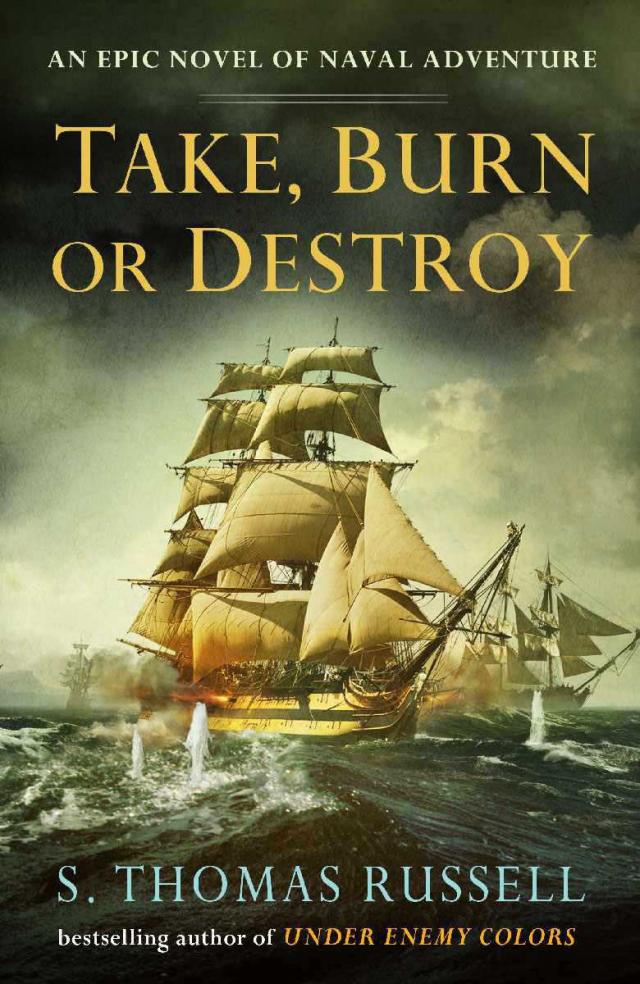


Finding the second ship in the murk, Hayden realised that his adversary would not dare to immediately change course to follow Hayden lest he run afoul of the ship emerging from Le Havre. It was a rare bit of luck that would see him jump ahead, for he was confident his crew could make sail more quickly than the French.
Aloft, the hands were making all possible sail, and the Themis heeled a little towards France, as though reluctant to let it go. And then the Themis was lifted on the wind, slipping into the rain-fog and morning gloom.
When sails were set and drawing, the master came puffing along the gangway, speaking trumpet tucked under an arm, a hand crushing down his hat as the wind freshened.
“We shall haul our bowlines, Mr Barthe. There is Pointe de Barfleur to be weathered, and do not tell me how distant it is. If we are forced to tack ship, we shall have two frigates upon us.”
“This wind will go into the north-east yet, Captain. See if it doesn’t. We shall easily lay our course for Tor Bay. By midday, sir, I will wager.”
Barthe had been involved in sufficient wagering so Hayden did not take this up, but he did hope the sailing master would be proven correct; reaching England was more than urgent.
Archer’s head appeared in the companionway, followed by torso, waist, legs, and running feet. He was gasping as he approached and only managed, “Your . . . orders, Captain?”
“We shall race these Frenchmen back to England, Mr Archer, and hope we have the luck to meet one of our own cruisers so we might turn things round on them. If that does not prove possible, we will attempt to fight these frigates off until we can reach the Channel Isles, though we must weather Barfleur to do even that. For now, we set everything she will carry and pray these Frenchmen do not know their business.”
The call “belay-o” reached Hayden. “Bowlines hauled, sir” came from the forecastle and Hayden went to the binnacle to discover their course.
“Not even nor’west by west,” Archer observed, following Hayden to the compass.
“Let us hope this wind veers, as Mr Barthe predicts.” Hayden turned his attention astern, into the drizzle and surface mist. A thin light began to penetrate the low-lying grey, revealing a dull, uneasy sea. A cool April northerly seemed to penetrate through his coat and whistled about his ears, which still rang from the blasting of the great guns.
Thin, grey daylight began to overspread the sea, revealing the coast of France, faintly charcoaled across the south and nearer than Hayden would like. In no direction was the horizon distant more than half a league. Beyond was obscured by rain and low, scudding cloud. Hayden went to the stern and, as he leaned his hands upon the taffrail, one of the French frigates emerged from a squall of rain. Aloft, French sailors could be seen setting top-gallants.
“Is that not the height of folly?” Archer wondered as he, too, came to the rail. “The horizon is less than half a league distant, and there is every sign that the wind is making and the squalls growing worse.”
“It is the height of folly, Mr Archer, I agree entirely. But if he overhauls us before there is another squall . . .”
“Shall I order top-gallants, sir?”
A second of hesitation. “I do not believe we have another choice, Mr Archer.”
The second frigate appeared at that moment, a little aft of and to leeward of the first. She was making sail in emulation of her sister. For a few moments Hayden stood at the rail, gauging the speed of the enemy ships. They were closing the gap, though there was some slight indication that the nearer frigate was a little faster than her sister—or so Hayden imagined. If he could but separate them by a league and a half, he would luff and bring this nearer ship to battle. If he could inflict enough damage on her rigging, he might gain some distance on them. But he hardly thought these Frenchmen would be so foolish. His only hope was that they would be separated by fog and he could act before they realised such distance had grown between them.
French ships, Hayden well knew, were reputed to be more lightly built than their British counterparts and notably faster, though Hayden was aware of enough instances of British ships chasing and catching French ships of similar rate that this argument did not impress him overly. The frigates in his wake, however, were larger and longer on the water line, and very likely did have a small advantage in swiftness. This advantage he hoped to overcome by seamanship and sail handling. In this, his father’s people did have an advantage, he knew, for the British ships and their officers and crews were at sea in all weather for much of any given year, whereas the French ships languished in harbour bottled up by the Royal Navy blockade. Though, as he had stated to Hawthorne, these particular French vessels might be exceptions to this, as at least one—and very likely both—had been raiding British commerce for some months, and doing it regularly.
For a few moments he stood at the rail, watching the chasing enemy, looking for signs of poor seamanship—poorly trimmed sails, an indecisive hand upon the helm, tardiness in the sail handlers, but he saw none of these things.
“She appears crack, does she not, sir?” Archer had reappeared at the moment after passing along the orders to Barthe and Franks. Clearly, he was thinking along the same lines as his captain.
“I am afraid she does, Mr Archer.” Hayden turned in a slow revolution, examining the brightening circle of sea within which his ship sailed.
“Mr Archer,” Hayden began after a moment’s contemplation, “I do believe I have made a mistake.”
“Sir?”
“Order Mr Barthe to belay setting top-gallants.”
Archer stood a moment; Hayden could feel him hesitating. “Aye, sir.” He went off at a run, calling out to Mr Barthe and to the men aloft at once.
Although Barthe complied immediately, he did not order the men down off the yards. He hastened aft to Hayden, who remained at the taffrail, his eye fixed on the French frigates.
For a moment Barthe did the same, saying nothing, but then could not hold his peace. “They will be upon us in a trice, sir.”
“Not if they are upon their beam-ends, Mr Barthe.”
Barthe turned his attention to weather. “It is a gamble, Captain Hayden. There have been squalls in quick succession and then long lulls between.”
“Let us hope I am not proven wrong. We shall luff through the squalls, Mr Barthe, and bear away the moment we are able. The French coast is too close for us to run off, and I do not wish to take in sail unless we must to save the ship.” Hayden turned to eye the coast, which was almost obscured in the low cloud and mist.
“Only the best helmsman shall have the wheel, sir. I will make certain they understand your wishes completely.”
“Thank you, Mr Barthe.”
The sailing master went off, calling out the names of the men he wished to take the helm.
Hayden could never remember wishing for a squall, but it was his most fervent desire at that moment. For half of an hour he kept watch on the chasing ships and the northern horizon, willing a squall to burst out of the rain and scudding cloud . . . but none did.
Standing at the taffrail watching the chasing ships, Hayden felt chagrined to the point of mortification. He had made an unconscionable mistake. He should have doused his lamps and lain silently in the dark and hoped the French frigate had not seen or slipped off before the French discovered him. Returning Monsieur Benoît’s intelligence to Britain had been paramount and he had foolishly let himself be drawn into an action with the French. He even wondered if pride had not been at work in this and he had not wished to appear shy before his crew—had even feared the Lords Commissioners might question his resolve. He cursed himself silently.
A bloom of smoke—quickly swept off to leeward—appeared at the bow of the nearer ship. A hundred yards aft of the Themis an iron ball splashed into the sea.
Among the crew there was shifting if not muttering. At sea, Hayden almost invariably made decisions quickly and with confidence, but this day he second-guessed himself at every turn.
Like a corpulent angel of doubt, the sailing master reappeared at his elbow at that moment.
“There is not a great deal of weight in this wind, sir,” he observed.
“Did you not tell me it would make and haul aft, Mr Barthe?”
“I fear I might be proven wrong, sir,” Barthe replied quietly.
“Let us hope not, Mr Barthe. Let us hope we are both proven right.”
But the wind appeared to be defying both Hayden and Barthe; it was neither increasing in strength, altering its direction, nor sending the hoped-for squalls and gusts that Hayden was gambling on. In the normal course of things, Hayden would never order top-gallants carried in such weather, but present circumstances could hardly be termed “normal.”
Again the French frigate fired her forward chase gun, the ball wounding the sea a little nearer than previously.
“Do you make it fifty miles to Pointe de Barfleur, Mr Barthe?”
“Nearer sixty, I should think, Captain.”
“Nine hours, then? Perhaps ten?”
“Just after dusk, sir, if this wind holds.”
“Will we weather it?”
The sailing master turned to look west, as though he could gauge the distance to the invisible point of France. “On this slant, sir? It will be very close run.”
This only confirmed Hayden’s own reckoning.
“I believe we could tack in this much wind, Captain,” Barthe observed, staring fixedly at the chasing ship.
“On deck!” came a call from aloft. “Gust in the offing.”
Hayden turned to windward and could see the tops of the waves being torn away in white spray, the sea rippling into fish scales as it did beneath a gust.
“Let us hope this presages our squall,” Hayden said quietly to the sailing master.
The helmsman gauged the progress of the gust, measured its moment of arrival to a nicety, and luffed just enough to shake the wind out of the sails, but not so much as to have them thrown aback. Running off, downwind, was the safest way to meet squalls, but with the mizzen sheeted flat and the mainsail set, the ship would not steer off, and it was often necessary to hand those sails, or at least let sheets fly, before such a turn could be made.
The sails shook and tossed their clews about, rattling the rigging. Even so, the gust heeled the ship over to leeward. Hayden turned to see the effect on the French and found them doing the same, though heeled much further down.
The length of the Themis’ deck, men whose attentions were not taken up by the present evolution stared, with great hope in their faces, at the heeling French ship.
“Carry away,” Barthe muttered, apparently placing a curse on the enemy’s top-gallant masts.
In a moment the gust withered away, and the helmsmen put their respective ships back on course, hard on the wind, as close as they could come without giving away speed. All along the deck there was a moan from the hands, and they turned away, back to their labours, with shaking heads.
Out of the companionway, the Reverend Mr Smosh appeared, pushing one arm into a woolen coat, then the other, settling the garment around his shoulders with a shrug. The doughy clergyman asked permission to approach the captain’s private area of deck and came to the rail beside Hayden and Barthe.
“Have you come to take the air, Mr Smosh?” Barthe asked.
“Indeed I have, and the sights, Mr Barthe. One should never miss the sights.” He paused to reflect. “In truth, my reading class has been superseded by the call of all hands. As I have no willing scholars this morning, and the doctor had no further use for me, I thought I might venture forth and see these French frigates I have been hearing much about.”
“Well, there they are, sir,” Barthe answered him, “as fine a team as you shall ever hope to see, I would venture.”
The clergyman stared at the pursuing ships a moment. “Have they not more sails than we carry? Three tiers to our two?”
“Courses, topsails and top-gallants, Mr Smosh, but the captain believes we shall have a squall by and by and then we shall be more evenly matched in sails, for some of theirs shall carry away.” Barthe turned to Hayden. “I thought that gust would convince these Frenchies to take in their top-gallants, but I see they have learned nothing from it.”
“I had hoped the same,” Hayden replied.
“Do they gain on us, then?” Smosh wondered.
“They do, Mr Smosh,” Hayden informed him, “though so little in these winds that one can hardly measure it. I have been observing the speed of the vessels, and it seems for a while they get a wind that carries them nearer and then, for a time, the wind will favour us. Only a few moments ago the furthest vessel appeared to be gaining on her sister, but now she seems to have fallen back somewhat. We could go on in this same manner until darkness finds us, or the wind could carry our enemy up to us within the hour. We will see who the winds favour.” Hayden had almost said “who the wind gods favour” but was reluctant to display such paganism before the clergyman.
Within the hour, the wind gods appeared to have made their decision in favour of the French, for the nearer ship began to lob shot very near the stern of the Themis, and Hayden had his own stern chase guns readied. Occasional gusts heeled the ships far over, though these were not so strong as to require luffing, though ships had a natural tendency to round up when so pressed. Squalls had ceased altogether, but rain and gusts were common, and the horizon never drew away beyond a league and it was commonly much nearer.
Noon saw the first French ball find the Themis, passing through the mizzen topsail and then the main topsail in turn. No other damage was reported, unless it was to the spirits of the hands, who became undeniably disconcerted.
The day’s full light never seemed to arrive, a dull near-twilight prevailing, the hidden sun’s glow never growing or lessening over the hours. Astern, the chasing ships appeared ominous and relentless, bearing down on them with a predatory determination. To Hayden, there seemed to be no human agency involved but only an unswerving, malevolent will. For someone who had commonly been the chaser, this was a feeling both singular and deeply unsettling.
A liquid bloom of grey-black enveloped the chasing ship’s bow. The iron ball howled by scant yards to starboard, the report pealing in its wake.
“Mr Archer,” Hayden addressed the young lieutenant, who hovered nearby. “Let us return fire.”
The watch warned of a gust just then and the ship heeled to the wind, which whipped about them, pressing the ship over and causing the men at the helm to struggle with the wheel on a slanting deck. The sails appeared to stretch, tight as drum skins, pregnant and slick with rain.
“Luff!” Barthe ordered the helmsmen. “Luff! Let run the foresail’s leeward sheet!”
The ship heeled, pressed down by the wind. A cracking of timber and shaking of sail alerted Hayden, who turned in time to see the Frenchman’s main and fore top-gallant masts go by the lee at almost the same instant.
A squall of wind struck the speeding ships, shaking anything that was loose and whipping the pennants at the masthead so that they curled and cracked. Hayden saw the French cruiser rounding up into the wind, and then she was absorbed into the curtaining rain. Whether she had been caught aback he could not tell.
The clew of the Themis’ mainsail flailed the air, threatening man and ship, until the wind relented and let the over-pressed and straining ship back onto her feet. She began to race on, the beam-sea lifting and lowering her in a plunging, ponderous rhythm.
The men on deck all cheered, as though they had been responsible for the enemy’s ill luck. In that instant, their spirits lifted notably.
Hayden left the taffrail and went with the sailing master and Archer around the ship.
“We are stretching these shrouds, Mr Barthe,” Hayden observed as they came to the standing rigging which supported the mainmast, “if we get upon the other tack, have Mr Franks employ his top-burton tackle and set them up properly again.”
For a moment all three looked up into the rigging at the straining sails, the rain driving to leeward and splattering against sailcloth and wooden deck.
“How much longer do you think we can carry our mainsail, Mr Barthe?” Hayden asked so that only the sailing master and Archer could hear.
Barthe shaded his eyes from the driving rain and gazed up. “I would have it off now if we had no Frenchmen in our wake.”
Hayden was of the same opinion, and Archer nodded agreement. “Do you think they were caught aback?”
“The Frenchman?” Barthe contemplated this a moment. “I couldn’t rightly say, Captain. The rain and mist closed over just as her masts went by the board. Perhaps not. I could not see her companion at that moment. Certainly, she might have all her masts standing yet.”
Hayden looked up at the straining sail with some misgiving. “Let us carry the mainsail as long as we dare, then.”
Hayden was sorely tempted to tack, trusting to the lack of visibility to hide them from the enemy—and throwing them off his trail entirely—but he was afraid they would pass close enough to one or the other of the chasing ships that they would be seen, and tacking in so much wind carrying all this sail was a dubious endeavour. Keeping on as he was appeared to be the only sensible course of action, for France was still ominously close to leeward. The thought that he bore information that might prove critical to the defence of England weighed upon him. Above all things, he needed to get into an English port, but he dare not let that push him into doing something reckless that might lead to the loss of his ship. He cursed himself now for engaging the enemy and not attempting to slip away. If what Benoît had told him was true, then certainly that knowledge was worth a hundred French frigates. Before he had been concerned that the Lords Commissioners of the Admiralty would think this reported invasion unlikely and judge him shy for not engaging the frigate; now he wondered if they would not think him a fool for not racing back to England with Benoît’s information and upbraid him for avarice and prize hunting when clearly the other matter was of critical importance.