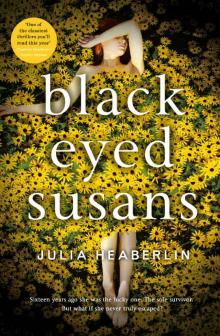
Black-Eyed Susans, page 9


“That’s great, Jo.” There is weary relief in Bill’s voice.
His tone reminds me that he is pushing a truck of bricks uphill every day with one hand and dragging me behind him with the other. This morning, I’d reluctantly agreed to ride along to meet the “expert” who is poring over my teen-age drawings. The detour to Jo’s office was a last-minute surprise, and welcome. I could breathe freely for a few more minutes before I started inspecting the swirls in a curtain for a face. That is, I could breathe if my eyes stopped wandering to that heart in a box.
“That was my boss on the phone,” Jo continues. “As we speak, the DNA of those two girls is being input into the national missing persons database. I don’t want to get your hopes up. It’s a useless hunt, obviously, if the families of the victims haven’t also placed their DNA into the system for a match. The database wasn’t even around when these girls went missing. Their families have to be ones who haven’t given up hope, who are still bugging police and on their knees praying every night. You two are most definitely not on a movie set with Angelina Jolie, and please don’t forget it.”
I wonder how many times she has repeated this. Hundreds. Thousands.
Her left hand is doodling a drawing on the edge of a magazine. A DNA strand. It has tiny shoes. I think it is jogging. Or dancing.
“Six weeks until D-Day,” Bill says. “But I’ve had less at this point with other cases and landed on top. Tell everybody thanks for persevering. Any detail about those girls’ identities could provide more reasonable doubt. I want to pile it on at the hearing.”
Jo’s hand pauses. “Tessa, do you know anything about the forensic use of mitochondrial DNA? I’d like you to understand what we do here.”
“A little,” I say. “It comes only from the maternal side. Mother. Grandmother. I … read … that you were able to use it to identify the bones of one of John Wayne Gacy’s victims thirty years later.”
“Not me specifically, but this lab, yes. William Bundy. Otherwise known as Victim No. 19, because he was the nineteenth victim pulled from the crawl space under Gacy’s house in Chicago. That was a very good day for his family. And science.”
John Wayne Gacy. Put to death by lethal injection in 1994, a month and a half before my attack.
Jo’s pen is moving again. Dancing DNA guy now has a partner. With high heels. Jo sticks the pen behind her ear. “Let me give you the twenty-five-cent science lesson I deliver to my sixth-grade tour groups. There are two kinds of DNA in our cells: nuclear and mitochondrial. Nuclear DNA was the kind used way back in the O.J. trial, and, by the way, if you have a scintilla of doubt, they had him dead to rights. But that was a fresh crime scene. For older bones, we have come to depend on mitochondrial DNA, which hangs around longer. It is tougher to extract, but we’re getting better all the time. You’re exactly right: It remains identical in ancestors for decades. Which makes it perfect for cold cases, like this one. And really cold cases, like, say, the Romanovs, where forensic work finally disproved the myth that Princess Anastasia escaped from that cellar where her family was slaughtered. Science was able to prove that anyone who claimed to be her, or descended from her, was a liar. Another great case. It rewrites history.”
I nod. I know plenty about Anastasia. Lydia had been fascinated with all of the romantic conspiracy theories—the ten women who claimed to be the only surviving daughter of Nicholas II and Empress Alexandra, who were executed with their children by the Bolsheviks, like dogs. I’d also watched the convoluted, sanitized, entirely imagined, happily-ever-after Disney version of Anastasia while babysitting my six-year-old cousin, Ella. “Are you a princess, too?” Ella had asked when it was over. “Weren’t you the girl who forgot?”
Bill moves restlessly. Impatient. “What about the hair, Jo?”
“Still in process. A little more red tape than we thought before we got the police to turn it over. Separate evidence box.”
“The hair?” I ask. “What hair?”
“Do you really still not know the details of the case?” Bill asks impatiently. “The hair is one of two pieces of physical evidence used to convict Terrell. They found it on the muddy jacket on the farm road.” Muddy jacket. Bloody glove. Suddenly I was back in O.J. Land.
“I’ve made it a point not to read much about the case,” I say stiffly. His frustration with me hurts. “It was a long time ago. I was only in that courtroom when I testified. I don’t remember a hair.”
Jo is examining me carefully, her pen stilled. “The hair was red.”
My hair.
“It was brought up at the last minute at trial. The prosecution expert examined it under a microscope and testified that it belonged to you. He was just one hundred percent damn sure it came off your head. It was the kind of junk science used back then. It is impossible to match a hair to a specific person by looking at it under a microscope. The only way is through DNA analysis. Which we are now doing.”
Yet … only 2 percent of the population has red hair. My grandmother had drilled that into me. First, after she caught me hacking off my orange locks with scissors at age four and then again six years later when I tried to dye it gold by squeezing thirteen lemons over my head and sitting like a piece of salmon in the Texas sun.
Red hair was something else that made me lucky. Special.
“I know about the jacket, of course,” I say steadily. “I know about the ID from the person who saw … Terrell … hitchhiking by the field. I just didn’t know about the hair.” Or I forgot.
Bill stands abruptly. “Maybe you also don’t know that seventy percent of wrongful convictions overturned on DNA involve eyewitness misidentification. That the jacket found on the road was a size too small for Terrell. And the red hair on the jacket? It was stick straight. If your school pictures are any indication, you looked like you were growing Flamin’ Hot Cheetos curls. It could have been a poodle hair, for Christ’s sake.”
Poodles have curly hair. And I don’t think red poodles exist. Although Aunt Hilda once dyed hers blue.
But I understand his anger. The need to lay it on.
I know what he’s thinking, although he isn’t saying it out loud. The real reason Terrell Darcy Goodwin lost the last seventeen years of his life isn’t because of a red hair or a jacket tossed carelessly by the side of the road or a woman who thought she could see in the dark while she was whizzing by in her Mercedes.
The real reason Terrell Darcy Goodwin sits on Death Row is because of the Black-Eyed Susan who testified, scared out of her mind.
Tessie, 1995
I can’t wait to tell him.
“I know that last week was rough,” he begins. “But there are only a couple of months left before the trial begins. That’s a very short time to learn what you do or do not know, and help you feel prepared.”
Fifty-nine days, to be exact.
“We should reconsider light hypnosis,” he says. “I know how you feel about it, but there are things lying in the shadows. Just inches away, Tessie. Inches.”
We had a deal. No drugs. No hypnosis.
My heart is slamming, my breath rapid, like a hot cat on the driveway. Like the time I ran three miles full out in the park last August, and Lydia had to yank the emergency paper bag out of her backpack.
Lydia, always there, always calm. Breathe. In and out. In and out. The paper bag, crickling and crackling, puffing and collapsing.
“What do you think?” he persists. “I’ve talked with your father about this.”
The silence between this threat and his next sentence is going to kill me. I’m trying to remember where I usually focus my eyes. Down? Up? At his voice? It’s important.
“Your father says he won’t support hypnosis unless you want it,” he says finally. “So this is between us.”
I’ve never loved my father more than this moment. I am filled with the relief of it, this simple, profound gesture of respect from the man who has watched his flame-haired daughter who believed she could beat the wind shrink to skin and bones and bitterness. My father holds up my future like a banged-up trophy that still means something, no matter how heavy it gets.
He is sitting outside this door, fighting for me. Every single day, fighting for me. I want to run out there and throw myself in his arms. I want to apologize for every silent night, every carefully prepared meal not eaten, every tentative invitation I have refused: to rock on the front porch swing or go for a walk or head up to Dairy Queen for a dipped cone.
“Our goals are the same, Tessie,” the doctor says. “For you to heal. Justice is part of the package.”
I haven’t uttered a word since I walked in the door. And I had planned to say so much. Tears hang in my eyes. What they mean, I don’t know. I refuse to let them fall.
“Tessie.” Going in for the kill. Corrupting my name into an order. Reminding me that he knows better than I do.
“This could help you see again,” he says.
Oh.
I want to laugh.
What he doesn’t know, what nobody knows yet, is that I already can.
Tessa, present day
I could have lived very happily with the idea of never, ever again. Never again plunking down on a therapist’s couch. Never again thinking about my manipulative drawings of the girl running in the sand and the girl without the mouth. Never again fighting this sick feeling that the other person in the room wants to take a paring knife and slowly carve out my secrets.
Dr. Nancy Giles almost immediately ushered Bill out the door, politely telling him he would be in the way. Actually it wasn’t all that polite. The fact that she is a beautiful gazelle-like creature probably took the edge off. Bill grumbled about being banned in such a little-boy manner that it made me think the two of them had known each other intimately for a long time, although he failed to mention it on the ride over.
My grandfather once told me that God puts pieces in the wrong places to keep us busy solving puzzles, and in the perfect places so that we never forget there is a God. At the time, we were standing on a remote stretch of Big Bend that was like a strange and wondrous moon.
Dr. Giles’s face may be the human equivalent, a glorious landscape of its own. Velvet brown skin with eyes dropped in like glittering lakes. Her nose, lips, cheekbones—all chiseled by a very talented angel. She understands her beauty and keeps things simple. Hair cropped into a bob. A well-cut blue suit with a skirt that strikes her mid-knee. Gold strings dangle from her ears, with a single large antique pearl at the end of each that dances every time she moves her head. I guess her age to be creeping toward seventy.
Her office, though, is like the favorite fat uncle who wears loud shirts and offers up a slightly smashed Twinkie from his pocket. Walls the color of egg yolk. A red velour couch, with a stuffed elephant plunked in the corner for a pillow. Two comfy plaid chairs. Low-slung shelves shooting out a riot of color, crammed with picture books and Harry Potter and Lemony Snicket, American Girl dolls of every ethnicity, trucks and plastic tools and Mr. and Mrs. Potato Head. A table topped with a tray of markers and crayons. An iMac at i-am-a-Child level. A refrigerator door riddled with the graffiti of children’s awkward, happy signatures. Off to the side, a basket loaded with snacks both forbidden and polyunsaturated, and no mother to smack your hand.
My eyes linger on the framed prints—not your usual doc-in-a-box muted abstractions. Instead, Chagall’s magical, musical animals and the loveliest blue ever imagined. Magritte’s steam engine shooting out of a fireplace, and his giant green apple, and men in bowler hats floating up like Mary Poppins.
Perfect, I think. If anything is surreal, it is childhood.
“My usual customer is a little younger.” Dr. Giles says it with good humor. She has misinterpreted my roving eyes, still on the hunt for my own grim artwork. I tell my nerves to shut up, but they don’t. My sweaty hands are probably stickier than the five-year-old who skipped out of the room with a dripping green Popsicle right before I stepped in.
“I’m not sure we can accomplish exactly what William wants, are you?” She has placed herself on the other side of the couch, crossing one knee over the other, her skirt inching up slightly.
Relaxed. Informal.
Or purposeful. Rehearsed.
“William has always set near-impossible goals, even when he was a boy,” she continues. “The older I get, and the more horrors I’ve seen, my goals have become … less specific. More flexible. More patient. I like to think that is because I am wiser, not tired.”
“And yet … he brought me to you,” I say. “With a deadline. For very specific reasons.”
“And yet he brought you to me.” Her lips curve up again. I realize how easily that smile could melt a child, but I am no longer a child.
“So your plan is not for us to look at my drawings together.”
“Do we need them? This is going to disappoint William, but I don’t think you wrote the killer’s name in the waves in the ocean. Do you?”
“No.” I clear my throat. “I do not.” I wasn’t sure whether this was true. One of the first things I did the night after my sight returned was to examine every swirl of the brush. Just in case. Who knows what the unconscious mind will paint? Lydia had asked rather dramatically.
“I find that drawings after a trauma like yours are often widely misinterpreted.” Dr. Giles reaches for the stuffed elephant tucked behind her, which is preventing her from leaning back. “There is a lot attached to the use of color, and the vigor of the pen. But a child may use blood red in his drawing simply because it’s his favorite color. The drawing only represents the feeling on that day, at that very moment in time. We all hate our parents on some days, right? A scratchy, angry version of a father doesn’t mean he is an abuser, and I’ll never testify to things like that. So I use the drawing technique, but mostly as a way to allow young patients to get out their emotions so they don’t eat away at them. It is much, much harder to say the words. I’m sure I don’t have to tell you that.”
“Dr. Giles …”
“Please. Nancy.”
“Nancy, then. Not to be rude … but why exactly did you take Bill up on this request? If you don’t believe there is really anything there to talk about.” Does she know that more than half of my drawings are faked? Do I need to tell her?
Jo’s chilling, detached lesson on bones, that damn heart in a box, the pink elephant perched beside us who knows way too much about the terrible, terrible things people do—it’s about all the reality I can take today.
In an hour and a half, I will be planted in the stands at Charlie’s volleyball game, surrounded by weary moms who will scream their throats raw, where the most important thing isn’t worrying about the Middle East’s urgent signs of Armageddon, or the 150 million orphans in the world, or glaciers melting, or the fate of all the innocent men on Death Row.
It will be whether a ball touches the ground.
Afterward, I will pull a bag of carrot sticks out of the refrigerator, throw four Ham & Cheese Hot Pockets in the microwave, one for me and three for Charlie, toss in a load of clothes, and attach white gauze to lavender silk. These are the pricks of light that have kept me mostly sane, mostly happy, day after day.
“Don’t misunderstand me,” Nancy is saying. “I’m not at all sure your drawings are meaningless. Your case is … complicated. I very much appreciate your permission to view the doctors’ notes on your sessions. It was helpful, although the notes from your last doctor were a little sparse. You were blind when you created many of those pictures, correct? Your doctor at the time clearly thought you were faking most of them.” So she knows. Good. “He also believed that the two of you explored every avenue when it came to figuring out the drawings of the curtain. The drawings that were, essentially, the ones that you declared spontaneous and genuine.”
She glances down at the beeper vibrating at her waist, checks the number, silences it. “So there are many reasons to discount the drawings. At least that was your doctor’s assessment. Would you agree?”
“Yes.” My throat is dry. Where was this going? And a random thought, Should I have ever asked to see the doctor’s notes?
A Susan quickly chimes: You don’t want to know what he said.
“Of course, it’s always a little hard to know exactly what we are faking,” Dr. Giles continues. “The subconscious is busy. The truth tends to creep through. I am, of course, drawn to the curtain. It reminded me of a famous case history that I thought would be worthwhile to share. It’s ironic, or a sign if you believe in those, but the girl’s name in this other case history is also Tessa. Her name has probably been changed and her story is far different, of course. She was a young girl who had been sexually abused in her home but was far too traumatized to name her abuser. The young girl drew a cutaway picture of her two-story house, so her therapist could see inside. She drew a number of beds on the top floor. The child said the beds were for all the many people living in the house. She drew a living room downstairs, and a kitchen with an oversized teakettle. But instead of asking the girl about the beds, the therapist asked the girl about the teakettle and why it was important. The girl told her that every morning, each member of the house would pour hot water out of that kettle for instant coffee as they left for school or work. So, using the teakettle, the therapist took the little girl through that awful day of the abuse. Tessa remembered, one at a time, who had used the teakettle that morning before leaving the house. The one person remaining, who didn’t use it, is the one who stayed alone in the house with her. The abuser. The girl was then able to tell the story of what happened to her.”
Against my will, this woman has mesmerized me.
“I can’t know for sure,” she says gently. “But I believe your ordinary object could be a similarly powerful tool. It belongs somewhere. We need to look around that place. If you like, we can try some exercises.”
My head pounds. I want to say yes, but I’m not sure I can. Nothing, nothing, is ever what I expect.