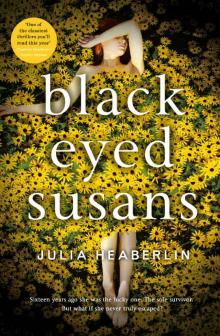
Black-Eyed Susans, page 29


I overheard him make a call to two of his salvage yard pals. He was paying them to gas up the doctor’s rental car and return it.
No matter how hard I try, I can’t get warm.
It seems like a million years ago that I stood behind a shed and watched him bury flowers under Tessie’s tree house.
Now my parents are on the couch making a plan and I’m out here in my back yard doing a little burying of my own. I’m calling it the little box of Bad Things. The key to the cabin that I forgot to leave on the counter. Tessie’s ring that I stole and stuck in a corner of my jewelry box because it was bad luck for her. My favorite Edgar Allan Poe book, because I thought I heard it ticking tonight on the shelf and I wasn’t going to live with that the rest of my life. I’m not ever going to be crazy like Tessie.
Tessa, present day
2:53 A.M.
She’s crazy. Lydia is crazy.
When should I have known? As soon as she sat down beside me in second grade with her red glitter pencils sharpened like ice picks?
She’s prattling now, like Lydia always does when she tells the truth, about Keats and the sky cracking over the lake and how the last thing I saw of him was a bald spot like a big mosquito bite and then black, black, black.
The doctor. My monster. Her lover.
At the bottom of the lake. The one where I taught Charlie to slalom. She probably skied right over him.
He was always dead.
Relief, flooding me. Realization, rocking me to hell.
I’m the one who kept my monster alive.
My best friend let that happen. Let me suffer. Let Terrell pay for what he did not do.
Lydia, a greedy flower. More like a black-eyed Susan than any of the girls in that grave. Controlling. Thriving in devastated soil.
“I watched him plant black-eyed Susans under your tree house four hours after we made love for the last time,” Lydia is saying smoothly. “I found them in little plastic pots under his cabinet and then I followed him and watched him dig the hole. You don’t have to hit me over the head.” She giggles.
He will never touch my daughter, I’m thinking.
He is bones.
Lydia loved him.
“You look strange, dear,” Effie says. “Tired. You should sit.”
“The flowers …?” I stutter at Lydia.
“Yes?” Impatient. Waiting for something.
Gratitude. Lydia’s waiting for gratitude. I strain against a flood of anger and disbelief. She held my sanity hostage for seventeen years and would like to be thanked for it. I feel a rabid urge to slap her, to tear at her shiny fake hair, to scream why until Effie’s old house shakes on its foundation.
Lydia is already restless, and I need to be sure. “Lydia,” I start again. “If he’s dead … who kept planting black-eyed Susans for me all these years?”
Her eyes steady on mine. “Are you accusing me? How should I know? They’re just flowers, Tessie. Are you still freaked out by a PB and J, too?”
“Liz’s job has not a thing to do with planting,” Effie interjects. “It’s Marjory Schwab over at the garden society who’s in charge of wildflowers. And it’s Blanche something who provides the sandwiches. Or maybe her name is Gladys. And it’s Liz, not Lydia, dear.”
“It’s OK, Effie,” I say.
Lydia dabs a napkin at her lips. More pretend. She hasn’t taken a bite of whatever Effie lump is on the plate in front of her. “I know you’re mad, Tessie. But perfect murders don’t just happen. Timing is everything. It was very O.J. of me to keep my shirt, don’t you think?”
“That’s … his blood on the shirt,” I say slowly. “The night you killed him.”
“Did you not finish the journal?” she demands. “I gave you forty-five minutes.”
My mind is shutting her out. Focusing like a laser on the one thing that is still important. That can still be fixed. Terrell.
The doctor’s blood on the pink shirt. The fetus in the grave. Aurora’s DNA.
All connected. Science that could help free Terrell. If Lydia is telling the truth, the blood on that shirt links them all. The doctor not only fathered Lydia’s daughter, but the child of a murdered Black-Eyed Susan.
“Aren’t you going to ask me why I’m here?” Lydia sounds plaintive, just like she did at ten and twelve and sixteen. “I have three years of research about the doctor out there in the shed. Colleges he taught at. Girls who disappeared while he was there. Circumstantial, but it ties up pretty nicely. And we’ll get them to drag the lake, of course. And I’ll let them interview me but I’ll be too devastated to share everything.” She’s giddy with her Lydia-ness. “I showed up for a reason, Tessie. The last-minute stay will be a fantastic way to end my new book. Even if they kill him, I’m a hero for trying. The book’s all about the other surviving Black-Eyed Susan. Me. I tell it like a modern feminist fairy tale. You’ll love it. The point being, the monster gets it in the ass.”
“I’m beginning to think you are not with the historical society,” Effie says.
Lydia is sticking her fork into a piece of Effie’s cake. It’s almost to her lips.
I don’t stop her.
For the first time in a long time, I feel hope. Like a cool wind has whistled my head clean.
The monster, 1995
October third, nineteen hundred and ninety-five, 1 P.M.
Cheers to O.J., who just walked out of court a free man.
It’s our final session. Tessie’s got that telltale flush in her cheeks. She’s upset.
Her itty-bitty scar stands out on her tan like a new moon in a sky of freckles. No makeup covering it up today. I like that. A sign of restored confidence. The nuclear emerald eyes are sharp and focused. That glorious copper hair is pulled back flat against her skull like she’s about to run a race. The muscles in her face are taut and purposeful, not a limp bag hanging off bone like the first day she walked in here. She’s still biting her nails but she’s painted them carefully with a lovely lavender polish.
I want to tell her so many things.
How I intended to tear her apart, but it was much, much more thrilling to put her back together.
How Rebecca was both a flippant lie I told a lazy reporter and a metaphor for everything. Rebecca is the ghost who kept me company on the worst night of my life. She is every wife and daughter I will never have and every special girl who sat down in my class, lifted her eyes, and did not glimpse her fate.
I want to tell Tessie that sometimes—many times—I am sorry.
I want to finish that story I started about the sad boy who walked to a lonely house after school and turned on the heat.
Tessie had been worried about that boy, I could tell. When she’s sad, her face always crinkles prettily, like origami.
That boy’s mother always left a horrible surprise for him to find while she was at work. A dead baby bird on his pillow. A live water moccasin in the toilet. A cat turd in the Twinkies box. Gags, she called them.
The Saturday night that he put twenty crushed pills into his mother’s cheap red wine, she fell asleep on page 136 of Rebecca. Daphne du Maurier. She pronounced it doomayer, like the fat clod she was.
He had plumped up her pillow, flipped on the air conditioner to high in the middle of winter, and read the whole book before he called the police and told them she’d been suicidal for months.
“I saw you with her.” Tessie is taunting me.
I want to put my hand on Tessie’s knee to stop its jackhammering.
I want to place that well-thumbed book in her hand.
I want to tell her that red flowers, not yellow ones, had a special meaning for Rebecca.
I want to tell her that very soon, I’m going to run my finger over the butterfly tattoo on her hip. The one just like Lydia’s.
Epilogue
* * *
Imagination, of course, can open any door—turn the key and let terror walk right in.
—Lydia, age 16, reading In Cold Blood under the bridge in Trinity Park, waiting for Tessie to finish her run, ten days before the attack, 1994
Tessa
One at a time, the pieces have come forward, like shy girls stepping up to dance.
Lydia admitted to a cold-blooded killing and to a relationship with the doctor, but never to planting the black-eyed Susans in her back yard or at my old apartment or nestled by my grandmother’s dead tomato vines or under the bridge that roared like an ocean.
If that’s true, the doctor planted flowers exactly once, the first time. The wind and a death penalty nut were responsible for the rest. I allowed a diabolical gardener to live in my head for more than a decade. Like the Brothers Grimm, I ascribed power to an ordinary, innocent object. Oh, the hell that can be wrought from a hand mirror. A single pea. A one-eyed flower.
I remembered the T-shirt Merry was wearing, one morning while I watched Charlie eat Frosted Cheerios out of a yellow cereal bowl that used to be my mother’s. Welcome to CAMP SUNSHINE, the shirt read, except the dirt and the blood obliterated everything but the SUN. S-U-N. My desperate mnemonic device naming the mothers of those girls was just a brain chip gone haywire. A survival tool, Dr. Giles says.
Dr. Giles tries to convince me every other session that the Susans in my head weren’t real. I’ll never believe her. The Susans are about as real as it gets. I used to lie awake at night imagining my mind as my grandfather’s house, with passageways and dark rooms seeking a candle and Susans sleeping and waking in all of the many beds. Now the moon is pouring like melted butter through those windows. The floors are swept. The beds are made. The closets emptied.
The Susans have flown from my head, but only because I kept my promises. That was my grandfather’s one survival tip if I ever found myself trapped in a fairy tale. Keep your promises. Bad things happen if you don’t.
The bones of the two other Susans in that grave have been officially identified as Carmen Rivera, a Mexican foreign exchange student at University of Texas, and Grace Neely, a cognitive studies major at Vanderbilt. The earth’s code turned out to be remarkably accurate. Eight other unidentified girls in morgues in three states have been linked to Lydia’s meticulous research.
To my relief, Benita Alvarez Smith does not peer out of any picture lineup except the one in her church’s directory. Lucas tracked her down for me. She’s a happily married mother of two in Laredo who’s meeting me for coffee when she’s in Fort Worth next month to visit her parents.
The best part, of course, is Terrell. Lydia’s encyclopedic research set Terrell free. That, and the DNA match between her shirt and the fetus, created enough reasonable doubt for a state court to halt the execution and release Terrell six weeks later. I was worried that three days wouldn’t be enough time to brake the Texas death train. Bill declared that, on Death Row, three days is an eternity.
So now Terrell is tearing out hearts on talk shows, reassuring people about a purposeful life, God, forgiveness, all the things that should not fall out of the mouth of a man who was the innocent victim of a racist system. Off camera, Terrell confines himself to one room, keeps the shades drawn, sleeps best on the couch, so far unable to wean himself from claustrophobia.
He’s also collecting $1 million in compensation from the state of Texas and a guaranteed $80,000 annuity every year for life. Who knew that the state that executed the most people also was the most generous in compensating for its errors?
Charlie and I miss Effie. She Skypes us in pink plastic curlers, mails food bricks without regard to the cost of postage, keeps up the good fight with her gremlins. The new owners next door painted her house a non-historical Notre Dame blue and gold. The three tiny human terrors they brought with them have ripped out every bit of Effie’s landscaping. Charlie politely refuses to babysit for a standing offer of $20 an hour.
Jo continues her battle with a never-ending supply of monsters, throwing on her white lab coat every day and grinding up the bones of the lost. We’ve become running buddies, and more. The night before Lydia’s grand appearance, she had dropped by. She unfastened her gold DNA charm necklace and looped it around my neck like an amulet of protection.
I spend a lot more time than I’d like to admit thinking about Lydia Frances Bell aka Elizabeth Stride aka Rose Mylett. She makes her home in England, where she lives with her two cats, Pippin and Zelda. At least that’s what it says in the bio on the back of her New York Times bestseller, The Secret Susan. Charlie is reading Lydia’s book on the sly. Let her do it, Dr. Giles insists.
Charlie and Aurora text regularly. They started following each other on Facebook after the media coverage that threw all of us into a boiling soup for two months. Aurora’s had a sucky life, and I haven’t, Charlie tells me, as if defending the relationship. She wants to be a nurse. Her foster parents just bought her an old yellow Bug. She’s still hoping her mom will pick up the phone and call.
Their relationship makes me happy, and uneasy.
My gaze is stretching as far as it can over the sloshing, murky Gulf. I’m thinking about how to paint it. With dark, reckless abstract strokes? With a brilliant Jesus sky resurrecting everything that lives under the surface?
Jesus isn’t a sunburst today. There was a shark attack an hour ago, so there are only a few spots of brave color in the water. It’s cloudy. The water is leaden and impenetrable, like it often is in Galveston even when the sun is shining. The sand is littered with seaweed that makes it feel like you are walking barefoot on a thousand snakes.
My daughter and I return to this rickety rental house for a week every summer anyway. The hard, chunky sand is perfect for castle building. The sunsets are worth every second of still watching. At night, you can plunk down on the seawall and count the fish jumping out of the water in the moonlight. It’s an island, ugly and beautiful, with a history as deep and dark and quirky as ours.
For the first time, we tentatively invited company. Bill may drop by this weekend. I’m on the deck, watching Charlie run along the water’s edge with her friend Anna, whose mom has been whisked to a three-month rehab for her Big Gulp Diet Coke and vodka habit. No one passing by would guess that anything tugs at either of these teen-agers. They are kicking at the surf, laughing, their chatter mixing it up with the seagulls.
Reminding me of two other girls.
Before Lydia hopped a plane, she told the police a serpentine and wholly convincing tale about the night she took out the Black-Eyed Susan killer. Self-defense. Rape. Manipulation by her parents. The police have never considered filing charges. When they stumbled across the same online psychological journal pieces I did, written under the doctor’s name, Lydia freely admitted penning them herself. “It made me feel less like his victim to use his name,” she told them. “I can’t explain it.” So they even let her off the hook for that.
Anti-death-penalty advocates are still trying to goad Terrell into suing her. The female talk show hosts who chatter in silly tribal circles don’t like that Lydia cashed in. Domestic violence groups remain staunchly behind her. She was a teen-age girl sexually manipulated by a killer. Either that, I think, or the other way around. Much has been made about the doctor’s cleverness. The risks he took to thwart the process. His ability to fool a district attorney and a devoted father. The way he snaked onto a list of doctor candidates so I’d choose him myself.
I lock my rage in a place I go less and less often. I use the tricks he taught me. When I do let him crawl into my head, he is very much alive. Sitting under that Winslow Homer painting with his legs stretched out, waiting for me. Slithering in the dark along the lake bottom. They’ve dragged parts of Lake Texoma with high tech equipment three times now, unearthing the skulls of a fifty-something unidentified woman and a two-year-old boy who went under last fall, but not the remains of a monster.
Of course, it makes me wonder.
If almost every word out of Lydia’s mouth was a lie.
If her pockets are full of seeds.
If Lydia and I are really finished.
Just in case, I hold on to a final weapon. Her diary. I’ve curled her notebook into my old hidey-hole in the wall of my grandfather’s basement. I won’t hesitate to pry open that tomb if I need to. Bring all of her darkness and vanity up to the light. Let Lydia’s own words vanquish her. Strip her back down to the pale, weird little girl no one wanted to play with but me.
I do go to sleep certain about one thing.
Wherever Lydia is, alone with her pen or lying on soft sands or stretched out in a field of flowers, the Susans are quietly building their new mansion in her head, brick by brick.
THE END
Look, you shoot off a guy’s head with his pants down, believe me, Texas ain’t the place you want to get caught.
—Lydia and Tessie, 14, watching Thelma and Louise, hanging out the back of a pickup at the Brazos Drive-in, 1992
Acknowledgments
This book took an army of kind, brilliant human beings—scientists, therapists, and legal experts—who generously advised me about cutting-edge DNA science, the impact of psychic trauma on teen-agers, and the slow path to a Texas execution.
Mitochondrial DNA whiz and Oklahoma girl Rhonda Roby consulted on Black-Eyed Susans over text, phone, email, and beer. She also shared her profound experiences identifying victims of serial killers, the Vietnam War, Pinochet, plane crashes, and 9/11. She stood with some of the best scientists in the world at Ground Zero in the days after the attack, and spent years getting answers for families. Her personality, expertise, and humanity are woven throughout this book. And that crazy deer story? It’s true. Rhonda now works a dream job as a professor at the J. Craig Venter Institute.
The University of North Texas Center for Human Identification in Fort Worth is represented with a little fictional license, but not much. Its mission, under Arthur Eisenberg, is beyond imagining—to put names to unidentified bones when no one else can. Law enforcement agencies from all over the world send their coldest cases here. And, yes, UNTCHI did identify one of the unidentified victims of serial killer John Wayne Gacy thirty-three years after his remains were dug out of a crawl space under a Chicago house.