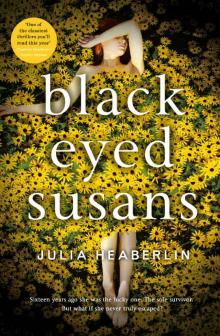
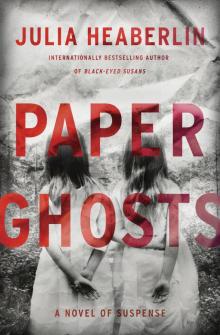
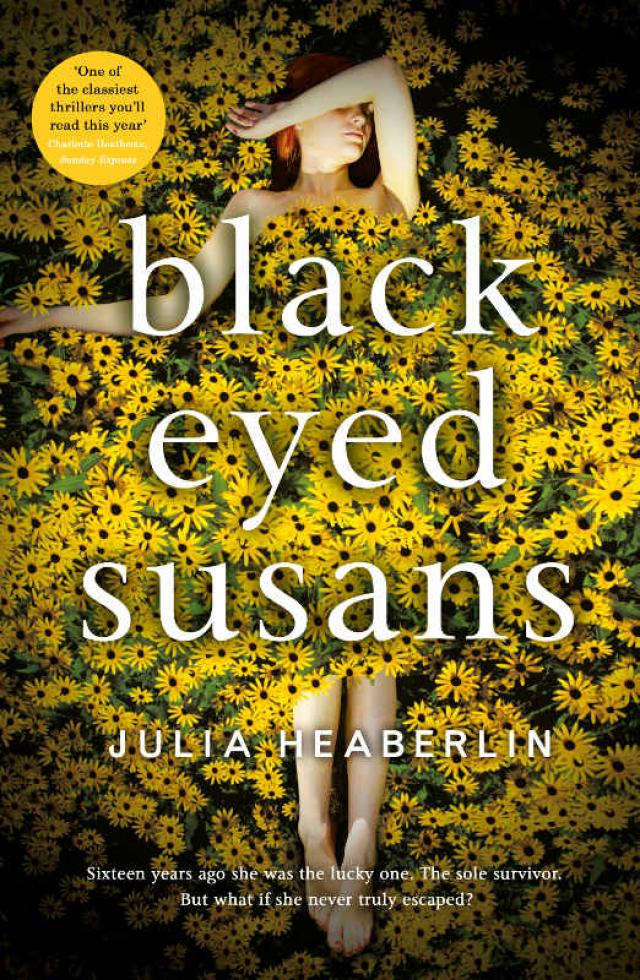
Black-Eyed Susans, page 12


“I’m not going to ride with Anna’s mom anymore,” Charlie announces.
The swing. Hypnotic. Keep talking.
Her phone starts to blare a song I don’t recognize. Instantly, Charlie stretches for it.
“Can I spend the night with Marley?”
She’s already edging off the swing, away from me.
“I love this place. Nothing like Saturday night at the Flying Fish.” Jo is lifting a giant frosty schooner of beer to her lips. She’s sporting old Levi’s and a red Oklahoma Sooners T-shirt and the gold DNA charm at her neck that goes with everything.
Bill has just returned from the counter with a basket of fried oysters and hush puppies for us to share. He’s loose, in old jeans, more relaxed than I’ve ever seen him. His shirt is untucked. He needs a haircut. He scoots across a giant schooner of St. Pauli Girl for me. His fingers linger longer than they need to, which I decide to chalk up to the beer. This schooner is going to make my drive home a little tricky.
“One size fits all.” He grins and slips in beside Jo on the opposite side of the booth, right below a crowded bulletin board with a photograph of a guy brandishing a fish on steroids.
“Is that for real?” I point at the sea monster, about as long as Charlie.
“It’s the Liar’s Wall.” Bill pops a hush puppy in his mouth without turning around. “I’ve been pushing for one of those in the DA’s office for years.”
“That’s really not fair,” Jo says, frowning. “For example, for at least ten years, Dallas County has been a machine at exonerating more people through DNA than just about anyone else.” An echo of Charlie.
“Ah, Jo, you’re always getting mired in optimism,” Bill says. “If I get Terrell a new hearing, then we’ll talk.”
The restaurant’s picnic tables and booths are loud and packed. A line snakes by us on the way to the counter, a cowboyand baseball-hat crowd with a Texas fetish for crispy crusts on everything. The state’s collective orgasm occurs at the state fair, where even Nutella, Twinkies, and butter get dunked in the fryers.
Almost as soon as Charlie bounced out the door for her sleepover, Bill had texted, asking if I’d join the two of them here for a beer. He didn’t say why.
So I hesitated, but not for long. It was either that or a sleepover with the Susans and a bottle of merlot while the thunder rumbled and lightning transformed every tree and bush into a human silhouette. I yanked my rainy day frizz into a ponytail, threw on an old jean jacket, and shot over here in my Jeep, windshield wipers slashing all the way.
Bill and Jo were at least one beer in and engaged in a heated exchange about the Sooners’ quarterback when I showed up looking like I’d been making out under a waterfall. Jo tossed me the roll of paper towels on the table to dry my head and wipe off a mascara smudge she pointed out under my left eye. The conversation drifted not toward Terrell but to one of Jo’s new cases, the bones of a three-or four-year-old girl that had been discovered in a field in Ohio, and then to me.
“What is it, exactly, that you do for a living?” Bill asks.
“I’m not sure there’s a name for it. I’m a … problem solver, I guess. People imagine something they’ve never seen before, and I make it. It can be little, like designing a wedding crown embedded with jewels from a grandmother’s ring, or big, like a floating staircase I built for a hotel in Santa Fe. Sunday Morning did a piece on the staircase in a series on female craftswomen, which has really helped. The host was classy enough not to mention the Black-Eyed Susan … thing. I can pick and choose now. Charge more.”
“Is that your favorite thing you’ve built so far? The staircase?”
“No. Hands-down my favorite thing is the pumpkin catapult for Charlie’s Field Day competition last year. We beat the school’s record by sixty feet.” I take another drag on my beer. “My father had a minor in physics and taught me a few things.” I should have eaten more than two crackers with pimiento cheese for lunch. Bill is looking more boyish than usual in a soft gray T-shirt that clings to taut muscle. I wonder whether he and Swedish Girl have hit it off officially yet.
I decide to shift the spotlight off of me, where it always feels too hot and too bright. I debate whether to ask if they’re getting me drunk to deliver bad news. My eyes linger on Jo. She could be anybody tonight—a housekeeper, a bank teller, a first-grade teacher. Her daily relationship with horror is well hidden under that Sooners T-shirt and clear blue eyes that indicate she sleeps pretty well. No one would ever pick her out as the scientist who stood in the middle of hell, running mathematical equations in her head, while the Twin Towers smoked.
“Jo, how do you keep doing what you do … day after day?” I ask. “Not letting it affect you.”
She sets down her beer. “My gift from God is that I can look at the grotesque and not be grossed out by it. The finger. The guts. But I’m not going to tell you that I don’t go home and think about the semen on the Little Mermaid nightgown. Or the bullet in the jaw of the POW that didn’t kill the guy. How he must have been tortured. I wonder things like, ‘Did this young mother live through the airplane crash or did she die right away?’ I think about who these people are. When I stop doing that, it’s the day I should quit this job.”
The last part sounded a little drunk and also like the most sincere thing I’d ever heard.
“This is the only thing I’m good at,” she says. “I’m a forensic scientist. It’s all I know.”
“You are just too damn nice.” Bill clinks her mug with his. “I spend most days wanting to punch someone in the face.”
She grins and toasts the air. “I’m from Oklahoma. We’re the nicest people in the world. And we also love to punch people in the face. And, now and then, I have a day like today.”
“If you hadn’t noticed, Jo and I are celebrating,” Bill tells me. “We just wanted to give you a chance to catch up first.”
“And?” I ask. Jo gives him a nod, the OK sign.
“We got a match on one of the DNA samples.”
His words aren’t registering. He can’t be talking about the Susans. Not this soon.
“We’ve made an ID on one of the Black-Eyed Susans through the national missing persons database,” Jo confirms matter-of-factly. “One of the femur extractions.”
“Are you OK, Tessie?” Bill’s face is twisted in concern. I don’t know if he’s realized what he’s done. Called me Tessie. This time his hand covers mine and doesn’t let go. It stirs yet another feeling I’m not prepared for at the moment. I snatch my fingers away and tuck a wet strand of hair behind my ear.
“I’m … fine. Sorry. It’s just a shock. After all this time. After everything you said about statistics, I just didn’t expect it. Who … is she?” I need to hear her name.
“Hannah,” Jo says. “Hannah Stein. Twenty years old. She disappeared from her job as a waitress in Georgetown twenty-five years ago. Her younger brother’s a Houston cop now. We got lucky. He insisted that his family enter DNA into the CODIS database a few months ago after he took a required course on missing persons investigations. Hannah’s mito-DNA is a match to Rachel and Sharon Stein. Her mom and her sister. Remember, mitochondrial DNA is one hundred percent from the maternal side.”
“If I can prove Terrell was nowhere near Georgetown the day she disappeared … well, it will help.” Bill’s voice carries a triumphant note.
“There’s one thing.” Jo’s eyes rest on me carefully. “The mother wants you to be there.”
“Be where?” This Susan is no longer a pile of teeth and bones and a disembodied voice in my head. Her name is Hannah. She’s a shadow darting out into the lightning, about to let me see her face.
“The mother is driving in from Austin with her son so we can formally give the family the ID. She specifically asked to meet you. She always suspected a cousin of theirs had something to do with Hannah’s disappearance. She … we … the cops … want to know if you recognize him.”
“The thing is,” Bill says. “He’s dead.”
Tessie, 1995
Two of them show up in the doctor’s office. A man and a woman.
The man is the prosecutor. Mr. Vega. Short, compact, around forty. Firm handshake, direct eye contact. Lots of Italian machismo. He reminds me of the football coach who hurled half our school into the gym during an impromptu tornado last year. He walks down the hall, and you know it.
The woman could pass for a high school senior. She seems like she’d be way more at home in something less uptight than whatever Ann Taylor thing she has on. I’m on the couch, and she’s sitting where the doctor usually does, tapping her left heel, nervous, like maybe I’m her first big case. She says she’s here as a child advocacy therapist, but I’m pretty sure she is mostly a chaperone to make sure I don’t accuse the prosecutor of anything creepy.
I’m feeling remarkably who-cares about all of it, because I took two Benadryl an hour ago. This is generally not my thing, but Lydia suggested it when she heard I was meeting the prosecutor for the first time. She pokes down a couple when her parents light off into one of their three-day screaming matches. Once more, Lydia has made the right call. The air is tense and thick, but I’m drifting through it in a cushy bubble.
The doctor isn’t happy. First, I haven’t begged him to stay. It just doesn’t seem to matter much at the moment and would require some energy on my part to make happen. Mr. Vega most definitely wants him out of the room. I am impressed that he has so quickly manipulated the doctor all the way to the doorway of his own office, because the doctor’s no slouch in the manipulator department himself.
They are talking in low, urgent tones that carry. The woman, Benita, and I can overhear every word. It’s awkward. I can tell she isn’t sure what to do, because she’s already told me we don’t have to talk. I feel sorry for her.
“I like your hair,” I say, because I do. It’s black with a few shiny red streaks. I wonder if she does it herself.
“I like your boots,” she says.
It’s not like we still aren’t listening to every word they’re saying.
“Don’t ask her any questions that begin with why,” the doctor is instructing the lawyer.
“Just give us about thirty minutes, sir. You have nothing to worry about.” This is the kind of “sir” that Mr. Vega probably also uses with judges and hostile witnesses. I’ve seen enough of Christopher Darden and Johnnie Cochran at this point.
I feel kind of sorry for the doctor now, too, being tossed out of his own space.
The Benadryl is making me so freaking nice.
While this tussle is going on at the door, I decide to give Benita her first test. She’s already announced that she’s here just for me and to ask her anything. Or ask her nothing. It’s entirely up to me. Of course, I’ve heard this so many times at this point I could vomit. It must be, like, Chapter One in the dysfunctional witness/victim textbook.
“Why is there a problem with asking me questions with the word why?” I ask her.
She glances at the prosecutor, who isn’t paying attention to us at all. I’m sure she’s worried about delivering inside information to a teen-age subject. Probably not addressed in the textbook at all.
“Because it implies that you are to blame,” she answers. “You know, like ‘Why did you do such and such?’ Or ‘Why do you think this happened to you?’ Mr. Vega would not ask you a why question. You are not to blame for anything.”
This interests me. I try to remember if the doctor has ever asked me a why question and decide he hasn’t. It never occurred to me that there is doctoring going on by omission, which is bothersome, and a whole new thing to worry about.
The door shuts with a crisp click, and the doctor is on the other side of it. The prosecutor rolls over the doctor’s desk chair, facing me intently.
“OK, Tessie. Sorry about that. I am not at all interested in discussing the case today, so you can relax if that’s on your mind. We probably won’t discuss it next time, either.” He nods at Benita. “Neither of us believes that it’s a good idea to ask you questions about something this traumatic and deeply personal when we have no relationship whatsoever with you yet. So first, we’ll get to know each other. I also want to assure you that I am completely prepared to go into court with your memory exactly as it is.”
This is not the impression I have from the doctor at all. He’s a seesaw, for sure, but always subtly pushing. Sometimes I think he is purposely trying to confuse me.
Now I have to wonder who is telling the truth. It makes my head hurt. I decide to turn the tables and ask Mr. Vega a question. He’s clearly a control freak, too.
The Benadryl has set me free. I just don’t care.
“Why,” I ask, “are you so sure this man is guilty?”
Tessa, present day
I’m staring at the stupid plastic heart again, half-expecting it to start beating.
It’s just Jo and me. I’m the first to arrive even though it took two frantic hours to decide the appropriate outfit to wear to meet Hannah’s grieving mother, who probably hopes part of her dead daughter is now living inside me. Of course, it turns out that she is living in me, but I don’t want to tell her that. It also turns out that the proper outfit for this event is a crocheted sweater, brown leather skirt, boots, and my mother’s dangling pearls, which I have never hooked around my neck before today.
“The heart is cool, huh?” Jo pulls it off the shelf, snaps open the box, and hands it to me like it is a rubber dog toy. It feels like a rubber dog toy. My instinct to take it was automatic, as is the one to fling it across the room. I hand it back gingerly.
“Is it real?”
“Yes. Preserved through plastination. I did it myself.”
So I wasn’t wrong about that part. Still, I can’t believe that Jo, my hero, my good guy, is being so cavalier.
“Want to hear the story?” She glances at her watch. This is apparently her idea of a good way to distract me for the next ten minutes.
I shake my head, but her head is bent down while she’s placing the heart back in its little customized stand. “My grandmother and I were driving to my aunt’s the night before Thanksgiving on a dark county road in Oklahoma. The deer darted out before I could slam on the brakes.”
A deer. OK. Feeling better.
“It was a nasty clunk,” she continues. “My grandmother and I were both OK. But I wanted to make sure the deer was dead before we drove off. I wasn’t going to leave him on the side of the road dying. But when I got to him, it was pretty clear the car did the job. Before I could decide what to do with the deer, three different pickups had pulled over to the side of the road. Three good ole boys passing by, and all three of them want to take the deer off my hands. I notice one of them has a sharp knife hanging off his belt.”
A distressing turn of events. The heart, back to being a question mark.
“I told the guy with the knife that I’d choose him to keep the deer if he let me borrow his knife. So he hands over the knife and I cut out the deer’s heart.”
Grimm’s fairy tale, Oklahoma-style. I’m nauseated and relieved at the same time.
“Did these truckers … have any idea you are a forensic scientist?” I interject. “Did they know why you wanted the heart?” Did you know why you wanted the heart?
“I don’t remember if it came up. They were focused on deer meat.”
“And you brought the heart … back to your grandmother in the car and put it … where?”
“A cooler.”
“And you brought it to … Thanksgiving?” I didn’t ask if the pumpkin pie and Cool Whip had to make room.
“My aunt was pretty distressed when she ran out to welcome us and saw the bashed-in hood and blood all over me. We had a good laugh about it.”
There’s something else niggling at me. “How were you going to kill the deer if he was alive?”
“I didn’t know. Maybe strangle him with my shoelace. No matter what, he was going to be dead when I left him.”
This is the Jo I know. And another one I didn’t.
There’s a knock on the door, and a student in a lab coat pokes her head in.
“Dr. Jo, the cops are here. I put them in the conference room. The front desk is sending up the family now. Bill called to say that the Stein family has officially rejected his request to be there but wanted to be sure you and Tessa knew the mother is bringing a psychic along with them.”
None of this appears to ruffle Jo in the least. After all, left alone on a black Oklahoma road with her grandmother, three hulking strangers, and a knife, all she’s thinking about is cutting out the heart of a deer.
“You ready?” Jo asks me.
Two detectives, one brother cop, one mother, one psychic—all waiting in grim silence around a conference table in a claustrophobic room whose only adornments are a stained coffeepot, a stack of Styrofoam cups, and a brown box of Kleenex that sits untouched in the middle of the table. The fresh-paint smell is so strong it stings my throat. Except for the brother, painfully young and official in full dress uniform, I couldn’t in a million years distinguish who was who. No weepy red eyes. No crystal balls or flowing peasant shirts. No other uniforms or badges.
A man in Wrangler’s and a tie immediately stands to shake Jo’s hand, as does a woman around fifty, with the most motherly, kind face in the room. Detective No. 1 and Detective No. 2.
I drop into a chair, wishing to be anywhere else on earth.
I turn my attention to the woman across from me, who immediately reaches over to cover my hands. Her hair is stiff with hair spray, and aggravated with bold blond streaks. Her eyes are the bluest I’ve ever seen. Rachel Stein, I assume. Except I can tell from a frown on Detective No. 2’s face that she isn’t.