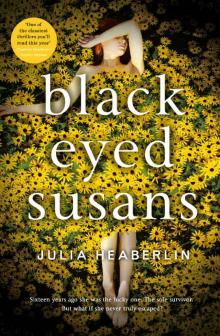
Black-Eyed Susans, page 24


I try to be casual as I move away. “What’s this?” I’m fingering an opened cardboard box. A new paperback lies next to it on the counter.
“That came in the mail yesterday. Charlie opened the box because she thought it was Catch-22 and wanted to get going on it for an English class. She says she asked you to order it a week ago?”
“I forgot. I didn’t order Catch-22. Or any other books.”
“Your name is on the address label.” He turns the box over so I can see.
“Where’s the receipt?” I’m staring at the book cover. A filmy image of half-spirit, half-girl rising out of a rocky sea. Beautiful Ghost by Rose Mylett.
Rose Mylett. The name stirs something unpleasant at the back of my brain.
Lucas reaches inside the box. “Here’s the receipt. It looks like it was a gift. There’s a message. Hope you enjoy. Nothing else.”
Hope you enjoy. Ordinary words that crawl like three spiders up my back.
“Are you OK?” he asks.
“Sure,” I say dully. “It’s just a book. A gift. I need to get these clothes off.”
“One more thing. Your friend Jo dropped by for a second. You need to give her a call. That geochemist friend of hers is coming to town, the one who’s been working on the Susan bones. She wants you to meet him. Oh, and that tooth from your grandfather’s yard? It’s from a coyote.”
Twenty minutes until Charlie gets home from school. A little longer before Lucas returns from his hunt for Catch-22 and coffee with a “new friend”—Lucas code for “female.”
There’s no time to dry my hair. I wrap the belt of my robe more tightly around my waist, ransack Charlie’s drawer for some fuzzy socks, and plant myself on her unmade bed with my laptop. It had found a happy home in her sheets during my absence.
I am suffused with manic energy, pulsed back to life by the shower and the certainty that Rose Mylett means something. Her name is an insistent drill in my skull, more important than me, as the Grim Reaperette, skipping across Twitter right now, or calling Jo to hear about more hopeless efforts to pull names from dust. Those bones are stubborn.
I get an immediate hit. The first Rose Mylett that pops up isn’t a true crime writer. The image on my screen isn’t of an airbrushed author trying to look smart and beautiful and ten years younger.
This Rose Mylett is very dead. Murdered in 1888. A purported victim of Jack the Ripper. A prostitute also known as Catherine, Drunk Lizzie, and Fair Alice. She was wearing a lilac apron, a red flannel petticoat, and blue-and-red-striped socks when she was found with the imprint of a string around her neck.
For a second, I’m fourteen again, in the second row, smearing on Pink Lemonade Lip Smacker, listening to Lydia’s Jack the Ripper report that instilled nightmares in half of our class.
My fingers are still working in the present. They skip to the next page and, four links down, find Rose Mylett, author, Beautiful Ghost, What Elizabeth Bates is trying to tell us about her murder fifty years later. Yep, the same book as the one sitting on my kitchen counter. I read the plot summary quickly. This crime rings no bells whatsoever—the tale of a young English royal who vanished off the rugged coast of North Devon on her honeymoon—184 reviews, 4.6 stars. Published five years ago in the U.K. That .4 off of perfect would eat at Lydia. There’s no author bio. No other book by Rose Mylett. The site does politely suggest, “If you like this author, you might also like these books by Annie Farmer and Elizabeth Stride.” I Google quickly even though I already know. Two more Ripper victims. Clever, clever Lydia.
This has to be Lydia, right? Sending me flowers. Mail-ordering a book for my reading pleasure.
Still walking the earth after all. Still sticking her nose in evil. Stealing her pseudonyms off of pitiful dead whores. Making money off of excruciating sorrow. For some ungodly reason, she’s messing with me.
Why are you suddenly back, Lydia?
I snap the laptop shut.
My daughter is coming home.
For a few precious moments, I bask in the Bohemian essence of Charlie: the black chalkboard wall she painted herself last summer, now scribbled with Stephen Colbert quotes and skilled graffiti from her friends; her collection of moon-and-stars ornaments that hang on fishing line thumbtacked to the ceiling; the array of candles in various stages of melted life on the windowsill. The trophies she’s stuffed into the top shelf of her closet because they are “braggy.”
I’m hurriedly spilling detergent into the washing machine when I hear the click of the key in the lock.
“Mom?”
“In the laundry room!” I yell back. Three clunks. Her backpack, hitting the floor. One shoe off, and then the other. Good sounds.
Charlie wriggles her arms around me from behind just as I’m about to drop the lid on clothes that will probably never feel clean again.
“Why is it so freaking cold outside?” she asks. Not Why are you such a freak? The kind of mom who ends up on Twitter? I pull Charlie’s arms tighter.
“I missed you,” Charlie says. “What are we eating?” She releases me from our backward hug. I decide to throw some extra Biz into the washer.
“I missed you, too. I’m thinking of making eggala.”
“Awesome.” Eggala, short for egg a la goldenrod, our go-to comfort food. Hard-boiled egg whites chopped into a white sauce, slathered over white toast, sprinkled with powdery yolk. Lots of salt and pepper. Dr Pepper on the side. Aunt Hilda made it once a week for me when I was blind.
“I’m sorry about … today,” I say.
“No big deal. My friends don’t believe it. They are starting a campaign against it. Make some bacon, OK? Hey, don’t start the washer. I’ve got a ton of volleyball clothes. People forgot shi—stuff all week and Coach kept making us run. Everything stinks. Plus, some guy’s mom is losing it because he has this scabby thing going on with his foot. These people in Star Wars suits cleaned all the locker rooms and now every person in school smells like Lysol. Well, the guys smell like Lysol and Axe.”
“Hmm, not good.” I shut the lid. “Don’t worry, I’ll wash another load of your clothes after this.”
“But there’s hardly anything in there,” she protests. “I’ll go get the rest of it right now. I can’t forget anything tomorrow. The team can’t take any more running.”
She’s already stripped off her clothes. She’s standing there in her bra, panties, and knee-high socks, the cheerful, melodramatic all-American girl. Fourteen years ago, she was the adorable pink package with red fuzz sent to a teen-age girl named Tessie so she’d agree to stay on the earth.
“That’s OK.” I shut the washer lid firmly. “I don’t want these clothes to bleed on yours.”
I’m lying and telling the truth.
I’m in my pajamas when I remember to call Jo. She picks up on the first ring.
“Tessa?” she asks eagerly.
“I’m so sorry I didn’t call sooner.”
“It’s OK. I talked to Bill. He told me about your trip. Ice and sorrow and no tequila. Sounds grueling. Can you drop by my office tomorrow?”
“Yes. Sure.” My response is immediate even though all I really want is to lock the front door and never come out.
“I wanted to give you a heads-up before we meet because this will be part of his presentation.” Jo is rushing the words. “I’ve held something back from you because it just seemed … like a little too much. You know? A week and a half ago, one of my Ph.D. students was finishing up cataloging the remains of the Susans from the two caskets we exhumed. There was a lot of detritus, as you might imagine. Dirt, clay, dust, bits of bone. I just wanted to make sure every last piece of it was recorded after we figured out the original coroner missed that there was a third right femur. In fact, we’re looking back at some of the other cold cases he worked and have found other mistakes.”
“Just spit it out, Jo,” I say.
“My student had a hunch about a tiny piece of cartilage. I confirmed that hunch. The cartilage came from a fetus. One of the two unidentified girls was pregnant with a baby girl. We just tested the baby’s DNA against Terrell’s. There’s a 99.6 percent chance he isn’t the father. We’re throwing the baby’s DNA into criminal databases. Maybe we’ll get a hit. A new lead.”
Of course Terrell isn’t a match.
I’m counting in my head. Six girls in that grave. Merry and me. Hannah makes three. Two more unidentified sets of bones. And now a little girl. One of them is buzzing awake in my head, reminding me, just in case I forgot.
I’m the one with the answers.
September 1995
MR. VEGA: Tessie, can you tell us a little about Black-Eyed Susan glitter?
MS. CARTWRIGHT: It’s hard to explain. My friend Lydia came up with the name for it.
MR. VEGA: Just do your best. Maybe you could start by telling us about the time you stood outside in the middle of a bad storm and your father couldn’t get you to come in.
MS. CARTWRIGHT: I was thinking that if I stood out there long enough the rain would wash out all the Black-Eyed Susan glitter.
MR. VEGA: Can you see this glitter?
MS. CARTWRIGHT: No.
MR. VEGA: And when did you first notice it?
MS. CARTWRIGHT: The day I got home from the hospital. Again, I can’t see it. For a while, I decided it was in my conditioner. In the Ivory soap. In the detergent we put in the washer. I decided that’s why I could never get it out.
MR. VEGA: Do you have glitter on you now?
MS. CARTWRIGHT: Just a little. The worst time, it was in the Parmesan cheese I put on my spaghetti. I threw up all night.
17 days until the execution
There are no Susan bones on Jo’s conference table. Just that lonely brown Kleenex box. My heart feels like someone hammered a nail into it.
I was worried I would be late for Jo’s meeting, but it’s apparent as I open the door to the conference room that everyone else is even later. The room is empty except for the table and chairs, unless you count the requiem of pain that Hannah’s mother and brother left behind. If there were a black light to reveal grief and anger, it would surely be streaked in graffiti, Dalí-like, on these walls. Not only sucked from Hannah’s family, but all of the others who sat here waiting for their loved ones to be reduced to the stubborn rules of science.
The door clicks shut behind me. The fluorescent glare feels like it’s restricting the flow of blood to my head. I slide into the chair where Hannah’s brother sat at attention in his dress blues not so long ago and, for a few minutes, try not to think.
The door opens, and all of them spill into the conference room at once. Bill; Lieutenant Myron; Jo; and her Russian friend, Dr. Igor Aristov, the genius from Galveston.
“Igor, as in Igor Stravinsky,” Jo had told me last night on the phone, knowing that I was, of course, imagining the hunchbacked Frankenstein one and not the one who composed The Rite of Spring.
This Igor, though, is not hunched, or wearing a black hood, or creeping me out with white golf ball eyes. He is tall and fit, wearing khakis and a red Polo. His eyes are warm and hazel. Fine wrinkles run out of the corner of his eyes and stop short. There are the tiniest shreds of gray at his temples.
He immediately crosses the room to take my hand first. “You must be Tessa. It is a pleasure.” His accent is thick as paste, and most women would want him to say their names over and to never let go of their hands. Not me. I’m only in this room as a conciliatory gesture to Jo. I don’t want to hear Igor’s maybes and ifs. Unless this lab genius is about to pull a miracle out of his ass, I need to listen to Bill. I need to come to terms with Terrell’s fate.
Lieutenant Myron is the first to slide into a chair. I wonder if I look as raw as she does. “Everybody, sit,” Jo says. “We’re going to make this as quick as possible. Ellen had a rough night.”
“A cop and his bride of six months,” Lieutenant Myron explains. “He fired a shot into her face for every month of marriage. Go ahead, Jo.”
Jo nods. Her hands are agitated with no place to go. I’ve never seen her this visibly on edge. “Usually,” she says, “I will send Igor samples of powder from the bones and he emails his findings to me. But that’s white paper between two scientists. I want the three of you to hear everything straight from his mouth just in case some detail tickles your brain.” She is careful not to look at me. It is obvious I am the one whose brain needs the most tickling.
Igor has settled himself at the head of the table. “I am a geochemist. A forensic geologist. Do any of you understand the basics of isotope analysis?
“I will keep it as simple as possible,” Igor continues, without waiting for an answer. “I will refer to each case as Susan One and Susan Two. I received samples from the femur of Susan One and from the skull and teeth of Susan Two. I also received a scraping from a fetus that belongs to Susan Two. I was able to determine that one of the women lived much of her life in Tennessee, and the other was most certainly from Mexico.”
“What?” Bill’s surprise pops the tension in the room. “How can you possibly know that?”
Igor shifts a level gaze to Bill. “Your bones absorb the distinct chemical markers in the soil where you live. Some of it has retained the same ratio of elements—oxygen, lead, zinc, et cetera—for hundreds of thousands of years, all the way back to when rivers and mountains formed. And then there are more modern markers. It’s easy to tell that Susan One is American, not European, because America and Europe used different refinery sources for leaded gas.”
“We’re soaking crap from the air into our bones?” Lieutenant Myron is pressing forward, suddenly engaged. “Regardless, we don’t use leaded gas for cars anymore.”
“It doesn’t matter,” he replies patiently. “The residue from leaded gas, even though it’s been banned for years, still clings to our soil and soaks into our bones. Susan One’s markers also indicate that for a significant portion of her life she lived near a specific set of mines, probably near Knoxville, Tennessee. I can’t tell you how long exactly. Or specifically where she died. I might have been able to if I had a rib bone. Ribs are constantly growing and remodeling and absorbing the environment. We can usually use them to guess at a victim’s residency for the last eight to ten years of life. And, of course, a lot of the bones were lost, so the grave only provided random puzzle pieces.”
“Mexico. Tennessee.” Bill’s eyes are trained on Lieutenant Myron. “Your killer could be a traveler. Terrell was a homebody.”
“He’s not my killer.” Lieutenant Myron’s sarcasm gets zero reaction from Bill, who continues tapping notes into his phone.
“Come on, guys, let him talk,” Jo says.
“It doesn’t bother me,” Igor says. “It’s thrilling to be out of the lab, frankly. To meet you, especially, Tessa. I rarely meet any victims. It makes my science … alive. And this case is particularly interesting. I was able to discern even more from Susan Two and her unborn fetus. Susan Two’s bones reflect a corn-based diet and the elements of volcanic soil. If I could hazard a guess, I’d say she was born in or near Mexico City. I concur with Jo that she was in her early twenties when she died.”
“What else?” Bill asks.
Igor lays his palms flat on the table. “There was only one skull in that grave, which belonged to Susan Two. I asked Jo to send me scrapings of very specific teeth because the teeth can give us a timeline.” His voice, so far in college lecture mode, has picked up a little excitement. “It’s fascinating, really, what this science reveals. As children, we put things in our mouths. The teeth enamel absorbs the dust. The first molar forms when a person is three, and freezes the isotope signal for that period of time. So I can say that Susan Two’s first molar tells us she was living in Mexico as a toddler. The incisors close at age six to seven. The chemical markers in one of her incisors indicate she was still living in Mexico. The third molar’s signal shuts down in the teen-age years. For Susan Two, still Mexico. After that, I don’t know. Sometime in her late teens or early twenties, she moved, or was kidnapped.”
“This is remarkable.” Lieutenant Myron glances around the table. “Isn’t this remarkable?” I can’t tell whether she is genuinely engaged or giddy from lack of sleep and a steady diet of savagery.
“How are you certain she left Mexico alive?” Bill asks. “We know the bones were moved at least once because they didn’t originate in that field of flowers where Tessa was dumped.” He flicks a look up at me, as if remembering I’m in the room. “Sorry, Tessa. My point is, maybe her bones were simply moved across the border.”
“Her baby tells that part of the story,” Igor says quickly. “This young woman lived in Texas for at least the last few months leading up to her death. I know this because fetal bones are the most current marker we can get. They were still developing and therefore still absorbing the current environment at the time of death.”
Lieutenant Myron shoves fingers through her uprooted hair. “If she was an illegal immigrant, or kidnapped, that makes our job nearly impossible. Her family wouldn’t want to reveal its illegal status and certainly wouldn’t stick their DNA in a database. If they thought a drug cartel grabbed their daughter, there’s even less of a chance—they wouldn’t want to piss them off. Those guys hang headless bodies from bridges. The family would need to protect their other daughters if they have them.”
Jo nods her head in agreement. “She’s right. I’ve worked on some of the bones of girls and women who have been murdered and buried in the desert near Juarez. Talked to the families. They’re scared shitless. There are hundreds of girls in that desert. More every year.”
“I can only share my science.” Igor shrugs. “And, frankly, I drummed up a lot more than is usual in cold cases like this. This is a fairly new strategy in forensic science. We are lucky these women lived in places where we have established soil databases. My dream is that we can map out a good portion of the geological world in the next decade, but it’s spotty as hell at the moment.”