Black-Eyed Susans, page 2


I’ve never met the man with the baronial name settling in on my couch. He can’t be older than twenty-eight, and he is at least 6’3”, with long, loose arms and big hands. His knees bang up against the coffee table. William James Hastings III reminds me more of a professional pitcher in his prime than a lawyer, like his body’s awkwardness would disappear the second he picked up a ball. Boyish. Cute. Big nose that makes him just short of handsome. He has brought along a woman in a tailored white jacket, white-collared shirt, and black pants. The type who cares only vaguely about fashion, as professional utility. Short, natural blond hair. Ring-free fingers. Flat, clipped, unpolished nails. Her only adornment is a glittering gold chain with an expensive-looking charm, a familiar squiggly doodle, but I don’t have time to think about what it means. She’s a cop, maybe, although that doesn’t make sense.
The gray lump, still covered in dust and ancient spider threads, sits between us on the coffee table.
“I’m Bill,” he says. “Not William. And definitely not Willie.” He smiles. I wonder if he’s used this line on a jury. I think he needs a better one. “Tessa, as I said on the phone, we’re thrilled that you called. Surprised, but thrilled. I hope you don’t mind that Dr. Seger—Joanna—tagged along. We don’t have any time to waste. Joanna is the forensic scientist excavating the bones of the … Susans tomorrow. She’d like to take a quick sample of your saliva. For DNA. Because of the issues we face with lost evidence and junk science, she wants to do the swab herself. That is, if you’re really serious. Angie never thought—”
I clear my throat. “I’m serious.” I feel a sudden pang for Angela Rothschild. The tidy silver-haired woman hounded me for the past six years, insisting that Terrell Darcy Goodwin was an innocent man. Picking at each doubt until I was no longer sure.
Angie was a saint, a bulldog, a little bit of a martyr. She’d spent the last half of her life and most of her parents’ inheritance freeing prisoners who’d been bullied by the state of Texas into wrongful convictions. More than 1,500 convicted rapists and murderers begged for her services every year, so Angie had to be choosy. She told me that playing God with those calls and letters was the only thing that ever made her consider quitting. I’d been to her office once, the first time she contacted me. It was housed in an old church basement located on an unpleasant side of Dallas known best for its high fatality rate for cops. If her clients couldn’t see the light of day or catch a quick Starbucks, she said, then neither could she. Her company in that basement was a coffeepot, three more attorneys who also worked other paying jobs, and as many law students as would sign on.
Angie sat in the same spot on my couch nine months ago, in jeans and scuffed black cowboy boots, with one of Terrell’s letters in her hand. She begged me to read it. She had begged me to do a lot of things, like give one of her expert gurus a shot at retrieving my memory. Now she was dead of a heart attack, found facedown in a pile of documents about Goodwin’s case. The reporter who wrote her obituary found that poetic. My guilt in the week since she died has been almost unbearable. Angie, I realized too late, was one of my tethers. One of the few who never gave up on me.
“Is this … what you have for us?” Bill stares at the filthy plastic grocery bag from Granddaddy’s basement like it is stuffed with gold. It has left a trail of pebbly mortar across the glass, right beside a pink hair band twisted with a strand of my daughter Charlie’s auburn hair.
“You said on the phone that you had to go … find it,” he says. “That you’d told Angie about this … project … but you weren’t sure where it was.”
It isn’t really a question, and I don’t answer.
His eyes wander the living room, strewn with the detritus of an artist and a teen-ager. “I’d like to set up a meeting at the office in a few days. After I’ve … examined it. You and I will have to go over all of the old ground for the appeal.” For such a large guy, there is a gentleness about him. I wonder about his courtroom style, if gentleness is his weapon.
“Ready for the swab?” Dr. Seger interrupts abruptly, all business, already stretching on latex gloves. Maybe worried that I’ll change my mind.
“Sure.” We both stand up. She tickles the inside of my cheek and seals microscopic bits of me in a tube. I know she plans to add my DNA to the collection provided by three other Susans, two of whom still go by the more formal name of Jane Doe. I feel heat emanating from her. Anticipation.
I return my attention to the bag on the table, and Bill. “This was kind of an experiment suggested by one of my psychiatrists. It might be more valuable for what isn’t there than what is.” In other words, I didn’t draw a black man who looked like Terrell Darcy Goodwin.
My voice is calm, but my heart is lurching. I am giving Tessie to this man. I hope it is not a mistake.
“Angie … she would be so grateful. Is grateful.” Bill crooks a finger up, the Michelangelo kind of gesture that travels up to the sky. I find this comforting: a man who is bombarded by people blocking his path every day—half-decent people clinging stubbornly to their lies and deadly mistakes—and yet he still believes in God. Or, at least, still believes in something.
Dr. Seger’s phone buzzes in her pocket. She glances at the screen. “I’ve got to take this. One of my Ph.D. students. I’ll meet you in the car, Bill. Good job, girl. You’re doing the right thing.” Gurrl. A slight twang. Oklahoma, maybe. I smile automatically.
“Right behind you, Jo.” Bill is moving deliberately, shutting his briefcase, gingerly picking up the bag, in no apparent hurry. His hands grow still when she shuts the door. “You’ve just met greatness. Joanna is a mitochondrial DNA genius. She can work goddamn miracles with degraded bones. She rushed to 9/11 and didn’t leave for four years. Made history, helping identify thousands of victims out of charred bits. Lived at the YMCA at first. Took communal showers with the homeless. Worked fourteen-hour days. She didn’t have to, it wasn’t her job, but whenever she could, she sat down and explained the science to grieving families so they could be as sure as she was. She learned a smattering of Spanish so she could try to talk to the families of the Mexican dishwashers and waiters who worked in restaurants in the North Tower. She is one of the best forensic scientists on the planet, who happens to be one of the kindest human beings I’ve ever met, and she is giving Terrell a chance. I want you to understand the kind of people on our side. Tell me, Tessa, why are you? Why are you suddenly on our side?”
A slight edge has crept into his voice. He is gently telling me not to screw them.
“There are several reasons,” I say unsteadily. “I can show you one of them.”
“Tessa, I want to know everything.”
“It’s better if you see it.”
I lead him down our narrow hall without speaking, past Charlie’s messy purple womb, usually pulsing with music, and throw open the door at the end. This wasn’t in my plan, not today anyway.
Bill looms like a giant in my bedroom, his head knocking into the antique chandelier dangling with sea glass that Charlie and I scavenged last summer on the gray beaches of Galveston. He ducks away and brushes against the curve of my breast by accident. Apologizes. Embarrassed. For a second, I see this stranger’s legs tangled in my sheets. I can’t remember a time that I let a man in here.
I watch painfully as Bill absorbs intimate details about me: the cartoonish portrait of Granddaddy’s house, gold and silver jewelry littered across my dresser, the close-up of Charlie staring out of lavender eyes, a neat pile of freshly laundered white lace panties on the chair, which I wish to God were tucked in a drawer.
He is already edging himself backward, toward the door, clearly wondering what the hell he has gotten himself into. Whether he has pinned his hopes for poor Terrell Darcy Goodwin on a crazy woman who has led him straight to her bedroom. Bill’s expression makes me want to laugh out loud, even though I am not above entertaining a fantasy about an all-American guy with two degrees, when my type runs the opposite direction.
Even though what I’m about to show him keeps me up at night, reading the same paragraph of Anna Karenina over and over, listening to every creak of the house and finger of wind, every barefoot midnight step of my daughter, every sweet sleep sound that floats out of her mouth and down the hall.
“Don’t worry.” I force lightness into my voice. “I like my men rich and less altruistic. And you know … old enough to grow facial hair. Come over here. Please.”
“Cute.” But I can hear relief. He makes it in two strides. His eyes follow my finger, out the window.
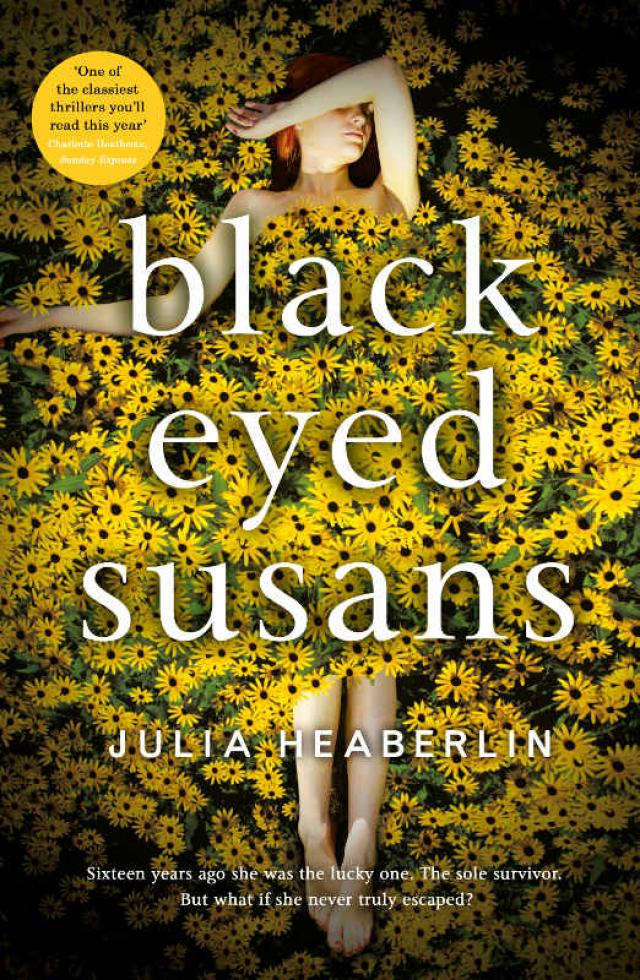
I am not pointing to the sky, but to the dirt, where a nest of black-eyed Susans is still half-alive under the windowsill, teasing me with beady black eyes.
“It is February,” I say quietly. “Black-eyed Susans only bloom like this in summer.” I pause for this to sink in. “They were planted three days ago, on my birthday. Someone grew them especially for me, and put them under the window where I sleep.”
The abandoned field on the Jenkins property was licked to death by fire about two years before the Black-Eyed Susans were dumped there. A reckless match tossed by a lost car on a lonely dirt road cost a destitute old farmer his entire wheat crop and set the stage for the thousands and thousands of yellow flowers that covered the field like a giant, rumpled quilt.
The fire also carved out our grave, an uneven, loping ditch. Black-eyed Susans sprung up and decorated it brazenly long before we arrived. The Susans are a greedy plant, often the first to thrive in scorched, devastated earth. Pretty, but competitive, like cheerleaders. They live to crowd out the others.
One lit match, one careless toss, and our nicknames were embedded in serial killer lore forever.
Bill, still in my bedroom, has shot Joanna a lengthy text, maybe because he doesn’t want to answer her questions on the phone in front of me. We meet her outside my window in time to watch her dip a vial into the black speckled dirt. The squiggly charm on her necklace, glinting in the sun, brushes a petal as she bends over. I still can’t recall the symbol’s meaning. Religious, maybe. Ancient.
“He or she used something besides the dirt in the ground,” Joanna said. “Probably a common brand of potting soil, and seeds that can be picked up at Lowe’s. But you never know. You should call the cops.”
“And tell them someone is planting pretty flowers?” I don’t want to sound sarcastic, but there it is.
“It’s trespassing,” Bill says. “Harassment. You know, this doesn’t have to be the work of the killer. It could be any crazy who reads the papers.” It is unspoken, but I know. He is uncertain of my mental state. He hopes I have more than this patch of flowers under my window to bolster a judge’s belief in Terrell. A little part of him wonders whether I planted the flowers myself.
How much do I tell him?
I suck in a breath. “Every time I call the cops, it ends up on the Internet. We get calls and letters and Facebook crazies. Presents on the doorstep. Cookies. Bags of dog poop. Cookies made of dog poop. At least I hope it’s just dog poop. Any attention makes my daughter’s life at school a living hell. After a few years of beautiful peace, the execution is stirring everything up again.” Exactly why, for years, I told Angie no and no and no. Whatever doubts crept in, I had to push away. In the end, I understood Angie, and Angie understood me. I will find another way, she had assured me.
But things were different now. Angie was dead.
He’d stood under my window.
I brush away something whispery threading its way through my hair. I vaguely wonder whether it is a traveler from Granddaddy’s basement. I remember sticking my hand blindly into that musty hole a few hours ago, and turn my anger up a notch. “The look on your faces right now? That mixture of pity and uneasiness and misplaced understanding that I still need to be treated like the traumatized sixteen-year-old girl I used to be? I’ve been getting that look since I can remember. That’s how long I’ve been protecting myself, and so far, so good. I’m happy now. I am not that girl anymore.” I wrap my long brown sweater around me a little more tightly even though the late winter sun is a warm stroke across my face. “My daughter will be home any minute, and I’d rather she doesn’t meet the two of you until I’ve explained a few things. She doesn’t know yet that I called you. I want to keep her life as normal as possible.”
“Tessa.” Joanna ventures a step toward me and stops. “I get it.”
There is such a terrible weight in her voice. I get it. Bombs dropping one two three to the bottom of the ocean.
I scan her face. Tiny lines etched by other people’s sorrow. Blue-green eyes that have flashed on more horror than I could ever fathom. Smelled it. Touched it, breathed it, as it rained down in ashes from the sky.
“Do you?” My voice is soft. “I hope so. Because I am going to be there when you excavate those two graves.”
My daddy paid for their coffins.
Joanna is rubbing the charm between her fingers, like it is a holy cross.
I suddenly realize that, in her world, it is.
She is wearing a double helix made of gold.
The twisted ladder of life.
A strand of DNA.
Tessie, 1995
One week later. Tuesday, 10 A.M. sharp. I am back on the doctor’s plump couch, with company. Oscar rubs his wet nose against my hand reassuringly, then settles in on the floor beside me, alert. He’s been mine since last week, and I will go nowhere without him. Not that anyone argues. Oscar, sweet and protective, makes them hopeful.
“Tessie, the trial is in three months. Ninety days away. My most important job right now is to prepare you emotionally. I know the defense attorney, and he’s excellent. He’s even better when he truly believes he holds the life of an innocent man in his hands, which he does. Do you understand what that means? He will not take it easy on you.”
This time, right down to business.
My hands are folded primly in my lap. I’m wearing a short, blue-plaid pleated skirt, white lacy stockings, and black patent-leather boots. I’ve never been a prim girl, despite the reddish-gold hair and freckles my wonderfully corny grandfather claimed were fairy dust. Not then, not now. My best friend, Lydia, dressed me today. She burrowed into my messy drawers and closet, because she couldn’t stand the fact that I no longer make any effort to match. Lydia is one of the few friends who isn’t giving up on me. She is currently taking her fashion cues from the movie Clueless, but I haven’t seen it.
“OK,” I say. This is, after all, one of two reasons I am sitting here. I am afraid. Ever since they snatched Terrell Darcy Goodwin away from his Denny’s Grand Slam breakfast in Ohio eleven months ago and told me I would need to testify, I have counted the days like terrible pills. Today, we are eighty-seven days away, not ninety, but I do not bother to correct him.
“I remember nothing.” I am sticking with this.
“I’m sure the prosecutor has told you that doesn’t matter. You’re living, breathing evidence. Innocent girl vs. unspeakable monster. So let’s just begin with what you do remember. Tessie? Tessie? What are you thinking right now, this second? Spit it out … don’t look away, OK?”
I crane my neck around slowly, gazing at him out of two mossy gray pools of nothingness.
“I remember a crow trying to peck out my eyes,” I say flatly. “Tell me. What exactly is the point of looking, when you know I can’t see you?”
Tessa, present day
Technically, this is their third grave. The two Susans being exhumed tonight in St. Mary’s Cemetery in Fort Worth were his older kills. Dug up from their first hiding place and tossed in that field with me like chicken bones. Four of us in all, dumped in the same trip. I was thrown on top with a girl named Merry Sullivan, who the coroner determined had been dead for more than a day. I overheard Granddaddy mutter to my father, “The devil was cleaning out his closets.”
It is midnight, and I am at least three hundred feet away, under a tree. I have darted under the police tape that marks off the site. I wonder who the hell they think is walking a cemetery at this time of night but ghosts. Well, I guess I am.
They’ve erected a white tent over the two graves, and it glows with pale light, like a paper lantern. There are far more people here than I expected. Bill, of course. I recognize the district attorney from his picture in the paper. There’s a balding man beside him in an ill-fitting suit. At least five policemen, and another five human beings dressed like aliens in Tyvek suits, wandering in and out of the tent. I know that the medical examiner is among them. Careers ride on this one.
Did the reporter who wrote Angie’s obituary know that his words would pry loose the rusty lever of justice? Create a small public outcry in a state that executes men monthly? Change a judge’s mind about exhuming the bones and considering a new trial? Convince me once and for all to dial the phone?
The man in the suit suddenly pivots. I catch the flash of a priest’s collar before I duck behind the tree. My eyes sting for a second, struck by this furtive operation and the supreme effort to treat these girls with dignity and respect when no one has a clue who they are, when there is not a reporter in sight.
The girls rising out of the earth tonight were nothing but bones when they were transported to that old wheat field eighteen years ago. I was barely alive. They say that Merry had been dead at least thirty hours. By the time the cops got to us, Merry was pretty well scavenged. I tried to protect her, but at some point in the night I passed out. Sometimes, I can still hear the animated conversation of the field rats. I can’t tell anybody who loves me these things. It’s better if they think I don’t remember.
The doctors say my heart saved me. I was born with a heart genetically on the slow side to begin with. Add the fact that I was in peak running condition as one of the nation’s top high-school hurdlers. On a normal day, doing homework, eating a hamburger, or painting my nails, my pulse clicked along at a steady thirty-seven beats a minute and crawled as low as twenty-nine at night when I slept. The average heart rate for a teen-ager is about seventy. Daddy had a habit of waking up at two every morning and checking to see if I was breathing, even though a famous Houston cardiologist had told him to relax. For sure, my heart was a bit of a phenomenon, as was my speed. People whispered about the Olympics. Called me the Little Fireball because of my hair and my temper when I ran a bad time or a girl nudged me off a hurdle.
The gray lump, still covered in dust and ancient spider threads, sits between us on the coffee table.
“I’m Bill,” he says. “Not William. And definitely not Willie.” He smiles. I wonder if he’s used this line on a jury. I think he needs a better one. “Tessa, as I said on the phone, we’re thrilled that you called. Surprised, but thrilled. I hope you don’t mind that Dr. Seger—Joanna—tagged along. We don’t have any time to waste. Joanna is the forensic scientist excavating the bones of the … Susans tomorrow. She’d like to take a quick sample of your saliva. For DNA. Because of the issues we face with lost evidence and junk science, she wants to do the swab herself. That is, if you’re really serious. Angie never thought—”
I clear my throat. “I’m serious.” I feel a sudden pang for Angela Rothschild. The tidy silver-haired woman hounded me for the past six years, insisting that Terrell Darcy Goodwin was an innocent man. Picking at each doubt until I was no longer sure.
Angie was a saint, a bulldog, a little bit of a martyr. She’d spent the last half of her life and most of her parents’ inheritance freeing prisoners who’d been bullied by the state of Texas into wrongful convictions. More than 1,500 convicted rapists and murderers begged for her services every year, so Angie had to be choosy. She told me that playing God with those calls and letters was the only thing that ever made her consider quitting. I’d been to her office once, the first time she contacted me. It was housed in an old church basement located on an unpleasant side of Dallas known best for its high fatality rate for cops. If her clients couldn’t see the light of day or catch a quick Starbucks, she said, then neither could she. Her company in that basement was a coffeepot, three more attorneys who also worked other paying jobs, and as many law students as would sign on.
Angie sat in the same spot on my couch nine months ago, in jeans and scuffed black cowboy boots, with one of Terrell’s letters in her hand. She begged me to read it. She had begged me to do a lot of things, like give one of her expert gurus a shot at retrieving my memory. Now she was dead of a heart attack, found facedown in a pile of documents about Goodwin’s case. The reporter who wrote her obituary found that poetic. My guilt in the week since she died has been almost unbearable. Angie, I realized too late, was one of my tethers. One of the few who never gave up on me.
“Is this … what you have for us?” Bill stares at the filthy plastic grocery bag from Granddaddy’s basement like it is stuffed with gold. It has left a trail of pebbly mortar across the glass, right beside a pink hair band twisted with a strand of my daughter Charlie’s auburn hair.
“You said on the phone that you had to go … find it,” he says. “That you’d told Angie about this … project … but you weren’t sure where it was.”
It isn’t really a question, and I don’t answer.
His eyes wander the living room, strewn with the detritus of an artist and a teen-ager. “I’d like to set up a meeting at the office in a few days. After I’ve … examined it. You and I will have to go over all of the old ground for the appeal.” For such a large guy, there is a gentleness about him. I wonder about his courtroom style, if gentleness is his weapon.
“Ready for the swab?” Dr. Seger interrupts abruptly, all business, already stretching on latex gloves. Maybe worried that I’ll change my mind.
“Sure.” We both stand up. She tickles the inside of my cheek and seals microscopic bits of me in a tube. I know she plans to add my DNA to the collection provided by three other Susans, two of whom still go by the more formal name of Jane Doe. I feel heat emanating from her. Anticipation.
I return my attention to the bag on the table, and Bill. “This was kind of an experiment suggested by one of my psychiatrists. It might be more valuable for what isn’t there than what is.” In other words, I didn’t draw a black man who looked like Terrell Darcy Goodwin.
My voice is calm, but my heart is lurching. I am giving Tessie to this man. I hope it is not a mistake.
“Angie … she would be so grateful. Is grateful.” Bill crooks a finger up, the Michelangelo kind of gesture that travels up to the sky. I find this comforting: a man who is bombarded by people blocking his path every day—half-decent people clinging stubbornly to their lies and deadly mistakes—and yet he still believes in God. Or, at least, still believes in something.
Dr. Seger’s phone buzzes in her pocket. She glances at the screen. “I’ve got to take this. One of my Ph.D. students. I’ll meet you in the car, Bill. Good job, girl. You’re doing the right thing.” Gurrl. A slight twang. Oklahoma, maybe. I smile automatically.
“Right behind you, Jo.” Bill is moving deliberately, shutting his briefcase, gingerly picking up the bag, in no apparent hurry. His hands grow still when she shuts the door. “You’ve just met greatness. Joanna is a mitochondrial DNA genius. She can work goddamn miracles with degraded bones. She rushed to 9/11 and didn’t leave for four years. Made history, helping identify thousands of victims out of charred bits. Lived at the YMCA at first. Took communal showers with the homeless. Worked fourteen-hour days. She didn’t have to, it wasn’t her job, but whenever she could, she sat down and explained the science to grieving families so they could be as sure as she was. She learned a smattering of Spanish so she could try to talk to the families of the Mexican dishwashers and waiters who worked in restaurants in the North Tower. She is one of the best forensic scientists on the planet, who happens to be one of the kindest human beings I’ve ever met, and she is giving Terrell a chance. I want you to understand the kind of people on our side. Tell me, Tessa, why are you? Why are you suddenly on our side?”
A slight edge has crept into his voice. He is gently telling me not to screw them.
“There are several reasons,” I say unsteadily. “I can show you one of them.”
“Tessa, I want to know everything.”
“It’s better if you see it.”
I lead him down our narrow hall without speaking, past Charlie’s messy purple womb, usually pulsing with music, and throw open the door at the end. This wasn’t in my plan, not today anyway.
Bill looms like a giant in my bedroom, his head knocking into the antique chandelier dangling with sea glass that Charlie and I scavenged last summer on the gray beaches of Galveston. He ducks away and brushes against the curve of my breast by accident. Apologizes. Embarrassed. For a second, I see this stranger’s legs tangled in my sheets. I can’t remember a time that I let a man in here.
I watch painfully as Bill absorbs intimate details about me: the cartoonish portrait of Granddaddy’s house, gold and silver jewelry littered across my dresser, the close-up of Charlie staring out of lavender eyes, a neat pile of freshly laundered white lace panties on the chair, which I wish to God were tucked in a drawer.
He is already edging himself backward, toward the door, clearly wondering what the hell he has gotten himself into. Whether he has pinned his hopes for poor Terrell Darcy Goodwin on a crazy woman who has led him straight to her bedroom. Bill’s expression makes me want to laugh out loud, even though I am not above entertaining a fantasy about an all-American guy with two degrees, when my type runs the opposite direction.
Even though what I’m about to show him keeps me up at night, reading the same paragraph of Anna Karenina over and over, listening to every creak of the house and finger of wind, every barefoot midnight step of my daughter, every sweet sleep sound that floats out of her mouth and down the hall.
“Don’t worry.” I force lightness into my voice. “I like my men rich and less altruistic. And you know … old enough to grow facial hair. Come over here. Please.”
“Cute.” But I can hear relief. He makes it in two strides. His eyes follow my finger, out the window.
I am not pointing to the sky, but to the dirt, where a nest of black-eyed Susans is still half-alive under the windowsill, teasing me with beady black eyes.
“It is February,” I say quietly. “Black-eyed Susans only bloom like this in summer.” I pause for this to sink in. “They were planted three days ago, on my birthday. Someone grew them especially for me, and put them under the window where I sleep.”
The abandoned field on the Jenkins property was licked to death by fire about two years before the Black-Eyed Susans were dumped there. A reckless match tossed by a lost car on a lonely dirt road cost a destitute old farmer his entire wheat crop and set the stage for the thousands and thousands of yellow flowers that covered the field like a giant, rumpled quilt.
The fire also carved out our grave, an uneven, loping ditch. Black-eyed Susans sprung up and decorated it brazenly long before we arrived. The Susans are a greedy plant, often the first to thrive in scorched, devastated earth. Pretty, but competitive, like cheerleaders. They live to crowd out the others.
One lit match, one careless toss, and our nicknames were embedded in serial killer lore forever.
Bill, still in my bedroom, has shot Joanna a lengthy text, maybe because he doesn’t want to answer her questions on the phone in front of me. We meet her outside my window in time to watch her dip a vial into the black speckled dirt. The squiggly charm on her necklace, glinting in the sun, brushes a petal as she bends over. I still can’t recall the symbol’s meaning. Religious, maybe. Ancient.
“He or she used something besides the dirt in the ground,” Joanna said. “Probably a common brand of potting soil, and seeds that can be picked up at Lowe’s. But you never know. You should call the cops.”
“And tell them someone is planting pretty flowers?” I don’t want to sound sarcastic, but there it is.
“It’s trespassing,” Bill says. “Harassment. You know, this doesn’t have to be the work of the killer. It could be any crazy who reads the papers.” It is unspoken, but I know. He is uncertain of my mental state. He hopes I have more than this patch of flowers under my window to bolster a judge’s belief in Terrell. A little part of him wonders whether I planted the flowers myself.
How much do I tell him?
I suck in a breath. “Every time I call the cops, it ends up on the Internet. We get calls and letters and Facebook crazies. Presents on the doorstep. Cookies. Bags of dog poop. Cookies made of dog poop. At least I hope it’s just dog poop. Any attention makes my daughter’s life at school a living hell. After a few years of beautiful peace, the execution is stirring everything up again.” Exactly why, for years, I told Angie no and no and no. Whatever doubts crept in, I had to push away. In the end, I understood Angie, and Angie understood me. I will find another way, she had assured me.
But things were different now. Angie was dead.
He’d stood under my window.
I brush away something whispery threading its way through my hair. I vaguely wonder whether it is a traveler from Granddaddy’s basement. I remember sticking my hand blindly into that musty hole a few hours ago, and turn my anger up a notch. “The look on your faces right now? That mixture of pity and uneasiness and misplaced understanding that I still need to be treated like the traumatized sixteen-year-old girl I used to be? I’ve been getting that look since I can remember. That’s how long I’ve been protecting myself, and so far, so good. I’m happy now. I am not that girl anymore.” I wrap my long brown sweater around me a little more tightly even though the late winter sun is a warm stroke across my face. “My daughter will be home any minute, and I’d rather she doesn’t meet the two of you until I’ve explained a few things. She doesn’t know yet that I called you. I want to keep her life as normal as possible.”
“Tessa.” Joanna ventures a step toward me and stops. “I get it.”
There is such a terrible weight in her voice. I get it. Bombs dropping one two three to the bottom of the ocean.
I scan her face. Tiny lines etched by other people’s sorrow. Blue-green eyes that have flashed on more horror than I could ever fathom. Smelled it. Touched it, breathed it, as it rained down in ashes from the sky.
“Do you?” My voice is soft. “I hope so. Because I am going to be there when you excavate those two graves.”
My daddy paid for their coffins.
Joanna is rubbing the charm between her fingers, like it is a holy cross.
I suddenly realize that, in her world, it is.
She is wearing a double helix made of gold.
The twisted ladder of life.
A strand of DNA.
Tessie, 1995
One week later. Tuesday, 10 A.M. sharp. I am back on the doctor’s plump couch, with company. Oscar rubs his wet nose against my hand reassuringly, then settles in on the floor beside me, alert. He’s been mine since last week, and I will go nowhere without him. Not that anyone argues. Oscar, sweet and protective, makes them hopeful.
“Tessie, the trial is in three months. Ninety days away. My most important job right now is to prepare you emotionally. I know the defense attorney, and he’s excellent. He’s even better when he truly believes he holds the life of an innocent man in his hands, which he does. Do you understand what that means? He will not take it easy on you.”
This time, right down to business.
My hands are folded primly in my lap. I’m wearing a short, blue-plaid pleated skirt, white lacy stockings, and black patent-leather boots. I’ve never been a prim girl, despite the reddish-gold hair and freckles my wonderfully corny grandfather claimed were fairy dust. Not then, not now. My best friend, Lydia, dressed me today. She burrowed into my messy drawers and closet, because she couldn’t stand the fact that I no longer make any effort to match. Lydia is one of the few friends who isn’t giving up on me. She is currently taking her fashion cues from the movie Clueless, but I haven’t seen it.
“OK,” I say. This is, after all, one of two reasons I am sitting here. I am afraid. Ever since they snatched Terrell Darcy Goodwin away from his Denny’s Grand Slam breakfast in Ohio eleven months ago and told me I would need to testify, I have counted the days like terrible pills. Today, we are eighty-seven days away, not ninety, but I do not bother to correct him.
“I remember nothing.” I am sticking with this.
“I’m sure the prosecutor has told you that doesn’t matter. You’re living, breathing evidence. Innocent girl vs. unspeakable monster. So let’s just begin with what you do remember. Tessie? Tessie? What are you thinking right now, this second? Spit it out … don’t look away, OK?”
I crane my neck around slowly, gazing at him out of two mossy gray pools of nothingness.
“I remember a crow trying to peck out my eyes,” I say flatly. “Tell me. What exactly is the point of looking, when you know I can’t see you?”
Tessa, present day
Technically, this is their third grave. The two Susans being exhumed tonight in St. Mary’s Cemetery in Fort Worth were his older kills. Dug up from their first hiding place and tossed in that field with me like chicken bones. Four of us in all, dumped in the same trip. I was thrown on top with a girl named Merry Sullivan, who the coroner determined had been dead for more than a day. I overheard Granddaddy mutter to my father, “The devil was cleaning out his closets.”
It is midnight, and I am at least three hundred feet away, under a tree. I have darted under the police tape that marks off the site. I wonder who the hell they think is walking a cemetery at this time of night but ghosts. Well, I guess I am.
They’ve erected a white tent over the two graves, and it glows with pale light, like a paper lantern. There are far more people here than I expected. Bill, of course. I recognize the district attorney from his picture in the paper. There’s a balding man beside him in an ill-fitting suit. At least five policemen, and another five human beings dressed like aliens in Tyvek suits, wandering in and out of the tent. I know that the medical examiner is among them. Careers ride on this one.
Did the reporter who wrote Angie’s obituary know that his words would pry loose the rusty lever of justice? Create a small public outcry in a state that executes men monthly? Change a judge’s mind about exhuming the bones and considering a new trial? Convince me once and for all to dial the phone?
The man in the suit suddenly pivots. I catch the flash of a priest’s collar before I duck behind the tree. My eyes sting for a second, struck by this furtive operation and the supreme effort to treat these girls with dignity and respect when no one has a clue who they are, when there is not a reporter in sight.
The girls rising out of the earth tonight were nothing but bones when they were transported to that old wheat field eighteen years ago. I was barely alive. They say that Merry had been dead at least thirty hours. By the time the cops got to us, Merry was pretty well scavenged. I tried to protect her, but at some point in the night I passed out. Sometimes, I can still hear the animated conversation of the field rats. I can’t tell anybody who loves me these things. It’s better if they think I don’t remember.
The doctors say my heart saved me. I was born with a heart genetically on the slow side to begin with. Add the fact that I was in peak running condition as one of the nation’s top high-school hurdlers. On a normal day, doing homework, eating a hamburger, or painting my nails, my pulse clicked along at a steady thirty-seven beats a minute and crawled as low as twenty-nine at night when I slept. The average heart rate for a teen-ager is about seventy. Daddy had a habit of waking up at two every morning and checking to see if I was breathing, even though a famous Houston cardiologist had told him to relax. For sure, my heart was a bit of a phenomenon, as was my speed. People whispered about the Olympics. Called me the Little Fireball because of my hair and my temper when I ran a bad time or a girl nudged me off a hurdle.