Black-Eyed Susans, page 17
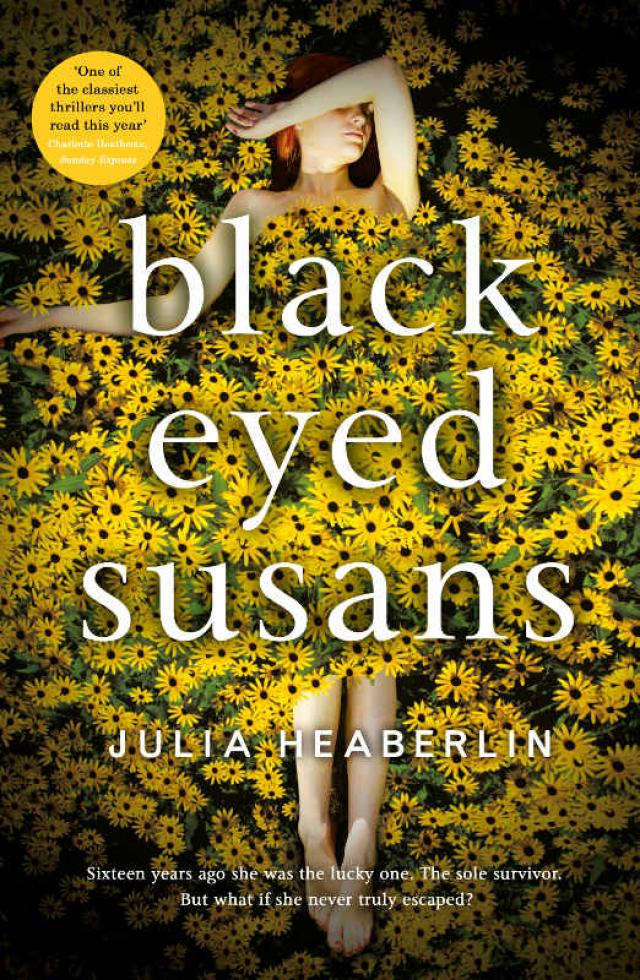


Why would Lydia bury this book? After my kidnapping, she probably scourged her room of anything with a yellow flower on it. But Lydia wouldn’t be able to completely part with a treasured book. She’d romanticize it like this, in a time capsule to dig up later.
Except she never came back.
Lieutenant Myron sets the book aside and dangles another bag from her thumb and forefinger. “What about this?”
I swallow hard and peer closer. “A key? I don’t even recognize the random keys in my own junk drawer.”
“So that’s a no?”
“That’s a no.”
“Worth asking.”
Lieutenant Myron reaches for the third bag. She holds it up, six inches from my eyes.
The room is waiting for me.
Tick, tick, tick.
Can everyone hear that? I don’t know if it’s my pacemaker, which never makes a sound, or the deer heart trapped in that box.
At ten, I could recite every word of “The Tell-Tale Heart.” Lydia was better at it, of course. Once, she hid a loud clock under my pillow.
“Tessa?” Bill grips my shoulders. I’m swaying. The ticking is louder. His watch, dammit, near my ear. Tick, tick. I push his arm away.
“I thought this was lost.” It’s the voice of a seething teen-ager. “She must have taken it.”
“Who took it?” The lieutenant’s voice is sharp.
“Lydia. Lydia took it.”
Tessa, 1995
The doctor is already seated in his chair right by the couch. He doesn’t bother to stand up and greet me. I can’t tell by his expression if he is still angry after last week, when I spewed that acid about his daughter being eaten by coyotes. He certainly hadn’t objected when I just got up and stalked out.
I throw my purse on the floor, flop back on the couch, and cross my legs, hiking the skirt so he can see to China. He’s not the slightest bit interested. I could be his eighty-year-old aunt. My face burns hot and angry, but I don’t know why. I twist the ring on my finger, wishing it were his neck.
“Your mother,” he says smoothly. “You found her on the day she died.”
Payback for conjuring his daughter. He’s wielding his sharpest knife today. It opens up a place where I store the exquisite pain of missing her. I want to scream, to shatter that pleasant, professional mask that he snaps on with an invisible rubber band. Sometimes I wonder if I died in that hole. If this room is hell’s purgatory, and everything else—Daddy, Bobby, Lydia, O.J. the Monster—is part of a dream when the devil lets me sleep. If this judge in a pin-striped shirt is deciding whether to throw me in a locked attic with a bunch of cackling Susans or set me free to haunt our killer for eternity.
“I’m leaving.” I say this yet remain planted on the couch. “I’m done with your dumb games.”
“That’s your decision, Tessie.”
I was in the tree house.
She had called my name from the kitchen window. I thought she wanted me to help with the dishes. She always made a mess. Grease and flour everywhere. Crusted pans. Dirty bowls in the sink. Daddy said it was the price for biscuits that crumbled in your mouth, fudge frosting, fried okra scramble with potatoes and tomatoes that we ate like popcorn, cold, as leftovers.
I was in the tree house. But I ignored her.
“You found her on the kitchen floor.”
My heart bangs against my chest.
“You were eight years old.”
Her face is blue.
“She died of a stroke,” he says.
I pull up the skirt of her apron. Cover her face.
“Are you angry that she isn’t here? That she left you?”
I was in the tree house.
I didn’t come when she called.
The guilt is roaming free now. Almost unbearable.
“Yes,” I breathe out.
Tessa, present day
The object in the third plastic evidence bag on Jo’s desk is tiny, probably never of importance to anyone but me and its first owner, a little girl in a frilly petticoat who is long dead and buried.
When I was fifteen, I found the ring in the bottom of a basket of junk in an antiques store in the Stockyards. It was so caked with filth that I didn’t see the inset pearl, like a microscopic spider’s egg, until I got it home. The ring fit perfectly on my pinky. The owner of the store told me it was a Victorian child’s ring from the 1800s, probably gold-filled, which is why she said she could give it to me for $35, but certainly not the $10 I suggested. Lydia countered to the woman that she wouldn’t have known the ring existed if we hadn’t wandered in. “Tessie could have just stuck it in her pocket,” Lydia spewed indignantly, at which point I slid an extra $25 of my Christmas money across the counter and dragged my best friend out the door.
Halfway down the block, Lydia decided that I had purchased the ring against the will of the universe and wanted me to return it. It’s bad luck to wear the jewelry of a dead stranger. Who knows what kind of terrible things happened to the girl who wore it? In Victorian times, children were raised by cruel nannies and saw their parents once a day by appointment. Winston Churchill said he could count the number of times he’d been hugged by his mother.
By the time we arrived at the bus stop, Lydia was even more insistent, to a higher degree of craziness than usual. She made the leap from the grubby little object on my pinky to the Hope Diamond. It grew in the ground for 1.1 billion years before it exploded out of the earth and then cursed almost everyone who touched it. Marie Antoinette got her head chopped off and her princess friend was hacked to death with axes and pikes. It even hexed the innocent mailman who delivered it to the Smithsonian. His family died, his leg got crushed, and his house burned down.
Say what you want about Lydia Frances Bell and her ridiculous chatter, she said things I never forgot. If she were standing here, she’d be alternately dismayed and thrilled to be starring in the kind of morbid tale she devoured and repeated over and over.
The lieutenant is holding the ring so the pearl faces me like a blind eye. Everyone is being courteously silent. The weight of their expectations is suffocating.
“Yes, that was mine,” I affirm. “It went missing right before I testified at the trial. Lydia thought the ring was bad luck and wanted me to stop wearing it.”
“Why did she think it was bad luck?”
Pearls bring tears. Suicides and insanity, murders and carriage crashes.
“She didn’t believe you should wear the jewelry of dead people unless it belonged to someone you once knew. History was important to her.” And she was right, a Susan chimes in my ear.
It’s true—the ring was on my finger when he threw me in that hole. Everything else I wore that night—my favorite black leggings, Dad’s Michigan T-shirt, the cross necklace that Aunt Hilda gave me at my confirmation—disappeared. The ER doctors cut off every bit of it and handed it over to the police.
The night nurse was the first to notice the ring while checking my IV, a couple of hours after my pacemaker surgery. I could feel her wriggling it off, her fingers floating like feathers across mine. Shhhhh. When I woke up, there was a pinched, untanned circle where the ring had been. A month later, at home, I discovered that someone had tucked a hospital Bible into a pocket in my suitcase. When I opened it up, an envelope was taped to Psalm 23, the ring tucked inside.
The first thing I think when I hear the thump is that Charlie has tumbled out of her crib. It takes an instant of consciousness to realize that Charlie has not slept in a crib in thirteen years. She’s tangled in the covers beside me, red hair splayed on the aqua pillowcase like she’s floating in an ocean. It’s coming back to me now: our late-night marathon of The Walking Dead, popcorn, and cheddar cheese chips. The antidote to identifying inexplicable objects dug out of your best friend’s back yard.
I’d shut off the TV in my bedroom around 1 A.M. That could have been thirty minutes or four hours ago. It’s pitch black outside the window. I reach over to touch Charlie’s bare shoulder to be sure I’m not dreaming. It feels velvety and cool, but I don’t make the usual move to cover her up.
A low hum of chatter, as the Susans gather in my head to confer. I feel for the phone in the bed, where it usually sleeps beside me: 3:33. Charlie’s breath is even, and I decide not to wake her. Not yet.
I hear it again. The leaden sound of something dropping, like the lid of a trunk. It’s outside, toward Charlie’s room, but definitely not in the house. I slip over to my closet. Drop to my knees to grope around the shoe rack that hangs over the door. Second row up, fourth pocket over. My fingers tighten around my .22. For three years after the trial, this pistol was tucked in my size 2 waistband. I considered a bigger weapon, but I didn’t want anyone to see the bulge against my bony hip. Especially not my dad. Lucas secretly taught me to shoot when we weren’t sneaking around accidentally making Charlie. He insisted on one thing when he pressed the .22 into my hand for the first time: Go to the gun range like it’s a church, at least fifty-two times a year.
I’ve always hoped it’s OK to shoot more than you pray, because that’s how it’s turned out. Lucas has urged me to trade up for the last ten years, but I can’t imagine any gun but this one in my hand.
I shake Charlie’s shoulder and she groans. “Not morning.”
“I hear something outside,” I whisper. “Put your slippers on. And this.” I toss over a sweatshirt, hanging out of my hamper.
“For real?”
“For real. Get up.”
“Why aren’t you calling the police?” The sound is muffled, as she tugs the hoodie over her face.
“Because I don’t want us to be on the evening news.”
“Is that your gun? Mom.”
“Please, Charlie, just do what I say. We’re going to slip out the back door.”
“That makes no sense. The … thing is out there. Isn’t this why we have an alarm system so freaking sensitive that it goes off every time I turn up Vampire Weekend? Shouldn’t we at least look out the window and make sure it’s not the garbage truck?”
It’s at times like this that I wish I had a daughter who wasn’t so wrapped in the confident armor of her beauty and intelligence and athletic grace. Instead, she is just like the Before Tessie. Both insisted strange noises outside the window were teen-age boys with soap and eggs, not monsters with rusty shovels and guns. Most of the time, they were right.
“Charlie, I just need you to do what I say. Follow me.”
Another thump. Now tapping.
“OK, I heard that. Weird.” Charlie is quickening her steps behind me as we navigate the darkened hall and living room. The shades are drawn as usual, but I don’t want to flip on any lights.
“Follow our fire drill plan,” I say. “Go to Miss Effie’s. Bang on her back door. Call her house if she doesn’t answer. Here’s my phone. If I’m not there in five minutes, dial 911.”
“Keep it. I already have my phone. What are you going to do?”
“Don’t worry, Charlie. Just go.” Run.
I push her out the back door, into utter blackness. The last thing I see is the fleeting deer flash of her pink-and-white polka-dot pajama bottoms between the pine trees that border our properties.
I creep toward the front yard, using my photinia bushes as a shield. The thumping hasn’t stopped, just moved inside me, to my chest. The gun is cocked in my hand. I want to be done with him. Tonight. Forever. I peer through a branch.
What the hell? Four gray squares are stuck in the middle of my yard like a row of gravestones. A small shadow hovers beside one of them, bathed in faint light. A time-traveling Victorian girl searching for her ring? I blink hard to make her go away. Instead, the shadow rises. The ghost child transforms into a man with a flashlight and a shiny gray nylon sweatshirt.
“Hey!” My reckless scream rips the air.
I make out a Nike swoosh, black hair, a wiry beard, before the man flips off his flashlight and runs.
If he’s running, dammit, so am I. Across the yard, down the street. Feet pounding. He’s too fast to be my monster. Young legs. Marathon legs. I am still fast, but not this fast. The slippers flop on my heels.
All of a sudden, he slows. Maybe he’s stepped in one of our historic potholes. He’s taking aim. I raise the .22 in warning just as he presses a car remote, triggering the taillights of a parked sedan. In seconds, a car door slams and he’s screeching off. I can’t make out the license plate.
I turn back. It’s not a cemetery in my yard. I’m staring at crude plywood signs. Hate shimmers off them.
BLACK-EYED BITCH
THOU SHALT NOT KILL
REPENT!!
TERRELL’S BLOOD, YOU’RE HANDS
Just one of the crazies.
I’m not relieved.
I have the sudden, certain feeling I’m being watched.
Charlie.
The house next door, still dark.
My feet tear up the ground to Effie’s. I bang hard enough on the front door that something inside clatters to the floor. There’s no answer.
I kick off my slippers on the porch and race to the back. I’m thinking of my monster, standing under my windowsill. Of my daughter, in her polka-dot pajamas.
I hurl my fist at Effie’s back door. More strangling silence. I survey the back yard, open my mouth again to scream Charlie’s name but nothing comes out.
My frantic gaze lands on Effie’s rickety garden shed in the back. In seconds, I am yanking open the door, ripping it half off its rusty hinges. Charlie is crouched in the corner by two bags of compost. The phone is pressed to her cheek, half-illuminating her face.
“Mom!” She is in my arms in seconds. A car has screeched to the curb. And another. Siren lights are filtering through the bushes.
A large shape is walking toward us, blinding us with his flashlight.
“I’m a police officer. Did one of you make a 911 call?”
“Yes, I’m Charlie. This is my mom. We’re OK.”
I nod, unable to speak. Gruff conversation floats from the front yard.
The policeman’s light continues to travel over us. When he’s apparently satisfied we aren’t hurt or dangerous, he turns it on the shed.
The light trickles like water into the corners, up and down the walls.
He sees nothing out of the ordinary because he thinks what he’s seeing is perfectly ordinary.
I’m seeing, but not understanding. I just know it’s not ordinary.
Row after row of garden diggers.
They hang neatly in every square inch of space.
Tessie, 1995
“Do you believe in the devil, Tessie?”
Great. Like I don’t get enough of this from Aunt Hilda.
“I mean it in a very metaphorical sense. I want to talk about the Black-Eyed Susan killer today. I think it would help when you’re testifying to understand him a little better. That he’s flesh and blood. Not mythic. Not Bluebeard. Not a troll under the bridge.”
My heart beats a little faster. My hand reflexively moves over the lump above my left breast, the metal chunk under my skin that keeps my heart beating at a minimum of sixty beats a minute. I run a nervous finger on the straight three-inch scar. Lydia is already looking for a bikini with a strap that will cover it up.
“We don’t know anything about the creep,” I say stiffly. “We never will. He isn’t talking. His family says he’s normal.” I don’t ever say his name out loud. Terrell Darcy Goodwin.
“I treated a serial killer once,” he says. “He was the smartest, most calculating person in the room. Could charm a million dollars out of an old lady, and did. He blended in, and stood out. He liked to get to know his victims and use that knowledge to scare them out of their minds.”
“The pig-and-daisy card at the hospital.” Out of nowhere.
“Do you think he sent that to you?” he asks.
“Yes. I think it made me go blind.”
“That’s good, Tessie. Excellent progress. Whether he sent it or not, it was a trigger for you. You control your mind, Tessie. Never forget it.”
I’m nodding. I’m flushing a little, embarrassed by his compliment.
“My patient understood right and wrong, he just didn’t care,” he continues. “He studied carefully how to behave. He was able to simulate empathy because he regularly sat in hospital waiting rooms and observed it. He spent a year selling suits at Brooks Brothers to figure out how to dress and speak. He used the newspaper to manufacture biographies about himself as he moved around. But serial killers make mistakes. This guy did. He carried the remains of his victims in the trunk of his car because he couldn’t help himself. The point is, they don’t think they are human, but they are.”
“I still don’t get … the why.”
“No one really knows. Maybe we will never know. For a while, doctors used to think it had something to do with phrenology. How many bumps you had on your skull. My patient turned out to be a cliché. He blamed his mother.”
“Because …”
“We’re getting a little off track here.”
“Were you trying to cure this guy?” I pester him. Or were you trying to figure out if he is the one who took your daughter?
“Yes, against all odds, against all the rules of psychiatry, I was trying to see if that was possible. But it didn’t turn out well. He is a psychopath, Tessie. He is perfectly happy the way he is.”
Tessa, present day
Jo has asked me to meet her at Trinity Park, near one of the running trails, about a half-mile away from the duck pond. It seems a little strange. Too close to the bridge. Too much of a coincidence. Did someone besides a home-schooled juvenile delinquent see me digging? Is Bill reporting everything I say to Jo?
The Susans are quiet this morning. It happens that way sometimes, when my paranoia roils into such hurricane force that they can’t catch their breath.
My body hasn’t stopped jangling since Saturday night when I clutched my gun and pointed it toward the ghostly shape on the front lawn. On Sunday, I tried to rebound and put my daughter’s life back in a normal place. I called Bill and told him to please not show up again on my doorstep with alcoholic beverages. That it was a mistake, that we had let overwrought emotion sweep us into the bed, that Swedish Scientist Girl and Assistant DA Girl would be more apt partners for him.