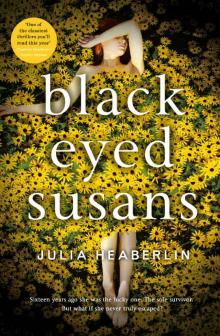
Black-Eyed Susans, page 5


He is at my side, reaching down, picking up the pad from the floor, placing it gently on the desk in front of me. My drawings, except for the one on the pad, are ripped out and scattered across his desk. My head pounds, and I press a finger into my right temple like there’s a pause button.
“May I?” he asks, which is ridiculous because I’m certain his eyes are already greedily scanning. He picks up a sheet, puts it down, picks up another.
The air is thick with the heat of his disappointment; he’s a teacher with a second-rate student who he has hoped will surprise him.
“It’s just the first time,” he says. Awkward silence. “You didn’t use any paint.” A hint of reproach?
He stiffens. Leans in closer, tickling my shoulder, turning my pad, which was apparently upside down. “Who is this?”
“I’m not done.”
“Tessie, who is this?”
I had scrubbed the charcoal against the page until it was black. I had dug into his desk drawer for the No. 2 pencil eraser that I used to swirl a chaotic nest of hair around her head. My fingernail carefully scratched out big eyes, delicate cheekbones and nose, full lips rounded into a frightened O.
I thought about the edges. No neck anchored her in the blackness. She floated in outer space, a silent, screaming constellation. I had drawn a face, but not the one he wanted.
“It’s your daughter.” Why I felt the urge to torture him, I do not know. I could have said it was Lydia. Or my mother. Or me. But I didn’t.
I feel a slight whoosh of air as he abruptly draws back. I wonder whether he wants to strike me. Oscar is whining way back in his throat.
“It looks nothing like her.” There is a slight crack in his voice. A picture forms in my head of a perfect black egg with a white hairline fracture.
I know that his reply is inappropriate, even silly. I am a skilled artist at seventeen, but this drawing is surely distorted, even childish. Of course it looks nothing like her. I’ve never met her. I’m blind.
He’s a doctor. He shouldn’t allow me to make any of this personal for him.
When did I become capable of such cruelty?
Tessa, present day
I’m thinking of Lydia as I shove a digger deep into the loose soil under my windowsill, pulling out the poisoned Susans, stacking them in a neat, weedy pile beside me. The metal of the digger is stained with traces of bloody rust, but the shiny part glints in the light filtering out the screen of my bedroom window.
The yellow curtains blow white in the moonlight, billowing and retracting. While I’d waited for Charlie to conk out, I plopped on the couch, flipped on Jimmy Kimmel Live, and scratched out a list on the back of a grocery slip, as if that somehow made the contents more harmless.
I wanted to see them neatly written down. Every single place I’d found a patch of black-eyed Susans in the years since the trial. The big question, which I already knew the answer to: Should I go back to each one of them alone? With Bill? With Joanna? Wouldn’t it just waste their time, make them think I was even crazier than they already did?
It seemed highly unlikely that I’d be able to find things he might have buried for me in the ground all these years later, or that I’d hit the right spot to dig, even with the photographs. Rain gushes, the earth moves.
Now, down on my hands and knees in the inky night, sifting my hand through the dirt, I wonder if I am wrong. I find an errant screw dropped from a worker’s hand when the windows were replaced two years ago. A scrap of paper. The stubborn roots of a vine that appeared like a white bone.
Lydia always knew what to do in these situations. She was the one with the scientific and logical mind, able to shove aside emotion and examine everything with the clinical detachment I didn’t possess. The summer we were eight, she stayed inside the lines of her coloring books, while I tried to invent a new color by melting crayons together on the sidewalk in the brutal Texas sun.
In elementary school, I liked to run against the wind for the battle of it; Lydia waited for me cross-legged on a blanket, reading something way too old for her. The Great Gatsby. Hamlet. 1984. Afterward, as I lay panting on the ground, she pressed cool fingers to my wrist and counted the beats of my pulse.
I knew that I would not die on Lydia’s watch. She’s the one who whispered in my ear while I stared at a waxy yellow version of my mother in the casket. She is not in there. She was unusually drawn to death, from the beginning.
When we were assigned a world history project on “a fascinating moment in British history,” two-thirds of Mrs. Baker’s freshman class wrote about the Beatles. I carefully etched a replica of the medieval London Bridge and pondered the miracle of God that kept the shops and houses crammed on top from crashing into the mighty Thames.
Lydia chose a river of evil so black and swirling you couldn’t see the bottom. Mrs. Baker asked her to read her report out loud to the class, probably because she knew it would keep us awake at our desks.
I’ll never forget Lydia’s chilling delivery of her opening lines, stolen from the coroner’s report.
The body was lying naked in the middle of the bed, the shoulders flat but the axis of the body inclined to the left side of the bed. The head was turned on the left cheek.
While most of her classmates were contemplating whether “I Am the Walrus” was just one big John Lennon acid trip, Lydia had buried herself in the story of Jack the Ripper’s final victim.
Mary Kelly met her grisly death at the 26 Dorset Street boardinghouse, room 13. She was 5’7”, twenty-five years old, a buxom prostitute, and owed twenty-seven shillings on her rent.
She was heard singing in her room hours before she died.
It doesn’t take a memory expert to figure out why I remember such details so many years later and very little about the medieval London Bridge. Lydia had turned on a British accent during her presentation. At one point, her fist thumped her chest three times in a dramatization of the first knife strikes.
Silly. Creepy.
To write that report, Lydia had immersed herself for two weekends in the Texas Christian University library, reading dissertations and nineteenth-century medical reports and essays from self-proclaimed “Ripperologists.” She tucked it in a plastic binder and told me to flip to the last page before she was supposed to turn it in.
I was gripped by horror porn: a black-and-white photograph of Mary Kelly lying in her flophouse bed, her insides ripped out. I never knew where Lydia found this, in the days before Google. Only that Lydia was always a relentless digger.
Why am I thinking about this now? I rub my hand across my forehead, wiping away sweat, leaving crumbs of dirt. I’m back in the kitchen, my foot on the trashcan pedal, dropping my collection into the trash. And then it hits me.
I had dismissed the scrap of paper because it didn’t bear a sadistic poem. Now I’m picking it out of the bin, examining it more closely. It could be part of a candy bar wrapper. Was it the kind of candy bar I bought at Walgreens the night I disappeared? The kind I bought every Tuesday for Roosevelt?
Roosevelt was a fixture on my Wednesday running route, nicknamed because at straight-up noon every single day, he stood on top of an old red bucket and spouted the entirety of FDR’s first inaugural speech.
By the time I flew by on Wednesdays after school, he was always long done with his diatribe. We had worked out a routine. I tossed a Snickers bar, his favorite, into the air without slowing my pace. He never failed to catch it and shoot me a big, toothy grin. It became a ritual of good luck during track season and a pact I kept up when summer started. I never lost a race after meeting Roosevelt.
And so it was decided. Every Tuesday night, I bought a Snickers bar. I didn’t buy two or three or four at a time. I didn’t buy them on Mondays or Saturdays. I bought one every Tuesday night, and he caught it on Wednesday afternoon, and I won and won and won.
But in those missing hours, I apparently did something I would never, ever consider doing. I ate his candy bar. There were traces of it in my vomit at the hospital.
I was committed to my ritual with Roosevelt. To winning. Did I eat the candy bar that night because I thought that I would never run a race again?
I grab a plastic snack bag out of the pantry shelf and seal the wrapper inside. Did he touch this? Did he stand under my window, snacking? My cell phone rings out from the living room couch, disturbing the silence that is everywhere except my chest.
Hastings, William.
“It’s late, Bill.” No hello.
“The day got away from me,” he says. “I just want to be sure you remember to be at the UNT lab tomorrow by 9:45, fifteen minutes before the techs start the process on the bones.”
How could I forget? I want to shout it at him, but instead say: “I’m driving myself.” This has to be the reason he called. He seems determined to pick me up.
Bill lets a couple of seconds elapse. “Joanna wouldn’t tell me what over the phone, but she says the forensic anthropologist has already found something.”
Tessie, 1995
“How is the drawing at home going?” He asks this before my butt hits the cushion.
“I forgot to bring any of them with me.” A lie. The drawings, nine new ones, are right where I want them—in a red Macy’s shirt box in my closet labeled Xtra Tampons, sure to dissuade my nosy little brother.
The phone on his desk suddenly buzzes. The emergency buzz, one of my favorite sounds in the world because it sucks minutes away from me.
“I’m sorry, Tessie,” he says. “Excuse me for just a moment. I’ve just checked in a patient at the hospital and was expecting a few questions from the nurse.”
The doctor’s voice travels over from the other side of the room. I can make out a few words. Elavil. Klonopin. Shouldn’t he be doing this privately? I’m really trying hard not to hear because I don’t want to imagine a person like me on the other end and get emotionally involved. So I focus on other things, like trying to match the doctor’s lazy drawl with Lydia’s description of him.
It was Lydia’s idea. Yesterday, with my blessing, she had hopped the bus to the TCU campus and sneaked into one of the doctor’s late afternoon summer classes: Anastasia Meets Agatha Christie: Exploring the Gray Matter About Amnesia.
When she told me the class title, I cringed a little. Too gimmicky. But then, I was looking for reasons to be critical.
If Lydia stuck on the big rounded plastic frames she wore when her contacts itched, she could easily disappear into a crowd of college students. Lydia’s father told her once that she was one of those people born thirty, and repeated it often, which Lydia carried around like a mortal wound. Me, well … I can’t tell Lydia but I feel a little uncomfortable around her dad these days.
Through our formative years, Mr. Bell concocted a kick-ass chili recipe, and hauled us to the shooting range, and whipped us around Lake Texoma in the unsinkable Molly every Labor Day and July 4th. But he was moody and known to strike out. And, since I turned fourteen, his eyes sometimes hesitated in the wrong places. Maybe he was just being more honest than most men greeted with puberty in bloom. Probably better to know, I reasoned, and wear longer shorts at her house.
Last night, after her successful day of spying and some of my dad’s leftover Frito pie, Lydia had been in especially good spirits. “Did you know that Agatha Christie went missing for eleven days in 1926 and no one had a clue where she was?” she had asked me breathlessly, from the corner of my bed.
I had her pictured in the usual position: legs pretzeled into an easy lotus, her pink-flowered Doc Martens lost somewhere on the floor, a hot pink scrunchy holding up a mountain of black hair. Pink was Lydia’s color.
A recap of the day’s events in the O.J. trial buzzed in our ears as background. It was impossible to get away from it. Daddy didn’t like a TV perched on top of my dresser, certainly didn’t like a bloody soundtrack, but he had relented instantly when I told him the constant noise made me feel less alone. That I wasn’t really listening to it.
It was only a half-lie. I found something soothing about Marcia Clark’s methodical voice. How could anyone not believe her?
“Agatha kissed her daughter goodnight and disappeared,” Lydia had continued. “They thought she maybe drowned herself in this pond called the Silent Pool because that’s where they found her wrecked car.”
“The Silent Pool?” I was skeptical. It was how anyone sane had to be with Lydia at least part of the time.
“Really. You can read it yourself.” She thrust a piece of paper at me. If it had been anyone else, this would have seemed like a mean poke. But it was Lydia. My vision was less gray when she was around. Lighter, like I was splayed flat on the tickly grass, staring up into late summer dusk. I let my fingers grasp her tangible proof that Agatha Christie lived out a page in her novels, as if it were important.
“Anyway, that’s where they found her car,” Lydia repeated. “The other thought was that her a-hole of a cheating husband killed her and abandoned the car there. While all of this was going on, Sir Arthur Conan Doyle even took one of her gloves to a medium to try to figure out where she’d gone. It was on the front of The New York Times.” More rustling of paper. “But she showed up. It turned out she had amnesia. For eleven days.”
“This was the focus of his lecture?” It was comforting, and somehow not.
“Uh-huh. I was intrigued by the class title, so I stopped off at the library before. When I got to class, your doctor was talking about the etiology of the fugue state and how it’s related to dissociative amnesia.”
It would be very hard to live in Lydia’s head. I imagined it blindingly bright and chaotic, like an exploding star. Both sides of her brain constantly at war. Because brilliant, steady Lydia was an addict when it came to murder and celebrities. The O.J. trial, her LSD. Any inane detail got her high. Like the other night, giggling about how O. J. Simpson had asked the cops for a glass of orange juice after the Bronco chase, followed up by ten minutes of her railing about the jury not getting the concept of restriction fragment length polymorphism.
“So what happened to her?” Trying to shuttle things along because I was curious, but wanting to know whether my doctor appeared to be a manipulative asshole.
“She was found in a spa hotel under an assumed name. She claimed not to recognize pictures of herself in the newspaper. Some doctors said she was suicidal, in a psychogenic trance. That’s like a fugue state, thus the title of your doctor’s class.”
“I’d rather think of her as a nice old lady writing cozy mysteries by the fire.”
“I know. It’s kind of like finding out that Edna St. Vincent Millay slept around and was a morphine addict. Ednas and Agathas should be true to their names.”
I’d laughed, something close to the way I used to, and imagined it drifting under the bedroom door, smoothing out a tight wrinkle in my father’s face.
“A mystery novelist with a cheating husband, gone missing. Sounds like a publicity stunt.”
“Some people might say that about you,” my best friend retorted. A rare slip, for her. It had hit its mark, a sharp pain to the right side of my stomach.
“Sorry, Tessie, it just came out. Of course that’s not true, either. He’s the kind of professor you could get a real crush on, you know, because he has that brain. He’s not a fake.” She sat silently for a second. “I like him. I think you can trust him. Don’t you?”
Smacked again. Fifteen hours later, back on the doctor’s couch, I’m fully absorbing the repercussions of this turn of events. Now, Lydia, my objective, loyal friend, would give my doctor the benefit of the doubt. I wondered if she’d been crazy enough to raise her hand. Ask a question. Get noticed. I should have thought this through.
The doctor has just excused himself and left the room. The longer he’s gone, the darker it gets. You wouldn’t think it would make any difference when you’re blind, but it does. The air-conditioning is noisily blowing through the vents, but it’s harder and harder to breathe. I’ve drawn my knees up tight and crossed my arms around them. My tongue tastes like a dead trout. There is growing dread that no one will find me and pull me out in time. That I will suffocate in here.
Is this one of your tests, doctor?
The second I decide I can’t take it any longer, he strides into the room. His chair creaks with his weight as he settles in. I fight the surge of gratefulness. You came back.
“That took longer than I thought. We can make up the time in our next session. We have about a half-hour left. I’d like to talk about your mother this week, if that’s OK.”
“That’s not why I’m here.” My response is quick. “I went over and over that years ago. Lots of people have mothers who die.” A fog drools at the corners of my vision. Frenetic pricks of light everywhere, like a swarm of frightened fireflies. New guests in my head. I wonder if this means I am about to faint. How would I know the difference? My lips contort, and I almost giggle.
“So you shouldn’t mind talking about it,” he says reasonably. “Catch me up. Where were you the day she died?” Like you don’t already know. Like there isn’t a big fat file on your desk that you don’t even have to bother to hide from a blind girl.
My ankle throbs and sends a message to the crescent scar on my face and to the three-inch pink line drawn carefully under my left collarbone. Can he not see how upset I am? That he should back off?
The pieces of his face spin around, stubborn, refusing to lock in place. Gray-blue eyes, brown hair, wire-rim glasses. Not at all like Tommy Lee Jones, Lydia had said. Still, no picture falling together for me. No way to draw him blind.
This is the worst session yet, and we are just getting started.
“I was playing in the tree house,” I tell him, while the fireflies do their panicked dance.
Tessa, present day
The first Susan has arrived, bundled in white cloth, like she is dressed for a holy baptism. The woman holding her is covered in head-to-toe white, too, her mouth and nose masked, so that all I can see are brown eyes. They look kind.
“May I?” he asks, which is ridiculous because I’m certain his eyes are already greedily scanning. He picks up a sheet, puts it down, picks up another.
The air is thick with the heat of his disappointment; he’s a teacher with a second-rate student who he has hoped will surprise him.
“It’s just the first time,” he says. Awkward silence. “You didn’t use any paint.” A hint of reproach?
He stiffens. Leans in closer, tickling my shoulder, turning my pad, which was apparently upside down. “Who is this?”
“I’m not done.”
“Tessie, who is this?”
I had scrubbed the charcoal against the page until it was black. I had dug into his desk drawer for the No. 2 pencil eraser that I used to swirl a chaotic nest of hair around her head. My fingernail carefully scratched out big eyes, delicate cheekbones and nose, full lips rounded into a frightened O.
I thought about the edges. No neck anchored her in the blackness. She floated in outer space, a silent, screaming constellation. I had drawn a face, but not the one he wanted.
“It’s your daughter.” Why I felt the urge to torture him, I do not know. I could have said it was Lydia. Or my mother. Or me. But I didn’t.
I feel a slight whoosh of air as he abruptly draws back. I wonder whether he wants to strike me. Oscar is whining way back in his throat.
“It looks nothing like her.” There is a slight crack in his voice. A picture forms in my head of a perfect black egg with a white hairline fracture.
I know that his reply is inappropriate, even silly. I am a skilled artist at seventeen, but this drawing is surely distorted, even childish. Of course it looks nothing like her. I’ve never met her. I’m blind.
He’s a doctor. He shouldn’t allow me to make any of this personal for him.
When did I become capable of such cruelty?
Tessa, present day
I’m thinking of Lydia as I shove a digger deep into the loose soil under my windowsill, pulling out the poisoned Susans, stacking them in a neat, weedy pile beside me. The metal of the digger is stained with traces of bloody rust, but the shiny part glints in the light filtering out the screen of my bedroom window.
The yellow curtains blow white in the moonlight, billowing and retracting. While I’d waited for Charlie to conk out, I plopped on the couch, flipped on Jimmy Kimmel Live, and scratched out a list on the back of a grocery slip, as if that somehow made the contents more harmless.
I wanted to see them neatly written down. Every single place I’d found a patch of black-eyed Susans in the years since the trial. The big question, which I already knew the answer to: Should I go back to each one of them alone? With Bill? With Joanna? Wouldn’t it just waste their time, make them think I was even crazier than they already did?
It seemed highly unlikely that I’d be able to find things he might have buried for me in the ground all these years later, or that I’d hit the right spot to dig, even with the photographs. Rain gushes, the earth moves.
Now, down on my hands and knees in the inky night, sifting my hand through the dirt, I wonder if I am wrong. I find an errant screw dropped from a worker’s hand when the windows were replaced two years ago. A scrap of paper. The stubborn roots of a vine that appeared like a white bone.
Lydia always knew what to do in these situations. She was the one with the scientific and logical mind, able to shove aside emotion and examine everything with the clinical detachment I didn’t possess. The summer we were eight, she stayed inside the lines of her coloring books, while I tried to invent a new color by melting crayons together on the sidewalk in the brutal Texas sun.
In elementary school, I liked to run against the wind for the battle of it; Lydia waited for me cross-legged on a blanket, reading something way too old for her. The Great Gatsby. Hamlet. 1984. Afterward, as I lay panting on the ground, she pressed cool fingers to my wrist and counted the beats of my pulse.
I knew that I would not die on Lydia’s watch. She’s the one who whispered in my ear while I stared at a waxy yellow version of my mother in the casket. She is not in there. She was unusually drawn to death, from the beginning.
When we were assigned a world history project on “a fascinating moment in British history,” two-thirds of Mrs. Baker’s freshman class wrote about the Beatles. I carefully etched a replica of the medieval London Bridge and pondered the miracle of God that kept the shops and houses crammed on top from crashing into the mighty Thames.
Lydia chose a river of evil so black and swirling you couldn’t see the bottom. Mrs. Baker asked her to read her report out loud to the class, probably because she knew it would keep us awake at our desks.
I’ll never forget Lydia’s chilling delivery of her opening lines, stolen from the coroner’s report.
The body was lying naked in the middle of the bed, the shoulders flat but the axis of the body inclined to the left side of the bed. The head was turned on the left cheek.
While most of her classmates were contemplating whether “I Am the Walrus” was just one big John Lennon acid trip, Lydia had buried herself in the story of Jack the Ripper’s final victim.
Mary Kelly met her grisly death at the 26 Dorset Street boardinghouse, room 13. She was 5’7”, twenty-five years old, a buxom prostitute, and owed twenty-seven shillings on her rent.
She was heard singing in her room hours before she died.
It doesn’t take a memory expert to figure out why I remember such details so many years later and very little about the medieval London Bridge. Lydia had turned on a British accent during her presentation. At one point, her fist thumped her chest three times in a dramatization of the first knife strikes.
Silly. Creepy.
To write that report, Lydia had immersed herself for two weekends in the Texas Christian University library, reading dissertations and nineteenth-century medical reports and essays from self-proclaimed “Ripperologists.” She tucked it in a plastic binder and told me to flip to the last page before she was supposed to turn it in.
I was gripped by horror porn: a black-and-white photograph of Mary Kelly lying in her flophouse bed, her insides ripped out. I never knew where Lydia found this, in the days before Google. Only that Lydia was always a relentless digger.
Why am I thinking about this now? I rub my hand across my forehead, wiping away sweat, leaving crumbs of dirt. I’m back in the kitchen, my foot on the trashcan pedal, dropping my collection into the trash. And then it hits me.
I had dismissed the scrap of paper because it didn’t bear a sadistic poem. Now I’m picking it out of the bin, examining it more closely. It could be part of a candy bar wrapper. Was it the kind of candy bar I bought at Walgreens the night I disappeared? The kind I bought every Tuesday for Roosevelt?
Roosevelt was a fixture on my Wednesday running route, nicknamed because at straight-up noon every single day, he stood on top of an old red bucket and spouted the entirety of FDR’s first inaugural speech.
By the time I flew by on Wednesdays after school, he was always long done with his diatribe. We had worked out a routine. I tossed a Snickers bar, his favorite, into the air without slowing my pace. He never failed to catch it and shoot me a big, toothy grin. It became a ritual of good luck during track season and a pact I kept up when summer started. I never lost a race after meeting Roosevelt.
And so it was decided. Every Tuesday night, I bought a Snickers bar. I didn’t buy two or three or four at a time. I didn’t buy them on Mondays or Saturdays. I bought one every Tuesday night, and he caught it on Wednesday afternoon, and I won and won and won.
But in those missing hours, I apparently did something I would never, ever consider doing. I ate his candy bar. There were traces of it in my vomit at the hospital.
I was committed to my ritual with Roosevelt. To winning. Did I eat the candy bar that night because I thought that I would never run a race again?
I grab a plastic snack bag out of the pantry shelf and seal the wrapper inside. Did he touch this? Did he stand under my window, snacking? My cell phone rings out from the living room couch, disturbing the silence that is everywhere except my chest.
Hastings, William.
“It’s late, Bill.” No hello.
“The day got away from me,” he says. “I just want to be sure you remember to be at the UNT lab tomorrow by 9:45, fifteen minutes before the techs start the process on the bones.”
How could I forget? I want to shout it at him, but instead say: “I’m driving myself.” This has to be the reason he called. He seems determined to pick me up.
Bill lets a couple of seconds elapse. “Joanna wouldn’t tell me what over the phone, but she says the forensic anthropologist has already found something.”
Tessie, 1995
“How is the drawing at home going?” He asks this before my butt hits the cushion.
“I forgot to bring any of them with me.” A lie. The drawings, nine new ones, are right where I want them—in a red Macy’s shirt box in my closet labeled Xtra Tampons, sure to dissuade my nosy little brother.
The phone on his desk suddenly buzzes. The emergency buzz, one of my favorite sounds in the world because it sucks minutes away from me.
“I’m sorry, Tessie,” he says. “Excuse me for just a moment. I’ve just checked in a patient at the hospital and was expecting a few questions from the nurse.”
The doctor’s voice travels over from the other side of the room. I can make out a few words. Elavil. Klonopin. Shouldn’t he be doing this privately? I’m really trying hard not to hear because I don’t want to imagine a person like me on the other end and get emotionally involved. So I focus on other things, like trying to match the doctor’s lazy drawl with Lydia’s description of him.
It was Lydia’s idea. Yesterday, with my blessing, she had hopped the bus to the TCU campus and sneaked into one of the doctor’s late afternoon summer classes: Anastasia Meets Agatha Christie: Exploring the Gray Matter About Amnesia.
When she told me the class title, I cringed a little. Too gimmicky. But then, I was looking for reasons to be critical.
If Lydia stuck on the big rounded plastic frames she wore when her contacts itched, she could easily disappear into a crowd of college students. Lydia’s father told her once that she was one of those people born thirty, and repeated it often, which Lydia carried around like a mortal wound. Me, well … I can’t tell Lydia but I feel a little uncomfortable around her dad these days.
Through our formative years, Mr. Bell concocted a kick-ass chili recipe, and hauled us to the shooting range, and whipped us around Lake Texoma in the unsinkable Molly every Labor Day and July 4th. But he was moody and known to strike out. And, since I turned fourteen, his eyes sometimes hesitated in the wrong places. Maybe he was just being more honest than most men greeted with puberty in bloom. Probably better to know, I reasoned, and wear longer shorts at her house.
Last night, after her successful day of spying and some of my dad’s leftover Frito pie, Lydia had been in especially good spirits. “Did you know that Agatha Christie went missing for eleven days in 1926 and no one had a clue where she was?” she had asked me breathlessly, from the corner of my bed.
I had her pictured in the usual position: legs pretzeled into an easy lotus, her pink-flowered Doc Martens lost somewhere on the floor, a hot pink scrunchy holding up a mountain of black hair. Pink was Lydia’s color.
A recap of the day’s events in the O.J. trial buzzed in our ears as background. It was impossible to get away from it. Daddy didn’t like a TV perched on top of my dresser, certainly didn’t like a bloody soundtrack, but he had relented instantly when I told him the constant noise made me feel less alone. That I wasn’t really listening to it.
It was only a half-lie. I found something soothing about Marcia Clark’s methodical voice. How could anyone not believe her?
“Agatha kissed her daughter goodnight and disappeared,” Lydia had continued. “They thought she maybe drowned herself in this pond called the Silent Pool because that’s where they found her wrecked car.”
“The Silent Pool?” I was skeptical. It was how anyone sane had to be with Lydia at least part of the time.
“Really. You can read it yourself.” She thrust a piece of paper at me. If it had been anyone else, this would have seemed like a mean poke. But it was Lydia. My vision was less gray when she was around. Lighter, like I was splayed flat on the tickly grass, staring up into late summer dusk. I let my fingers grasp her tangible proof that Agatha Christie lived out a page in her novels, as if it were important.
“Anyway, that’s where they found her car,” Lydia repeated. “The other thought was that her a-hole of a cheating husband killed her and abandoned the car there. While all of this was going on, Sir Arthur Conan Doyle even took one of her gloves to a medium to try to figure out where she’d gone. It was on the front of The New York Times.” More rustling of paper. “But she showed up. It turned out she had amnesia. For eleven days.”
“This was the focus of his lecture?” It was comforting, and somehow not.
“Uh-huh. I was intrigued by the class title, so I stopped off at the library before. When I got to class, your doctor was talking about the etiology of the fugue state and how it’s related to dissociative amnesia.”
It would be very hard to live in Lydia’s head. I imagined it blindingly bright and chaotic, like an exploding star. Both sides of her brain constantly at war. Because brilliant, steady Lydia was an addict when it came to murder and celebrities. The O.J. trial, her LSD. Any inane detail got her high. Like the other night, giggling about how O. J. Simpson had asked the cops for a glass of orange juice after the Bronco chase, followed up by ten minutes of her railing about the jury not getting the concept of restriction fragment length polymorphism.
“So what happened to her?” Trying to shuttle things along because I was curious, but wanting to know whether my doctor appeared to be a manipulative asshole.
“She was found in a spa hotel under an assumed name. She claimed not to recognize pictures of herself in the newspaper. Some doctors said she was suicidal, in a psychogenic trance. That’s like a fugue state, thus the title of your doctor’s class.”
“I’d rather think of her as a nice old lady writing cozy mysteries by the fire.”
“I know. It’s kind of like finding out that Edna St. Vincent Millay slept around and was a morphine addict. Ednas and Agathas should be true to their names.”
I’d laughed, something close to the way I used to, and imagined it drifting under the bedroom door, smoothing out a tight wrinkle in my father’s face.
“A mystery novelist with a cheating husband, gone missing. Sounds like a publicity stunt.”
“Some people might say that about you,” my best friend retorted. A rare slip, for her. It had hit its mark, a sharp pain to the right side of my stomach.
“Sorry, Tessie, it just came out. Of course that’s not true, either. He’s the kind of professor you could get a real crush on, you know, because he has that brain. He’s not a fake.” She sat silently for a second. “I like him. I think you can trust him. Don’t you?”
Smacked again. Fifteen hours later, back on the doctor’s couch, I’m fully absorbing the repercussions of this turn of events. Now, Lydia, my objective, loyal friend, would give my doctor the benefit of the doubt. I wondered if she’d been crazy enough to raise her hand. Ask a question. Get noticed. I should have thought this through.
The doctor has just excused himself and left the room. The longer he’s gone, the darker it gets. You wouldn’t think it would make any difference when you’re blind, but it does. The air-conditioning is noisily blowing through the vents, but it’s harder and harder to breathe. I’ve drawn my knees up tight and crossed my arms around them. My tongue tastes like a dead trout. There is growing dread that no one will find me and pull me out in time. That I will suffocate in here.
Is this one of your tests, doctor?
The second I decide I can’t take it any longer, he strides into the room. His chair creaks with his weight as he settles in. I fight the surge of gratefulness. You came back.
“That took longer than I thought. We can make up the time in our next session. We have about a half-hour left. I’d like to talk about your mother this week, if that’s OK.”
“That’s not why I’m here.” My response is quick. “I went over and over that years ago. Lots of people have mothers who die.” A fog drools at the corners of my vision. Frenetic pricks of light everywhere, like a swarm of frightened fireflies. New guests in my head. I wonder if this means I am about to faint. How would I know the difference? My lips contort, and I almost giggle.
“So you shouldn’t mind talking about it,” he says reasonably. “Catch me up. Where were you the day she died?” Like you don’t already know. Like there isn’t a big fat file on your desk that you don’t even have to bother to hide from a blind girl.
My ankle throbs and sends a message to the crescent scar on my face and to the three-inch pink line drawn carefully under my left collarbone. Can he not see how upset I am? That he should back off?
The pieces of his face spin around, stubborn, refusing to lock in place. Gray-blue eyes, brown hair, wire-rim glasses. Not at all like Tommy Lee Jones, Lydia had said. Still, no picture falling together for me. No way to draw him blind.
This is the worst session yet, and we are just getting started.
“I was playing in the tree house,” I tell him, while the fireflies do their panicked dance.
Tessa, present day
The first Susan has arrived, bundled in white cloth, like she is dressed for a holy baptism. The woman holding her is covered in head-to-toe white, too, her mouth and nose masked, so that all I can see are brown eyes. They look kind.