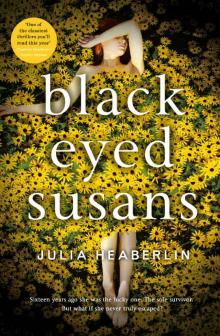
Black-Eyed Susans, page 23


The protester’s shoulders are hunched in an arthritic mountain. She’s traveling on red cowboy boots anyway. She drawls her answers to the reporter a little cynically, as if she’s seen a hundred of him. Yes, the lights of the whole town used to dim for a second every time a prisoner was electrocuted. Yes, this is a typical crowd. Yes, Karla Faye Tucker was the biggest zoo, being a woman. Someone on the square even advertised “Killer Prices.”
The reporter cuts her off abruptly.
Bill nudges my shoulder. Gloria has raised the bullhorn to her lips.
Shadows are moving across the street. Ice keeps shooting out of the sky.
The air suddenly vibrates with the roar of a hundred angry tigers, so loud and so fierce that it rattles my brain, the balls of my feet, the pit of my stomach.
The thunderous noise drowns out Gloria shouting into her bullhorn and the hymn of the women, whose mouths continue to open and close like hungry birds.
The Blue Knights are revving their motorcycles in unison, so he can hear.
Kill him.
September 1995
MR. VEGA: Will you please state your full name for the record?
MR. BOYD: Ural Russell Boyd. People call me You-All. Ever since I played basketball in high school. The cheerleaders turned it into one of their yells.
MR. VEGA: How would you like me to address you today?
MR. BOYD: You-All’s fine. I’m a little nervous.
MR. VEGA: No need to be nervous. You’re doing just fine. You own four hundred acres of land approximately fifteen miles northwest of Fort Worth, correct?
MR. BOYD: Yes, sir. In my family for sixty years. But everybody still calls it the Jenkins property.
MR. VEGA: Will you please tell us what happened on the morning of June 23, 1994?
MR. BOYD: Yes, sir. My hound dog went missing. We were supposed to go bird hunting that morning real early. When I couldn’t find him, I set out with Ramona.
MR. LINCOLN: Ramona is …?
MR. BOYD: My daughter’s horse. Ramona was the most in the mood for a ride that morning.
MR. LINCOLN: And what happened after that?
MR. BOYD: Almost right away I heard Harley start to howl near the west pasture. I thought maybe he met a copperhead. I’ve had some problems with copperheads.
MR. VEGA: You followed his howl?
MR. BOYD: Yes, sir. Once he started he wouldn’t stop. I think he felt the vibration of Ramona’s hooves and could feel us coming. He’s a real smart dog.
MR. LINCOLN: Approximately what time was this?
MR. BOYD: About 4:30 A.M.
MR. LINCOLN: How long did it take to find Harley?
MR. BOYD: Ten minutes. It was dark. He was at the far corner of the property, about a half-mile off the highway. He was keeping watch.
MR. VEGA: What was he keeping watch over?
MR. BOYD: Two dead girls. I didn’t know that the one girl was alive. She didn’t look alive.
MR. VEGA: Will you please describe to the jury exactly what you saw when you came upon the grave?
MR. BOYD: First, I flashed my light on Harley. He was flat down in a bunch of flowers in a ditch. He didn’t move. I didn’t see the hand at first because his nose was lying on it. I knew it was a girl’s hand because of the blue fingernail polish. Sir, I’d like to take a minute.
MR. VEGA: Certainly.
MR. BOYD: (inaudible)
MR. VEGA: Take all the time you need.
MR. BOYD: It was a bad moment. My daughter picks those flowers all the time. I hadn’t checked her bed before I left the house.
18 days until the execution
While Bill and I waited for Manuel Abel Gutierrez to die, a light freezing rain had transformed the highway home into a ribbon of glistening ice. It’s the kind of storm that Yankees make fun of on Facebook with a picture of a spilled cup of ice on the sidewalk that shuts down schools or a cartoon that depicts massive car pileups with one culprit snowflake. It would be funny, if a tenth of an inch of ice in Texas wasn’t deadly.
Bill had announced six minutes onto I-45 that he wasn’t about to skate the four-hour trek back, and swung the car around. So here we are, locked in a Victorian ice castle two blocks from the death chamber and its dissipating cloud. We were lucky that Mrs. Munson, the eighty-seven-year-old B&B proprietor, picked up her phone at 11:26 P.M. Every other hotel that lined the highway was booked solid, their parking lots crammed with cars frosted like petits fours.
Bill is running the water in his bathroom. The sound rushes through the wall and under the one-inch gap beneath the connecting door. Mrs. Munson had called up to us three times as we climbed the stairs to say that the whole house was replumbed and wired with central heat, as if we might not understand the $300 price tag per room. I bounce lightly on the bed, running my fingers over the path of tiny stitches of red and yellow tulip quilt. I want to tell Mrs. Munson that her accommodations are worth every penny.
Lydia would love this room with the cheery lemon walls and the grim faces of dead people staring off the dresser. The iron lamp with a gold-fringed shade that glows like a tiny fire. The ice chips clicking against the window, chattering teeth.
She would lie on this bed and construct a doomed romance for the gauzy antique wedding dress that hangs like a ghost in the half-open wardrobe, and a more terrifying tale about the door to another dimension that hides in the shadows behind it. Maybe she’d combine the stories into one. This night would race ahead, a splendid, radiant adventure. We would be girls again, before monsters and devastating words, our imaginations locked together.
There’s a short knock on the connecting door.
“Come on in, Bill,” I say immediately.
Bill hesitates on the threshold, dressed in jeans and a T-shirt that must have been hidden under his button-down. “I found toothbrushes in a cabinet in my bathroom. Want one?” I slide off the bed and walk over.
“Thanks.” I pick blue over yellow. “I could use a glass of wine, too. Maybe a shot of tequila.”
“I don’t think that’s stocked in the bathroom cabinet. I’m getting a bottle of water from the little fridge in the hall. Want one?”
“Sure.”
He disappears into his room before I can tell him to use my door to the outside hall. We are being so very polite. Earlier tonight, before we headed to the execution, Bill had punched a button on his computer and officially filed Terrell’s habeas corpus appeal with the federal court. It emphasizes the “junk science” DNA results on the red hair, the overwhelming statistics on faulty witness ID, and a statement from me, the living victim who thinks the real Black-Eyed Susan killer might still be stalking her and is willing to testify to it.
No mention of mysterious black-eyed Susan plantings or a buried book of Poe in Lydia’s back yard or a tooth in an old U-Haul box.
I have wished, more than once, that I had kept the sick piece of poetry I found under my tree house instead of ripping it to shreds and throwing away the pill bottle it came in. It might have been impossible to retrieve DNA or fingerprints from the paper or plastic all these years later, but it was tangible proof that I wasn’t making it up.
Bill’s habeas petition is far short of what he wanted to file at this point, but he is hoping it is enough for the judge to grant a hearing. He’s hoping that Jo will shake more loose from the bones in the meantime.
“Here you go,” Bill says. “I see you’ve got cable TV, too. It’s just a little hard to see around these tree trunk bedposts. Did you reach Lucas?”
“It’s all good. He’s got it covered. Charlie’s asleep.”
“Can I sit down for a second?”
“Sure.”
He pulls the straight-back chair from beside the dresser and sits on a needlepointed seat of roses. I reassume my position on the corner of the bed.
“You asked the other day if there’s hope,” Bill says. “After today … I just think it’s better if I’m honest. I think it is likely that Terrell is going to die. He’s on a runaway train. I know today was tough. Meeting Terrell. The execution. It doesn’t matter how you feel about the death penalty. I was all for the death penalty five years ago and it’s just as fucking grim either way.”
I’m stunned by this admission. I had never imagined him with a single doubt.
“Two things happened for me to change my mind. The duh lawyer moment when I realized that you’re never going to find a rich white guy on that gurney. And the Angie moment. She made me get to know a couple of guys on Death Row. Guilty ones, like a guy who broke in to a back yard high on meth and shot an elderly woman sitting in the garden in her wheelchair, so he could run inside and steal her purse. Angie didn’t think I could do this job to her satisfaction until I understood that it wasn’t just about proving innocence. That I needed to be all in. To understand that men on Death Row were human beings who did horrible things but that didn’t mean they were horrible things. The men that I’ve met who are sitting on Death Row are not the same men who committed those crimes. They are sober. Born again. Repentant. Or bat-shit crazy.” He eases back in the chair. “Occasionally, but not often, innocent.”
I wonder how long he’s been holding in this speech and why he chose tonight to give it. “I don’t know where I am on the death penalty,” I say. “I’m just … not … there.” I have promises to keep.
“And Terrell?”
“I can’t talk about Terrell.”
He nods. “I’ll let you get some sleep.”
As soon as he shuts the door between us, I’m desperate to wash away everything about this day. I enter a bathroom both bygone and modernly appointed, strip off all of my clothes, and lay them on the counter. I dread putting them on in the morning. They’re tainted by death. But I’d brought nothing else in my backpack—just a couple of PowerBars, a water bottle, a spool of silk thread and needles for an experiment in lace-making. And, at the last minute, I’d tossed the testimony inside, mostly in case Bill asked if I’d read it. I hadn’t. I’d opened the envelope, pulled out the papers, and stuck them right back in.
I push aside the shower curtain and crank the knob. The hot water responds, silky, hot, and immediate. I wash everything three times before stepping onto slick white subway tile and reluctantly tugging on the day’s underwear and a white cotton tank that had been my ineffective effort at winter layering. I towel-dry my hair into a frenzy of curls, too exhausted to use the expensive ceramic blow dryer on the counter.
I slip into chilly sheets, shivering, trying not to think about the grieving mother who raced to a morgue tonight. Who hoped, for the first time in years, to touch the body of her son, a killer, while it was still warm.
At 4:02 A.M., my eyes pop open. I’m gasping for breath as if someone just snatched a pillow from my face.
Lydia.
Cool light streams through the windows. The winter storm, asleep. My mind, racing.
To Charlie, safe at home, tangled in her comforter. I picture her breathing softly, in and out, and I breathe in rhythm with her. To Lydia, holding the paper bag to my face after a race, telling me to breathe, and I do. In and out.
Lydia, Lydia, Lydia. She’s invaded this room. The old Lydia, who checked my pulse, and the other one, who is scratching to get out of Bill’s envelope in my backpack.
Did I just miss the clues? Or are all of us just one betrayal, even one sentence, away from never speaking to each other again? I always, always defended my best friend. Even Granddaddy, a fan of her rabid imagination, wasn’t completely sure.
He asked once: “What do you see in Lydia?”
“She’s like no one else,” I had replied, a little defensively. “And loyal.”
She changed in the month before the trial. The old Lydia made fun of the push-up Wonderbra. She stuck her hands under her breasts, arranged them into little mountains and mocked the Eva Herzigova billboards. Look me in the eyes and tell me that you love me. She cocked her knee, planted her hands on her hips, thrust out her chest, and drawled: Who cares if it’s a bad hair day?
The new Lydia bought a Wonderbra and strapped it on. She complained that all high school boys wanted was a blank slate to draw their pencil on. Her grades dipped into the A minuses. She renounced Dr Peppers and Sonic cheese tots, and worst of all, she stopped her incessant, encyclopedic chatter. I knew I should press her, but I was trapped in my own head.
Old Lydia kept all of my secrets.
New Lydia told my secrets to the world.
I’m standing over his bed. The covers are a rumpled drift, like snow is falling through the ceiling. Bill is facing the other way. His body, rising and falling, slow and steady.
It isn’t like me to do this, I think, as I shed my T-shirt and it falls soundlessly to the floor. I don’t play games. I’m not impulsive. I’m not that girl. I lift up the quilt and slide in. Press my bare skin against the heat of his back. His breathing stills. He waits pregnant seconds before turning over to face me. He’s left a few inches of distance between us.
“Hey,” he says. It’s too dark to read his expression.
This was a mistake, I think. He’s already mentally moved on. He’s reaching out now to push me away.
Instead, his finger travels my cheek, the side without the scar. I’m suddenly aware that my face is wet.
“You OK?” His voice, husky. He’s being chivalrous, offering me a last chance to escape, even as I make a naked present of myself in his bed.
“I’m not that kind of girl.” I lean in. Drift my tongue along his ear.
“Thank God,” he replies, and tugs me to him.
A bird’s distress call slices the silence and jars me awake. It’s a high-pitched plea from a branch by the window. Why is my world frozen? Where did everybody go?
I crawl out of bed, away from the delicious heat of Bill’s body. His breathing, rhythmic.
I shut the connecting door, back on my side of it. I relive the intimacy of what just happened. Things I didn’t do unless I was in love. How can I ever be sure his attraction is to me, and not the shiny glitter of Black-Eyed Susan?
My red North Face jacket drips like blood off the closet doorknob. A fresh white orchid is stuck all alone in a slim vase, even though no one knew I was coming. A young woman in the antique frame on the dresser gazes at me coolly as if I have no place in her room.
She’s just a girl in this picture, about Charlie’s age. A thick, migraine-inducing braid is roped around her head. I imagine her with loosened braids and a little of Charlie’s MAC eye makeup. I pick up the picture and flip it over.
Mary Jane Whitford, born May 6, 1918, died March 16, 1934, when a convict roaming the sugarcane fields stepped in front of her carriage and startled the horses.
A tourist attraction. Like me.
It makes sense that Lydia would come to me here, in this room, embroidered like a doily in the dark fabric of this town. Where I’m reminded by a pretty girl in braids that we don’t get to choose.
I almost died three hours ago on I-45, halfway between Huntsville and Corsicana. What an ironic end that would have been—the lone survivor of the Black-Eyed Susan killer taken out by an eighteen-wheeler packed with baked goods. A truck driver a hundred feet in front of our car had skidded on a patch of ice into a perfect jackknife. If skidding were an Olympic sport, he’d win. All I could think for six seconds, while Bill and I hurled toward a picture of a giant pink confetti-sprinkled donut, was, Is it all going to come down to this?
Instead, it came down to me completely rethinking BMWs. Their drivers act superior for a reason.
Lucas is opening my front door before I can, a good thing because I don’t remember the new security code he insisted on, and a bad thing because Bill is still in the driveway making sure I get inside safely. I turn to wave but Bill is already backing the BMW onto the street. I hope he believed me when I said I wasn’t sleeping with Lucas.
Breakfast at the B&B was a little awkward. Bill sat across from me, at a table formally appointed with fragile crystal and an array of silverware, while Mrs. Munson sat at the head of the table and chattered on about how prisoners carved the intricate detail on the cupboard behind us. It was impossible to resist the work of art placed in front of us by Mrs. Munson’s daughter, a Dutch baby pancake with a strawberry fan on top and a spritz of powdered sugar.
Maybe Bill was upset that he woke up alone in bed. Later, in the car, we each seemed to be waiting for the other to bring up those thirty intimate minutes. It almost seemed like a dream conjured by a house that missed the noise and meaning of its old life—the people who wed on its lawn, gave birth in its beds, lay dead in their coffins in the front parlor. Except I can still feel his handprints on my skin.
After Bill avoided the near-accident, the silence in the car grew even more awkward. As if Bill was exhausted from saving lives.
Because I’m distracted by such boy-girl worries, still wearing death like a coat, still delirious not to be a Dutch baby pancake, it takes a second to register the expression on Lucas’s face.
“Welcome home.” He seems uneasy. He’s pulling the backpack off my shoulder as I walk the few steps into the living room.
“What’s wrong?” I ask.
“Someone leaked your … feeling … that the Black-Eyed Susan killer has planted flowers for you over the years. A few quack experts on TV are chiming in on your mental state. There’s a shadowy picture going around of a woman with a shovel at the old Victorian house where you used to live. It’s supposed to be you. Well, it is you. But it’s hard to tell.”
“When did you find this out?”
“Why don’t you sit down?”
“I’ve been sitting for hours.”
Lucas examines my face carefully. “Charlie texted me. It’s all over Twitter and Instagram.”
“Shit. Shit, shit, shit.”
He hesitates. “I had to turn off the ringer on the phone. Why do you even have a landline?”
“Is it OK if we don’t talk about this right now? It doesn’t really matter, does it? Terrell’s going to die. It’s impossible to protect Charlie.” I’ve moved over to the kitchen island, where Lucas has stacked the mail. He’s behind me, rubbing my shoulders. Kind. Concerned. But not helping. His fingers are grinding the death that clings to these clothes into my skin.