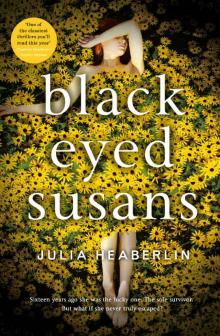
Black-Eyed Susans, page 7


“There’s a digger snatcher.” She waves a small garden trowel, which I hadn’t noticed until now. “I’m going to take it up with the neighborhood watch.”
“Digger … snatcher?”
“I just drove to Walmart to buy this one—$2.99 plus tax. Been going on for six months. I buy a digger, and it disappears. I can’t keep buying diggers. Do you know where your digger is? I’m thinking of taking a block digger survey.”
“Um.” I have to think about whether I want to answer. “Behind the house. I think I left it there when I was … doing a little weeding.” Stuck upright in the ground, like a grave marker.
“I’m warning you, you might as well be leaving out a crisp $100 bill.”
“I’ll keep an eye out. Do you have a place … you regularly put your digger?” I ask this cautiously, knowing that organization is a sensitive topic for Effie.
Things in her house have a way of dancing around: a Scientific American on genetic engineering stashed in the freezer, the extra house key taped to the bottom of the butter dish, a bottle of Stoli vodka crammed under the bathroom sink with the rusty can of Comet from 1972.
“Well, back to sorting my seedpods.” Effie stands. “The grubs ate my beans something terrible last year. I’m going to try putting out a bowl of beer for them this year. I’m sure that’s pure bunk but it seems like a happier way to go than me stomping their guts out. I wouldn’t mind drowning in a bowl of beer when it’s my time.”
I laugh. Reach over and give her a hug. “Thanks for making my life … normal,” I say.
“Honey, I’m a sweaty mess.” She meekly returns my hug. “Most people think I’m pretty weird.” Most people generally meant her daughter.
“Well, I can relate. What kind of person builds staircases for farting actors?” What kind of person suppresses the flutter in her chest every time the sun goes behind a cloud, afraid she’s going blind? Or when she opens a jar of peanut butter? When someone yells “Susan!” across a playground?
On her way to the door, Effie pauses. “Can you send Charlie over in about a half-hour to help me and my hysterical society lady friend move some stuff? I mean, historical. Although she is a bit hysterical. These ladies need to get their heads out of their damn bustles, if you get my drift.”
“Of course.” I grin. “I’ll tell Charlie.”
From the stoop, I watch her navigate across the thick carpet of golden brown Bermuda, disappearing into her overgrown front garden until all that’s visible is her hat bobbing like a bluebird above a mound of fountain grass.
For sixty-one years, Effie has occupied the frilly yellow house next door, a Queen Anne cottage that, like our 1920s Arts and Crafts bungalow, sits in the middle of Fort Worth’s famous historical Fairmount District. Effie can’t remember the exact number of paint colors she’s slapped on her spindlework and fish scale shingles over time, but she dates things by saying, When the house was lilac, or When the house was in its awful brown period. Effie still pulls her Cadillac boat out of the garage to attend the neighborhood monthly historic preservation meeting. She revels in dragging Charlie, one eyeball at a time, away from her iPhone and assaulting her with neighborhood history. The trolley once rumbled down our street, which is why it is wider than most of the others. Over on Hemphill, there used to be a fantastical mansion with a life-size windmill on top, until it mysteriously burned to the ground.
When the phone inevitably reasserts its magnetic force on Charlie, Effie just brings out the hard stuff: tales about Butch Cassidy and the Sundance Kid, who lived in Hell’s Half Acre only three miles from here, or the creepy, boarded-up pig tunnels that run under the city. “That’s how Judas goats got their name,” Effie asserts. “By herding pigs to slaughter to spare themselves. Back when, goats herded as many as ten thousand pigs a day through Fort Worth’s underground tunnels to their miserable fates in the Stockyards. Like New Yorkers in the subway.”
Generally, when it came down to Effie vs. Twitter, Effie won. “Kids need a sense of place,” she liked to admonish me. “A sense that they all aren’t living and talking in outer space.”
Back in the kitchen, I firmly root myself in the uncomfortable present, on the one kitchen stool that obediently twirls little half-circles. I sip my tea and stare at the card on the flowers. It begs to be opened. I reach over, tug it off its plastic holder, lift the tiny flap, and pull out a flat cardboard square decorated with a cartoon spray of balloons.
I miss you.
Love, Lydia
The card slips from my hand onto the counter. The corner begins melting into the ring of sweat left by my iced-tea glass. Lydia’s name blurs into a purple stain. Not the handwriting I remembered, but maybe it isn’t hers. Maybe it is the florist’s.
Why would Lydia casually send me flowers? Wouldn’t she understand that I’m still in mortal daily combat with them? That I’m hanging on to the bitter shreds of our fight after the trial? We hadn’t talked for seventeen years, since her family up and left without a word. The flowers seem like a taunt.
I yank the arrangement out of the vase, splashing my jeans in the process, and slide open the glass door to the back yard. Within seconds, pink Gerbers and purple orchids are scattered on top of the funeral pyre of my compost. I carry the vase to the recycling bin sitting empty outside the two-car garage that backs up along our fence line. Bemoan that Charlie should have taken in the recycling bin two days ago.
No reason to panic and think my monster sent these and signed Lydia’s name. I open the gate to the slim ribbon of grass that is our side yard. SpongeBob’s squeaky voice wafts from an open window next door. That means the babysitter is inside, not the fussy lawyer parents with matching Tesla sedans.
I learned a long time ago to pay attention to what is usual, and what is not.
To retrieve an encyclopedia from the smallest sound.
I round the corner. No one has planted any more black-eyed Susans under my bedroom windowsill. The ground is smoothed flat and swirled, like a pan of chocolate cake batter. The thing is, I hadn’t done any smoothing or swirling.
And my digger is gone.
Tessie, 1995
“If you had three wishes, what would they be?” he repeats.
His latest game.
The curtain had gotten us nowhere last time. I had no clue why I was drawing it. I had told him that it was an ordinary curtain. Still, like there was no breeze. When I didn’t bring in my drawings today, he didn’t bring it up. He noted my boundaries, unlike the others, but he’s irritating me in whole new ways. For instance, now insisting I show up for his little interrogations twice a week.
“Really?” I ask. “Let me see. Do you want me to say that I wish my mother would come down from her puffy cloud and give me a hug? That I wish I wasn’t living in some kind of Edgar Allan Poe poem? That I wish my three-year-old cousin would stop snapping his fingers in my face to see if he can magically make me see? That I wish my father would yell at the TV again? I need a whole lot more wishes than three. How about this: I wish I weren’t answering this stupid question.”
“Why do you want your father to yell at the TV?” A trace of amusement in his voice. I relax a little. He isn’t mad.
“It was his favorite thing. Yelling at Bobby Witt when he makes one of his wild throws. Or walks somebody. Now Dad just sits there like a zombie when the Rangers play.”
“And do you think that’s your fault?”
The answer to this is too freakin’ obvious.
I wish I’d never met Roosevelt, so I wouldn’t have needed to buy a Snickers bar, so I wouldn’t have been walking out of that drugstore at 8:03 P . M . on June 21, 1994. I wish I never cared about winning, winning, winning.
“It’s interesting that you bring up Poe.” Already moving on.
I’d bite on that one. “Why?”
“Because most people on that couch who’ve endured a psychic trauma compare their experiences to something in more current pop culture. Horror movies. Crime shows. I get a lot of Stephen King. And John Paul. When did you start reading Poe?”
I shrug. “After my grandfather died. I inherited a lot of his books. My best friend and I got into them for a while. We read Moby-Dick that summer, too. So don’t go there, OK? It doesn’t mean anything. I was a happy person before this happened. Don’t focus on things that don’t mean anything.”
“Poe was mired in his lifelong fear of premature burial,” he persists. “The reanimation of the dead. His mother died when he was young. Don’t you think that could be more than coincidence?”
A hammer is pounding my brain. How did he know? Just when I thought he was an idiot, he surprised me. He was always going somewhere.
“Do you want to tell me about it?” he asks.
Oscar picks that moment to readjust himself. He licks my bare knee on the way back down. Aunt Hilda yells at him idiotically all the time, “No lick! No LICK!” but I love his slobber. And right now, it is like he is saying, Go ahead, take a chance with this one. I want you to throw the Frisbee to me someday.
“The college girl from East Texas … Merry or Meredith or whatever.” I speak haltingly. “She was alive when they dumped us in that grave. She talked to me. I remember her both ways. Dead and alive.” With eyes like blue diamonds and with eyes like cloudy sea glass. Maggots hanging out in the corners, twitchy pieces of rice.
He doesn’t answer immediately. I realize this is not at all what he was expecting.
“And the police have told you that’s not possible,” he says slowly. “That she was already dead when you were in that grave. That she’d likely been dead for hours before you were dumped.”
How carefully my doctor had read everything about this case.
“Yes. But she was alive in the field. She was nice. I could feel her breath in my face. She sang. And she was in the church choir, remember?” Begging him to believe me, and I am only telling him the least crazy part. “She told me her mother’s name. She told me all of their mothers’ names.”
I wish I remembered them.
Tessa, present day
I am waiting for the morning bomb to go off. Or not. I have made coffee and buttered a piece of bulgur-banana bread, listened to Charlie blast music in the shower, loosely sketched an appliqué design for the tutu, thought about how lucky I am.
Because, make no mistake, I am terrifically lucky. If I ever forget, the Susans remind me, in chorus. And the bread isn’t half-bad.
“Mom!” Charlie’s shriek carries easily from inside her room. “Where’s my blue jersey?”
I find Charlie in her underwear, hair slapping around like wet red string. She is tossing her room, a rabbit’s nest of dirty clothes.
“Which jersey?” I ask patiently. She owns two practice uniforms and four game uniforms. The uniforms were “required to play,” cost $435, and three of them looked exactly alike to me.
“Blue, blue, blue, didn’t you hear me? If I don’t have it for the scrimmage, Coach will make me run. He might make the whole team run because of me.” Coach. No last name necessary. Like God.
“Yesterday, he threw Katlyn out of practice for forgetting her red socks. She was so embarrassed. And it was just because her mom washed them and accidentally stuck them in her brother’s baseball basket. He’s on a team called the Red Sox. Duh.”
I pull something blue out of the tangle of clothes on the floor. “Is this it?”
Charlie is now spread-eagled and lying faceup on her unmade bed, deciding whether the world is ending. She cranes her neck slightly in my direction. I note that her backpack is open on the desk, unpacked, biology homework still flayed out. The digital clock on her dresser says nineteen minutes to go before my friend Sasha and her daughter pick her up for school.
“Mom! No! It’s the one with the white number and that cool edging at the bottom. The practice jersey.”
“Yes, I should have read your mind. Have you looked in the washer? Dryer? Floor of the car?”
“Why does this have to happen to me?” Still staring at the ceiling. Not moving. I could say, I’m done. Good luck. Walk out. When I shouted that very same question of the world at the tender age of sixteen, “Coach” would have seemed like a wasp to swat. Hard to believe I’d only been two years older than Charlie is now.
The very best thing about landing in that grave? Perspective.
So I peer through this morning’s prism: a science test looming in second period, an a-hole of a coach who probably could have used more childhood therapy than I got, and a telltale tampon under my foot.
I consider the clawed tiger on the bed, the one wearing the zebra-printed sports bra—the same tiger that every Sunday night transforms into the girl who voluntarily walks next door to help sort Miss Effie’s medicine into her days-of-the-week pill container. The one who pretended her ankle hurt one day last week so the backup setter on her volleyball team would get to play on her birthday.
“It was a really kind gesture,” I had told her that night when she explained why she did not need the ice pack. “But I’m not sure it was such a good idea.”
Charlie had performed her usual eye roll. “Mom, you can’t let the wrong stuff happen all the time. There is no way Coach would have ever let her play. And she set three points right after that. She’s just as good as me. I’m just two inches taller.”
I can’t count the times that Charlie has offered me her bits of tempered wisdom along with a little frightening Texas grammar.
“Dry your hair, get dressed, pack up,” I order. “You have a little over fifteen minutes. I’ll find the jersey.”
“What if you don’t?” But her legs are in motion, swinging over the side of the bed.
Eight minutes later, I find the jersey behind her hamper. White number 10 on the back, nearly invisible edging along the bottom. Strong odor of sweat and deodorant. Apparently, she’d made a half-hearted effort to put it where it belonged. No wonder we hadn’t found it.
I stick it in her duffle by the front door and check for red socks. Two short honks chirp from outside.
Charlie appears. “Did you find it?”
“Yep.” She looks so perfect to me that it hurts. Damp curls that hadn’t been sacrificed to a Chi Ultra flat iron springing up like tiny flames. Lip gloss only, so the freckles are out. Jeans, plain white T-shirt, the St. Michael charm that she never takes off nestled in her throat. Her father mailed it last Christmas from overseas, a design from James Avery, the kingpin of tasteful Christian fashion accessories. He started selling his stuff out of a two-car garage in the Texas Hill Country in 1954. Now, six decades later, his jewelry is both holy and pricey.
But for Charlie, this piece of metal out of a Kerrville factory isn’t a status symbol. It is a talisman, a sign that her daddy, in the guise of a sword-carrying saint around her neck, will keep her safe. Keep all of us safe. Lucas had worn the good luck charm as long as I’d known him, a gift from his own mother the first time he went to war.
“You’re good to go,” I say. “You look especially pretty. Good luck on your test.”
She slings the duffle over her shoulder and glances over my breakfast offerings on the table by the door.
“Nice try, but not takin’ the booger bread.” She slips the granola bar and the banana into the side pocket of her backpack. Another toot of the horn. Effie will be peering out her living room window at this point.
“This day sucks.” Charlie spins out the door, leaving the air charged and a chaotic trail from the bathroom floor to her room.
I catch the slamming screen in time to toss a wave to Sasha, whose face is hidden by the harsh glint of sun off the windshield of the familiar blue minivan. The glass is black, impenetrable. I can’t tell if she is waving back.
That doesn’t mean I need to run out and check that she isn’t bleeding on the ground, out of sight, behind the live oak, tossed out of the vehicle while she waited patiently for Charlie. That a stranger, with all of Effie’s stolen diggers stacked in the trunk, isn’t necessarily behind the wheel, about to drive my fire-breathing angel off to hell.
I shut the door and lean back against smooth, cool wood. Breathe in deep. Hope that other, more normal moms harbor similar out-of-control thoughts about their children’s safety.
I wrap up the rejected slice of Effie’s bread, generously lathered in strawberry cream cheese, and stick it in the refrigerator. Lunch, maybe. Wash up my coffee cup and set it to drain.
For the next ten minutes, the erratic whirring of the sewing machine breaks the silence. My foot, pressing the pedal. Fingers manipulating satin. Stop. Start. Stop. Start. The background noise of my childhood before Mama died.
Not the scrape of saw against bone.
My mind is not traveling in a row of tiny perfect stitches. It is skipping, out of order, to the places he has planted black-eyed Susans. My eyes close for a second and the stitches derail and zigzag like a train off track.
The list I’d made a couple of days ago is taped to the bottom of the vegetable drawer. Shades of Miss Effie.
In forty-five minutes, I am pressing the pedal of my Jeep.
Long after Lydia and I broke apart, I had returned to this place. Again and again. Maybe hoping a little bit that she would, too.
Until I stopped.
It is different, and the same. The ducks sail on the shivering glass. Aimless. Waiting for the day’s first crust of bread to hit the pond.
My car is slung, alone, by the side of the road. Lydia and I had usually ridden the bus here, from Hemphill to West Seventh.
My feet are soundless on the earth. About here is when they used to pick up speed, ready for takeoff.
Lydia was always talking, laughing, talking while we traveled this path. Telling me what library book she’d dragged along with her dad’s soft old green hunting blanket and an already lukewarm can of Diet Dr Pepper.
The Unbearable Lightness of Being.
Diana: Her True Story.
There’s a slight breeze rustling things. Half of the leaves on the hackberries and pecans are still trying to make up their minds. Is it winter or not? When Lydia and I walked here, the trees were leafy and thick. They blocked the blazing sun like a tight football huddle, casting a dark, intimate comfort that I wonder if only a Southerner can understand.