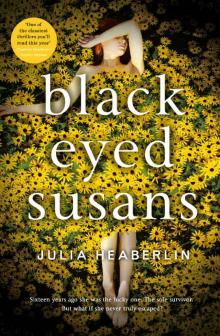
Black-Eyed Susans, page 14


“Yes.”
“Well, let’s start this way. What’s the first thing you remember one of the other … Susans … saying to you?”
“It was in the hospital. When I first woke up. One of them told me the strawberry Jell-O sucked. And it did. It was sugar-free.”
“And what else?”
“Mostly warnings. Be careful. Like that.” We told you not to touch the pig-and-daisy card.
“When they speak, do you think they are trying to control you? Or make you do things you don’t want to?”
“No. Of course not. I think, like, they want to help. And I promised to help them. Sort of a pact.” It sounds absolutely insane when I say it out loud. I am rocked by the sudden terror he might convince my father to toss me in a loony bin. I am 100 percent certain that Lydia was wrong about her advice this time.
“So you talk back to them?”
“No. Not usually. I just hear them.” Careful.
“And they never suggest that you harm yourself?”
“Are you kidding? What the crap are you talking about? Do you think I’m suicidal? Possessed?” I waggle my fingers on either side of my head, like horns.
“Sorry, Tessie. I have to ask the question.”
“I have never once thought about killing myself.” Defensive. And a lie. “I have thought about killing him.”
“Normal,” he says. “I’d like to do it myself.” This does not seem at all like something a psychiatrist should say. I don’t want to feel warm and gushy about him right now. I want a freaking answer.
“So … the voices. Do you think I’m … schizophrenic? Maybe borderline?” It occurs to me that I’m opting to be schizophrenic rather than possessed by demons. Lydia absolutely refused to help me research anything about schizophrenia. Whatever knowledge I had about it up to that point was gleaned from Stephen King.
So Oscar and I ventured to the local library on our own. The eighty-five-year-old volunteer who can barely see was on duty so I thought it was safe to ask for her help. She didn’t recognize the Cartwright Girl, which is what old people call me instead of a Black-Eyed Susan.
After fifteen minutes, while the checkout line stacked up eight deep, she brought over An Existential Study in Sanity and Madness, One Flew Over the Cuckoo’s Nest, and a Harlequin romance titled Kate of Outpatients, all published in the 1960s. The gist of the one by the existential psychologist was to let crazy people be crazy and stop bothering them. I reshelved it and Cuckoo and checked out Kate of Outpatients. Lydia and I are taking turns doing dramatic readings from it.
The doctor’s gaze is surprisingly kind and steady but he lets the silence stretch. Probably trying to figure out how to deliver the bad news to the poor little girl who’s soon going to be rocking and drooling in a room full of checker players.
“You are not a schizophrenic, Tessie. I know there is a set of psychiatrists out there who always think that voices indicate mental illness. There are an equal number of us who don’t. Lots of people hear voices. When a spouse or child dies, the people left sometimes talk to them on and off all day, and hear them respond. For the rest of their lives. It doesn’t make them dysfunctional. In fact, many of them claim these conversations make their lives better and more productive.”
I love this man. I love this man. He is not going to lock me up.
“The Susans don’t make my life better,” I say. “I think they are ghosts.”
“As we discussed previously, the paranormal is a normal temporary response.”
He isn’t getting it. “How do I get rid of them?” I don’t want to make them mad.
“How do you think you could get rid of them?”
In this case, my answer is immediate. “By sending the killer to prison.”
“You are well on the way to doing that.”
“And by finding out who the Susans are. Giving them real names.”
“What if that is not possible?”
“Then I don’t know if they’ll ever leave me.”
“Tessie, did your mother ever talk to you after she died? Like the Susans do?”
“No. Never.”
“I ask only because you have endured two terrible traumas for someone so young. Your mother’s death and the horror of that grave. Part of me thinks you are still grieving for your mother. Tell me, do you remember what you did at the wake?”
My mother again. I shrug. “We ate food people brought over and then my little brother and I played basketball on the driveway.” I let him win. We played H-O-R-S-E. The score was ten games to two.
“Children often play the day of the funeral as if it’s any other day. It’s deceptive. They grieve far longer and more deeply than adults.”
“I don’t think so.” I remembered the awful sounds of my dad and aunt weeping, like someone was peeling off my skin.
“Adults grieve harder in the beginning, but they move through it. Kids can get stuck in one stage … anger or denial … for years. It might be at the root of your symptoms—the memory loss, the blindness, the Susans, the code that you made up in the grave—”
“I’m not stuck,” I interrupt. “Merry and I didn’t make up a code in the grave. And I don’t want to talk about my mother. She’s gone. My problem is strictly with ghosts.”
Tessa, present day
It is only thirteen blocks from where I live now.
Lydia’s old house.
It might as well be a hundred miles. I’m standing in front of her childhood home for the first time in years. It is the second place he left black-eyed Susans, and the first time I turned and ran.
Lydia always described her house as a shotgun wedding cake, a two-story beige box with a last-minute white piping of scalloped trim. A lot has changed since our childhood. The icing is crumbling. What used to be a perfectly tended green square of lawn is now black dirt choked by hoodlum weeds. No more wooden stake poked in the ground with welcome y’all and a painted yellow sunflower. Lydia told me that her dad ripped the sign out of the ground before I came home from the hospital.
“Hey.” I didn’t hear his car pull up, but Bill is suddenly striding toward me, lankier and taller than I remember. Maybe it’s because his long legs are extending out of black Nike shorts and expensive athletic shoes. Everything about him is damp—hair, face, neck, arms. A triangle of sweat stains the front of a crimson Harvard T-shirt, so beloved that a few rips don’t matter. He finally got a haircut but it’s too short for his big ears. I want him to go the hell away. And stay.
“I said not to come,” I protest. “I thought you were playing basketball.” I’d regretted my impulsive phone call the second Bill answered. He was out of breath. I wondered whether I had interrupted acrobatic sex with a fellow do-gooding lawyer. He claimed he was playing a pickup game.
“All but over. My fellow law pals and I were getting creamed by a bunch of high-schoolers. Your call was a welcome distraction on the way to my parents’ house in Westover Hills, where I’ve unfortunately committed to dinner. Unless you’d like to invite me over. Or accompany me. So you said you had something to tell me. What’s up?”
I promptly burst into tears.
I’m unprepared for this, and by the look on his face, so is Bill. And, yet, the river is flowing like it hasn’t since my father died so swiftly four years ago of pancreatic cancer. He hugs me awkwardly, because what’s he going to do, which makes me sob harder.
“Oh, hell,” he says. “I’m too sweaty for this. Here, let’s sit.”
He guides me to a sitting position on the curb and curls his arm around my shoulders. The brace of solid muscle, his kindness, is waking up every hormone in my body. I need to pull out of this embrace immediately. No complications. Instead, my head falls sideways like a rock onto his chest and my shoulders heave.
“Uh, I don’t really recommend that you put your nose in that … underarm,” he says. But once he realizes how fully committed I am, he pulls me tighter.
After a few seconds, I lift my head slightly and let out a choke. “Hold on. I’m under control.”
“Yes, you definitely have things under control.” He pushes my head back down but not before I catch something hungry on his face that isn’t do-gooding at all.
I raise my chin again. Our lips are two inches apart.
He pulls back. “You’re red all over. Like a plum.”
I giggle and hiccup at the same time. I’m a giggling, hiccuping plum. I tug my skirt down. He averts his eyes and gestures to the house behind us, the one whose address he had plugged into his GPS at my behest only twenty minutes ago. “What’s up with this house? Who lives here?” It is an abrupt, purposeful shift.
God, I’m pitiful. I stand up.
“You, um, need to wipe your nose.”
Utter, utter humiliation. I use my sweater because at this point, it doesn’t matter. I suck in a deep breath as a test. It doesn’t trigger another tsunami. “Hear me out for a second first,” I say stiffly. “I think the Black-Eyed Susan killer has been leaving me flowers for years. Not just the other night at my house.”
“What? How many other places?”
“Six. If you include under my bedroom window.”
“Are you sure …”
“That they aren’t just growing up in places like God intended and I’m a lunatic? Of course not. That is why I said, I think. The first time, I was only seventeen. It was right after Terrell’s conviction. The killer left me a poem buried in an old prescription bottle. I found it when I dug up a little patch of black-eyed Susans, in the back yard of the house over there.” I point four houses down, at a yellow two-story on the opposite side of the street. “My childhood home. He planted the flowers by my tree house three days after the trial ended.” I watch for the awareness to set in. “That’s right, after Terrell was locked up.”
“Go on.”
“The … person who left it twisted a warning into a poem called ‘Black-Eyed Susan’ written by an eighteenth-century poet named John Gay. The poem indicated that Lydia would die if I didn’t keep my mouth shut.” Bill’s face is blank. I don’t know whether it’s because he doesn’t know who the hell John Gay is, or whether he is trying to contain his fury.
“I didn’t figure out who John Gay was until about ten years ago. He was most famous for The Beggar’s Opera. Have you heard of it? Captain Macheath? Polly Peachum? No? Well, more to the point, he also wrote a ballad about a black-eyed girl named Susan sending her lover off to sea. There’s some romantic theory that this is how the flower got its name …”
I begin to recite softly, as a mower revs up in a nearby back yard.
“Oh Susan, Susan, lovely dear
My vows shall ever true remain
Let me kiss off that falling tear
I never want to hurt you again
But if you tell, I will make Lydia
A Susan, too.”
“Jesus, Tessa. What did your father say?”
“I never told him. You’re the first person I have ever told, other than Angie. I just couldn’t … worry my father anymore.”
“And Lydia?”
“We weren’t speaking.”
Bill looks at me curiously.
“I told Angie right before she died,” I continue. “She was concerned for Charlie and me. At the end, she was considering leaving me completely out of things.”
“Why …”
“Why didn’t she tell you? Because she was protecting me. I think she was wrong, though. I can’t live with knowing I might be part of killing an innocent man. It wasn’t a hard decision at seventeen. The trial was over. I wanted everything to go back to normal. I figured it could be just another sick individual who was obsessed with the case. There were plenty of those. Which meant Terrell could still be guilty as hell. The prosecutor, Al Vega, was sure. And Lydia … I was furious with her, but I certainly didn’t want her life in danger.”
“Hold on, OK?”
Bill leaps up and jogs to his car, a small black BMW, three little letters that I think turn normally nice human beings into road demons. He disappears inside his fancy womb for so long, I wonder whether he is listening to Bach and contemplating whether to flip on the ignition and screech off. When he finally emerges, he holds a pen and pad in his left hand. He plops back down on the curb. He’s already written some notes, and I glimpse a few of the words.
John Gay. 1995.
“Keep going,” he orders.
“Lately, I’ve revisited a couple of the places I think he left flowers … on my own. In no particular order.”
“Whoa. Stop right there. You’ve been returning to these places. Why in the hell are you doing that?”
“I know, I know. Crazy. You see, after the first time, I never dug to see if he buried something else for me. It was like I couldn’t give him the satisfaction. I couldn’t let myself believe that much. I thought it could be some kid’s idea of a joke. Or a random freak. We were all over the newspaper, even Lydia.” She always pointed out her name to me. She was thrilled when she made The New York Times as Miss Cartwright’s neighbor and confidante.
“I survived on denial,” I continue. “And, yes, I realize it’s insane to think anything would still be there. And yet, what if? I just thought if I did find something, it might help … Terrell.”
And I promised the Susans.
“You’re digging? Alone? Have you found anything?”
“Nothing. It’s a relief, and it isn’t.”
“Why are we here, if your old house is there?”
“This is Lydia’s house. Well, it used to be. I found black-eyed Susans here, too, a few weeks after the trial.”
How much should I explain? I’d shown up at the door on a Friday afternoon with a cardboard box of her stuff. I was enacting a ritual goodbye, after our friendship imploded at the end of the trial. She hadn’t been at school for a week and a half. The box held two videotapes, The Last of the Mohicans and Cape Fear, the backup makeup bag she always left in my bathroom, her Mickey Mouse pajamas.
But the house was asleep at three in the afternoon, which was unusual. No cars. The living room shades were drawn for the first time ever. I could have dumped the box and run. Instead, I unlocked the back gate. Curious. When I glimpsed the small sea of yellow flowers, I was even angrier at Lydia, and I hadn’t thought that possible. How could she let them grow? I couldn’t get out of there fast enough. Two weeks later, a For Sale sign went up, and the Bells were gone, like no one was worth a goodbye.
“Let her go,” my father had advised.
“I was in the back yard returning something to Lydia and saw them,” I tell Bill. I place my fingers at my temples and rub in concentric circles. “It’s OK if you think this is stupid. Let’s go. I’m sorry I bothered you.”
He stands and yanks me up. Then he surprises me. “We’re here. Might as well check it out.”
We knock three times before a pasty woman with short, frustrated black hair opens the door about six inches. She surveys us like we are Texas liberals and stabs a finger at the sign under the mailbox attached to the porch siding, a slight variation on a familiar plaque to ward off solicitors: WE’RE PISS POOR. WE DON’T VOTE. WE’VE FOUND JESUS. OUR GUN IS LOADED.
Bill ignores her warnings and sticks out his hand. “Hello, ma’am, I’m William Hastings. My friend Tessa here used to have a very good friend who lived in your house. Tessa has fond childhood memories of playing in the back yard. Would you mind if she took a quick look back there for old times’ sake?”
The door opens a little wider, but it’s clearly not an invitation. She swivels to shove her foot at a fat yellow cat that can’t make up its mind about going out. I’m guessing she’s around forty-five, wearing tight jean shorts that are the size she wore two sizes ago. She is carting around a lumpy rear end on skinny legs, and I’m figuring the legs are what she’s gauging her weight by as she sits on her ass and sucks down another beer.
No shoes. Band-Aids are wrapped around her big toes. Her breasts are generous flat pancakes, encased in a tank top. A tattoo of red roses snakes from her left shoulder to her elbow. The tattoo clearly required a lot of both time and clenching of teeth.
“Yeah, I mind.” The woman ignores Bill’s outstretched hand. She’s staring at the scar under my eye. I perceive a fleeting flash of respect in her eyes. She’s probably thinking bar fight.
“I’m curious, Mrs. …?”
“Gibson. Not that it’s any of your damn business.”
Bill flashes his courthouse badge.
“I’m just curious, Mrs. Gibson, at 5216 Della Court, if you were a no-show to jury duty in the last five years. I have a few friends in the courthouse who would be happy to look that up for us.”
“Son of a bitch,” she fumes. “Five minutes. That’s it. Go around the side by the gate and be sure to shut it when you go. I have a dog.” She spits out the last four words like a threat and slams the door.
“Nice move,” I say.
“It’s not my first Mrs. Gibson.”
The same old chain link fence is standing guard around back, although several degrees rustier. The horseshoe catch on the side gate requires a good thump from Bill to lift. I think about how Lydia’s dad oiled it religiously.
It is a small, crunched yard with too many plastic buildings. A fake-shingled shed is shoved into the right corner, the “fancy” version with a flower box that was forgotten a long time ago. A filthy white doghouse with a red roof is plopped on the slab of concrete posing as a back porch.
A picnic table used to sit directly under a red oak tree that is now a four-foot stump topped by a statue of a bald eagle with outspread wings. The grass is long and tickly. It creeps up my leg, like a rambling daddy longlegs. Maybe it is. I almost trip over a toy plastic fire truck transformed into a weed planter.
Bill’s foot lands in an enormous pile of soft dog poop, and he lets out a loud “Shit.”
We halt, and stare more intently at the doghouse. It’s big enough for a two-year-old child to sleep in. Bill whistles. A dog starts a serious racket somewhere inside the house, and I wonder if Mrs. Gibson is loading her shotgun.
“OK, where?” Bill’s tone indicates he may be losing some faith in my treasure hunt. Once again, I regret involving him.