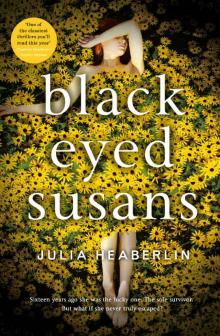
Black-Eyed Susans, page 6


She unbinds the cloth and raises Susan carefully up to the window. Most of the small group gathered in the hall on the other side eagerly raise their iPhones. Susan is bathed in brief flashes, like a movie star.
Her skull is a horror show. Her eyes are holes going to the bottom of the ocean. Most of the lower half of her jaw, gone. A few rotten teeth hanging like stalactites in an abandoned cave. It is the emptiness, those two gaping, awful holes that remind me she was once human. That she could once stare back.
Remember? Her hollow, toothless voice bubbles up in my ear. An unspent grenade erupts in my chest. It’s a shock, but it shouldn’t be. The Susans had been silent for more than a year this time. It had been foolish to think they were gone.
Not now. I imagine my hand clamped over her mouth. I screech out “The Star-Spangled Banner” in my head.
Bombs bursting in air. Jo is squeezing my arm.
“Sorry I’m late.” I gulp in her quirky normalness. White lab coat, khaki pants, purple Nikes, plastic badge hanging off a skull-and-crossbone-printed lanyard around her neck. A whiff of something chemical, but not unpleasant.
Deep breath. I’m on this side of the glass. This side of hell.
She nods casually to the group. Besides Bill and me, four other people are cleared for this event: three Ph.D. students—one from Oxford, two from the University of North Texas—and a beautiful, unbottled blond scientist from Sweden named Britta.
We’d spent the last fifteen minutes together, strangers pretending we weren’t about to observe death at its most sadistic. The students’ eyes flicked to me with interest, but no one was asking questions.
Before Jo arrived, we had settled on discussing the three places in Dallas and Fort Worth that Britta should not miss seeing before returning home to her Stockholm lab in two weeks: the Amon Carter for its muscled bronze Russells and Remingtons, and for the beautiful black boy in the newspaper hat; the Kimbell for the silvery light cascading on buxom masterpieces and for the ill-fated young man in the company of wicked sixteenth-century cardsharps; the Sixth Floor Museum, where Oswald angled his rifle, and a wild-eyed conspiracy theorist defiantly roamed the sidewalk, saying, Nope, not like that.
As Britta eyes Bill, I am thinking it is more likely she will end up in his bed. I’d gotten a curt smile from him this morning.
“Stephen King researched part of his Kennedy time-travel opus at the Sixth Floor Museum archives,” Bill is telling them.
“Great book,” Jo says. “King’s a genius. But he never really got Texas. And I’m saying that as an Oklahoman. Hi, Bill. Tessa. Sarita. John and Gretchen. Britta, glad you could make it today. Looks like they are just getting started.”
The skull is now facing us, leering from its spot on the counter. The woman in white is still unwrapping puzzle pieces. A long, pearly leg bone, and then another in much worse shape, like a tree branch snapped off in winter.
“Tammy’s in charge today,” Jo says. “Running the room.” The two exchange a brief wave. Four other women dressed in sterile suits are taking their places in the lab in front of clear glass hoods. The fluorescent light is brutal, and cold.
“Looking into a serial killer’s refrigerator,” Bill mutters in my ear.
Jo glances our way, but I can’t tell if she heard. “Each forensic analyst has a specific job,” she explains. “Margaret will cut a small piece out of the bone. Toneesha will clean it with bleach, ethanol, and water. Jen will pulverize it to a fine powder, from which we extract the DNA. Bessie’s only role is to spray down the surfaces as we go, to keep things as sterile as possible. It’s protocol. Always.”
Her eyes are focused on the activity behind the window. Jo’s in her element. Brilliant, without ego. Empathetic, without cynicism.
I am thinking that Jo remembers every single person by name on both sides of the glass. I am thinking, she could be talking about how to refine sugar.
“Never forget protocol.” Suddenly stern. “Never get sloppy. Somebody accused me of that once. Worst time of my life.”
She doesn’t extrapolate. So far, no talk of the actual case—who these bones represent, why they are special.
“We like the skull and the denser bones, particularly femurs,” she continues. “Gives us the longest string of mitochondrial DNA and the best chance at retrieving information on our way to finding out who they are. We’re lucky we’ve got these three specimens, considering the bones have been scavenged and moved at least once.”
The skull is being tucked under one of the hoods. The buzzing of the saw drifts through glass, like it is floating down the street on a lazy Saturday.
When the first Susan returns to the counter, a new one-inch-square hole glares out of the top of her head.
One more degradation in an endless string of them.
I’m sorry, I say silently. But there is no toothless, hollow answer in my head.
The Dremel saw drills a leg bone while the piece of skull is scrubbed raw in the second station. The technicians have forgotten us, slipping into a comfortable rhythm. I don’t know what I was expecting, but not this surreal, matter-of-fact routine.
“It must be especially exciting to work on the Black-Eyed Susans,” Sarita says brightly. The student from Oxford. Her voice is British, clipped. Her black heels are too high. “It must be an honor for these techs. These must be your best.”
I can feel Jo’s body go taut as if it is my own. “To them,” she says. “And to me, this case … these bones … are no different than any other bone entrusted to us. Each one represents the same thing. A family, waiting.”
Admonished. All of us.
“Why are there three bones?” Bill shifts the conversation abruptly. “For two unidentified skeletons? I thought you only tried one bone from a victim at a time.”
“Now, there’s the question I’ve been waiting for.” Still an edge to Jo’s voice. “The girls’ skeletons were ransacked by critters over time. Moved by their killer at least once. The old case file documents foreign soil along with the red clay mixture in that field. So, of course, not every bone was there. Our forensic anthropologist laid out what was exhumed from the two caskets, and counted. He counted three right femurs.”
I hear someone suck in a strangled breath. It takes a second to realize it’s me.
“Three skeletons, not two,” Bill whispers, as if I can’t do the math.
Five Susans in all, not four. One dead girl named Merry, three gnawed-on nobodies, and me. Another member of my tribe. Another family, waiting.
I’m the one, a Susan says conspiratorially. I’m the one with the answers.
Jo shoots me an odd look, even though I know I am the only one who can hear.
Tessie, 1995
I wonder what he is looking at first.
The girl without a mouth. The girl with a red blindfold. The spider’s web with the trapped swallowtail. The faceless runner on the beach. The roaring bear, my personal favorite. I’d worked hard on the teeth.
“Did you remember to bring your drawings today?” he had asked first thing.
Anything was preferable to talking about the day of my mother’s death. Last time, he might as well have taken a hot poker and stuck it in my belly button.
And what did he learn? That I heard nothing. Saw nothing. That all I remember is a vague image of blood, but that was dead wrong, because the police told me there was no blood. All of it seemed so freakin’ off point. Another way to clutter up my head.
So, yes, I brought drawings today. As soon as he asked, I handed Doc a white cardboard poster-mailing tube. It once held the Pulp Fiction poster now hanging over Lydia’s bed. Lydia had rolled up my drawings carefully after our three-hour session sprawled on the rough Berber of her bedroom floor surrounded by a kindergarten chaos of paper and crayons and markers.
She didn’t like my idea when I sprang it on her two days ago, but I begged. More than anyone else, she understood my fear—that someone else would find out my secrets before I did.
So she’d ridden the bus back to the TCU library. Skimmed The Clinical Application of Projective Drawings. The Childhood Hand That Disturbs. And, because she was Lydia: L’Imagination dans la Folie, which translates to Imagination in Madness, some random tome that studied the drawings of insane people in 1846. She had educated me on the principle of the House-Tree-Person test. House, how I see my family. Tree, how I see my world. Person, how I see myself.
When it was all over, the black crayon worn to a flat nub, I thought we’d faked it pretty well. Lydia was even inspired to draw a picture herself, which she described to me as an army of giant black-and-yellow flowers with angry faces.
The doctor is sitting directly across from me, not saying a word. I can hear the crisp rustle of paper as he flips from one sheet to the next.
The silence has to be something they teach all these manipulative bastards.
Finally, he clears his throat. “Technically excellent, especially since you have no vision. But, mostly, cliché.” No emotion in his words, just a statement of fact.
My scars begin to thrum. Thank God, I didn’t give him my real drawings.
“This is why I don’t like you.” I speak stiffly.
“I didn’t know you didn’t like me.”
“You don’t know? You’re like all of the others. You don’t give a flip.”
“I give a flip, Tessie. I care very much about what happens to you. So much that I’m not going to lie to you. You obviously spent some time on these drawings. You are a very smart, talented girl. The thing is, I don’t believe them. The angry animal. The girl who has no voice. The idea of running along the ocean’s abyss. These Jackson Pollock black and red swirls. They’re all just a little too pretty. Too pat. There is no single emotion that connects these drawings to one another. They stand alone. That isn’t how trauma works. Whatever emotions you are feeling right now … they connect everything.”
His chair creaks as he leans over, placing a sheet in front of me. “Except for this one. This one is different.”
“Am I supposed to guess?” Trying to be sarcastic. Trying to figure out how he saw through me so fast. Which drawing he found meaningful.
“Can you?” he asks. “Guess?”
“Are you really going to make me play this game?” I grip Oscar’s leash like a lifeline, letting it bite into my flesh. Oscar obediently clambers up. “I’m going home.”
“You can go home anytime you like. But I think you want to know.”
My stillness says everything.
“Tell me.” I barely croak it out, suffused with rage.
“The field of strangled flowers. Leering. The little girl cowering. It’s terrifying. Messy. Real.”
Lydia’s drawing. She’d spent two hours on it while singing along to Alanis. Got a plastic smile on a plastic face.
Lydia used to laugh about the fact that she couldn’t even draw Snoopy.
She hadn’t told me about the little girl. I wanted to see.
I dropped the leash and scooted myself to the edge of the cushion, words rushing up my throat before I could stop them.
“What would you say if I told you that the main thing I’ve been drawing …” I suck in a breath. “Is a curtain. Over and over, until I want to crawl out of my skin?”
“I’d say, it’s a start.”
A slightly higher pitch to his voice. Is it hope?
Tessa, present day
I jiggle the key into the first of two locks on the front door. My mind is dwelling on pristine white laboratories and trees made of brittle bones and the fraction of statistical hope that one of the three tiny pieces of dead girl will lead somewhere. All the way home, there was blessed silence from the Susans. While the lock refuses to cooperate, a shadow clobbers into mine, making me gasp.
“What are you so damn jumpy for, Sue?”
Euphemia Outler, right-hand neighbor. Known to me as Effie, to Charlie as Miss Effie (despite a marriage or two) and to a few mean boys on the block as Miss Effing Crazy. She is an ex–science professor, a self-employed suburban spy, and an early dementia patient who regularly calls me Sue—not because of my past, but because it is her only daughter’s name, the one who lives in New Jersey, who had decided when her mother turned eighty, What the hell, out of sight, out of mind.
“Hey, you snuck up on me,” I say. “How’s it going today?”
In her right hand, Effie proffers a small, oblong item wrapped in aluminum foil so crinkled that it could have been reused since the Depression. In her left hand, a vase of flowers, in the tight professional array of a florist. None of the flowers are yellow and black. On her head, the floppy blue-checked sun hat that Charlie and I bought from a beach vendor in Galveston four summers ago as a gift. Effie’s eyes, still those of a provocative teen, peer out of a face toughened by sun.
“I made you some banana bread. Threw some bulgur in it. And I brought in these flowers for you this morning. I saw the guy plop them on your front porch. Thought the wind might blow ’em over. Plus, I’ve got a problem to discuss with you.”
“That was so nice. Thank you.” I twist the second lock. The deadbolt is a little cranky, too. Need to take care of that. Maybe add a third lock. I shove open the door and Effie tramples after me in her battered green Crocs without invitation.
“Let me stick these groceries away.” I avert my eyes from the flowers. “Go ahead and put the flowers and bread here on the counter, and then you can tell me about your … problem. I have iced tea in the fridge. Charlie brewed it last night. Caffeine, sugar, mint, lemon—the works. Charlie stole the mint from your garden after dark.”
“I put bulgur in the bread because I know Charlie especially likes it. And I’ll take that tea.”
I am pretty sure my daughter has no idea what bulgur is, but this is likely a step up from last week’s offering of oatmeal and carob cookies that Charlie cheerfully likened to eating cow manure.
Effie fancies herself as something of a chef. The problem is, she thinks like a scientist. For instance, deciding it would be a good idea to boil fresh pumpkin for pumpkin pie rather than using a time-tested can of Libby’s puree. Chunks and pumpkin strings and a lot of canned whipped cream are what I will remember about last year’s Thanksgiving dinner. But that’s OK: Most Thanksgivings just flow into a dull, pleasant river, and Charlie and I will laugh about that one forever.
“The New York Times called bulgur ‘a wheat to remember,’” Effie informs me. “They try to make everything so damn profound. I’d stop reading the paper if it weren’t for the science section and if I didn’t think the crossword puzzles were reviving my dead brain cells. What the hell do they know? Dead isn’t necessarily dead. Do you think they know a four-letter word for Levantine coffee cup?” They generally referred to her neurologist.
“Zarf,” I say automatically.
“Well, you’re the damn exception to a damn lot of things.” She wanders from the black granite bar that divides the tiny kitchen from the living room and surveys the industrial Bernina sewing machine on the dining room table, draped like a bride in white tulle. “What’s this week’s project? Something else for one of those damn rich ladies?”
I kick the refrigerator door shut. “For one of those damn rich ladies’ little girls. A tutu. For competition. Tulle underpinning, lavender appliqué. Swarovski crystals.”
“Fancy-pantsy. I bet she’s paying you a fortune.”
In fact, she isn’t paying me a fortune, because it’s a sad fact that most damn rich ladies no longer appreciate the cost of things made by exacting, artful hands. Not when everything can be purchased from China with the click of a mouse.
“It’s a little side job,” I say. “The costume designer for a Boston ballet company has asked me to dress the leads for its spring production. I want to make sure I know what I’m doing before I say yes.”
“They’d be lucky to have you. You’re getting quite global. I thought you were leaving this week to design a staircase for that crazy actor fellow in California, the one who farts through his movies. Doesn’t he want it made out of an old Camaro or some damn thing? And wasn’t Charlie’s soldier daddy flying in to stay with her while you were gone? The one who promised to patch that spot on my roof. What’s his name? Lucifer?”
“Lucas. That California job’s on hold for now.” No explanation, because my past is never discussed. Effie knows about that part of me, or she doesn’t. I have no idea and want to keep it like that. Either way, it isn’t important to her.
I can always tell by the way someone looks at me the first time, like I’m a distressing piece of modern art. As an added piece of luck for me, Effie had mostly cut the newspaper out of her life because it made her think the world was “going to damn hell in a damn rocket ship.”
That didn’t mean she canceled her subscription. During the four years we’d lived in this house, she had dropped The New York Times on our stoop with random regularity, unread, minus the puzzle. No iPad crosswords for Effie, despite Charlie’s best efforts. Effie was certain the device was controlling her, instead of the other way around.
I nudge her over to the couch. “Sit. What’s the problem?”
“Aren’t you going to open the card on those flowers? What’s the occasion? Belated birthday?” Her eyes are lit with curiosity.
“No occasion I’m aware of. Did you say you saw who left them?” I drop the question as casually as I can. Flowers always punched a little panic button, because anyone who liked me well enough to send them, wouldn’t.
“Cute fellow in a Lilybud’s Florist outfit. His shorts hung off his bottom. Gave me an eyeful.”
Effie could have seen that bottom today. Or yesterday. Or a month ago. Time is a dull, pleasant river for Miss Effie.
I tap her on the shoulder; I’d need to pick up Charlie from volleyball practice soon and she would be craving something besides bulgur-infused banana bread. “So what’s the problem?” I repeat. “Shoot.”