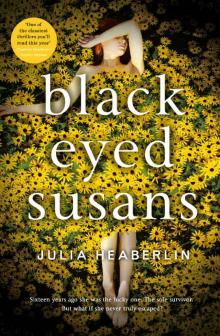
Black-Eyed Susans, page 20


There’s a YouTube video link beside his blog, which my fingers click without my brain’s permission. At once, his voice is jarring the silent house, rising and falling like a preacher’s, still a saw against my skin. I hurry my finger to turn him down. He’s an upright cockroach roving an anonymous stage. Lincoln-esque, is how his fans describe him. I failed Terrell, he’s saying. I destroyed that girl. The Black-Eyed Susan case was the turning point of my life.
I can’t listen to any more.
He didn’t just destroy me. He destroyed my grandparents. The police and Dick the Dick worked in odd concert in that regard. The police ransacked their castle and drove off with my grandfather’s beloved truck as evidence. Nobody in Texas took a man’s truck unless he was guilty as hell, so even his best and most stalwart farmer friends wondered. It didn’t matter that the police said “whoops” months before the trial. Dick the Dick still hammered away in court. A tabloid screamed, Could Grampa be the killer? No, I can’t offer Dick forgiveness despite the fact that, in the last thirteen years, Richard Lincoln has used DNA evidence to free three innocent men from Texas’s Death Row. I pull the cover over the iPad. Nudge a couple of extra pillows to the floor. Slip deeper into sheets rough with sand from a war zone. Squeeze my eyes shut. Imagine the doctor lounging in pajamas covered with ducks in front of a Colbert rerun. Hope that Benita’s life is strung like a party with purple and yellow beads.
I’m floating at the edge of consciousness when Lydia finds a tiny wormhole.
It’s not like I haven’t dragged the Internet for her a hundred times. Nothing. Not about her or Mr. and Mrs. Bell. It’s like they are tiptoeing around in invisible ink while everyone else is galloping in screaming neon. The Bells were odd. They had little family, and made very few deep connections in town. Both sets of Lydia’s grandparents were dead. I retain vague memories of a distant cousin of Mrs. Bell’s who sent a poinsettia at Christmas. But how could a family simply vanish? How could nobody really care?
Over the years, I’ve imagined all sorts of outrageous plotlines about their fate. Maybe my monster killed them because Lydia knew something. She was always clipping out articles about the Black-Eyed Susan case and pasting them in a scrapbook she didn’t think I knew about. Scribbling notes in the margins in her cramped, intelligent hand. My monster didn’t turn the storm cellar into a family mausoleum, but he could have scattered their bones across the West Texas desert.
Or their bodies could be lying miles and miles under the sea with ocean garbage. The whole family could have bounced off on a spontaneous vacation and sunk to the bottom of the Bermuda Triangle in a wayward craft piloted by Mr. Bell. He was always forgetting to buy a boating permit. They could have slipped, undocumented, under the waves.
My most logical theory was witness protection. Someone had to plant the For Sale sign. Mr. Bell dealt in recycled auto parts with Mexican mafia types in the salvage yards. He rushed off in the middle of the night all the time to meet them. Lydia had shown me his drawer full of hundred-dollar bills.
I do know this. If another family on the block had quietly slipped out of town right after the trial, and Lydia was the one speculating, she’d suggest that the father was the Black-Eyed Susan killer. His wife and daughter were in on it. They were spooked by my survival and now travel from town to town, changing their names as they go, killing girls.
That’s exactly the kind of story Lydia would have made up when we were under the blanket with our flashlights, and she was scaring the crap out of me.
Tessie, 1995
October third, nineteen hundred and ninety-five, 1 P.M.
O.J. was set free an hour ago, which makes me sick to my stomach.
In mere minutes, if I don’t screw this up, I will be, too.
This is my last session. The doctor is recommending a follow-up every six months for the next two years, and, of course, I should call before then if I’m ever feeling any distress. He’s taking a sabbatical in China, so he won’t be around, but he will recommend someone perfect for me. In fact, he already has someone in mind. There’s a little transfer paperwork to fill out, but he’ll take care of that before he leaves. How lucky, he says, that the trial only lasted a month. That the jury took only one day to reach a verdict.
Everyone is beaming. The doctor. My dad. I’m beaming back because otherwise I might explode. Almost free, almost free, almost free.
“I want to say again how brave you were to testify,” the doctor says. “You held your own. The bottom line: Because of you, a killer is on Death Row.”
“Yes. It’s a relief.” A lie. The only thing that’s a relief is the news that my doctor is moving to China.
He’s sitting there, so smug. I can’t let him get away with it. I won’t forgive myself.
“Dad, can you just give us one second alone to say goodbye?”
“Sure. Of course.” He plants a kiss on my head. Shakes the doctor’s hand.
Dad doesn’t pull the door shut hard enough when he leaves, so the doc gets up to close the two-inch gap. Click. Doctor-client confidentiality and all.
“Why wouldn’t you ever talk about Rebecca?” I ask, before he sits down.
“Tessie, it’s very painful. Surely you can understand that. And it would have been unprofessional of me to do so. I shouldn’t have even said what I did. You need to let this go. It can’t be a part of our professional relationship.”
“Which is ending. Right now.”
“Yes, but that doesn’t matter. You are still my patient until you walk out that door.”
“I saw you with her.”
“You’re really beginning to worry me, Tessie.” And, in fact, his face does look worried. “You were right. My daughter is most likely dead. She isn’t … talking to you, is she? Like the Susans?”
“I’m not talking about your daughter.”
“Then I have no idea what you mean,” he says.
I don’t say it out loud, because what’s the point?
We both know he’s lying.
“See you around,” I say.
Part II
* * *
COUNTDOWN
“According to the L.A. Times, Attorney General John Ashcroft wants to take ‘a harder stance’ on the death penalty. What’s a harder stance on the death penalty? We’re already killing the guy. How do you take a harder stance on the death penalty? What, are you going to tickle him first? Give him itching powder? Put a thumbtack on the electric chair?”—Jay Leno
—Tessa, listening to The Tonight Show in bed, 2004
September 1995
MR. VEGA: I know that this has been a very difficult day of testifying, Tessie. I appreciate your willingness to speak for all of the victims and I know the jury does, too. I have just one more question for now. What was the worst part of lying in that grave?
MS. CARTWRIGHT: Knowing that if I gave up and died, my father and little brother would have to live without knowing what happened. That they would think things were more horrible than they were. I wanted to tell them that it wasn’t that bad.
MR. VEGA: You were lying near-comatose with a shattered ankle in a grave with a dead girl and the bones of other victims—and you wanted to tell your family that it wasn’t that bad?
MS. CARTWRIGHT: Well, it was bad. But imagining what happened for the rest of your life is worse. You know, letting your mind fill all that in, like, a million different ways. That’s what I thought about a lot … how they’d have to do that. When the rescuers came, I was, like, so relieved that I could tell my dad it wasn’t that bad.
29 days until the execution
In a month, Terrell’s coffin, black and shiny as a new Mustang, will be hitched on a wagon to the back of a John Deere tractor. He will sink into the ground with the bodies of thousands of rapists and killers rotting in the Captain Joe Byrd Cemetery. Most of these men lived violently on the surface but they are interred on a pretty little hill in East Texas summoned out of Walt Whitman’s dreams. These were men officially unclaimed in death. In Terrell’s case, people claim him, love him—they just don’t have the money to bury him. The state of Texas will do that with $2,000 of taxpayer money and surprising grace.
Inmates will rumble that tractor. They will be his pallbearers and bow their heads. They will chisel out his stone. Stencil on his inmate number. Maybe misspell his name.
They will use a shovel like the one in my hand.
My stomach churns for Terrell as I stare at the patch of black earth that my grandfather used to till behind his fairy tale house. At the very place where, twelve years ago on a hot July day, I found a suspicious patch of black-eyed Susans. It is the last place I’d ever want to dig for a gift from my monster, and so that’s what I’ve done. Left it for last. My stomach boiled in a sick stew that day, too.
I was twenty-two. Aunt Hilda and I had banged a For Sale sign onto the front lawn a few hours earlier. Granny had died eight months before. She was buried beside her daughter and husband in a small country cemetery, eight miles down the road from their fantastical house.
That day, I’d gone outside to breathe after opening a drawer in Granny’s jewelry box and sucking in a powerful hit of her church perfume. Charlie was almost three, and she’d slammed the screen door to the back porch ahead of me a few minutes earlier. When I opened the door, my beaming daughter stood several feet from the bottom of the steps, hands behind her back. She thrust out the handful of black-eyed Susans that she was strangling in her sweaty fist. Behind her, a hundred feet away, their sisters danced in flouncy yellow skirts—pretty little bullies hanging out near a row of sickly beans and a bonsai-like fig tree.
I poured a pot of boiling water into their eyes while Charlie stared from the porch. When my aunt called out from the house and asked what I was doing, I told her I was getting rid of a vicious pile of fire ants, which was just a bonus. Don’t want Charlie to get stung. A few ants were already carting the dead away on their backs.
I’m jolted back to the present as Herb Wermuth lets the screen door slam behind him. It echoes like a tinny symbol. More than a decade later, it’s his castle, not my grandfather’s. He’s gone inside, abandoning Lucas and me with little instruction to the devious winter sun and the garden that he says his wife, Bessie, chews up with a tiller twice a year. Good luck finding anything. Herb has made it clear he couldn’t care less where we are digging as long as it is not for a dead body and the media isn’t involved. He did ask us to try to get our business done before his wife returned in a couple of hours from a session with her new personal trainer.
At first, when we showed up on his front porch, Herb hadn’t been so accommodating. “I listen to the news,” he’d said grimly. “After all this time, you’re not sure they got the right killer. You’re working with his lawyer.” His eyes had raked over the shovel hanging from my hand. “Do you actually think one of his girls is buried out back?”
“No, no, of course not.” I had rushed to reassure him while hiding my revulsion at the use of the pronoun. His. Like the monster owns us. Owns me. “The cops would be here if that was the case. As I said, I’ve just always thought that it was possible that the mon … killer buried … something for me in the garden.”
Herb couldn’t hide it on his face—he believes, like most people around here, that the Cartwright girl had never been right in the head again.
“You’ve got to promise,” he insisted. “No media. I got rid of some tabloid photographer yesterday asking to snap a picture of the room where the Black-Eyed Susan slept. And some guy called the other day from Texas Monthly wanting permission to get a portrait of you in front of the house. Said you hadn’t called him back. It’s so bad I’m taking Bessie to a condo in Florida until this execution thing passes over.”
“No media.” Lucas had responded firmly. “Tessa only needs to ease her mind.” Patronizing. It sent a trickle of annoyance up my neck, but it did the trick for Herb. He even retrieved a shiny new shovel out of the garage for Lucas.
So Herb has left us to it. Except Lucas and I haven’t budged since the screen door ricocheted on its hinges a minute ago. Instead of investigating the garden, Lucas is casting watchful eyes up the walls and windows of my grandfather’s mythical house. He has never been here before, even though it’s just an hour’s drive from Fort Worth. By the time Lucas and I were wrestling in the backseats of cars, my grandfather was half-blind and permanently propped in bed.
It is comforting to know that Lucas is so focused. Protecting me from my monster, even if he has always believed, no matter what I say, that the monster is mostly confined to my head.
The house has cast a cool, dark arm across my shoulders. I know this house like it is my own body, and it knows me. Every hidden crevice, every crooked tooth, every false front. Every clever trick from my grandfather’s imagination.
I start a little when Lucas steps beside me, armed with his shovel and ready to go.
The Susan times her warning to my first squishy step into the soil.
Maybe he did bury one of our sisters here.
If it weren’t for the fig tree standing there like an arthritic crone, I wouldn’t know where to dig. The garden is twice as large as when my grandmother grew her precise rows of Early Girl tomatoes and Kentucky Wonder beans and orange habanero peppers, which she turned to jelly that ran on my tongue like lava. This morning, other than the fig tree climbing out of it, the plot is a flat brown rectangle.
I used to stand in this garden and pretend. The blackbirds stringing across the sky were really wicked witches on brooms. The distant fringes of wheat were the blond bangs of a sleeping giant. The black, mountainous clouds on the horizon were the magical kind that could twirl me to Oz. The exceptions were brutal summer days when there was no movement. No color. Nothingness so infinite and dull it made my heart ache. Before the monster, I would always rather be scared than bored.
“This is a very open area, Tessa,” Lucas observes. “Anyone who looked out a window on the west side of the house could have seen him plant the flowers. That’s pretty brazen for a guy you think has managed to fool everybody into thinking he doesn’t exist.” He shades his eyes to look up. “Is that a naked woman up there on the roof? Never mind. It is.”
“She’s a replica of The Little Mermaid statue that gazes over the harbor in Copenhagen,” I say. “The Hans Christian Andersen one—not the Disney version.”
“I get that. Definitely not G-rated.”
“My grandfather cast it himself. He had to rent a crane to lift it up there.” I take three carefully measured steps north from the fig tree. “About here,” I say.
Lucas thrusts the glistening metal of Herb’s shovel with crisp, clean determination into the dirt. My own rusty shovel is leaning against a tree. I’ve brought a stack of newspapers, an old metal sieve from the kitchen, and a pair of work gloves. I plunk myself down and begin to sift through the first chunks of overturned soil. I hear Jo’s voice in my head insisting that this isn’t the way.
I glance up, and for a second, see a little Charlie on the porch. I blink, and she’s gone.
It isn’t long before Lucas has stripped off his shirt. I keep sifting, averting my eyes from the muscles rippling across his back.
“Tell me a story,” he says.
“Really? Now?” A black bug is skittering down my jeans. I blink, and it’s gone.
“Sure,” Lucas says. “I miss your stories. Tell me all about the girl up there on the roof with the nice boobs.”
I pull out a rough piece of old metal. Think about how many layers to leave out of a multi-layered fable. Lucas has a short attention span. I know that he is just trying to distract me.
“A long time ago, a mermaid fell madly in love with a prince she rescued from the sea. But they were from different worlds.”
“I’m already sensing an unhappy ending. She looks lonely up there.”
“The prince didn’t know it was the mermaid who rescued him.” I pause from breaking apart a large chunk of soil. “She had kissed him and laid him on the beach, unconscious, and swum back out to sea. But she desperately wanted to be with him. So she swallowed a witch’s potion that burned away her beautiful singing voice but in return carved out two human legs. The witch told the mermaid that she would be the most graceful dancer on earth, yet every single step would feel like she was walking on knives. The mermaid didn’t care. She sought out the prince and danced for him, mute, unable to speak her love. He was mesmerized. So she danced and danced for him, even though it was excruciating.”
“This is a horrible story.”
“There’s lovely imagery when it’s read aloud. It loses a lot in my retelling.” I raise my eyes to the window in the turret of my old bedroom. The partly drawn shade makes it appear like a half-closed eye. I imagine the muffled sound of my grandfather reciting on the other side of the stained glass. An ocean as blue as the prettiest cornflower. Icebergs like pearls. The sky, a bell of glass.
“And did this a-hole of a prince love her back?” Lucas asks.
“No. Which means the mermaid was cursed to die unless she stabbed the prince and let his blood drip on her feet, fusing her legs back into fins.”
At this point, I stop. Lucas has already produced an impressive hole the circumference of a small plastic swimming pool and about as deep. I’m way behind on sifting through his piles of earth. All I have to show for my efforts are a stack of rocks, the ribbon of rusted metal, and two plastic pansy markers.
Lucas drops the shovel and falls to his knees beside me. “Need some help?” he asks. I know him well enough to translate. He thinks this is futile. My heart isn’t really in it, either.
I hear the creak of a door opening, punctuated by a noisy slam. Bessie Wermuth is trotting our way in fire-engine-red workout gear that clings to two narrow inner tubes of fat around her waist. She’s carrying tall yellow Tupperware cups chunked with ice and amber liquid.