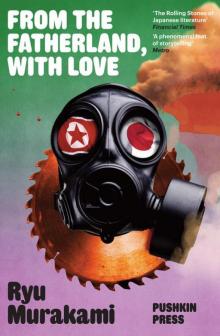
From the Fatherland, with Love, page 9


Having never seen ships dock or set sail before, he had also once spent a day on an old wooden bench in the ferry-service waiting room, just to watch. He found it all pretty exciting. Vessels entering the harbor blew their whistles, ropes were thrown from boats easing into their berths, and anchors plummeted from bows with a splash and a clanking of chains. The island the ferry went to was called Nokonoshima. In the waiting room were posters featuring the island, as well as pamphlets that Tateno had read so many times that he now knew them by heart. Nokonoshima Island was famous in Japan for its beaches and fishing spots. In the pamphlets, the white beaches seemed to stretch for ever. A lot of fruit was grown on the island, and the pamphlets mentioned a seedless papaya. Tateno was fascinated by this. If the papaya didn’t have any seeds, what was in the core of the fruit? He was determined one of these days to go to Nokonoshima, eat a seedless papaya, and sail his boomerangs over that pure white sand.
As he was making his way up the road to the shrine, a rumbling that came from beyond a curve just ahead quickly became a roar, and he felt the earth tremble beneath his feet. The next moment, a pack of about fifteen bikers blasted past him, heading downhill. Several of them waved as they blew by. The Speed Tribes were all but extinct in Tokyo or Osaka, but they remained in Fukuoka like some sort of protected species. Members of this particular Tribe had been regulars at Nobue’s shop, and they still visited Ishihara frequently. They’d been aficionados of Nobue’s jeans and Hawaiian shirts and among his best clients, of course, for the big imported motorcycles. Well aware of the rumors that the pair had been responsible for some sort of massive explosion in Tokyo and were now lying low here in Fukuoka, the leaders and members of the Tribe all but worshiped Ishihara and Nobue. For them, perhaps the two older men represented a more exotic kind of rebel, quite distinct from the yakuza or the right-wingers they were generally in thrall to. “Ishihara-san, we’ll help you out anytime,” the Tribal Chief used to say. “When we gonna have another shop like Nobue-san used to run?” It was clear that the Chief hoped to form some sort of alliance with Ishihara’s group, but Ishihara would always just mumble a vague reply, more or less ignoring any such suggestion. And yet the Tribe still dropped by from time to time to pay their respects. “If there’s ever anything we can do, just say the word,” the Chief always assured them.
Beyond the curve the road dipped briefly, but Hakata Bay was still just visible through the crumbling walls of the ruined school building. The sun was already on its way down. From up at the shrine he’d be able to watch it set over Nokonoshima. On the opposite side of the road was a shuttered nursery school. The windows were broken, the painted animals on the walls were flaking away, and the playground, with its see-saws and sandboxes and monkey bars, was now a refuge for the homeless. There were rows of cardboard huts and vinyl tarps. The people here had been shouting at one another, but when they saw Tateno they fell silent and shuffled into their huts. The Speed Tribe had probably just done something to them—thrown stones or bottles, or thundered through the grounds on their bikes, shouting threats. Maybe they thought Tateno was one of the Tribe, returning to dish out more punishment. Ryokuchi Park had been run by yakuza, and there were thousands of other occupants, so no one ever bothered them. But elsewhere around the country the homeless were being harassed and even murdered daily. It was said that their numbers were growing at an almost exponential rate. On his journey from Tokyo to Fukuoka, Tateno had noticed them hunkered down at almost every train station, highway overpass, riverbank, public park, and sheltered bus stop. When vagrants were attacked or murdered nowadays, it no longer even made the news.
For some reason, the sight of a man peering fearfully out from the shadows of his cardboard shanty enraged him. If this had happened before he met Nobue or came to live in Ishihara’s compound, he’d probably have tried to kill something with his boomerang right now. He’d killed crows at Ryokuchi Park, and in Yamanashi he’d put down stray dogs. He probably would have killed a person eventually. And the homeless are the easiest people in the world to kill. Kids are scared of becoming failures themselves in later life, and the media reinforce that fear by depicting the homeless as shameful losers in a winner-take-all society, people who’ll never get back on their feet and will have to scrounge for leftover food, wearing dirty rags, smelling to high heaven, and living in cardboard boxes till the day they die. After bank accounts were frozen and inflation had set in, the poor came to be scorned even more openly. Some kids probably reasoned that if it was all right to look down on the destitute, it must be all right to knock them around as well.
The sun was slanting toward the west. Ahead, he could see the top of the shrine’s tall red torii gate protruding from the dense woods that covered the final gentle slope. Ants and other insects had built whole civilizations in the moist ground behind the shrine. On Tateno’s right was what had once been a shopping street, now a ghost town, and he stopped to look it over. A sign with the words MEINOHAMA SMILE TOWN arched over the entrance to the street. The cord for the sign’s decorative illumination had been severed and hung flapping in the wind. A headless mannequin leaned out toward the street, impaled on the broken glass of a clothing-store window. Some sort of white powder had spilled from the innards of an industrial freezer that lay on its side at the entrance to a butcher’s shop. A pile of smashed energy-drink bottles had collected at the foot of a pharmacy’s broken steel shutter; a rusty compact station wagon sat decomposing in front of the greengrocer’s; and a small swing hung from the eaves of a stationery store. It was a portable swing, built for infants, and it waggled in the wind from time to time, causing the chains by which it dangled to creak and groan. Tateno stared at it. There had been one just like it in the garden of the house he grew up in.
Tateno was the only child of a Yamanashi-based building contractor. When he was small, his family had been very well off and employed some twenty workers, who were housed on the grounds in a sort of prefab tenement building. His grandparents lived with the family, and every year they all traveled to Australia or New Zealand together and went boating, skiing, or skin-diving. When Tateno was twelve, his dad bought him a wooden boomerang, an Aborigine hunting tool, at Sydney Airport. On their return, they practiced throwing it together over a meadow on a nearby hill. His father had been a baseball player in high school, and he could throw the boomerang a tremendous distance. Tateno’s dream was to make it fly the way his father did, in a long, graceful arc, and he began practicing each day after school. Having been at it till dark one day, about a year and a half after he started these sessions, he was taking a short cut home when he spotted the familiar silhouette of his father in the wood ahead. He was about to call out to him but froze when he sensed that he was witnessing something he shouldn’t. It occurred to him to run away, but his body wouldn’t move. In a place well hidden from the road, his father was digging a shallow trench. When he finished digging, he put down his shovel and with the heel of his boot pushed a long, heavy bundle over the edge. Tateno could clearly make out a human foot protruding from the bundle as it fell into the trench, and he had to clap a hand over his mouth to suppress a scream. An electric torch flashed its light for a moment, and his father’s face showed clearly against the dark trees. It was a terrifying face. A face he scarcely recognized.
The fact that he couldn’t tell anyone about this was a real source of anguish for Tateno. He had seen his father burying someone, but even more frightening was the expression he’d seen on his face in that brief flash of the electric torch. It was as if his father had become someone else—that face didn’t belong to the man Tateno knew. He ditched school from that day on and went to the hillside to throw the boomerang over and over again. He threw it in order to stave off the fear he felt, focusing his mind only on trying to recreate the beautiful arc the thing described when his dad threw it. He had just reached the point where he could consistently make it go where he aimed it, when his father was arrested. Because of the depression, construction jobs had dwindled and the company had been on the verge of bankruptcy. Some of the workers had complained of back wages they were owed, and his father murdered six of them, one at a time. After the arrest, Tateno’s mother returned to her family home in Fukushima, taking his sister with her, but Tateno refused to budge. His grandparents were against his staying behind and dragged him to Fukushima several times, but he always escaped and came back to Yamanashi. His sessions with the boomerang continued, and by the time he could throw it even farther than his father had, he’d also found a way of overcoming his fear—the horror of that transformation he’d witnessed in the wood. He had to acquire the ability to become the same sort of person his father had been at that moment, to prove to himself that it could happen to anyone. He began making boomerangs of sharpened steel, and when eventually he set out for Tokyo, he was capable of decapitating a stray dog at a distance of fifty meters.
“You looking for Shinohara?”
It was Kaneshiro, descending the path from the shrine. Behind him were Matsuyama, Takeguchi, Toyohara, Felix, and Okubo, and they were all drenched with sweat. That meant they’d been practicing some martial arts up here. Tateno had been invited to join them but hadn’t taken them up on it yet. According to Hino, the wristbands Kaneshiro wore on both arms were there to hide the scars of multiple suicide attempts he’d made before discovering and devoting himself to terrorism. Matsuyama, behind him, had become convinced as a child that his mind was being controlled by the TV, and at the age of fourteen had burst into a regional NHK studio and shot two people dead with a homemade pistol. Young Takeguchi, whose face was as pretty as any female teen idol’s, was a bomb-making specialist. When he was ten, his father had walked into the offices of the company where he’d just been laid off, with sticks of dynamite strapped to his chest. He succeeded only in blowing himself up, and the footage from a security camera that had captured the entire scene was shown on television dozens of times. Watching the footage, Takeguchi was forced to conclude that his father had failed simply because he was ignorant about explosives, and he took it upon himself to compensate for this disgrace. He did so by learning to make and detonate an astonishing variety of bombs. The short, hulking boy named Toyohara had once stolen his grandfather’s samurai sword and used it to hijack a bullet train, taking the life of a conductor in the process. Felix was Japanese, in spite of the name. His father, a civil engineer, had been killed along with his mother by a street thief in Colombia, where they had lived since before Felix’s birth. The orphaned boy was placed in an institution, where he was effectively raised by a homosexual Brazilian hacker eight years his senior. The nickname Felix, given him by the Brazilian, became his handle when he himself began hacking. Okubo was a native of northern Japan who’d once been a rather famous child actor, appearing frequently in television commercials and dramas. As a small boy he’d possessed the face of an angel, and by the time he reached elementary school he was something of a superstar. But as he grew, his face became more and more like anyone else’s, and by his middle-school years the offers had stopped coming in. It was at that point that he started using the name Kamimoto for a separate email address to which he sent himself letters. Over time, he began to suffer the delusion that the only people who deserved to live in this world were himself and Kamimoto. Everyone else ought to die. By the time he was arrested, back in his hometown of Iwate, he had committed forty-six acts of arson.
“Tateno, we’re training again the day after tomorrow. Why don’t you join us?”
Kaneshiro’s invitation was delivered in the tones of a student-council president gathering support for a pep rally. “I’ll come if I have time,” Tateno said, which made Kaneshiro light up and say, “Really?” Kaneshiro had been noticeably more respectful ever since seeing his boomerang skills in the vacant lot behind the warehouse, but in fact he was polite to everyone. Nonetheless, Tateno considered him the most dangerous of all the people around Ishihara. Kaneshiro never smiled, but he never looked gloomy or worried either, and unlike most of the others he never spoke about his past. His face was thin but healthy-looking, his eyes clear and piercing. There was never anything hesitant or unfocused about him. And you sensed that when he actually did get around to carrying out some sort of terrorist attack, that icy expression on his face wouldn’t change at all.
After parting from Kaneshiro and the others, Tateno hurried up to the shrine to join Shinohara. The narrow stone steps were bordered on either side by thick woods, and the cold, moist air seeping out from under the trees reminded Tateno of home. Had he changed since his Yamanashi days? He had people to hang out with here, and he was calmer, but he didn’t really think he’d changed. He’d figured out that he wasn’t going to get anywhere killing dogs and crows, and he no longer saw much point in beating up homeless people, but aside from that… He still felt that weird energy boiling up from deep inside, and he didn’t think it was going to be kept under just because he had friends to talk to now. And this was probably true, to one degree or another, of every member of the Ishihara group.
He began to sweat slightly as he climbed the stairs. The sun descending over Nokonoshima was huge, and it made the entire sea sparkle. His spirits rose at the thought of searching for insects with Shinohara and watching the sun sink into Hakata Bay.
PHASE ONE
1
NINE COMMANDOS
April 1, 2011
HAN SEUNG JIN and the eight members of the Special Operations Forces under his command boarded their ship and, once the sun had gone down, set sail, accompanied by twenty other vessels intended as decoys. The stern bore a Japanese name: Atago-Yamashiro Maru. To all appearances, it was an ordinary trawler, but the hull, with a camouflaged twenty-millimeter machine gun installed, was of reinforced steel. The engine room had false walls, concealing weapons, explosives and two rubber boats, and contained an eight-hundred-horsepower engine. Kang Deok Sang, the training supervisor, had told his charges that over the past couple of years some two thousand decoys had been mobilized in support of the mission. Kang was an instructor in the General Political Bureau; Han Seung Jin was a political officer in the SOF Light Infantry Guidance Bureau.
Kang hadn’t spoken extensively about the decoys, but apparently the National Security Agency, the Military Affairs Mobilization Bureau of the People’s Army and its reconnaissance division, the West Sea Fleet command headquarters, and even the Coast Guard had been called on to provide ships. Each day over the past two weeks, a large number of vessels had set out simultaneously from various ports, heading for Japanese waters. Sometimes there would be seventy of them for several days running; then the number would drop to ten. The strategy was to throw Japan’s Maritime Safety Agency and the Self-Defense Force off their guard by setting off a series of false alarms. “They won’t pay you the slightest attention,” Kang had said when he saw them off, his shiny cheeks bulging in a big smile.
The ship’s captain stood at the helm, keeping one eye on the radar. Han Seung Jin reckoned that the man was in his late forties, but he knew neither his name nor his rank. In the pilothouse with them, in a floor space no larger than two ping-pong tables put side by side, were the first officer and Kim Hak Su. Han marveled at the sight of the sea, spread out in the darkness like a grand hall, the ceiling and floor painted black, the walls hung with thick satin of the same raven shade. Dense clouds covered the sky, and from the receding shoreline no light could be seen. The vessels accompanying them were likewise invisible. There was just a light breeze, with the gentlest of waves, so that even as the ship chugged through the open sea, he could scarcely sense that they were moving. Han wondered for a moment whether these calm waters were a good omen but then quickly dismissed the thought. Emotions could only get in the way of the job. Though he’d been assigned to numerous clandestine missions, including security work at nuclear facilities and sabotage in the demilitarized zone, this was to be the first time he had infiltrated enemy territory. And yet his mind was as calm as the glassy surface of the dark water, devoid of both tension and excitement. Those under his command were the most able and courageous operatives in the Republic. They’d been thoroughly trained and were ready for anything.
His deputy, Kim Hak Su, had been two years Han’s junior at college. During the recent training period, Kim had celebrated his thirty-seventh birthday and received gifts from the Dear Leader himself: a fountain pen and some sweets. Han had always been as tough as they come, ever since primary school, and was deservedly confident in his boxing and gyeoksul skills; but even so he would not have wanted Kim as an opponent. Gyeoksul, the art of the hard punch, was all about killing, and Kim was a past master. Strikingly tall, he had a direct and steady gaze, and while his thin nose hinted at sensitivity, his square jaw counteracted that impression, as did a deep bayonet scar running from the corner of one eye to the temple above. His father had been a political officer with the Air Force Command in Pyongyang, his mother a professor of piano at the Mangyongdae Children’s Palace. As Han’s second-in-command, Kim was well qualified: clear-headed, brave, unquestionably loyal to their Comrade General and the Republic, and fluent in Japanese. If he had a flaw, it was perhaps a perfectionism that made him unforgiving of any failure or breach of etiquette on the part of others. He had a short fuse and could be relied on to punish any offender both physically and mentally.