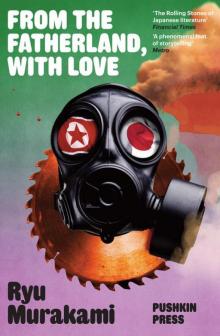
From the Fatherland, with Love, page 28


Resignation was gradually spreading around the table, like a bad smell. Resignation meant submitting to greater power, and abandoning any idea of resistance. Power was built and maintained with violence. A population accustomed to peace had no taste for either meting out or being subjected to brutality, and couldn’t even imagine what it would involve. People unable to imagine violence were incapable of using it. Like that officer’s ear: nobody wanted to think about how it had been burned. They didn’t even want to think about ears being burned. They didn’t want to burn anyone, and they didn’t want to be burned. But the reality bearing down on everyone at the table right now would entail one or the other, or possibly both. There was only one way to avoid it—and that was willingly to sever part of their territory from the rest of Japan.
3
BEFORE DAWN
April 4, 2011
YOKOGAWA SHIGETO hadn’t been asleep long when he felt his wife Naeko shaking his shoulder. Woken from a nightmare in which his newspaper office had run out of paper and printed the daily edition on stone instead, he bawled out like a child, “Gimme paper!” Naeko pressed a cellphone into his hand and smiled. “You were dreaming,” she said. Dazed, Yokogawa threw back the blanket, slowly sat up, and gazed vacantly at the hanging scroll on the wall in front of him. The ink painting of a tiger and dragon battling a vast army from ancient China had been a gift from a Korean artist he’d known when working at the Seoul office. Somehow he always found it soothing to see this scroll in the morning. He wasn’t especially interested in either art or tradition, he just liked that particular painting. He glanced at the clock and saw that it was three in the morning. From the kitchen came the sound of the coffee maker and the aroma of Kilimanjaro. “Not up yet?” Naeko poked her head around the door. She had a cardigan slung over her nightdress.
“Hello? Yokogawa-san, are you there?” It was Matsuoka, from the city-news desk. Yokogawa had scarcely had any sleep since the first reports of North Korean guerrillas occupying Fukuoka Dome. He’d been inundated with requests for information from domestic and foreign media following the joint press conference given by the commander of the Koryo Expeditionary Force and the city mayor yesterday morning. The Asahi and Yomiuri newspapers had sent their top reporters from Tokyo to the press conference, but they hadn’t been able to get any proper answers from the KEF commander. Japanese reporters were good at summarizing events, but hopeless at quizzing subjects, especially foreign ones. Yokogawa had learned the importance of incisive questioning from his time in Seoul, where he’d seen how all the foreign journalists would go for the very questions most likely to fluster politicians and industrialists—the sort of things that required consistent answers, ensuring that the gloves were always off at press conferences. Reporters in Japan were only trained to root around for information.
Yokogawa had really stood out from the other journalists at the hotel in Fukuoka. His face had been broadcast the world over, and his Fukuoka-based newspaper had been besieged by TV crews including CNN and the BBC ever since. When his boss at the paper had finally ordered him to go home and get some sleep, he’d had to sneak out the back door like a thief, or a corrupt Diet member, to grab a taxi. Naeko held up a tray with a cup of steaming coffee and pointed alternately to the kitchen and the bedroom—did he want it in bed or out here? He jerked his chin in the direction of the kitchen and said hello to Matsuoka as he got up. “Did you manage to get some rest, Yokogawa-san?” He could hear people answering the phone in the background—“Nishi Nippon Shinbun, city-news desk”—and someone yelling, “Then get it confirmed by the KEF commander, dammit!” He sat down at the kitchen table and raised the coffee cup to his lips, feeling himself return to reality with the familiar din of the newspaper office in his ear.
It seemed that the KEF was about to start the round of arrests. Nishi Nippon Shinbun was just one of three news outlets including NHK and the Asahi Shinbun to have been given permission to go along, and they wanted Yokogawa on hand. So that was what it was about. He shook his head and took another sip of coffee. As a veteran reporter in his late fifties, it would come as no surprise if his paper urged him to take early retirement. He had spent practically all of his thirties in the Seoul office, and seven years of his forties writing editorials. His tough, outspoken style had won him a lot of fans, but he had always felt the heat from politicians and public officials. After his stint as an editorial writer he was offered the position of chief editor, but he turned it down and went back to reporting instead. He liked this sort of work—and you had to be at the center of the action to do it. He now ostensibly belonged to the city-news desk, but he also sometimes wrote copy for the politics and business-news desks. Being Nishi Nippon Shinbun’s star reporter sounded good, but Yokogawa thought of himself rather as a handyman who could write fast and had good contacts. “Matsuoka, are you telling an old man of fifty-seven to get back to work after two hours’ sleep?” he said, his resonant voice rising in pitch. “I’m afraid so,” Matsuoka laughed.
Naeko brought him a freshly ironed shirt with a suit and necktie. “You’ll eat before going, won’t you?” she asked. “I made some rice balls, and I can warm up some miso soup with clams.” Yokogawa wasn’t hungry, but it would probably be a long session. “Okay, thanks,” he said. Naeko put the rice balls on the table, and the soup on the burner. The kitchen walls were covered with photos of the two of them around the time they’d first started dating. When their only daughter, Yoshiko, married and left home, she had searched out pictures of her parents as a young couple, had them framed, and hung them on the walls. “It’s gonna be just the two of you from now on,” she’d told them. “These’ll help you remember how to be lovey-dovey.” A fresh, salty fragrance rose from the miso soup as Naeko placed it on the table, a little pile of thinly sliced green onion floating on top. Yokogawa looked away from the photos. Yoshiko had married a lawyer five years her senior, and now lived in Yokohama with two children of her own. In recent years it had become an annual event to go to Yokohama in the spring to see the grandchildren and have dinner in China Town. When Yoshiko brought the kids home with her in the summer, they would take them to the beach at Karatsu in Saga Prefecture. Little by little, the grandchildren had become the main focus in their life. Naeko was looking at the newspaper on the table. It was the evening edition of yesterday’s Nishi Nippon Shinbun, and the front-page story had been written by Yokogawa. The bold headline in white lettering on a black background read: BLOCKADE TO CONTINUE, SAYS PM.
“Yoshiko called several times yesterday. She said you appeared a lot on TV.”
“Oh, really?” said Yokogawa, putting his arm into a shirtsleeve and telling himself not to be jittery. Just speak and act as usual.
“I wonder when we’ll be able to see her again,” Naeko muttered, as if to herself. It was a difficult question. All of Fukuoka’s residents must be feeling similarly anxious. Would the Prime Minister or Chief Cabinet Secretary be able to reassure them? They’d probably hide behind some vague answer: “The government is doing its utmost to find a solution to the problem.” But such fudging wouldn’t fool Naeko, who had lived almost thirty years with a no-bullshit journalist. “I don’t suppose we’ll see her for some time,” said Yokogawa. “But nobody knows what the future holds, so there’s no point fretting about it. That North Korean bunch I met yesterday were more civilized than I’d expected. They probably won’t do anything too terrible.”
“It’s scary to think about what might happen,” Naeko said with a faint smile. “But I’ll be fine as long as I can hear your voice.”
As he went out the front door, Yokogawa told her to take some sleeping pills if she needed to, but to make sure she got some rest. Getting into a taxi, he thought, My voice? He and Naeko had met in the choir club at college. Yokogawa had been a tenor, Naeko an alto. It was the defeat of the student movement when he was in high school, and then, at Kyushu University, the vicious infighting among left-wing radicals, that had clinched the matter for him and he’d taken refuge in the choir club, singing Beethoven’s Ninth and Mozart’s Requiem and the like. For better or worse, the collapse of the student movement had left in its wake a pervasive sense of political demoralization. Even after returning to Kyushu from Seoul, Yokogawa’s frequent contact with politicians had convinced him more than ever that politics was a waste of time.
Yesterday, though, he realized he’d been wrong. Conflict was essential to politics. During Yokogawa’s time as a newspaper reporter, the dichotomies in Japanese society—rich-poor, conservative-reformist, business-labor unions, and so forth—had all become less obvious. No doubt they were just suppressed, but you couldn’t blame the politicians, the bureaucrats, or the media for that. Society as a whole had suppressed opposition because it was less bother that way. Yokogawa had been given a jolt by the North Korean officers he’d met at the press conference yesterday. They must have grown up in a world where struggle was a fact of life, the only thing they could be certain of. In that sort of environment, politics became necessary. Politics was basically about distributing resources amongst people with very different interests—and it was when a conflict of interest became apparent that the concept of negotiation arose. The politicians Yokogawa knew were not really engaged in politics as such. He’d go so far as to say that the reason nobody was trying to negotiate with the KEF was because it hadn’t even occurred to anyone to do so.
The taxi driver had the radio tuned to NHK, but there was no new information. Apparently it had not yet been made public that the KEF was starting to make arrests. That didn’t necessarily mean that NHK was being restrained or was coming under any government pressure; the information probably just hadn’t been confirmed yet. Four years earlier, when the government had proposed revisions to the Foreign Exchange Law and a freeze on bank accounts, it had imposed restrictions on the media. Interest rates were skyrocketing, and it was said to be only a matter of time before the economy went into meltdown; and when rumors of a media gag spread on the Internet, banks nationwide had been attacked by mobs smashing windows and beating up bank clerks. The riot police had been deployed, and there had been casualties. The last time cities like Tokyo and Osaka had been blanketed with the smell of tear gas had been over the amendment of the Japan-US Security Treaty four decades earlier. The government had tried to justify itself, but ironically the riots only subsided once the legal measures were officially announced. Politicians had learned their lesson and had made no attempt since to regulate, manipulate, or suppress information.
Up ahead was Fukuoka Airport, normally brightly lit up at this time of day with preparations for the first arrivals and departures, but today still sunk in darkness. There were no lights on the runway or in the terminals or control tower. Most of the troops sent to enforce the blockade had already withdrawn since passengers had stopped demanding to be allowed to fly, and there were now just two SDF trucks on the tarmac. Yesterday media helicopters had been circling around all day, but they’d all disappeared once night fell. The silhouette of the airport, shrouded in darkness, reminded Yokogawa of a coffin. It was as if the pulse of some giant creature had stopped. “The cops are stopping cars near the airport, and it’s best to avoid the expressway. How about taking side roads?” asked the driver, and Yokogawa agreed.
He lived just east of the airport in a district called Shimemachi, about a twenty-minute taxi ride from the Nishi Nippon Shinbun office in the city center. Taking the expressway would normally shave five minutes or so off the journey, but not with the blockade. The roads around the airport were deserted, with no sign of the usual lines of trucks. The area around Shimemachi was a major distribution center for medical supplies, clothing, and fuel, and was full of factories and industrial parks. The noise and vibrations from the endless convoys of trucks every morning often brought complaints from residents of the neighborhood. This morning, however, Yokogawa only saw two or three trucks. Supplies from the mainland would have been interrupted, of course, but goods in the warehouses couldn’t have been depleted that much in just one day. He asked the taxi driver about it. “It’s because of the police roadblocks,” the driver told him.
These had been set up on all the main through roads in Fukuoka, including the Kyushu Expressway, which was the major artery running from Moji through Fukuoka all the way down to Kagoshima and linked to all the island’s main cities via national trunk roads. There were twenty-six roadblocks altogether, and the entire Kyushu police force had been deployed to man them. Cars and trucks were being exhaustively searched one by one, with the exception only of special vehicles like tankers, and so traffic was of course backed up. Unable to do their job, most trucking companies seemed to have given up and weren’t bothering to send out any vehicles.
“I don’t get it,” said the taxi driver suddenly. “If any of these North Koreans want to go to Tokyo, they can easily get around them roadblocks. All they have to do is go east and take their pick of the little side roads, and once they hit the coast they can grab a boat and nip across to the mainland where they can jump on a train. The police must know that much!”
The driver was only saying what everyone in Fukuoka already knew. All the police and SDF in Kyushu wouldn’t be able to stop the KEF commandos from sneaking over to the mainland if they wanted to. Yet the government had still opted for the blockade. In other words, this was all purely for appearances’ sake, a charade intended to reassure citizens that the government was taking the security of the nation seriously. And everyone knew it. They hadn’t contained the guerrillas in Fukuoka, they’d cut the people of Kyushu off from the rest of Japan. The Prime Minister and Chief Cabinet Secretary had wept when they announced the blockade. Were those really tears of compassion for the people they were sacrificing? Toward the end of the Pacific War, commanding officers had wept as they sent off kamikaze pilots to die. It seemed that Japan’s leaders always shed a tear or two when some poor bastards had to take it in the neck. Afterwards, of course, they forgot all about them.
“How’s the taxi business? Has there been a drop in custom?” asked Yokogawa. “About forty per cent,” answered the driver. “Everyone’s afraid of going out, especially with more of ’em on the way over from North Korea.” He told Yokogawa that he’d been dispatched to take an elderly patient to the Kyushu Medical Center for dialysis treatment, but the old man’s niece, who was to accompany him, made a fuss about going there. “Do you want me to die?” the old man had said angrily, and the niece had snapped back, “Why can’t you go to another hospital?” A furious row broke out between them, and both had asked the taxi driver his opinion. The driver, thinking of those armed North Koreans, had been unable to offer much comfort. In the end, the niece refused to go, and the driver had taken the sick man alone to the Medical Center. It was the first time he’d been to the area since the start of the crisis, and he’d almost pissed himself when they were stopped by the rebels at a checkpoint. A woman soldier asked for their resident cards and put them into the card reader. When they came up clean, she gave the passenger a concerned look and told him in Japanese to get well soon before waving the cab through. “She had bright-red cheeks,” said the driver, smiling. “These days you don’t often see such bright-red cheeks here, even out in the country. She was like the women I knew when I was a boy.”
He looked in the rear-view mirror. “Say, aren’t you that reporter from the Nishi Nippon Shinbun?” he asked. “I guess I am,” Yokogawa replied, thinking to himself that he really had become famous. “All them college professors and whatnot on TV are making the North Koreans out to be cold-blooded killers. That woman soldier I met didn’t look like one to me, though. But then, she’s along for the ride, so… I dunno, maybe they are all a bunch of killers. What do you think?” The question gave Yokogawa pause. Asked whether the Hawks could win the championship this season, he’d have no problem answering, “Yes, definitely,” or, “No, they haven’t got a hope,” even though it was obvious that nobody could possibly know the outcome yet. Everyone seemed to want the future to be black or white, and predictable. With baseball it didn’t matter what you said, but deciding whether the KEF was dangerous or not was rather different. Depending on the circumstances, the rebels might well kill Fukuokans without so much as a second thought. They were probably capable of slitting the throats of old men, women, children—even infants—with no more feeling than if they were swatting flies.
The young officers he’d seen yesterday were unlike anyone you saw in contemporary Japan. Both physically and mentally they were sharp as knives—and not the kitchen variety, either. That commander and his aide were doubtless as well trained in using a combat knife as they were in preparing documents and speaking at press conferences. Along with the spread of education and culture in advanced democracies like Japan, the very idea of killing or hurting other people had become anathema. Yet though the KEF pair may have received the very best education available to the elite in a socialist country, they would also have been exposed to a harsher reality, where life was cheap and death a constant shadow.
The taxi driver’s question only left room for two answers, black or white: they’re good guys, no need to worry; or they’re depraved and we’re all doomed—but Yokogawa couldn’t give either. He fudged by saying he really didn’t know and changing the subject to his own business and the effect the blockade was having on it. A million copies of a forty-page newspaper required a huge amount of paper, and the printer’s stock wouldn’t last two days. It was normally brought in by land from Yatsushiro in Kumamoto Prefecture and by ship from Ehime in Shikoku, but with the blockade in place nobody knew whether it would continue to get through. At yesterday’s editorial meeting it had been decided for the time being to publish a six-page edition in place of the morning issue, cutting all the usual home, culture, sports, and entertainment sections, and all ads, and to suspend the evening issue altogether. The driver didn’t show much interest in paper-supply problems, however, and before long was talking again about the woman soldier’s rosy cheeks.