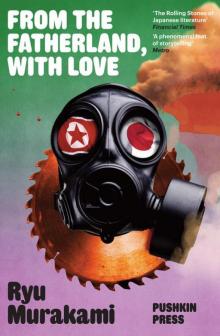
From the Fatherland, with Love, page 23


“Strictly speaking,” Jo replied, “we have not launched a rebellion against the Comrade General. We have raised our banner against the ultra-liberalizers in his entourage and those generals and bureaucrats who have become the puppets of foreign interests. Our Republic is presently being led astray by the honeyed words of American imperialists and bowing to outside intimidation. As a remedy, we have left the Fatherland, prepared to endure the humiliation of being named as rebels for the sake of establishing a new homeland, together with Japan’s democratic forces. The Comrade General is surely not indifferent to our fate, and any statements he may have made to the contrary only reflect the prevailing domestic situation. It was precisely in response to our national crisis that we, the Koryo Expeditionary Force, have abandoned our own country. Consequently, we will not yield to intimidation, whether from Japan’s SDF or from US forces stationed here. If we are attacked, we will counterattack. The KEF is currently comprised of four companies from the Special Operations Forces’ 907th Battalion. These are elite troops armed with the latest weaponry and highly trained in street combat. No matter whose army is sent against us, we will not be easily defeated. Moreover, if hostile elements should gain control of the Party and attack our comrades waiting to leave the shores of the Republic, or if any other nation should attack them once they have departed, we will retaliate. Such measures may include executing politically dangerous elements we have already taken into custody and ordering special-operations personnel who have already infiltrated other urban areas of this country to carry out acts of retribution.”
Behind his glasses, the reporter Yokogawa opened his eyes wide as he listened to this, then nodded and took some notes, muttering to himself. Of course, the reference to SOF infiltrators in other Japanese cities was a piece of disinformation. Yet it wouldn’t be difficult for the KEF, in fact, to send agents into Osaka or Tokyo on sabotage operations—and no doubt they would do so if necessary. An Asahi Shinbun reporter named Ito raised his hand and stood up to ask, “What do you intend to do now?” Taking advantage of the ambiguity of this, Han replied, “I have not slept for more than a quarter of an hour since yesterday morning, so I am planning to take a nap.” A Yomiuri reporter named Moriwaki asked what “independence from Japan” was supposed to mean. “Surely you know what the term ‘independence’ means?” he was asked. Moriwaki replied that of course he did. “Then please confine your questions to those you do not already know the answer to.” Yokogawa burst out laughing, but when Moriwaki glared at him, he stopped and nodded an apology. A member of the NHK crew asked what was to become of those Japanese tourists and hotel employees who were still being detained. Pak answered this one, saying that some would be released once certain politically dangerous elements and criminals had been arrested, and Yokogawa spoke up again. “On what legal grounds,” he said, “will you carry out those arrests? In other words, which country’s laws will you be applying?”
Jo and Han looked at each other, as if confirming that they needed to keep an eye on this journalist. “As a general rule,” Han answered, “Japanese law will be applied in the case of ordinary criminals. As for political offenders, ethical principles accepted internationally will take precedence over strictly legal considerations.” Pak explained further: “We anticipate establishing bylaws for the governance of Fukuoka, as well as revising some existing laws, but it would be a mistake to think that we have come to Fukuoka in order to inflict unreasonable punishments and penalties on any of its citizens. The Koryo Expeditionary Force intends to follow the path of coexistence. We believe that the long-standing historical ties between the people of our Peninsula and the people of Kyushu will make for a positive common influence. We the Koryo Expeditionary Force aim to foster well-being and order, creating in Fukuoka and all of Kyushu a land of mutual respect and prosperity. We the Koryo Expeditionary Force have no intention of attacking either the Self-Defense Force or the US troops based in Japan, much less the local citizenry. As long as no military action is launched against us and there is no violent resistance or hostile propaganda, we the Koryo Expeditionary Force will live in our enclave as peacefully as doves. Since the time of our arrival here in Fukuoka, we have not fired a single shot. It is true that in the course of securing Fukuoka Dome we were forced to launch a rocket-propelled grenade, but even then there were no fatalities or injuries. For its part, the Japanese government has set up a blockade, cutting off Fukuoka from the mainland. You, the citizens of Fukuoka, should reflect on the significance of that act. Is it not your destiny and ours to live together in one harmonious community?”
“A last question,” said Yokogawa. “Do you think the Japanese government will ever allow Fukuoka to become independent?”
Colonel Han Seung Jin replied: “We do not intend to ask for permission.”
2
KNIGHTS OF THE ROUND TABLE
April 3, 2011
JUST BEFORE DAWN on April 3, Yamagiwa Kiyotaka was relieved of his duties as deputy chief cabinet secretary. Officially he was to resign due to poor health, but in fact he’d been given the axe. Prime Minister Kido and Chief Cabinet Secretary Shigemitsu had both been hopping mad when told of the arrival of another five hundred or so North Korean commandos in Fukuoka. Shigemitsu, who had a Band-Aid on his forehead after a run-in with a TV camera at Tokyo Station, bitterly accused Yamagiwa of being incompetent, and Kido had started yelling at him the moment he strode into the crisis-management room.
Kido Masaaki had not always been involved in Japanese politics, having spent much of his career as head of an NGO providing refugee assistance and humanitarian aid in places like Cyprus, Cambodia, and Palestine. He had been propelled into the limelight six years ago, when he was named as a possible candidate for the Nobel Peace Prize because of his work as part of the committee overseeing the EU-led Palestinian peace process. Despite an exposé in the British tabloid press about him having spread the Nobel Prize rumors himself, he stood as the former Democratic Party candidate for prime minister at the general election and was voted in. Kido had just turned fifty at that time. When the Liberal Party split over the freeze on bank deposits and spiraling inflation, and its young reformist faction merged with the main Democratic Party faction to form Japan Green, they were unable to agree on which camp should provide the new party’s leader. It was thought that someone untainted by party politics was needed, and Kido seemed the ideal candidate.
Yamagiwa had disliked Kido from the start. Kido’s professional experience was the opposite of his own. A graduate of a Christian university, Kido had been licensed as a lawyer on the East Coast of the US before passing up the high-paying corporate world for a career in international environmental NPOs. He was better known abroad than in Japan for his work in conflict zones. Yamagiwa, on the other hand, had taken the conventional route of graduating from the School of Law at Tokyo University and then working for the Bank of Japan, only becoming a Diet member on retirement. Kido was also tall and handsome, still in his early fifties, fluent in English, and often featured in men’s magazines even after becoming prime minister. Yamagiwa’s dislike of him stemmed not from envy of his position or appearance, however, but from the man’s underhandedness—although this was a defect that all politicians shared to some extent. Kido’s behavior and way of speaking changed according to whom he was dealing with: faced with someone powerful he would be courtesy itself, and if a good impression was needed he was all smiles, but with someone who didn’t matter he’d not bother to conceal his impatience.
He was good at remembering people’s names and backgrounds after only meeting them once, and the press loved him for his outspokenness, but the fact remained that everything he said and did was calculated. Few politicians or bureaucrats had seen the real Kido. As deputy chief cabinet secretary, Yamagiwa had often had occasion to work under him and had inevitably noticed this side of his character. Despite a successful career, Yamagiwa lacked strong connections, money, and presence, and was little more than a convenient punchbag for the brash Prime Minister, who often humiliated him in front of his own staff. Yamagiwa was in his late sixties, and had come across any number of men of this type. All of them, without exception, had grown up in modest circumstances, had had bad relationships with their fathers, and were both insecure and intensely ambitious. They studied and worked hard but were excessively concerned about other people’s opinions of them, and to compensate could be unduly high-handed with those weaker than themselves. Ironically, this youngish international figure, considered an outsider in respect to Japanese politics, was in fact a classic example of the Japanese politician.
Shigemitsu Takashi, a mid-level Diet member of the old Democratic Party at the time, was the one who had persuaded Kido to stand for PM. The Chief Cabinet Secretary was of course a lawyer by training, and for almost ten years, beginning in his late thirties, he had served as governor of Okayama Prefecture. He had revitalized Okayama City and its surroundings, creating a special economic zone comprising medical care, education, agriculture and fishing, and implementing wide-ranging tax cuts. Okayama was said to have developed by leaps and bounds with Shigemitsu as governor, although some economists pointed out that all he had really done was to create an irreversible gap between rich and poor. Shigemitsu had studied at Stanford after graduating from a good university in Tokyo. He was four years older than Kido, but still in his fifties.
Kido and Shigemitsu had returned by helicopter and bullet train from Morioka and Okayama respectively, and by the time they reached the Cabinet Office it was already around eleven at night. Kido would have arrived earlier had he flown directly to the heliport at his official residence, but after his intention to do so was broadcast on the TV news, he’d been forced for security reasons to change his plans. On entering the crisis-management room, he had pointed a finger at Yamagiwa and bellowed, “Have you any idea what’s going on? What the hell have you been doing all this time?” He slammed the pile of documents he was holding onto the table, and swore in English.
From Yamagiwa’s point of view, it was outrageous that he should take the blame. It was not his fault that a lot more terrorists had just flown in. Apart from anything else, he had been the first Cabinet member to arrive, followed later by the Environment Minister. None of the other ministers had shown up yet, while the head of the National Public Safety Commission had gone fishing without leaving an emergency contact number and wasn’t even aware of what was going on. Still, he couldn’t deny that his response to the crisis had been less than stellar, particularly since his mishandling of the media had resulted in the leak about the Prime Minister’s helicopter. But he couldn’t very well have told a nation in shock that the PM’s whereabouts were unknown.
“Sorry, but I’ll have to ask you to leave the crisis team,” Kido told him as he took his seat at the round table. This amounted to being fired from his post as deputy chief cabinet secretary. Yamagiwa’s face flushed with outrage, and his heart beat so violently he thought it would fly out of his mouth. There were almost thirty staffers in the room at the time, and he had been dismissed in front of all of them. He was about to protest, but quickly realized he was being made a scapegoat. Someone had to take responsibility for the unprecedented occupation of Japanese territory by North Korean guerrillas, and Yamagiwa was the obvious choice for fall guy.
He rose to his feet, but Shigemitsu stopped him. “Hold on. Until this meeting is over, you are still deputy chief cabinet secretary. You have a duty to report on developments so far.” Yamagiwa fought back tears of frustration and an urge to punch them both as hard as he could. Nobody could have done anything in the circumstances! In just two hours? Did they think that if they’d both been here, those North Koreans wouldn’t have flown in? In any case, they hadn’t been here. They’d been off swanning around the countryside!
But all he said was, “I see,” and, head still bowed, he sat down again at the table. Protesting the unfairness of it all would be seen as an attempt to shift the blame, and would only cement his fate as the sacrificial lamb. Shortly afterwards, Itagaki, the deputy chief cabinet secretary for crisis management, arrived. “Other ministers will be turning up soon, so would you mind moving to another seat?” someone whispered in Yamagiwa’s ear. He got up and walked to a chair as far away from the Prime Minister as possible. As he did so, he was watched sympathetically and also apprehensively by Iwata of CIRO, Yoshizaki of the Foreign Ministry, Korenaga of the Public Security Investigation Agency, Katsurayama of the National Police Agency, and Yonashiro of the Defense Agency—all of whom were clearly aware that the same treatment could be meted out to them at any time. They had already moved from the central table to the chairs along the wall. The lower-ranked aides had given up their seats and were either leaning against the wall or had left the room.
Ministers of state and various bureau chiefs were arriving one after another in the crisis-management room. Foreign Minister Ohashi; Motoki from the Asian and Oceanian Affairs Bureau; the female Foreign Ministry official Tsunemura Taki; Togo from the North American Affairs Bureau; Finance Minister Takahashi; Justice Minister Nagano; Minister of State for Economic and Fiscal Policy Atoda; the commissioner of the Financial Services Agency Moriyama Kazue; Arita from the Inspection Bureau, and Misaki from the Supervisory Bureau, of the Financial Services Agency; Minister for Economy, Trade, and Industry Umezu; Koganei of the Manufacturing Industries Bureau; the female Minister for Information and Communications, Matsuoka Kusuko; the Minister for Health, Labor, and Welfare Minami; the female Home Affairs Minister Araki Yukie; Minister of State for Defense Shimada; the Senior Vice Minister for Defense Takamura; Chief of Staff for the Ground Self-Defense Force Shinomiya; Chief of Staff for the Maritime Self-Defense Force Kanno; Chief of Staff for the Air Self-Defense Force Godai; Commissioner General Oikawa of the National Police Agency; Superintendent General Nanbara of the Metropolitan Police; Kosaka of the Info-Communications Bureau; and others. The Minister of Land, Infrastructure and Transport was being flown back from a meeting in Hokkaido by the SDF, and was due to arrive at one o’clock in the morning. Word had come from the family of the head of the National Public Safety Commission, Kurusu, that he had returned from his fishing trip blind drunk, so a member of the Commission named Sadakata was called upon to substitute for him. The Chief Cabinet Secretary told them that they would establish the Crisis HQ in the Cabinet as well as a National Safety Committee in the official residence.
The room was becoming increasingly claustrophobic with the arrival of more and more people. The TVs were all on, showing the non-stop coverage and special broadcasts from NHK and other stations; the phones and faxes were ringing continuously; computer keyboards were clattering; and a heavy aroma of coffee and green tea hung over everything. Umezu, the Minister for Economy, Trade, and Industry, turned to Shigemitsu and said, “The Crisis HQ is supposed to be set up in the event of a missile or terrorist WMD attack, isn’t it?” Umezu was a veteran Diet member on the right of the old Liberal Democratic Party, and didn’t get on at all well with Shigemitsu.
“With all due respect, isn’t having part of your country occupied by North Korean terrorists a good enough case for a Crisis HQ?” Shigemitsu didn’t bother to hide his exasperation. What an idiot, thought Yamagiwa. Umezu had just been winding him up, and he’d have done better to let it pass. “That’s not what I meant,” Umezu said bluntly. Shigemitsu was younger, and he wasn’t about to defer to him. “These people call themselves a rebel army faction, but what do we, as the government, call them? An invading army? Terrorists? Spies? Illegal-arms smugglers? We can’t very well call them our guests, can we?” This last quip roused laughter from Matsuoka, Minister for Information and Communications, as well as the bureau chiefs of the Ministry of Economy, Trade, and Industry—all of them anti-Shigemitsu.
This wasn’t to say that Shigemitsu had many enemies. He’d had sufficient flair and public support to get Kido installed as prime minister. Nevertheless, the pair of them had yet to produce any substantial results. There had been a slight improvement in the level of inflation, and the slumped yen and government bonds seemed set to bottom out—but now this had happened. It was unclear how it would impact on Kido and Shigemitsu. No, even if things turned out well, the Cabinet would probably not survive. Umezu would no doubt force responsibility for the incident onto Kido and Shigemitsu, and was probably already thinking that once things were under control he could aim for the premiership himself.
“Obviously they are terrorists, and in my opinion that’s what we should call them,” said Shigemitsu. Just then, a call came from the Fukuoka prefectural police for Oikawa, head of the National Police Agency. After a brief exchange the latter, looking pale, stood up, phone still in hand. Everybody looked at him. “I’ve just been informed that some of the terrorists are headed for the Diet and the Imperial Palace,” he said sheepishly. There was an audible gasp around the table, and the room fell silent as ministers and bureau chiefs stopped speaking mid-sentence, the aides seated in the chairs by the wall stopped talking on their cellphones, and even the clatter of clerical workers’ keyboards ceased.
As the sound of voices died, noises from fax machines and the coffee maker echoed through the room. A new mood seemed to have taken over. It wasn’t that people looked startled, or gloomy, or anxious, or even furious or frantic. They looked deflated, Yamagiwa thought, as if the life had drained from their faces. It was the sort of expression worn by someone meeting a prospective marriage partner for the first time and finding that they were far uglier than they had looked in their photo. Everyone felt disheartened and inadequate in the face of this new complication.
“What do you mean?” Kido asked Oikawa. He was always asking people what they meant, thought Yamagiwa, stifling a laugh. What a stupid question. How much room for interpretation did the news leave? “Were we informed by the terrorists themselves?” asked Shigemitsu. “No. It’s what we’ve been told by hostages released from the Dome, and by drivers of some of the commandeered buses and taxis,” Oikawa replied. “They’re bluffing,” said Kido. “If they really meant it, they wouldn’t go spilling the beans to their hostages,” he added, but then buried his face in his hands. It was ninety-nine per cent likely to be false information, but what if it was true? You couldn’t very well ask the terrorists themselves to confirm or deny it. Yamagiwa was beginning to feel he was probably lucky to have been fired. This was just about the worst possible development, and it was hardly surprising that everybody looked so discouraged. It wasn’t the sort of problem that you could solve and get brownie points for; whatever action they took would have a price, and a terrorist attack on Tokyo would mean the collapse of the Cabinet and the end of Kido’s and Shigemitsu’s political careers.