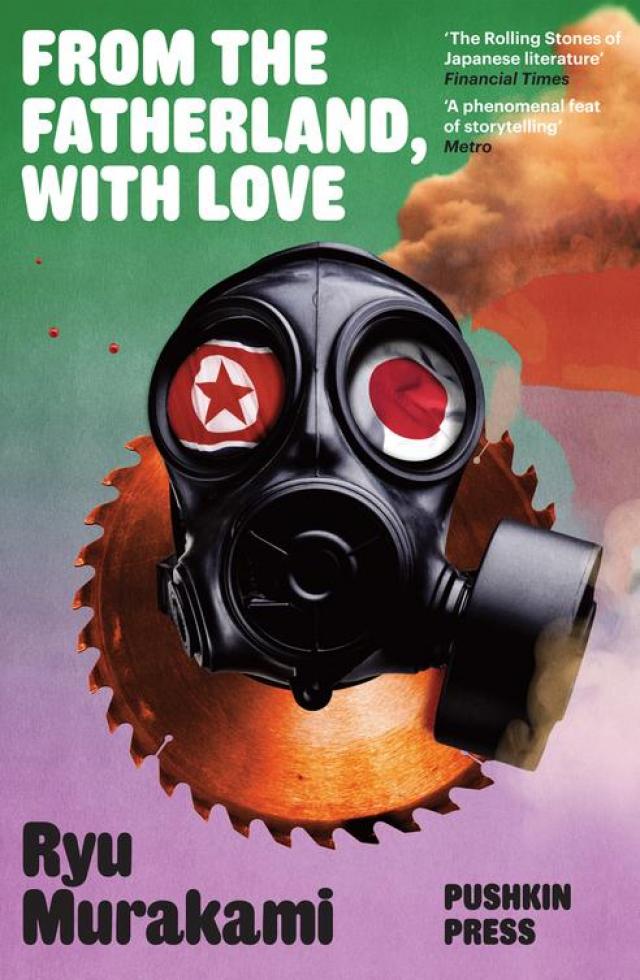
From the Fatherland, with Love, page 36


He tried to move his right hand. It was slimy, as though he were covered in oil. Shadows appeared in the sparkling whiteness that filled his eyes. They were moving about, their number increasing. Like sediment settling in a glass, images began to take shape at the lower edges of his field of vision. He moved his fingers to see whether he still had his AK and Scorpion, but both were gone. Jagged streaks of lightning slashed through his head. He could see nothing with his right eye, and what he saw with his left looked as though it were filtered through a night-vision scope, but even coarser and more distorted. Outside, the shooting and screaming continued. Who was firing, and who was getting hit? He was lifted off the floor and turned over on his back. It felt like the skin of his abdomen was being peeled off with sharpened sticks. Again he convulsed. An oval shadow appeared before his eyes; something within the oval was reaching toward him. He opened his eyes wide, first the right, then the left. With one, he saw nothing; with the other, the same watery darkness, with flashes of lightning that delivered bursts of intense pain. He was brought to his feet, and now he could see his stomach, bare of both clothing and skin, the burned, reddish-black muscles exposed. A body was lying in front of him, its torso torn to shreds, and there was blood, as though dumped from a bucket. He could just make out what appeared to be a blue uniform. Was it Ra? Others were lying there, but whether they were his team or the enemy, he didn’t know.
He was dragged out of the room. All around him were dark, shadowy figures: in the hall and at the head of the stairs. Dozens of them. Before him was a large mirror, which seemed to contain a different world. He saw a man held up by two dark figures. The man’s clothing was in tatters, and his raw, reddish-black belly and burned genitals were in full view. Who the hell was that? Choi had once gone to a concentration camp in mountainous South Hamgyong Province in the company of a member of the Politburo, at whose request he killed a political criminal with a blow to the chest. “You have a reputation for your gyeoksul skills,” Choi was told. “Let’s see if you can really stab somebody with those hands of yours.” The prisoner who was brought before them was wearing rags that left him virtually naked, his genitals drooping down beneath lice-ridden pubic hair. To refuse or hesitate to carry out the act would have been an offense in itself. “This creature’s been condemned as a traitor to our Comrade General,” the Politburo member told him, his face red with drink. “It’s subhuman scum, and deserves no more sympathy than a maggot.” He laughed and added: “Or do you sympathize with maggots?” It was the first time Choi had ever plunged his fingers inside a human being. He was surprised how hot it felt.
That subhuman was there in the mirror now. It was the same man. The image of that criminal scum was looking back at him and laughing: “You and I are just alike now. Look at you. Your smashed eye, your skinned belly and genitals…” The dark figures were dragging him toward the stairs, and the man in the mirror was slipping away. “No!” Choi shouted, forming a blade with his right hand and trying to twist away from those holding him. “I’m not like you!” he bellowed. The shadowy figure on his right let go, and the one on the left said, “Hey! What’s going on?” Just below what appeared to be the head of the speaker was a narrow pale spot that must be the throat. With all his remaining strength, Choi drove his fingertips into that spot. He heard a strangled howl, as though from a dying dog. He had missed the larynx but scored a hit nonetheless: the tips of his fingers were warm and sticky. The shadow staggered back, still howling. “Son of a bitch!” someone shouted, and another shadow stretched out an arm and shot Choi in the knee.
He started to fall but was again held up by his armpits, and then his legs were being hoisted up in front of him. “Get him out of here! Out!” His right leg was bloody and bent at an odd angle, but he couldn’t feel it. He wondered what damage he’d inflicted: it wouldn’t have been fatal, but the bastard’s windpipe was surely crushed. I’m a man, he told himself. I’m not scum. The whirling ceiling shifted to clear sky. He was outside. The gunfire ceased as if on cue. He could feel the wind from the blades of the helicopter directly overhead, and he heard a thin, weeping wail, like a mournful Western hymn. The first-floor windows of the restaurant had all been destroyed; bodies were strewn about in front of the place and along the paths. Torn scraps of canvas and sketch paper danced around in the wind. The four buses began rolling this way, with more shadowy figures walking alongside them. Peering past the parking lot, he could see that another MAV was coming. So Tak had indeed managed to call in reinforcements. The backup MAV was armed with thirty-millimeter autocannon. It rolled over fallen bicycles as it approached, crushing them like bugs. Why had the shooting stopped? Why wasn’t the MAV turning its guns on the buses? It was toward those buses that he was now being carried, on the shoulders of the shadow people. Hostage, he thought. They’re taking me hostage. Could he move his right hand? The left-side pocket of his uniform was still there. A dead hostage wouldn’t do them any good. With a groan he reached toward his chest, looking for the button on the pocket. He found it and wrapped the thread around his index finger. He was about to pull it, when a strange image floated up in his mind. It was of the dog inside the gate at the house of the felon Maezono. A black dog with shiny fur and an elegant, slender face, its legs and body sleek and supple. Why was he thinking of it now? Such a beautiful animal. Choi pulled on the thread with all his might.
5
SPIRIT GUIDES
April 6, 2011
MORI LOOKED AT HIS WATCH. What was keeping them? It was six minutes past noon. He and Toyohara had left their bicycles in front of a convenience store on a corner in Odo, just at the west end of Atago Bridge. They were lurking in the shadow of a fat concrete pillar that supported the overhead Route 1, peering east across the river and down Yokatopia Avenue. Felix had been monitoring the police band and said that the Koryos were heading for Odo and would be arriving at the danchi—the old public-housing apartment blocks—at noon. They should be passing through here any minute now. Mori had elected to do some surveillance these past few days, having both the time and a bicycle, but no one showed much interest in his reports. Toyohara went along because he had a bike too, not to mention a pair of binoculars, which he was holding now in such a stranglehold that his hands were trembling and the tips of his fingers had turned white.
The North Korean troops were camped out near the high-rise hotel and the Dome. They called themselves the Koryo Expeditionary Force, but everyone in the Ishihara group referred to them as the “Koryos”—an abbreviation Ando had first used and everyone liked: it had a satisfyingly mocking feel. The Koryos had begun airing a daily thirty-minute public-relations program on NHK Fukuoka TV, featuring a female news anchor interviewing the “propaganda and guidance officer” Jo Su Ryeon. On today’s show Jo had announced that barracks for the incoming reinforcements would be erected on vacant reclaimed land in Odo and other sections of Nishi Ward. “Bidding has already been completed, and construction will begin immediately,” Jo said with a smile, adding that the project would help stimulate the economy of Fukuoka. He also politely emphasized that any aggression toward the new arrivals would result in retaliatory measures being taken in Tokyo and other cities throughout Japan. The program began at eight-thirty in the morning, and NHK affiliates throughout Kyushu carried it live. Those outside Kyushu, however, regarded the show as propaganda and simply provided summaries of the content during their regular news programs.
Jo also laid out specific charges against the “criminals” who had been arrested, explained the shooting at Daimyo 1-Chome and the incident at Ohori Park from the Koryo point of view, and spelled out their vision for the immediate future. He guaranteed free economic activity but insisted that ordinary working people would be given special consideration; he censured the Japanese government’s continued blockade of Hakata Bay as a hindrance to crucial trade with China, South Korea, and Taiwan; he announced a willingness to admit UN inspectors to the occupied zone in Fukuoka as soon as the time was right to do so; and he promised that the South Korean, Chinese, American, and other consulates would be reopened soon with extraterritorial rights according to international law. Jo’s TV appearances made him the best-known of the Koryos. He was particularly popular among Japanese women for his handsome features, cogent explanations, and smooth speaking voice. Even the NHK anchor selected to interview him blushed whenever he looked directly at her.
When Mori had first seen Jo, he’d wondered how someone of the same species could be so different from himself. Mori was round all over and resembled an owl. His face was as soft and puffy as freshly baked bread, and his eyes, nose, and mouth were like half-buried raisins. Jo’s cheekbones wouldn’t have looked out of place on a Grecian statue; the skin covering his facial bones and muscles was so taut and smooth that it might have been flesh-colored plastic wrap. And whereas Mori’s eyes were like pebbles embedded in wet sand, Jo’s were as sharp and clear as mountain pools beneath a cloudless sky.
For the time being, the additional hundred and twenty thousand troops were to be billeted in the Odo danchi, as well as in abandoned houses and a shut-down elementary school in the neighborhood. The north side of Odo had once been heavily populated, but residents had moved away as the recession dragged on, and a typhoon a few years ago had pretty much finished the place off. Now it was a virtual ghost town. The Koryos had purchased the entire neighborhood from the City of Fukuoka and accepted bids from private contractors to reconnect and repair the water, sewage, electricity, and gas. The work was to begin this afternoon, and Mori and Toyohara were awaiting the arrival of the Koryo engineering corps.
Toyohara trained his binoculars on the far side of Atago Bridge. He was a beefy lad with short limbs and a shaved head, and wasn’t the sort of person you’d expect to own precision optical equipment. He looked as if he were trying to extract a pair of dark tubes from the center of his face. The German-made binoculars were the oversized type you saw dangling from the necks of generals in old war movies. The metallic parts had a dull, dark patina, the surface of the leather case was cracked in places, and the strap had been repaired more than once with leather of slightly different hues. Mori wanted to peer through the glasses but didn’t know how to go about making that happen. He wasn’t familiar with the notion of “sharing.” The only thing his older brother had ever shared with him was the wrong end of a knife, after using it on their parents when Mori was in middle school. Neither had there been any sharing at the orphanage he’d been placed in later. The stronger kids, and the ones whom the nurses and attendants liked, monopolized all the toys and books.
Just before falling asleep, or whenever he closed his eyes to block out the world, Mori always saw one of two scenes: the common room at the orphanage, or the playground there. The interior scene consisted of children playing with blocks or engrossed in video games while he himself sat alone at the window, looking out. In the playground scene, he sat alone beneath a poplar tree while the other children tossed Frisbees, kicked balls about, and skipped rope. Something had always separated Mori from objects of amusement like blocks, video games, Frisbees, or soccer balls—something much more difficult to overcome than mere distance—and the concept of lending or borrowing possessions was one he couldn’t even begin to grasp.
Toyohara pried the binoculars from his eyes. Whether because of nervous tension or because he didn’t know his own strength, he always seemed to use more force than necessary when holding things—his fingers turned chalk-white when he gripped the handlebars of his bike as well. He now noticed that Mori was staring at the binoculars, and he looked from them to him and back again. “These were made in Germany,” he said. Mori nodded and said, “I know”—this being the fourth time Toyohara had told him.
He thought there must be some sort of story connected with the binoculars. He was interested in old things and liked reading books about history and bygone cultures. He wanted to quiz Toyohara about them but didn’t know exactly how to go about it. They’re so cool—did someone give them to you? They look old. When were they made? How close does, like, the Sea Hawk Hotel look from here? Questions like these occurred to him one after the other, but they quickly got all mashed up in his head. He sensed that the moment he said anything aloud his enthusiasm would get all tangled with self-doubt, and he wouldn’t know how to continue. So he said nothing.
He’d never had an actual conversation with Toyohara. Together they had chased after the Special Police on each of the two previous days, but in spite of all they’d witnessed they had scarcely spoken. Big things had happened—especially yesterday. A lot of people died, the Koryo officer blew himself up, and the MAVs’ autocannon shredded four buses, right before their eyes. And yet the pair had barely exchanged three words all day. Of course, there had been a lot of excitement and confusion—not to mention bullets whizzing through the air—but he and Toyohara hadn’t discussed it even after returning.
Toyohara stared at the binoculars in his hands, then peered at Mori for some time, and then at the binoculars again. Finally he looked up at Mori with a troubled face. Mori thought he probably wanted to let him look through the things but didn’t know how to make the offer. Toyohara was half a head shorter than Mori, who was only 1.65 meters tall, but the muscles bulged on his broad shoulders and barrel chest, and his arms and legs, while short, were as thick and sturdy as logs. Ishihara often called Toyohara “Hulk,” after the Incredible one. He was also extraordinarily hairy. Long black hair sprouted from his shoulders and the nape of his neck, he had a solid unibrow, and he was furry down to the second knuckles of his fingers and toes. On closer inspection, you discovered that he also had the face of a baby, but what you noticed first and remembered always was the physique and the body hair.
Toyohara had been a sickly child who’d suffered from infantile tuberculosis. His parents lived in Tokyo, but he was raised at the home of his paternal grandfather in Saga Prefecture, to the south-west of Fukuoka. His grandfather was descended from the ruling family of the old fiefdom of Nabeshima and served as the postmaster in a small country town. He was a proud man with a feudalistic outlook, and Toyohara was given the strictest of upbringings. The boy was forced to learn kendo and once had his head cracked open with a wooden sword. As a sixth-grader, he saw the animated series Cuore: Three Thousand Leagues in Search of Mother and decided it was normal for a child to want to track down his own mom, so he bought a platform pass and sneaked aboard a bullet train for Tokyo, but was soon caught and booted off. The next day he again boarded a bullet train, this time carrying one of his grandfather’s antique samurai swords, in what essentially became a hijacking. The first conductor who tried to subdue him was run through with the blade. Toyohara extracted it with some difficulty, then attempted to behead the corpse. After defeating an enemy, one was obliged to remove his head, hold it up for all to see, and proclaim victory—at least according to the samurai code his grandfather had always instilled in him. Toyohara both respected and hated his grandfather, whom he called “Pop-Pop.” He thought the old man would praise him for cutting down the offending conductor, but in fact he never so much as spoke to him again. It hadn’t occurred to Toyohara to wonder whether his grandfather’s tales of the Warring States were still applicable today. And he still couldn’t understand how something that was good five hundred years ago could be bad now, or why the same behavior that made you a hero in war could make you a criminal in society. But then, those things didn’t make sense to Mori either. Toyohara had arrived on Ishihara’s doorstep bearing one of the very finest swords in Pop-Pop’s collection.
The sky was cloudy over Yokatopia Avenue. The weather forecast had said the wind would be unusually chilly even for early April, but Toyohara was wearing a garish Hawaiian shirt, cotton shorts, and flip-flops. The shirt had red, yellow, and green skulls on it and was big enough to accommodate his broad shoulders but hung down to his knees, hiding the shorts, so that it looked more like a muumuu. Toyohara dressed like this even in midwinter, his body temperature being warmer than most people’s. Mori was wearing a size XL blue shirt, jeans with a forty-inch waist, and a black nylon jacket that was much too small for him. He’d bought the jacket at an outlet in Kashii for exactly three thousand yen, including tax. Medium was the largest size they had, and he couldn’t even zip it up, but he’d bought it anyway because the clerk said it looked good on him. He couldn’t help noticing that people entering and leaving the convenience store nearby gave him and Toyohara a wide berth.
The sound of distant rotors grew louder, and a helicopter appeared above the Sea Hawk Hotel. Painted large on either side was the legend NHK FUKUOKA. The Koryos had announced that they would shoot down any helicopters flying over the hotel or encampment other than ones belonging to NHK or the Fukuoka-based newspaper Nishi Nippon Shinbun. “Here they come,” Toyohara said and put the binoculars back in their case. The cars on Yokatopia Avenue all pulled over to the shoulder to make way, and the traffic lanes, which had been jammed with vehicles of all sizes and colors, were suddenly clear in both directions. Whenever the Koryos’ armored vehicles appeared, an electric tension seemed to charge the air. Mori loved that moment. An MAV mounted with two machine guns materialized around a gentle curve in the road. Behind it was a microbus, and beyond that you could just make out another MAV. The NHK helicopter was hovering at a considerable distance behind the vehicles.
Toyohara pushed his bicycle out of the parking lot and got on it. It was the type popular with housewives, with a basket on the front and no crossbar, but the seat was too high for his short legs, so he had to pedal standing up. Gaining speed, the bike leaned left-right-left as his bottom swayed right-left-right. Mori straddled his bike as well. He would have liked to get a closer look at the MAVs, but it would probably be best to get back indoors before the Koryos reached the danchi complex. The Odo danchi weren’t far from the warehouses occupied by the Ishihara group, and it was no time to be drawing attention to themselves. Today Takei was going to distribute the firearms. They’d been told to report to the Living first thing in the afternoon. Mori couldn’t wait to get his hands on his own weapon, and wondered what kind it would be.