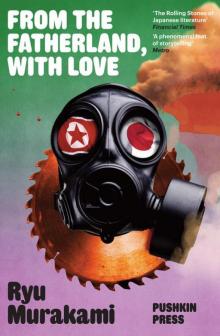
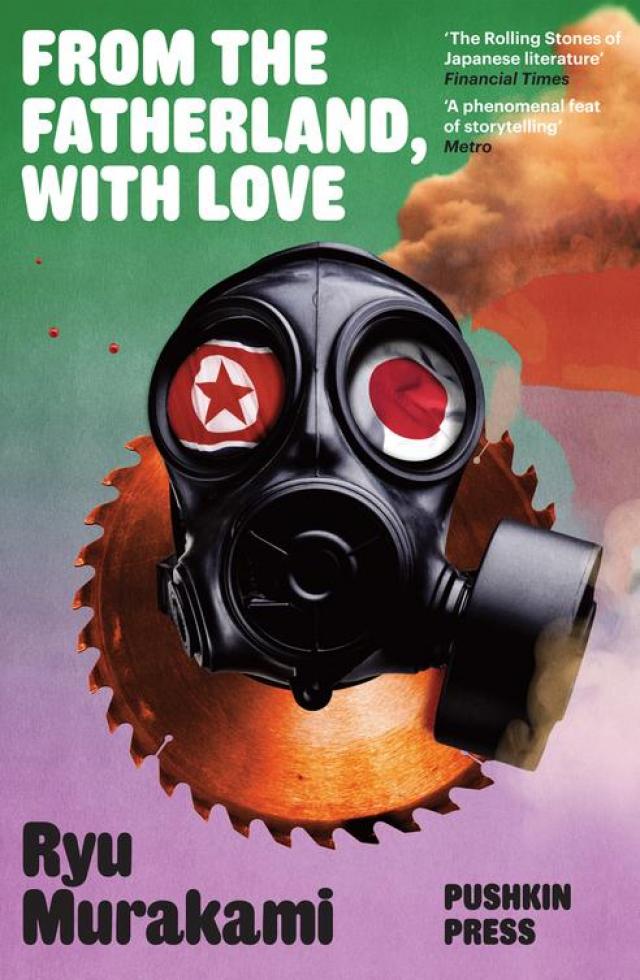
From the Fatherland, with Love, page 5


Such was the gathering here in the projection room. It was the crème de la crème, men in their forties and fifties, representative of those members of the reformist faction who had survived the pressure of the anti-American hardliners. With the eyes of all these men upon him, Pak felt gooseflesh creeping up his back and down both arms. It was a sensation quite unlike any he’d ever experienced before: as if his very skin had suddenly grasped the reason this group had been brought together. Pak Yong Su probably possessed the most complete command of the Japanese language of anyone in the Republic, and everybody here knew that. He felt as though, when they looked at him, what they saw was Japan.
“A rebel army faction that isn’t a rebel army faction,” said Kim Gweon Cheol from his place in front of the screen. “The Organization and Guidance Department has approved the plan to send such a combat team to a city overseas.”
Someone in the audience struck a match. A city overseas… that could only mean a city in Japan. Pak now realized that he was present at the birth of a momentous operation. He was sure of this, and it filled him with the same sort of anxiety and excitement the birth of a child would. As a political officer in the Fifth Division of the Special Operations Forces Guidance Bureau, he had been involved in more sabotage operations than he could count, but they had been planned by the People’s Army, not by those in Building 3.
A rebel army faction that isn’t a rebel army faction. Everyone was muttering and thinking about these words. They seemed to have struck a chord. The twelve men assembled here were now at the center of an epoch-making stratagem. As men, as soldiers, as Party members, privileged to have been born in the Republic, what could be a greater thrill than this? All sabotage projects were nominally subject to authorization by the Party Central Committee, but in practice, formal procedures were bypassed. This was because every agency involved in such operations had its own troops and funding. Moreover, as a universal principle, authorization was inimical to successful intrigue: nowhere did parliaments or cabinets debate the advisability or justification of clandestine undertakings and then approve them. Plotters loved to conceal and loathed to reveal, and their plans were thus never the work of the national body as a whole. Nor was there ever a clear or unified chain of command. The constant risk of disclosure ruled out any elaborate hierarchy, while absolutely requiring the cooperative interaction of a complex network of lateral organizations.
A case in point was the Kennedy assassination, in which a number of rightist groups were thought to have been involved, including conservatives in the government, the Department of Defense, the military, retired members of the military, the CIA, and the FBI, as well as the mafia, Cuban refugees, local police, and foreign mercenaries. That is to say that there was neither a single, unified organization, nor a chain of command. Everything was compartmentalized, each group being responsible for its own role and unaware of who was leading other groups and even what they were doing. It was basically the same for Islamic extremists and other international terrorist organizations. There were groups that did the groundwork, groups that collected data, groups that constructed bombs, groups that transported fuses, groups that rehearsed the actual bombings, groups that housed the perpetrators until the day of the operation, groups that arranged for vehicles, groups that rigged the explosives to the vehicles, and so on, with the tasks of each parceled out in great detail. Each group did only what it was assigned to do and had nothing to do with the others. On the day itself, the only ones present were those who carried out the actual bombing; everyone else had left the country.
“Now then, Professor Pak,” said Kim Gweon Cheol. “How many members of the Special Operations Forces have a thorough knowledge of Japanese?”
Pak thought for a moment what the definition of “thorough” might be. Rephrasing the question, he replied, “If by that you mean those who can pass for native speakers of the language, I’m afraid there are none, unless we begin training some of our Chongryon compatriots. Do you intend to infiltrate deep-cover agents?”
Chongryon was the General Association of Korean Residents in Japan, commonly perceived as the de facto North Korean embassy there. Kim explained that this was not what he meant, that what was called for was good comprehension, not flawless speech. It was not to be a deep-cover operation; the commandos would be operating in secret until landing, but from that point on they would be relying on force of arms. In other words, he added, they would not have to be able to impersonate Japanese. All that was needed was a sufficient grasp of the language to allow them to carry out their mission.
The first man Pak thought of was Han Seung Jin. Han was exceptionally talented, as shown not only in his command of Japanese but in his fighting prowess and, above all, his leadership skills. Eight other current SOF members came to mind, all former students of his with some expertise in the language. “One short of ten,” he replied to the initial question. “Only nine?” Kim muttered and then, smiling wryly: “Well, it can’t be helped. We’ll have to make do with what we’ve got.” An officer from the Defense Security Command brought Kim a map, which he unfolded on the desk in front of him. It was on a scale of a million to one and displayed the northern half of Kyushu and the Korean Peninsula. “The operation will consist of three phases,” Kim explained. “In Phase One, the nine commandos will slip into the country and occupy certain facilities. Phase Two begins two hours later, when we drop in four SOF companies by air and secure a beachhead. This will involve not sandbags or trenches but rather the blood and lives of Japanese.”
“Which city are we talking about?” Ri Dong Ho asked. Hwang Pung Gu pointed at the tip of Kyushu on the map.
“Probably there: Fukuoka.”
The four units were to establish a foothold in a residential district and secure it until the arrival of the main force, which would carry out Phase Three: one hundred and twenty thousand troops landing in Hakata Bay by sea. The figure caused a ripple of excited murmurs and a general fumbling for cigarettes. “A rebel army faction that isn’t a rebel army faction.” Kim Chang Bok, on Pak’s right, repeated the words as he slowly exhaled the smoke of a Seven Stars cigarette. “If it’s a rebel army faction, neither the Americans nor the South can justifiably attack the Republic,” he said, nodding repeatedly. “The Republic will announce that this isn’t the work of the People’s Army but rather a terrorist attack by a mutinous faction. The South and the US will have to hold back, and since Japan’s own constitution renounces war, the Self-Defense Force won’t be able to attack us either. If by some accident Pyongyang should come under attack, there would be full-scale war, and Seoul would be a sea of fire within thirty minutes. No one wants that—not the South, not the US, and equally not China or Russia.” It was a well-founded plan, and Pak Yong Su could not contain his excitement. Their southern neighbors would not be harmed, and the homeland would go unscathed. The battle was to take place overseas. Blood might flow, and towns might be destroyed, but only in the country that had once ruled the Fatherland and forcibly displaced countless numbers of people, creating the cause for their partition: that hated land, Japan.
“Will we need the cooperation of our compatriots over there?”
This question came from Gong Chang Su. He was referring to the General Association of Korean Residents in Japan. Kim Gweon Cheol shook his head.
“Even if Chongryon offers its assistance after the four companies have occupied Fukuoka, we will refuse. Any further attempt to link up with us will be forcibly blocked. Let me remind you: this plan has already been approved by the Organization and Guidance Department. In the first place, there is the danger of leaks. Chongryon is under constant surveillance by the Japanese intelligence agencies and has been infiltrated. Also, since first-generation Korean residents have all but disappeared, the character of the organization has changed. Most of the younger generation have much the same mentality now as the Japanese and as a result of public outrage over the abduction of Japanese citizens have been losing any loyalty they felt toward the Fatherland, especially since the Pyongyang Declaration. Just as the Dear Leader is always saying: ‘The wolf raised by dogs becomes a dog.’ Members of Chongryon will consequently be given no special privileges whatsoever; they will be treated in the same way as the Japanese.
“I will go over this with each of you later, but the operation will differ in each phase; leaders will be selected, as will a temporary command structure, and from the moment that the hundred and twenty thousand troops enter Hakata Bay, the job is done. The crucial point to remember is that it is not the Republic that is invading Japan.”
Shin Dong Won, nodding vigorously, whispered to Choi Ho Gyeong, “I wonder which division will be sent to Fukuoka in Phase Three.” Choi considered for a moment, then smiled meaningfully and muttered: “Perhaps the Fourth Division, or the SOF Eighth Corps.” The two units he mentioned, both led by officers of the conservative, hardline faction, were seen as possible barriers to future reunification. There had been endless rumors of a possible coup d’état, with the SOF Eighth Corps prominent in the intrigue; and the Party leadership was intent on keeping these divisions in check. The corps commander sent to Fukuoka would be assured that calling it a rebel army faction was only a subterfuge to prevent counterattack and that if the Republic labeled him a traitor it was only for purposes of deception. Hardline officers who feared that reunification would leave them out in the cold ought to be thrilled to be entrusted with the grand and noble task of invading Fukuoka.
“What is the goal of the mission?” asked Yim Gang San, but Ri Hyeong Sup said that perhaps there was no need to decide on one, and both Kim Gweon Cheol and Choi Deok Cheol loudly concurred.
If the rebel army faction and the United States wound up in a standoff, Pak reflected, that would be an accomplishment in itself. To succeed in transferring the buffer zone between China and the United States from the Peninsula to Kyushu would be enough. There was little risk of fighting the US forces stationed in Japan. And the Japanese government would have neither the strategy nor the courage to start a war embroiling the citizens of Fukuoka. Japan might even let Fukuoka go, severing all ties with it. “If Japan hadn’t mismanaged its economy, this operation would not have been possible,” Ri Dong Ho said under his breath. “Japan didn’t mismanage its economy,” replied Choi Ho Gyeong, displaying the discernment he’d cultivated in Washington. “But in any country, once vested interests have gone bad, it’s very difficult to revitalize an economy. In Japan’s case, it was critical to close down the financially draining quasi-government corporations, but when this proved impossible, the much easier path of constitutional revision was chosen. To use an analogy, it’s similar to when a corporation is unable to produce profits and simply gives up on that and turns to fiddling with its corporate philosophy. Japan is a dying elephant that lacked the will to heal itself.”
Hwang Pung Gu raised his hand to ask if a name had been chosen for the operation. Kim Gweon Cheol spread both arms to call for quiet and said, with a smile, “It has.” There was only one man in the Republic who could give this operation a name. Kim puffed out his chest and looked around the room as he proudly revealed it: “From the Fatherland, with Love.”
INTRODUCTION 1
A MISSED SIGN
March 3, 2011 Tokyo
SUZUKI NORIKAZU flinched at the cold air outside the exit to Kasumigaseki subway station. Feeling the chill on his neck, he sneezed as he set off down the road. The government district was thronged with demonstrators, from right-wingers in their campaign trucks to civil-rights groups and labor unionists, all yelling through bullhorns, vying with one another to be heard. Awfully cold for March, Suzuki thought to himself. He felt like joining in the shouting. He hadn’t been getting enough sleep lately and could feel himself coming down with a cold. He should have worn a muffler. That morning he’d sent his thirteen-year-old daughter a bouquet of flowers complete with a free hina doll via an Internet florist. She had remained with his ex-wife after the divorce five years ago, and Suzuki had resolved to send her flowers every year on her birthday. Ever since elementary school she had grumbled about it being on March 3, coinciding with the Doll Festival held for Girls’ Day, which meant she had to make do with one celebration instead of two. Each time he sent the flowers, he was reminded that it was already March and spring had almost arrived. Over the years the connection had become fixed in his mind, and although the weather forecast that morning had warned that the temperature was ten degrees lower than normal for the time of year, he’d left home without a scarf.
Suzuki worked in the Cabinet Intelligence and Research Office, commonly known as CIRO. For the past few years they had been steadily cutting back on staff, suspending new recruitment, and transferring some existing personnel, so that by last April the workforce had shrunk from more than a hundred and fifty to fewer than a hundred and twenty. Taking time off work for a cold now would merely add to the flak already being directed at employees like himself who had come from the private sector. All the ministries and government offices in Kasumigaseki were being restructured, not just the Cabinet Office and the Home Affairs Ministry. Whenever he got together with colleagues, the conversation would always turn gloomily to rumors of the retirement fund drying up within five years.
Hunching against the wind, he joined the swarm making its way toward the various government buildings. On opposite sides of the road outside the Cabinet Office, right-wingers and labor unionists were trying to outshout each other in their tirades against the government and bureaucrats. The rightists were calling for Japan to arm itself with nuclear weapons and revive the military draft, so that it could stop kowtowing to America and China and become a truly sovereign nation. The unions, meanwhile, howled that adhering to Article Nine of the Constitution was essential to maintain peace and protect jobs. Both sides, however, were united in their hatred of the present administration.
The herd of civil servants, Suzuki among them, scurried along to their various offices, trying to ignore the blaring loudspeakers. For a number of years the economy had been in sharp decline, leading to an unprecedented recession coupled with inflation. As a last resort bank accounts had been frozen to save the financial system, but this had devastated the money markets. A regulated economy was anathema to foreign investors, and they had abandoned the Japanese market in droves. Businesses had undergone ruthless downsizing in an attempt to survive, and the number of suicides among middle-aged and senior citizens had almost doubled. It wasn’t only the rightists and labor unions that loathed the bureaucrats, whose jobs and monthly salaries were secure.
“Good morning,” Suzuki greeted the security guard at the entrance to the Ministry, sneezing again as he showed his pass.
“You all right, sir?” asked the elderly guard, his familiar face creasing in a concerned smile. “I always use these meself,” he added, pulling out several pocket warmers from his jacket. “With those guys around, it somehow feels a whole lot colder.” Behind him was an armored vehicle and several Self-Defense Force soldiers in combat gear. The thick steel panels of the heavy camouflaged truck really did seem to emanate a chill. Following the freeze on bank deposits, Molotov cocktails had been thrown at the Ministry of Finance, a bomb was planted in the Prime Minister’s official residence, and last summer there had been an Islamic fundamentalist-style suicide bombing outside the National Diet building. The explosion hadn’t been large enough to cause a major tragedy, but it had led to emergency legislation allowing deployment of the SDF to guard the Diet, government offices, and other key facilities such as nuclear power stations.
The Self-Defense Force was isolated in its relations with East Asia and the wider international community, and even its dealings with US forces stationed in Japan had soured. The freeze on bank accounts had been precipitated by the pensions crisis as the baby-boomer generation of civil servants began reaching retirement age. Local government bonds together with investment and loan bonds had gone into free fall, and interest rates on national bonds had shot up. Inflation and recession hit at the same time, anxiety and discontent spiraled, and resentment simmered nationwide. In order to stay in power, last year the government had tilted toward expanding the military, provoking strong warnings and opposition from America and Europe as well as China, Russia, and South Korea. Many who had lost their life savings, and the politicians who depended on their support, were in favor of amending the Constitution to allow a military build-up and nuclear armament as a means of salvaging national pride. This faction held sway despite calls for international cooperation from financial circles and liberal politicians. The more isolated Japan became, the more people disillusioned by financial hardship were drawn to a hardline point of view.