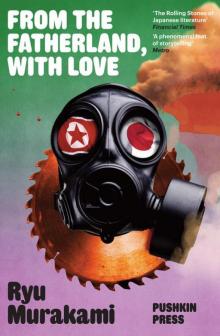
From the Fatherland, with Love, page 37


Takei had kept the weapons hidden in the basement of Building G, and in order to avoid being seen, he’d transferred them all to Building C under cover of night, with four helpers to do the actual carrying—Kaneshiro, Hino, Yamada, and Mori. Takei was nearsighted, farsighted, and astigmatic, and since he wasn’t wearing glasses and there was no light above the door it took him for ever to open the various locks. At no point did it seem to occur to him to hand the keys to someone else, however. The interior of Building G, which had originally been a clothing warehouse, was thick with dust and smelled of mildew. Filaments of cottony stuff billowed up in little clouds at their feet, and after only a few steps Hino stopped and doubled over, wheezing, from some sort of allergic reaction.
The weapons were stored in the innermost room in the basement, an area of about thirty square meters. It was pitch dark until Kaneshiro switched on a flashlight. Against the far wall were stacks of cheap suitcases. Mori and Yamada pulled one down and set it on the floor, and Takei bent over to open it, wriggling in anticipation. “Look!” he said. “Look!” Inside were three long, flat metal cases and five oilpaper-wrapped packages about the size of hardcover books. Takei lifted one of the metal cases, put it on his knee, and opened the lid. “It still blows me away!” he said. The stock and barrel of the rifle were silvery in color, while the trigger and other movable parts were made of black steel. Mori swallowed his breath. It was the first time he’d ever seen a real gun close up. Yamada said “Whoa!” and bared his big rabbit teeth. “It’s beautiful,” Hino breathed, and reached out to touch the barrel, but Takei slapped his hand away. Kaneshiro said, “Let’s start hauling the stuff,” but Takei just took the weapon out of its case and stared at it dreamily. He then looked up at Kaneshiro, Yamada, Hino, and Mori in turn, with a Cheshire Cat smile. It looked like a recumbent crescent moon in the wavering beam of the flashlight.
“This,” he announced without losing the smile, “is the legendary Dragunov.” Takei had dyed his hair brown to look younger, but everyone said he was forty-eight this year. He had a vacant sort of face—one that was difficult to focus on. When he was standing beside a wall, regardless of the color of the paint, he seemed to melt into it and disappear. He wasn’t particularly ugly, but the outlines of his face and body were somehow fuzzy and indistinct. He was about to attach the magazine and scope to the Dragunov right then and there, but Kaneshiro put his foot down, saying there was no time for that. Takei, Kaneshiro, and Mori carried the three flat metal cases on that first trip, and Hino and Yamada the oilpaper bundles.
Mori rode his bike up the sidewalk beside Marina Avenue, then through the shabby residential district of Toyohama. To his left, across the street, was an elementary school. It was the middle of the lunch hour, but the school bells suddenly rang out with that nostalgic bing bong bang bong melody and a voice came over the loudspeakers: Attention all students. Return to your classrooms at once. The lulling sound of the chimes seemed out of place amid the agitation caused by the approaching MAVs. Most of the students obediently migrated toward their classrooms, but some ran in the opposite direction, toward the front gate, where they’d have a good view of the street. People were getting used to the vehicles and their peculiar diesel rumble, and no one ran away when they approached now.
A lot of people had died at Ohori Park the day before, and NHK had run endless repeats of the shoot-out footage. It was a bird’s-eye view, shot from a helicopter, and though it showed several deaths, many of the more gruesome things Mori had seen on the ground were omitted—like heads and limbs being blown off and bullets turning a child’s body to bloody hamburger. Nonetheless, it had had an enormous impact. No one had ever seen footage of Japanese citizens being mowed down, other than in war documentaries of more than half a century ago. But the city government had yet to issue any instructions or notices. They didn’t even warn people to stay away from the armored vehicles but merely kept advising that it was best to exercise caution when encountering “any potentially dangerous situations.” Nor had the schoolyard announcement a moment earlier stated why everyone should return to their classrooms. Telling people not to go near the MAVs might seem adversarial, and apparently that was to be avoided at all costs.
Clerks and customers alike were pouring out of the convenience store, the post office, and the neighborhood shops to get a closer look at the MAVs. Some smoked, some drank cans of fruit juice, and some chattered excitedly with friends, lining the roadside as if for a parade or a marathon. If the citizens of Fukuoka weren’t afraid, in spite of the tragedy at Ohori Park just the day before, it was because they had watched that tragedy unfold on TV and knew exactly what had happened and who was really to blame.
Just after one o’clock in the afternoon of the previous day, two officers of the KEF Special Police and five Fukuoka prefectural policemen had entered a building together to make an arrest. Some minutes later there was a loud explosion on the second floor. When four Koryo police from a separate squadron ran toward the building, a volley of gunfire erupted from four tour buses in the parking lot. It was all filmed from the NHK helicopter and witnessed by a large number of bystanders, and it was clear that the first shots came from the buses, which had been Trojan-horsed with members of the Osaka Prefectural Special Assault Team. One Koryo took a bullet in the neck and went down like a puppet with cut strings, all but decapitated by the shot. The remaining three took cover and returned fire with rifles and machine guns. Visitors to the park panicked and scattered in all directions. A ricocheting bullet shattered the glass of a restaurant window, and customers dashed outside, some running directly into the line of fire. If they had simply hit the dirt and stayed put, they might have been all right, but there was no such thing as a Japanese civilian who knew what to do in the midst of a sudden firefight.
The Koryos had promptly issued an official statement about the incident, to the effect that they were lodging a formal complaint against the Japanese government, protesting “this inexcusable act of naked aggression, which has resulted in serious injuries to civilians and members of the Fukuoka police as well as to our own personnel,” adding that this time, and this time only, they would refrain from taking retaliatory measures. Koryo reinforcements had destroyed the four buses with autocannon fire, annihilating virtually the entire Special Assault Team. Many of the people in the park—Mori among them—had instinctively run toward the Koryos for cover, since the SAT had been the first to open fire, apparently with little concern about collateral damage. The entire incident only served to enhance the Koryos’ image, increase the number of kids chasing the MAVs, and swell the crowds watching the public arrests. The Koryos had announced at their press conference that they would not interfere in any way with citizens who weren’t hostile toward them. Now, ironically enough, thanks to the “pre-emptive” actions of the ultimately decimated SAT, they had gained credibility with the people.
Osaka prefectural police, for their part, issued a tortured statement explaining that their intention had been to detain KEF officers in order to extract information, that evacuating the park beforehand would have alerted the KEF to the plan, that the unexpected arrival of a second KEF squadron had endangered their men on the ground, and that they had lost control of the situation when the public panicked. The statement did little to stem the criticism from Fukuoka City, the mass media, and pundits who viewed the operation as “ill-considered.” The chief of the Osaka prefectural police and a further dozen or more top officials accepted responsibility for the fiasco and resigned. The Japanese government announced that the operation had been planned by the Osaka police alone. The Chief Cabinet Secretary implied that while the idea of taking prisoners for interrogation was a reasonable one, the tactics employed were reprehensible.
But it was hard to believe that the prefectural police agency had acted on its own. The media and most of the populace suspected that the government had known about the operation in advance but forced the Osaka police to take the rap. Forty-six civilians had died, including six children under the age of thirteen. Only four survivors were listed as “injured.” Ambulances had been late in responding, so even people with treatable wounds had bled to death or died of shock. Neither Fukuoka City nor the Japanese government had said a word about compensation for the victims.
Toyohara was heading home at full speed, his unseated bottom ticking left and right as he pedaled, with Mori following along behind. Mori’s was a child’s bike, but its five gears made it fairly fast. It had been rust-covered, with a broken chain and no tires when he found it, but Fukuda, Ando, and Felix, who were all mechanically inclined, had picked up spare parts here and there and helped restore it. There were lots of abandoned bikes around. Mori had once brought one home as a present for Yamada, only to find that he didn’t know how to ride it.
In fact, about half of the Ishihara group had never ridden bicycles. Mori had stolen a bike from a parking lot and taught himself to ride the year before his brother freaked out, whereas Yamada had never even ridden one and hadn’t even realized it was something you needed to learn. Most adults forgot how they learned to do it. Generally your parents or grandparents bought you a bike around the time you entered kindergarten, and you practiced on it with the help of others. Your friend or older brother or father held the back of the seat, and you kept trying, falling off again and again before you finally got it. Yamada was raised by parents who had no interest in him whatsoever, and he’d had no siblings or friends. But no one in the group had had an idyllic childhood; none of them had been taught cycling or swimming or other wholesome sports by their parents. Most had never even played soccer or catch.
Almost all of the houses Mori passed now lay vacant. Toyohama had been one of the earliest tracts of land to be reclaimed from the sea, and had fallen out of favor as newer developments sprung up. After its huge shopping mall went out of business, the neighborhood had quickly gone to hell. Row upon row of identical houses were squeezed together here like stones on a go board. He passed a toppled plaster statue of the Virgin Mary in a weed-choked garden; an old woman in bra and panties hanging clothes on a line to dry; a pile of empty liquor bottles spilling out of an alley; an empty bamboo birdcage swinging from a crooked eave; a family altar in a dark room with a big broken window; a concrete-block wall with torn and curling graffiti-covered campaign posters; a propane gas cylinder lying on the ground like a giant condom; a skinny dog attached to a short chain; a trampled carton of milk on somebody’s doorstep, crawling with ants; a buckled, listing postbox decorated with a crude spray-painted vagina; children on a porch poring over a couple of comic books; children playing tag with someone’s cap as a young mother in yellow sandals scolded them… These sights registered on his eyes as he pedaled past, but in his mind’s eye he saw only the buses from yesterday, the ones that held the Special Assault Team, being shot to pieces with machine guns. He thought how awesome it would be if everything around here were blown to bits like that. The machine guns had made a sound that punctured the air and punched you in the pit of your stomach. He mimicked the sound and imagined the liquor bottles, the dog, the children, and the young mother all getting ripped to shreds by bullets.
Toyohara took a series of rights and lefts in an attempt at a short cut. Mori, bringing up the rear, continued straight on and lost sight of him from time to time. Since the streets were all more or less at right angles, there was really no such thing as a short cut, and shortly after Mori finally did turn, Toyohara reappeared right in front of him. Mori wondered where the MAVs would be now. The Koryos never ran them at full speed—he had followed every outing of the vehicles and was always able to overtake them on his bicycle. Presumably they were trying to learn the layout of the city and taking care not to cause any accidents.
The Koryos seemed to have given a lot of consideration to public relations, to avoid being disliked by the local people. It wasn’t that they visited orphanages or helped old ladies across the street or weeded the parks, but they kept their encampment clean and sanitary and were invariably polite, so as to maintain the moral high ground. Jo Su Ryeon always bowed deeply to the camera at the beginning and end of each TV appearance. The criminals arrested by the Koryos were all figures of wealth and influence, for whom there was little general sympathy. And it was the Koryos who had transported the injured from Ohori Park to the Kyushu Medical Center, before the ambulances ever arrived. They also gathered up the victims’ remains, wrapping them in thick vinyl sheets, and cleaned up the blood and gore. And that same evening, their commanding officer visited the hospital rooms of the wounded, with a bouquet of flowers for each.
Even before the explosion, a small incident in Ohori Park had made a big impression on Mori. A Koryo officer with a hard, scarred face had spoken to a group of old people who were in the park sketching. The interaction between the elderly citizens and the North Korean officer had been both unlikely and heart-warming. But, oddly enough, Mori couldn’t remember it visually. He remembered that there had been some interaction, but he couldn’t picture it in his mind. His memories of the events in the park were fragmentary and fleeting, like the brief glimpses he’d had of Toyohara pedaling along a parallel street.
The boarded-up shopping mall was visible ahead on the right. To the left, on the forested slope of a big hill, were a few scattered Shinto shrines. Shinohara, who raised frogs and centipedes and spiders in his rooms, collected ants to feed his creatures on the damp grounds of one of those shrines. Between the medical clinic and the elementary school was a convenience store where Mori often went with Yamada. Sometimes they’d buy a sandwich and a soda, then walk north to the water’s edge, to eat looking out at the sea. On the way was a middle school and a McDonald’s where members of the local Speed Tribe gathered, and farther along you came to a spot where the horizon opened up and the sea filled your entire field of vision.
Mori knew this area well and was able to picture all the streets. But his memories of yesterday in Ohori Park were piecemeal and disconnected, consisting of images that would leap suddenly into focus, like flashbacks. One of them was of an old man hit by a stray bullet, whose body seemed to swell up and burst. He’d been sketching, but squatted down on the ground the moment the shooting started, burying his head in his hands and wailing like a child. One of the Koryos ran right past him toward a ditch in which to take cover, and a bullet whizzed past the soldier and pierced the old man’s back. Before he toppled over, the man’s belly inflated for a split second and then burst in a shower of blood and intestines. When Mori talked about this, back at the hideout, Takei had said that SAT snipers sometimes used bullets with soft tips to make sure of a kill. The tip came apart on impact and sent a shock wave through the body, rupturing vital organs and leaving a gaping exit wound. The old man had been wearing a green vest of thick yarn. The bullet entered his back on a downward trajectory and exited at his groin. Internal organs, shredded by the shock wave and looking like dark red clumps of excrement, spilled from the hole beneath his belly.
*
Toyohara left his bike next to the entrance to Building C, then ran inside and straight up the stairs. Mori followed close behind. They didn’t lock their bikes; bicycle thieves wouldn’t waste their time in a deserted warehouse district. Mori was completely out of breath, but the sensation wasn’t unpleasant. He hadn’t felt any pain when forced to run a marathon at the orphanage, either. Even when his legs began to cramp, he experienced only a vague sort of discomfort, and eventually both he and Yamada, running alongside him, passed out from oxygen deprivation. The doctor at the orphanage said that, astonishingly, they seemed to share a deficiency of the substance that stimulates the nerves to register pain. Mori and Yamada had subsequently tested this by choking each other, poking each other with safety pins, pinching each other’s flesh, and so on, but the attendants and doctors found out and made them stop. Mori could feel heat and cold, and something close to pain in certain parts of his body—sometimes his head hurt, or his stomach ached, and when he went without sleep for a long time he’d feel a dull throbbing behind his eyeballs, but that was about it. It wasn’t a question of faulty genes, the doctors said, but a psychological issue, which meant that at some point something might happen that would trigger the production of the proper metabolites. He was warned that unless and until that happened, however, he needed to take particular care of any flesh wounds, to make sure they didn’t get infected.
Everyone had already assembled in the Living. They were all excited that the weapons were about to be distributed. Ishihara was in the rocking chair just outside his study, and Kaneshiro, Fukuda, and Takeguchi were standing in the center of the room. Fukuda and Takeguchi had apparently just finished making a batch of a new type of explosives they called “cookies.” Ishihara, looking sleepy, leafed languidly through the vintage nude-photo book of a one-time porn actress. When he saw Mori enter the room, Yamada looked up through his black-rimmed glasses and said, “Welcome back.” He had removed his black leather boots and was sitting on the carpet in cream cotton trousers, a pink shirt, and a beige jacket.
Yamada sometimes took part-time jobs. As bad as the economy was, whenever there was an opening at a sauna or massage parlor or love hotel, Yamada had no trouble landing it, for some reason. Mori had once gone to a massage parlor he worked at, lured by the promise of free entry. It was ten minutes before closing time, but Yamada wasn’t at the reception desk. When a middle-aged Chinese lady came out, he told her he was Yamada’s friend, and she led him back to a narrow, dimly lit room—scarcely more than a bed surrounded by curtains. Yamada, slathered in oil, was lying naked on the bed. His back shone crimson in the light of a bare red bulb. When he realized that Mori was standing there, the oil-sleek Yamada said, “Hey! You made it!” and gave him a rabbit-like grin. Yamada owned three suits he’d bought with money from his part-time jobs, and all three of them were beige. He claimed that one of the suits was from Italy, but Mori knew it was actually made in Honduras. Mori took part-time jobs as well sometimes—packing things into cardboard boxes or walking through the streets of the entertainment district in a sandwich board. Sometimes he got temporary work at a local bookstore. That was the best, because it gave him access to cheap books.