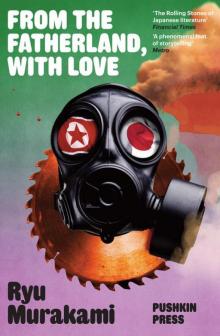
From the Fatherland, with Love, page 6


For the past five years, the United States had been redeploying its overseas armed forces, and the number of its troops based in Japan had already been halved. The financial and trade deficits had ballooned under the War on Terror, causing the dollar to plummet and effectively ending American global hegemony. The new administration formed by the Democrats sought more collaborative ties with Europe, China, and Russia. It joined China and Russia in expressing grave concern over Japan’s nuclear armament, and hinted at revoking the Japan-US Security Treaty while also indicating its willingness to end the embargo on weapons sales to China and abandon the Japan-US joint missile defense system. It then announced a hike in the price of feed grain to Japan, which was still reeling from depleted foreign reserves due to the drop in value of the yen. This was taken to mean that America would not give any aid to Japan in the event of food or energy crises—which were in fact already happening. This sudden U-turn provoked indignation even among the most pro-American politicians and media, and Japan-US relations cooled almost overnight. The reality was, however, that the US had been unable for some time now to maintain its position as the world’s single economic and military superpower, and it had effectively given up its role as the world’s policeman. It was also pushing for collective-security agreements in East Asia between China, South Korea, and Japan, and even North Korea and Russia, but in Japan this was misinterpreted by the media and a large portion of the population, who felt that they’d been abandoned. Politicians found themselves unable to check the rising tide of anti-Americanism.
The SDF soldiers stood with their Type 89 assault rifles at the ready, making no attempt at eye contact with the stream of employees entering the building. It was as if they were cut-outs. Suzuki had come to recognize some of them, but they never responded to his greetings. Soon after they’d been deployed, he had tried asking one young soldier, who remained standing motionless in the same spot every morning for hours, where he went for lunch. The soldier hadn’t answered—hadn’t even looked at him. There was strong opposition amongst employees to being guarded by the SDF, and many in the mass media were also critical. Suzuki thought that some minimal communication might help matters. They didn’t need to go so far as sharing a joke or anything, but as it was the soldiers were just too unnaturally distant from those they were guarding. If a terrorist attack did happen, some level of cooperation would be necessary; establishing some basic connection from the start would make things easier.
On reflection, though, it wasn’t just the relationship between the SDF guards and employees that was unnatural. Even politicians and bureaucrats in the various ministries and agencies, not to mention in CIRO itself, seemed incapable of maintaining normal civility and communicating appropriately among themselves. It wasn’t that they were openly hostile to one another, but their relationships tended to be either generally uncooperative or artificially chummy.
“Suzuki-san, would you mind handing this up to the Chief?” No sooner had he sat down at his desk than Yoshida, of the International Division’s Exchange Section, passed him a printout of an email from the US National Security Agency. “What’s it say?” Suzuki asked, then sneezed three times in succession. “Caught a cold?” The huge office, some fifty square meters in size, was freezing. “Forgot my muffler,” he said. “Chilly in here, isn’t it?” Yoshida nodded. “They’re getting mean with the heating. It’s the cost-cutting drive.” He opened his mouth and sent out a puff of white breath to prove his point. Suzuki decided to keep his coat on.
The email Yoshida had given him confirmed that the US NSA had officially admitted the existence of the major surveillance network known as ECHELON. “Handing it up” was office jargon for the process of sending information up through the various stages of the hierarchy. At just thirty years old, Yoshida was ten years Suzuki’s junior, and like Suzuki he had come from the private sector. Suzuki agreed to pass the email on, but Yoshida remained standing there. “I dunno,” he muttered, glancing at the Chief sitting at his big desk by the window. Suzuki looked at him questioningly. “What’s up?”
“Think about it,” Yoshida said, pretending they were discussing some papers on Suzuki’s desk. “The budget for our own IGS Center was approved on the basis of ECHELON.”
“I suppose it was.” Suzuki knew what he was getting at. ECHELON was the vast surveillance system operated by government agencies in five countries: America’s NSA, the UK’s GCHQ, Canada’s CSE, Australia’s ADSCS, and New Zealand’s GCSB. Telephone calls, faxes, and emails worldwide were intercepted and analyzed for certain specified keywords, and transferred to a database. A supercomputer known as Dictionary automatically logged the sender and recipient of any emails containing words such as “US President,” “assassination,” “bomb,” “Hamas,” and so forth. These key words covered everything related to the national interests of the countries concerned, from politics, public security, the UN, and the economy, to campaigns by environmentalists and civil-rights activists. This involved an enormous amount of data. It had been manageable when email was still only used by a limited number of people, but with the growth of the Net in China, India, and other developing countries, costs had snowballed. Even just inputting different languages into Dictionary cost a fortune—and then armies of translators were needed to decipher the results. Plus there were cases of civil-rights and anti-US/UK organizations sending out mass spam emails containing terms that would be picked up by Dictionary so that it overloaded and crashed—which happened frequently, each time incurring major costs to get it up and running again.
And now the NSA had not only blown the cover of ECHELON but also announced they would henceforth be limiting the range of intercepted communications. It was common knowledge that the high-tech system at Japan’s Information Gathering Satellite Center was modeled on ECHELON at the urging of the US. It had been heralded as the world’s newest IGS system, with antennas erected in a vast tract of land east of Tomakomai, Hokkaido, with technical assistance from American corporations. It had cost a whopping thirty billion yen, but here it was, not yet even fully functioning and now faced with the main ECHELON network being made obsolete.
“We won’t be able to laugh this one off. It will get handed up to the Chief Cabinet Secretary, won’t it?”
“Well, that’s not for me to say,” Suzuki replied. He collated information from the various sections and handed anything important to the International Division Chief, who in turn passed it on to CIRO’s Director of Communications, who again vetted it before sending it on to the Chief Cabinet Secretary. As had long been the custom, the International Division Chief had come from the National Police Agency. What Yoshida was getting at was that this information, which was bound to complicate matters in the global community, would end up in the hands of old-timers who still saw any threat to the nation only in terms of the extreme right or extreme left.
“The sooner you become Chief, the better—that’s what everyone my age thinks.”
“All right, all right. Get back to work,” said Suzuki, aware of the Chief’s eye on them. The Chief was in his fifties and had followed an elite career path through Tokyo University and the NPA’s Security Bureau, but unlike Suzuki and Yoshida he had few overseas connections and was weak on foreign languages, aside from a smattering of Chinese that he’d picked up as a hobby. In this age of international terrorist networks, it was obvious that the anti-terrorist authorities also needed international knowledge and experience, yet Kasumigaseki hadn’t changed one bit in the last thirty years—even the old seniority system was still in place. The Chief himself was well aware of all this and prickly about the obvious fact that Suzuki was more suited to the job than him. Suzuki was from a family with three generations of police officers, starting with his great-grandfather, but had broken with tradition to start out in a major trading company, dealing first in paper pulp from Alaska and Latin America, and then Middle Eastern oil. He had come under the spotlight when he won a prize for his analysis of the Israel-Palestine deadlock at a conference attended by delegates from think tanks around the world, and subsequently, at his father’s prompting, he had taken a post in Kasumigaseki.
He was no longer sneezing; perhaps he hadn’t caught a cold after all. He spent the morning sorting through all the reports handed up to him by the various sections in charge of trade, exchange, Southeast Asia, the Americas, and so on. There were also a few from the Domestic Division and Economics Department. As deputy leader of the Cabinet Crisis-Management Center’s General Affairs Section, Suzuki’s job consisted essentially of collecting, analyzing, and classifying information. He vetted reports from the domestic and international media, and handed anything important up through the hierarchy.
Within CIRO, Suzuki was generally considered an expert on foreign affairs, although he hadn’t in fact spent all that much time abroad other than short business trips. His couple of months in Chile and half a year in Bahrain hardly compared, for example, to Yoshida’s two years in Frankfurt, year and a half in New York, two and a half years in Geneva, and stays in Southeast Asia and West Africa. Suzuki himself thought that he wasn’t so much an authority on foreign matters as simply very good at gathering and analyzing information. You could grasp pretty much everything that was going on through data that was publicly available. Especially in America and Western Europe, almost everything you needed to know could be picked up from magazines, newspapers, and the Internet. It was only in movies and novels that spies risked their lives to steal important secrets behind enemy lines. Page one of training manuals for new recruits in many intelligence agencies around the world stated that you could get ninety-nine per cent of the necessary information about a country just by sifting through its magazines and newspapers, and it was true.
“Suzuki, have you got a moment?” He was just digging into a sandwich for lunch when the Chief called him over to his desk by the window. He peered through his thick glasses at the reports Suzuki had handed up that morning, while the latter gazed in distaste at his superior’s tie, with its oversized white polka dots. “In simple terms, what is this about?” The Chief held up the email from the NSA. It was in English, but there was of course a Japanese translation attached. The word “tapping” had been used instead of “surveillance,” but the important thing was that the existence of the vast spy network ECHELON, until now top secret, had been acknowledged by the most secretive organ of the US government, the NSA. This, in and of itself, was evidence that the network had ceased to be effective. Suzuki explained this to the Chief, choosing his words carefully to avoid sounding patronizing. The trick was to precede his comments with phrases such as “As you know,” or “As I’m sure you’re aware…”
“How come it’s marked Top Priority?”
The idiot doesn’t want to hand it up to the Cabinet, thought Suzuki. Any fool could immediately infer from the email that ECHELON was now obsolete. Some of the Cabinet and bureaucrats responsible for approving the Japanese IGS system were still in government and in CIRO itself, and while the thirty billion yen would not be entirely wasted, the news, if leaked, would be grist to the mill of the factions within the government that had been against it, as well as the opposition parties and the media. And if there was anything to be gained by leaking information, you could be sure someone would leak it.
“Well, it’s from the NSA and it’s about ECHELON, so I believe it is of some urgency,” Suzuki said, hoping the other would see that ignoring the matter now could lead to trouble later.
The Chief made a sour face and was about to deliver a rebuttal, when a black object swooped into the edge of Suzuki’s field of vision. Turning toward the window he saw a large black bird gliding through the gap in the buildings opposite and heading for them at breakneck speed. It frantically flapped its wings and long gray tail in an attempt to avoid crashing, but hit the window with the sound of a plastic water bottle being crushed underfoot. A new girl in the economics section who sat at a desk by the window shrieked and jumped to her feet. It must have sounded to her like a gunshot.
“Another bird?” muttered the Chief looking up briefly, before immediately returning to the document.
Suzuki went over to the window and watched the bird, now some distance below, flying groggily away. The rooftop garden of a private building diagonally opposite CIRO was reflected in the window, and birds would crash into it from time to time, leaving splattered stains on the glass. The new girl came over and stood next to him. “What was that?”
The Chief decided the email about ECHELON should remain on file in the General Affairs Section. When Suzuki emailed Yoshida to this effect, he received a one-word reply: Shit! As the US was fond of pointing out, the various intelligence services in Japan had no history of sharing information, and there was no system in place for integrating intelligence. In the event of an emergency or major disaster, it fell to the Security Council to collate information and direct the appropriate response to the crisis, but the various intelligence agencies lacked the channels for passing information to the Council in the first place. Why didn’t the Japanese government take intelligence seriously? Foreigners often asked Suzuki this question, but he was unable to give a good answer.
With the number of homeless people having increased fourfold, a rapidly rising suicide rate, unemployment approaching ten per cent, and an enormous jump in youth crime, civil order was expected to continue to deteriorate, but the budgets of the intelligence services had been the first to be cut. The most talented bureaucrats in Kasumigaseki were basically concentrated in the agencies dealing with economic affairs. This might be due to the constitutional renunciation of war and the post-war drive for economic development, or possibly even to the indelible association of the words “intelligence” and “civil order” with the dark image of the pre-war special police. But Suzuki thought there was a simpler reason for it: that it simply wasn’t seen as necessary and therefore wasn’t considered important. Japan had no history of invasion by foreign countries, and was not composed of different ethnic groups with conflicting interests. For centuries domestic relations had been far more important than foreign ones, and the country was simply unable to adapt to the changed circumstances.
By the afternoon, documents were piling up on Suzuki’s desk. There was a summary of a report from a British newspaper on the three-way split between the Sunnis, Shia, and Kurds in Iraq; a Macao newspaper article about armed Islamic-militant groups in the Philippines; a report from the homepage of a US West Coast radio station on a number of shooting rampages; an exposé in an Italian magazine of the Israeli source of funds for the Russian mafia controlling the world of professional sports; a newspaper published by North Korean refugees living in north-eastern China; an article in a weekly magazine about the spread of extremist groups amongst Japan’s homeless; a Qatar newspaper report on alliances between extremists in Egypt and Saudi Arabia; the newsletter of an NGO that was digging wells in Afghanistan; an essay on Pakistan’s secret police by a British university professor; and a printout of an American electric-power company’s website that had been taken over by a Brazilian hacker who’d uploaded photos of a morbidly obese woman engaged in bestial sex. Suzuki’s stomach churned at the images of the fat woman tangling with a stallion’s penis.
Next was a report in a right-wing South Korean tabloid that was known for its scathing criticism of North Korea but occasionally ran information on the North that you couldn’t find in mainstream papers. It was this same minor publication that had shocked the world with a scoop on North Korea’s sudden acceptance of the inspection of its nuclear facilities. Now it was claiming that North Korea was up to something, even if its only proof for this was that no military activity at all had been observed there for the past two months. Kim Jong Il was known to regularly move troops around, although it was unclear whether he did this to maintain a state of alert or to forestall any attempt at a coup d’état. But according to the tabloid there had been no movements or maneuvers whatsoever for the past couple of months. “It’s probably just too cold,” muttered Suzuki with a wry smile, recalling that North Korea was currently in the grip of its coldest winter for thirty years.
An article on the back page of the tabloid caught his eye. He read it, and then read it again, his head tilted to one side. Something about it bothered him. It was a report on spy boats shipping out of North Korean ports in large numbers over the past two weeks. But why should this catch his attention? There was nothing very unusual about it.
“Kawai, could I have a word?”
Kawai, of the Korean Affairs Section, had studied contemporary East Asian history, Mandarin, and Korean at universities in China and South Korea. He also had connections with an NPO that provided assistance to refugees from North Korea.
“This came from you, right?” Suzuki said, indicating the paper in his hand.
“Yes.” Kawai was short and skinny and gave the impression of being rather weak, but his attitude was vaguely defiant. His was the type of personality least suited to the work of a bureaucrat.
“This isn’t the first time there’s been a concentration of spy boats in and around ports over a particular period, is it?”
“No, it isn’t,” Kawai said, adding that there had been similar incidents on at least eight occasions in the last five years. He even specified when and for how long.
Suzuki wondered what it was about this report that made him feel uneasy. Something had caught his eye, but he couldn’t say what or why.
“It’s just that this time it’s a little different,” said Kawai.
“How’s that?”
“Every time this has happened before, a number of the spy boats have zigzagged in and out of Japanese waters, checking the timing of the patrol boats and keeping an eye on Coast Guard movements. This time, they haven’t done any of that.”