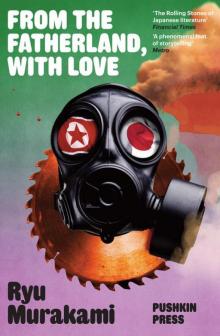
From the Fatherland, with Love, page 29


They headed as usual up Sumiyoshi Avenue toward Hakata Station, but the big black building looming out of the dark before them wasn’t immediately recognizable. The only people to be seen in the station area were the riot police. The bright lights and neon of this normally lively district had all been turned off, leaving what looked to Yokogawa like an Eastern European town he’d seen in a spy movie long ago. The shutters were down at the station entrance, and the glass door of Hakata Post Office was boarded up and secured with chains. The usual line of taxis waiting for passengers was gone. Only a white banner outside the Izutsuya department store announcing a sales campaign for Chinese products fluttered in the breeze.
Trains could usually be seen stopped at platforms on the elevated tracks, but since yesterday they had all been transferred to Shimonoseki to prevent them being hijacked by the KEF. The taxi driver had just been describing Hakata in the late Fifties and what the Tenjin district and the sumo arena were like at that time, but at the sight of the darkened station he fell silent. The sight of the closed, empty station would have weighed on anyone; it was a powerful symbol of the blockade. Economic activity in Fukuoka hadn’t completely ceased, and at the press conference yesterday the mayor had said that the city buses would begin running again this morning. Today was Monday, and most people in the areas not directly affected would no doubt be going to work. At the talks between the KEF and the mayor, it had been decided to keep the schools open. Eventually, though, the already rattled residents would begin to feel trapped in their own city, and that could only lead to serious levels of fear and anxiety.
His office was at the heart of the government district in Tenjin 1-Chome, alongside City Hall and the central police station. The newspaper occupied the top five floors of their own fourteen-story building, Nishi Nippon Shinbun Kaikan, and leased the lower nine floors to a department store. Until the day before yesterday there had been two security guards at the entrance; now there were six. They were civilian guards armed only with nightsticks and stun guns, and given the KEF’s firepower were clearly only there to provide some peace of mind. But it was low-paid employment, and with the increased demand for guards from many local businesses, security firms had suddenly found themselves short-staffed. The sound of a rotor starting up came from the helipad on the roof. It would be daylight in two hours. No doubt the helicopter would be flying throughout the day again.
Yokogawa first went to the international-news desk to learn more about the reaction abroad to the KEF occupation and the government blockade. He was surprised to find the office thick with cigarette smoke—the smoking ban had evidently been abandoned. With their nerves shot to pieces since the occupation of the Dome, even those who’d given up had probably started again. Kodama sat at the desk, slurping down some instant noodles, with his shirtsleeves rolled up above his elbows and his eyes a bright bloodshot red. When he saw Yokogawa come in, he cleared a huge pile of papers off a chair for him. Real-time reports from news agencies were constantly feeding in on his computer screen: the US government had called for restraint on the part of both the KEF and the Japanese government; the Department of Defense and the commander of the US forces stationed in Japan confirmed that public order was being maintained and that US troops would not get involved in the situation; an undersecretary of state claimed that the Japanese government had absolutely no measures in place for protecting the US consulate in Fukuoka; the Chinese government stated that they had once again obtained confirmation from North Korea that the force occupying Fukuoka was a rebel army faction; and the South Korean government feared that the blockade of Fukuoka and Kyushu would be a major obstacle for the East Asian economy. It was clear that South Korea and China were avoiding saying anything that might provoke the North. With no change in the situation, there was nothing new to report.
“Have a look at this.” Smirking, Kodama put his cup of noodles on the desk and scrolled down to an article from a British tabloid, sent in by Reuters, suggesting that the Japanese government had funded the KEF to overthrow the Kim regime but that the coup d’état had failed and they had fled to Fukuoka. “There are a few other interesting theories too.” He took a pack of Hi-Lites out of his shirt pocket and lit one up. AFP had sent an article from a Moroccan daily claiming that Kyushu aimed to gain independence from Japan and become the fifty-first state of the USA, while a Hong Kong paper wondered what the exchange rate of the Kyushu yen against the Japanese yen would be in the event that Kyushu did become independent. “Folks abroad don’t seem to have grasped what the blockade actually means,” Yokogawa commented. “Can’t say I understand it myself,” said Kodama, shaking his head, the cigarette still in his mouth. “Weren’t you a Seven Stars man?” Yokogawa asked. “They’ve sold out all of a sudden—can you believe that?” Having spent seven years in the North American office of the paper, three and a half of those years as bureau chief, Kodama had many friends in the American media. When the Japanese government had announced the blockade yesterday, he had flown into a rage and slammed his fist on the desk. Why didn’t the SDF attack? The small team of commandos that had initially occupied Fukuoka Dome may have been terrorists, but the five hundred uniformed troops were clearly an invading army.
After the press conference, Kodama had said angrily, “Who gives a damn whether they’re a rebel army or not? They have to be stopped now! They occupy the Dome, we call it a terrorist attack, they get a foothold, and there goes our national sovereignty. And instead of fighting the invaders, our government goes and imposes a blockade. Isn’t that just conceding defeat? If the SDF had attacked, there’d have been civilian casualties, sure, including a lot of patients at the Medical Center, but who knows how many we’ll end up with anyway? If another hundred and twenty thousand troops arrive from North Korea, that’ll be the end. That’s in seven days, right? Maybe it’s already too late.” The lounge was packed with reporters grabbing some shut-eye, while several others lay on sofas around the office or rested their heads on their desks, fast asleep. The final checking of the morning edition had just been completed. It must have been a tough choice for the editors to decide which articles to include in the six-page edition. Yokogawa thanked Kodama for showing him the news-agency reports, and was just leaving when Kodama stopped him. “You’re going along with the KEF on the round of arrests, aren’t you?” Yokogawa nodded. “You’d better borrow a bulletproof vest from the police.” Apparently he’d received information from Germany that someone in the Police Agency had unofficially contacted the crack GSG-9 counter-terrorism unit. “If the government’s dumb enough to send in an SAT team, there could be one hell of a shoot-out.”
Making his way to the city-news desk, Yokogawa tried to think of reasons why Japan hadn’t attacked the KEF. True, the combination of the terrorist attack and invasion by combat units made any response difficult. Thirty thousand spectators had been held hostage in Fukuoka Dome, while there were a large number of patients in the adjacent Medical Center, some of whom were too ill to be moved. The KEF had arrived barely two hours after the occupation of the Dome, when the surrounding area hadn’t yet been evacuated. Supposing the SDF had attacked them? Had there been the will to do so, they could immediately have sent in fighter jets and attack helicopters from the Kasuga base right next door. The terrorists would probably have been caught ill-prepared, although there could have been a horrendous number of civilian casualties.
Then again, it might all be down to a simple lack of experience, he thought. The only occasions in recorded history that any foreign force had tried to invade Japan were the Mongolian expeditions in the thirteenth century. The Americans in Japan at the end of World War II had been an occupying force, not an invading army. If the Mongol army had succeeded all those centuries ago, Japan’s history and culture would have taken a totally different course. There probably wouldn’t have been kabuki, or the tea ceremony, or ukiyo-e woodblock prints, or haiku poetry. What would have happened if in August 1945 Japan hadn’t surrendered unconditionally and there had been prolonged fighting on the mainland? Not only America, but the Soviet Union and China almost certainly would have invaded, and Japan would probably have been partitioned off much like Germany had been and the Korean Peninsula still was. Invasion and occupation by a foreign army was the worst thing that could possibly happen to a nation and its people, and of course it was better not to have experienced it. Without that experience, however, the country had no means of deciding whether to capitulate or attack. “I dunno,” Yokogawa muttered to himself. Should the SDF attack the invaders? He just didn’t know.
*
The city-news desk was buzzing. A major disaster never failed to bring a newspaper office to life and the phones were ringing off the hook, with some reporters speaking into several phones at once. There was the constant clatter of keyboards; news reports from CNN, BBC, and other stations were being shown on five TV monitors; and the fax machine was beeping continuously as more and more stuff came in. A tall female reporter by the name of Saeki Yoshiko was sitting with her feet up on her desk drinking a can of beer, dark rings under her eyes. She had just swigged down the last of the can when she noticed Yokogawa come in. She got up and clapped him on the shoulder. “Good luck going with that bunch today. I’m off home to shag my man and get some sleep,” she said as she walked out of the office. Yesterday Saeki had gone to a KEF checkpoint to get information, and her report had been printed as a boxed article on page two. She was probably still high on the adrenalin. The office was more chaotic than usual, with memo pads, copy materials, food wrappings, and paper coffee cups scattered about the floor, and the recycling bins piled high with cans and plastic bottles.
Nabeshima from the business-news desk and Karita, chief of the regional-news center, were also there, seated on a sofa facing Matsuoka’s desk. The regional-news center corresponded to the political-news desk in other newspapers, and mainly covered local politics, government, and elections in Kyushu. As Yokogawa approached, the three of them stood up to greet him and made space for him on the sofa. Matsuoka looked especially happy to see him, and said they’d arranged for him to meet the KEF at four-thirty. The reason Yokogawa was popular with local reporters, according to the person who toasted him at some party or other, was his freewheeling but common-sense approach, and his cool head. What that meant, Saeki had explained later, was that he was able to see through to the reality in a given incident. “Let’s say a drug-addict mother strangles her child—it’s awful, but it’s a reality. If you get all moralistic and let it upset you, there’s no way you can produce a balanced report. You’ve got to have the skin of a rhinoceros.”
Once Yokogawa was seated, the three started talking about the challenges presented by the six-page format, but after a bit they lowered their voices and drew closer until their knees were almost touching. Nabeshima looked around cautiously. “It appears they’ve got bank accounts,” he whispered to Yokogawa. “At the Fukushima Ajisai Bank and the Shin Kyushu Bank, I’m guessing, and maybe the Seiwa Bank too, but we can’t confirm it because the banks themselves refuse to discuss the matter on the record.” Yokogawa asked if the accounts were in the KEF’s name, but the other three smiled wryly and shook their heads. “No, and keep your voice down, will you?” According to information leaked to Nabeshima by one bank employee, the KEF had secretly taken over the account of an existing company. “The mediator for the account was apparently someone high up in City Hall,” said Karita, frowning. “In the end the KEF managed to get a huge amount of money together, somewhere in the order of several billion or tens of billions of yen. City Hall was feeling the pinch and the banks had one foot in the grave—they must have jumped at the chance, even if it meant they’d be branded as collaborators.”
“Yokogawa-san,” said Matsuoka, his hair tousled and lank, “I heard that the mayor wants to see you, but don’t go telling him about this bank account stuff, okay? There are factional splits in City Hall over the KEF, you know. The mayor probably has no idea these accounts exist.” Yokogawa replied that once the KEF started buying things, everyone would know about them. The other three exchanged a glance. “It’s only conjecture based on the bank leak,” explained Nabeshima, keeping his voice low, “but if the government gets wind of the KEF accounts they’ll try to freeze their assets, right? Obviously they can’t do that without the bank’s cooperation, however. And the bank can hardly go to the KEF and tell them, sorry, but your account’s been frozen on government orders. If you’ve got a gun to your head, you do as you’re told. You’ll do whatever you can to cover up for them—secret accounts, fictitious account names, whatever. And what if the government excludes the Kyushu banks from Japan’s financial market? They’ll have to freeze every single account on the island, won’t they? Of course, if it comes to that, it’s like the government announcing that all the cash and bonds held in banks here aren’t worth the paper they’re printed on. So even if Fukuoka and the rest of Kyushu don’t deliberately seek independence from Japan, we might find ourselves effectively cut off anyway.”
“Wow,” said Yokogawa. He had mixed feelings listening to the three of them. It probably was true that the KEF had bank accounts, and that top people in the banks and in City Hall had helped them along. Karita had used the word “collaborators,” and no doubt that’s what they’d be labeled for dealing with an invading army. But then, who could blame them? When the rocket destroyed the electronic scoreboard in Fukuoka Dome, it was as if the spectators had been frozen and seemed to lose the ability even to react. They did as the commandos told them. Even now, nobody knew how to respond to the KEF. Nabeshima was probably right when he said the government was leaning toward separation from Japan—but that didn’t mean they were happy about it. They probably didn’t know what they should sacrifice and what they should try to save, and therefore couldn’t make any decisions. They hadn’t issued any order to fight the KEF, but neither had they told people to cooperate with them; and all the measures they had taken, including the blockade, had been ad hoc, not part of any overall policy. Given the circumstances, what could anyone do when threatened by guns but obey?
The other three began discussing what would happen with mail and courier services between Kyushu and the rest of the world if the blockade continued. Airmail might be difficult, but surface mail would only need permission from the ministry to allow trucks through. The ban on exports of cars, machinery, electrical appliances and so forth from Hakata Port was a problem, but, as Nabeshima said, they were bound to be resumed at some point. None of the three had had any sleep that night, but they were all pumped up and eager to talk. “I ordered one of those dirty photo collections from Amazon,” Karita said, “and I’d just been notified that it’d been dispatched when that lot went and occupied the Dome. I’m a bit nervous that it might slip through somehow and get into my wife’s hands.” Matsuoka and Nabeshima laughed, puffing away on their cigarettes. Matsuoka was smoking Hi-Lites and Nabeshima Mild Larks, although both of them normally preferred Seven Stars. Kodama had said that Seven Stars had sold out—a result of supplies not getting through? Matsuoka mentioned that the clubs in Nakasu would probably still be open, and Karita, laughing, said, “That Korean pub by Haruyoshi Bridge—the one called the Pleasure Brigade—might have to think about changing its name now, though!”
Yokogawa had been instructed to go to the camp’s Checkpoint D at four-thirty that morning, so he had just enough time to drop by City Hall. His boss had called to say the mayor wanted to see him, and that he should keep the meeting a company secret. Matsuoka, Nabeshima, and Karita saw him off from the city-news desk with various bits of advice: we don’t know how long electric power will last, so take an ordinary camera instead of digital; you’d better change those leather shoes for sneakers in case you have to run for it; don’t go trying to speak your pidgin Korean to the KEF, and so on. They wanted to accompany him as far as the elevator, but he waved them away. “No need to overdo it, you know,” he told them.
To be honest, he did feel nervous about the upcoming session with the KEF. Just the thought of going back to that camp made his heart beat faster. But that didn’t merit seeing him off with so much fuss. He’d always tried to avoid overblown send-offs when going to cover conflicts overseas—the more normal the departure, the better. Farewell parties or dramatic partings from your friends and loved ones were just unhealthy. For journalists and photographers habitually reporting in war zones, the more dangerous the mission the more they tried to maintain a semblance of normality, as if they were just going for a walk in the park. Yokogawa went out through the back entrance and got into a chauffeur-driven car. City Hall was right up ahead, and in the deserted streets it stood out more than usual.
All the floors of the building were brightly lit. There hadn’t been any rest for civil servants since the KEF occupation and the blockade. Yokogawa went to the main entrance and showed his business card to the guard, telling him that he had an appointment with the mayor. The guard directed him to the Environment Bureau on the thirteenth floor, not to the mayor’s office, but when he stepped out of the elevator nobody was waiting for him. There was a row of meeting rooms down one side of the corridor, with numbers starting from 1301, but he had no idea which one to go to. They were partitioned off by frosted glass, and continued down the corridor to double doors that opened onto a large meeting room at the end. He could hear voices coming from several of the rooms, but he couldn’t just barge in to see who was there. Just as he’d decided to go back and ask the guard for the room number, he heard his name called from behind. He turned to see Mayor Tenzan, whom he’d met many times before in his role as a reporter, peeping out of one of the rooms.