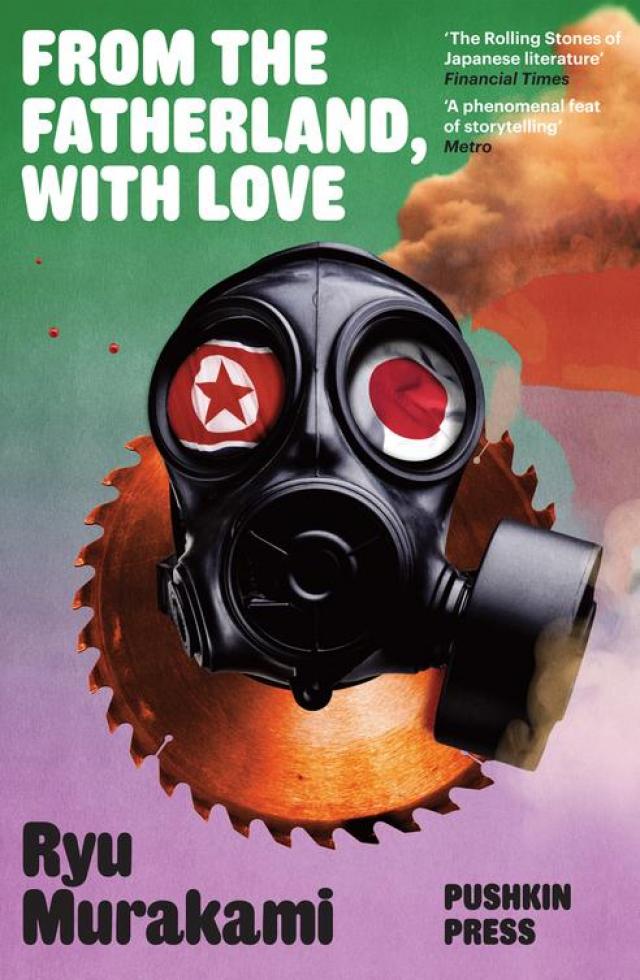
From the Fatherland, with Love, page 69


It was not an unpleasant chore. In the summer, they would also catch fish, and from the winding mountain road there were glimpses of the sea. Beyond the stream was a sweet-smelling orchard with apples, pears, and bitter oranges. But what she enjoyed most was chatting with her brothers as they walked along. Once, when she had just turned five, she asked why it was their job to fetch water, and the younger of them told her it was to ease the burden on their parents, who had to work from early morning till late at night. The older one said that when their mother was thirsty or their father wanted some tea or to wash his face and shave, he was glad he could be useful. They said there was nothing better than making their family happy. They also mentioned the Great Leader, who had constantly said that seeing the people of the Republic content filled him with a joy beyond all personal pleasure. And this too inspired them.
In the winter, when the temperature sometimes fell to twenty below zero, scooping up water meant first breaking through the frozen surface of the stream. That job belonged to Hyang Mok’s brothers, and she was told to remain on dry land. They would carefully check the thickness of the ice and then, using a sharp stone, gouge out a hole and lower their buckets, holding on to the attached cord. Their fingers would promptly turn purple and go numb. And yet despite the cold, the pain, and the effort involved, it never occurred to them to hate the job. They would sometimes slip and slide about, as if they had real skates on their feet, or eat the frozen oranges that had fallen down from the orchard onto the ice. The fruit would melt in their mouths, the blend of tartness and fragrance more delicious than any sherbet.
Just being with her older brothers was pleasure enough for her. On winter days, they wrapped their socks in plastic as insulation, and when hers broke, resulting in chilblains and chapping, they cut their own wrappings in half for her. Over the plastic they wore cotton-lined cloth shoes, which they then bound with twine. All she had to do now was close her eyes to remember the village’s crisp winter air; their ragged shoes, endlessly patched and resewn; and her brothers’ grinning faces. The eldest was doing military service on the DMZ; the younger was a first lieutenant in the Third Artillery Corps. For them the idea of hot water coming straight out of a faucet would no doubt be hard to imagine. She wondered what they would think of her being in Fukuoka.
She wet her hair a little with some of that hot water, then ran a white plastic brush through it. The brush, included among the hotel-room amenities, was clean, lightweight, and pleasant to use, and it could be folded in half and carried about. She had had some compunction about borrowing hotel property, but after being informed by a City Hall employee that the brush was disposable, she’d consulted with other female officers and finally obtained the permission of the deputy commander. She stood in front of the mirror that covered the entire bathroom wall as she brushed her hair. She had never liked her face, thinking it made her look willful or impudent. She’d grown up being told by everyone around her that she was pretty, but that never made her happy; it was as if she were being told to be seen and not heard. To be “pretty” or “cute” was in the male mind synonymous with “knowing one’s place.” Besides, she didn’t think of herself as pretty. Her eyebrows were a bit too thick, her forehead was too broad, her nose was on the flat side, and her face was as round as the moon.
Still, there was one feature that she did like: her eyes. Their contours were distinct, the corners pointing neither up nor down, and they suggested an uncompromising and independent nature. It was this that pleased her. From the time she was a child, her family and neighbors alike had said that she never whimpered or gave up. And now in this far-off place she had the self-confidence to endure whatever lay in store. She was unlikely ever to see her brothers or her village again, and the thought brought a stab of pain with it. But there was no room in her present duties for any sentimentality. Nor must she allow silly thoughts and dreams to distract her emotionally. There was a lot to do, and the work itself would help her forget about the person that was so much on her mind.
She passed the Oak Room on her way to the command center. This was the room in which, until yesterday morning, the bodies of Captain Choi Hyo Il and the other men killed in the Ohori Park shoot-out had been. It was common knowledge that there had been a difference of opinion higher up as to whether they should be interred according to Korean custom. Back in the Republic, particularly in the countryside, traditional ways in this regard had persisted, not in defiance of the Party, but simply out of adherence to an older convention.
In her own village, Hyang Mok attended many such funerals, from early childhood on. Her father, a physician, had been among those ethnic Koreans in China who had fled to the Republic during the Great Proletarian Cultural Revolution and was thus a critic of traditional practices. Her mother, on the other hand, a distant relative of the Great Leader’s mother, Kang Ban Sok, was a staunch supporter. When Hyang Mok was still small, even before she started to help with fetching the water, the chief engineer at the local coal mine died suddenly of a stomach ailment. It was a small-scale mine, with only about thirty workers, two families of which were also returnees from China. Her father’s clinic included an isolation ward for patients with contagious diseases still in the incubation stage, but he also made house calls. On his return from the miners’ barracks one day, he informed his wife of the man’s death, and she set out for the funeral with her daughter. As their house was located on a hill, they had not gone far before they could see the relatives of the dead man on the roof of the barracks, waving his clothing and wailing: “Aigo! Aigo!”
As they walked along, her mother told her about the three souls a person has. When somebody dies, she explained, one soul stays on in the memorial tablet and another in the grave, while the third goes to the next world—a place Hyang Mok was now hearing about for the first time. She asked where this “next world” was. “On the other side of this one,” her mother replied. “‘The other side’?” she asked again, and her mother pointed at a flat stone, about the size of a human head. “Tell me what you see there,” she said. “I see moss,” the girl replied. “But you can’t see what’s underneath it, can you?” her mother continued. “No one can say what’s on the bottom of the stone, whether it’s wet or has weeds growing there, whether it’s also covered with moss or with little bugs. But we know that it has another side. The next world is like that.”
The miners’ barracks, consisting of four long, high-roofed buildings made from old railroad ties, mine timber, and corrugated iron, stood on a hill overlooking the mineshaft. Inside, they were partitioned into spaces about half the size of Hyang Mok’s own living room, each inhabited by an entire family. Her mother pointed to the deceased’s house, where a blue plastic sheet had been spread in front of the sliding door. On it were three bowls of corn-and-rice meal, some shriveled pumpkins, and three pairs of plastic sandals. Hyang Mok’s mother noted that traditionally the footwear was supposed to be made of woven straw, but as the village produced neither rice nor barley, this wasn’t possible. The food and sandals were apparently intended to be used by the three envoys charged with taking the soul of the deceased to the next world. There, ten judges would examine him to determine whether, according to his conduct on earth, he should be sent to heaven or hell, a subject about which they were already well informed from spirit sources of their own.
Hyang Mok’s mother approached the entrance and stood among the other mourners. And then, to the girl’s astonishment, she suddenly covered her face and burst into tears, wailing “Aigo!” too. Family members were serving liquor and plates of fish, and many of the men were already drunk. One of them was even vomiting in a ditch out back. Hyang Mok was surprised to see that they all seemed to be in high spirits. Some had spread out a sheet of paper and sat down to gamble at cards. Others were laughing or telling jokes. Of course, neither the family nor the chief mourner was indulging in any of this. Hyang Mok would later learn that the guests’ behavior was meant to distract the survivors from their grief.
At dusk the pallbearers lit some crude handmade lanterns and bore the coffin away on a plank, as the accompanying crowd sang for the repose of the departing soul. The door-sized plank was decorated with wild flowers and red and blue streamers. The pallbearers, close male friends of the deceased, were so drunk that the coffin came close to falling off as it tilted this way and that. One of them joked: “If we drop ’im, he might come back to life!” The coffin was lowered into a grave dug halfway up a nearby hill, and then covered with branches. Soju was poured over the branches, and each member of the family tossed in some dirt. When the burial ceremony was over, the pallbearers shouldered the plank and went back to the house. There the women pretended to break the three bowls of corn-rice and to discard the three pairs of plastic sandals; then, seeing the empty plank, they burst into a new round of wailing. Such was the tradition that Hyang Mok had known.
Funeral traditions varied widely by region, but common to all was the consumption of alcohol in large quantities by the male guests. This became an issue here at the camp, in relation to the burial of the three bodies in the Oak Room. When Hyang Mok objected that providing drink for five hundred soldiers would be both too costly and undisciplined, voices were raised. “No alcohol?” a senior officer exclaimed. Even Kim Hak Su, despite all his concerns about maintaining discipline, complained that a funeral with only water or tea was not a Korean funeral. How would it be then, she asked, if each soldier were given a can of Kirin beer? The plan was approved, with her further stipulation that as the item could not be paid for out of her section’s budget, it should be deducted from each man’s food allowance. Ri Hui Cheol expressed amazement at Comrade Kim’s frugality, in a way that made everyone laugh.
Seen off by nearly five hundred soldiers, each raising a can of beer, Choi Hyo Il and the other two fallen comrades had been borne away in an MAV. They were buried on a south-facing slope in a hilly and sparsely populated section of Higashi Ward, far from any shrines, temples, or houses.
In the canteen that had been set up in the smaller ballroom, Hyang Mok made do with a simple breakfast of tea and a pine-nut cookie. Black tea, ginseng tea, cookies, and bread, as well as apples and other fruit, were always available. At lunch and dinnertime, rice, a main dish, soup, and kimchi were served. The main dish was typically reheated canned fish; in the soup was wakame seaweed, pork, or vegetables with miso. After breakfast, she made her way to her desk in the command center. Snoozing on the sofas to one side were those assigned to all-night duty. Only two of the chandeliers were lit. As there were no windows, some artificial lighting was needed even in the daytime.
Later she would have various meetings with representatives of food wholesalers, large-scale retailers of electrical goods, and wholesalers of cooking utensils, and she’d need to go over the numbers first. With the new troops about to arrive, she was wrestling with so many different problems that it made her head spin. Particularly troubling was the fact that most of the officers, including the commander and his deputy, were much more interested in political and military concerns than in money matters and tended to take lightly the sort of funding challenges that she and Ra Jae Gong, her colleague in the financial section, faced every day. At present, a soldier’s daily food allowance was slightly below three hundred yen; for officers, it was ten yen more. They had been able to stick to these amounts because of the cheap rice, warehoused and then forgotten, that had been discovered with the help of City Hall. Even if these figures remained feasible, however, the daily outlay for the main force would come to thirty-six million yen.
So far the funds seized from major felons came to over thirty billion, part of which Ra Jae Gong had put to various uses, even investing in Western hedge funds. Working with him, Hyang Mok had become something of an expert on hedge funds, investment management, and the art of moving money around. The fact remained, however, that feeding the newcomers for just three days would cost a hundred million yen. Simple arithmetic suggested that even thirty billion would, at that rate, be gone in less than three years’ time. Moreover, when the cost of clothing and medical care, along with temporary housing, electrical appliances such as rice cookers, eating utensils, and writing materials, was taken into account, it seemed likely that the seized assets would be depleted within the year. Since the end of the previous week, the number of those arrested had dropped: it was not as if there were millions of well-heeled undesirables waiting to be fleeced. In addition, with the American and Chinese consulates likely to be reopened, the ongoing confiscation of funds would become more problematic. And even Ra Jae Kong’s wizardry had its limits.
The commander and his entourage were apparently of the opinion that the new arrivals should be put to work locally. Yet all members of the Eighth Corps were trained combat soldiers and had probably never so much as tilled a field back home. What’s more, interaction with the local business sector made it clear that there was already a surplus of workers in Fukuoka. Han’s group had also decided to disarm most of the newcomers, despite concerns about the willingness of the military hardliners to go along with the idea. Disarmament was likely to be a condition set by the Americans, the southern Koreans, and the Chinese for the reopening of their consulates. One proposal for raising money was to sell the decommissioned weapons; another was to impose a tax on citizens to pay for the KEF’s efforts to maintain order and security. These were rejected, however, because of the prospect of fierce opposition to such measures.
After consulting Ra, Hyang Mok felt that the best that could be done was to arrange for the troops to receive Japanese-language lessons and occupational training, in order to be farmed out as cheap labor. Training would take between three and six months. In the meantime, it was essential to shave every yen possible off the price of items to be bought in such vast quantities—even T-shirts and socks.
*
By 7:00 a.m. there were more people present at headquarters, and all the chandeliers were lit. The large television screen in a corner of the ballroom was showing state-of-the-art warships and fighter planes in readiness for action, but nobody was paying much attention. No one believed that the SDF would engage in combat with the ships. Earlier that morning, the Cabinet Secretary had declared that the government was still calling for cooperation from the US and its forces stationed here, and urging the UN Security Council to denounce these acts of aggression. A TV announcer went on to say that there had been no signs of sabotage at any of the country’s liquefied-natural-gas facilities. Under pressure from the media and various interest groups, including the opposition parties, an initially reluctant government had stepped up surveillance and banned the public from an area of five kilometers around all storage sites. But with twenty-nine such installations and more than a thousand kilometers of pipeline, it would be impossible to protect the entire LNG infrastructure. The implausible idea that any attempt to stop the incoming ships would result in terrorist attacks on LNG tanks was treated as fact by the media and fully exploited by the KEF. Han Seung Jin made the following declaration at a press conference.
“We are regular troops, neither guerrillas nor terrorists. We are very much opposed to terrorism. The fact of the matter is, however, that unless you surround the soft targets, which your gas tanks and pipelines are, with impenetrable concrete barriers, you will not be able to ward off attacks. All it would take would be a long-range anti-tank rocket fired from outside the perimeter. Hitting one of those large sites would be easy. A trained soldier would hardly be needed: with a few minutes of instruction, even a child could do it.”
Why had the Japanese media jumped to the conclusion that these would be prime targets? Lieutenant Pak Myeong of the operations section had his own explanation: most people here were looking for a justification for the blockade and an excuse for not attacking the KEF, and the threat of sabotage suited this purpose perfectly. It reflected the weakness of individuals and groups seeking a way out in the face of a crisis. As any excuse would do, they were sure to find one. Pak added that while it was easy enough for those standing outside Japanese society to recognize this attitude, there was little awareness of it on the part of those on the inside.
As she was going over the list of companies with which arrangements had already been made regarding provisions for the arriving troops, Hyang Mok was summoned to the reception area by the deputy commander, Ri Hui Cheol. She left the hall and made her way to the Katsura Room, which served as reception. Ri and Major Kim Hak Su were there, going over the security plan for the main force’s temporary barracks. They asked her how many truck deliveries of clothing and fresh and processed food would be made daily, and she replied that the tentative figure was around forty. She had saluted and started to leave the room, when Kim called her back. Sitting on the sofa, he slowly turned his broad shoulders and looked at her. “Are your plans for securing food provisions going well?” he asked with a smile. “If there’s any problem, you can always come to me.” This was an officer feared by all, but for some reason he was always exceptionally nice to her.