From the Fatherland, with Love, page 40


This hollow reservoir of stagnant sperm descended the staircase hand in hand with the expressionless Miyazaki. When they reached the bottom, they lined up facing the assembly alongside Sato, Shibata, Orihara, and Kondo. It was a tad creepy that they were holding hands, but worse was the fact that they were singing along with the recorded choir. “What was this song again?” Tateno asked, if only to distract himself from the hand-holding, and Takeguchi, juggling three cookie bombs as he joined in, said, “‘Ah, Lovely Meadows.’” Yamada commented that it was originally a Czech folk song and the first tune ever sung on NHK’s Everyone’s Songs. Tateno asked him how come he knew something like that, and he explained that he’d watched a lot of reruns of old NHK shows from the Fifties and Sixties late at night with his dad. His father, who had aspired to and extolled poverty, only allowed the TV to be turned on late at night because he believed electricity was cheaper then.
“Here we go! Miyazaki is carrying the Vz 61, also known as the Scorpion, a sub-machine gun developed in the former Czechoslovakia. It fires 7.65-millimeter rounds at a rate of nine hundred and fifty per minute. Thank you! And over here, the gun Ando is holding is a high-powered military pistol from the Belgian firm Fabrique Nationale. I don’t know any Belgian songs, and it’s no good playing two tunes at once anyway, so I chose, as some of you seem to have recognized, a Bohemian folk song. As for the uniforms, neither the Czech Republic nor Belgium has any special forces worth mentioning, so I went for those of the Gendarmerie Einsatz Kommando of nearby Austria, known commonly as the Cobra Unit. Dankeschön!” Somebody asked Miyazaki and Ando if they were going to hold hands for ever, and they looked at each other and let go. Ando’s cheeks turned bright red, but Miyazaki remained unreadable.
“Our final number will be Toyohara, but we need to set things up for him, so we’ll take about a three-minute break. Thank you!” Takei ran up the stairs to the third floor. Ishihara had drained his beer and told someone to fetch him another, then sat down in his rocking chair and looked at the muted TV. On the screen, officials from the Fukuoka Department of Waterworks were surveying the grounds of the abandoned danchi, while members of the Koryo engineering corps went over diagrams with representatives of gas and electric companies. Two MAVs loomed behind the Koryos, and some company vehicles were parked on either side of the road that cut through the danchi, where workers had already begun digging. A big red subtitle flashed on the screen as the picture switched back to the studio: SOME 120,000 NORTH KOREAN REBEL TROOPS ARE MASSED AT FOUR PORTS ON THE EAST COAST OF NORTH KOREA, PREPARING TO SAIL TO FUKUOKA. Matsuyama, sitting in front of the TV, muttered, “I wonder if they’ll really come.” Ishihara turned up the volume.
“Why doesn’t the Generalissimo arrest ’em all?” Fukuda asked, and Ishihara snapped at him to shut up and watch. The NHK announcer was standing beside a three-dimensional diorama-style map. He spoke gravely. “Let me summarize the responses of the Japanese and North Korean governments so far to this new development. The government of North Korea, through their official newspaper and a national television broadcast, as well as their embassy in Beijing, have issued the following statement: ‘One hundred and twenty thousand troops are seeking political asylum overseas. Any attempt on our part to attack or arrest them would likely result in the so-called Koryo Expeditionary Force retaliating with strikes inside the nation of Japan. We have therefore determined that it is in the best interests of all concerned to refrain from any rash action.’ Our own government, meanwhile, has been unwilling to take a stand on whether the North Koreans should or shouldn’t attempt to stop and detain the rebels, who could be here within fifty hours of leaving port.” The announcer now introduced an authority on the geopolitics of the Korean Peninsula, standing behind the diorama. The expert, whose thin hair was plastered over his pate, used a long pointer to indicate ports on the eastern side of the peninsula as he spoke.
“It appears that the majority of the rebel troops are from the Eighth Corps, which is led by a few hardline anti-American generals. We have reports that the Fourth Corps is involved as well, but in any case there seems no doubt that an intense anti-Americanism is predominant among the rebels, making them an obstacle to the official policy of improving relations with the US. The Eighth Corps is officially called the Special Eighth, so these are probably what we call special-ops forces. So far North Korea has refrained from clarifying whether they have been disarmed, and we can’t tell from the satellite photos. But, personally, I believe they are indeed still armed.”
“What are you, a moron?” Ishihara said to the man on TV. “Why don’t you suck cold noodles through your nose?” It did seem unlikely that invaders would go to the trouble of discarding their weapons before invading. The dominant opinion among the media was that North Korea would probably do nothing to stop the ships from sailing. Kim Jong Il didn’t want to attack or jail the rebels; he just wanted them out of his country. The Japanese Maritime Self-Defense Force had deployed some fifty vessels in Japanese waters, while all the Air SDF bases on the west coast were on alert to scramble fighter jets. The SDF hadn’t said they’d attack if the North Korean ships entered Japanese waters, but they hadn’t ruled it out either. To say they would take action would amount to a declaration of war against the KEF. And Jo Su Ryeon, on the NHK Fukuoka propaganda program, had made it clear that retaliatory measures would be taken if the reinforcements were attacked.
The hundred and twenty thousand troops were apparently to board some four hundred transport and naval vessels, large and small. For the past three days, security had been beefed up at the Prime Minister’s official residence, the Diet, the Cabinet Office, and the Imperial Palace, as well as airports and major train stations, to prevent any KEF attacks. What NHK wouldn’t say is that if the troops were to take over the government offices of a few small cities or occupy some of the outlying islands, there would be nothing the central government could do about it. The day before, an article in one of the weeklies had stated that there was a movement within the government to restrict the Koryos to Fukuoka, or at least the island of Kyushu, so as to prevent the damage spreading to the mainland. A certain politician was quoted as saying that, after all, what the rebel troops wanted was Fukuoka, not the entire country.
“In any case we must closely watch the movements of these additional troops.” With this duh!-inducing comment the expert wrapped things up, never expanding on the vital question of whether Fukuoka would have to be sacrificed. Mori thought it was a sure bet that the government would turn its back on Fukuoka. When you’re preparing to turn your back on someone, you don’t go around advertising it.
“All right! Ready? Is everyone ready? Thank you. And now, last but not least…” Takei spread his arms wide, the pitch of his voice rising as he tried to manufacture excitement for his finale. “Toyohara, come on down!” Shinohara hit the MD player, and the familiar theme song of a well-known movie began to play. Mori had seen it but couldn’t remember the title until he heard Felix say “Indiana Jones.” There was a clank, and then another clank, as Toyohara began descending the iron staircase from the third floor. A murmur swept through the Living. Even Ando and the five Satanists let out a collective “Whoa,” and Ishihara turned his gaze from the TV back to the show, then stood up from his rocking chair, his jaw dropping. Clank… clank. Toyohara paused after each step.
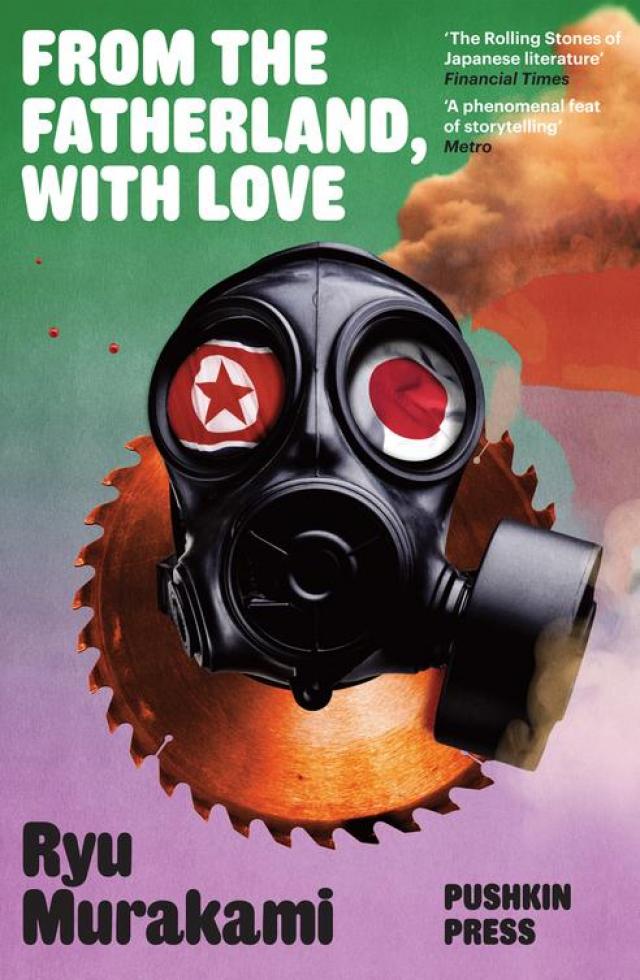
The calf-high lace-up boots were much too big for him, and because his legs were so short they came to just below his kneecaps. They must have had steel soles, too, judging by the metallic sound echoing through the Living. The hem of the black uniform jacket reached the tops of the boots, and over the jacket he wore a camo-patterned cape. His helmet, green and too small for his shaved head, looked like a turtle drying its shell on a sandbar. Much of his face was hidden by a gas mask, the type with a rubber nozzle protruding from the mouth to filter poison gas, but the mask was too small as well, and the rubber dug into the flesh of his cheeks and chin. Strange-looking optical instruments hung from straps around his neck, and beneath the jacket he wore a triangular bulletproof vest, to which was attached a rappelling harness covered with attachments of various sizes that clattered as he walked. He had a gun in each hand and a pistol in a belt holster.
Toyohara’s oversized boots and limited visibility left him no choice but to ease down one step at a time. His silhouette was nearly circular. He didn’t look like a soldier; in fact, he didn’t look like anything human—more like a robot out of Star Wars or Star Trek. But everyone knew that Toyohara was a serious and sensitive lad in his own way, and he’d only made it down six steps so far, so no one laughed. As he got nearer the bottom you could hear his breathing, even over the Indiana Jones theme.
Mori himself was such a wheezer that he’d been given the nickname Steamwhistle at school, but even at its worst his breathing was nothing like this. After his older brother killed their parents, Mori had been put in a welfare facility near his father’s family home. Early in his stay there he’d gone on a field trip to a cattle farm, where he was unfortunate enough to hear the bellowing of cows being slaughtered—killed by blows to the skull with a long spike attached to the end of an iron bar. It had been an unearthly sound that made Mori squat down on the floor with his hands over his ears, wailing and feeling that his very life was being squeezed out of him. The sound Toyohara was making reminded him of those cows. Ishihara had lost his usual aplomb the moment Toyohara came into view, and had turned toward the door, as if preparing to flee the room. Others were watching Toyohara slack-jawed, instinctively backing up as he descended.
Up to this point, Kaneshiro had stared hard at each of the uniforms and guns being modeled, but when Toyohara appeared he frowned as if in pain and turned away. Takeguchi and Fukuda began putting the cookie bombs back in their special case. Yamada spilled Java tea from his paper cup and stained his beige made-in-Honduras jacket but didn’t even notice. Matsuyama and Felix didn’t stand up and applaud as they had for the others but sat with bowed heads, hugging their knees. The five uniformed Satanists stood stock-still, and Ando, his pretty mouth still open, tried to hide behind Miyazaki.
“Whoa! Toyohara! Talk about intense!” Takei alone was in high spirits, seemingly oblivious to the weirdness. Mori remembered those war photographers he’d read about, who even in the midst of heavy shelling were too busy peering through their viewfinders to feel much fear. Toyohara’s breathing grated not only on the ears but on the chest and brain. His boots hit the floor at the bottom of the stairs with a bludgeon-like whomp, whomp, and the eeriness was only magnified by his proximity: the harness and bulletproof vest made an unpleasant noise as they rubbed together, the camo cape fluttered in a draft from the open window, and the pleated filtration nozzle swung slowly back and forth. The nozzle was a strangely in-between length—too short to resemble an elephant’s trunk and too long to be a pig’s snout.
It was impossible to make out Toyohara’s expression behind the gas mask. He stopped, raised both guns above his head, and tried to let out a rebel yell. The mask had a grip on his lips, however, and all he was able to produce was a high-pitched, screechy exhalation. Stumbling in boots twice the size of his feet, he lined up next to Ando and the five Satanists. The rubber of the mask was stretched to the breaking point to accommodate his soccer-ball-size head, and the goggle lenses were pulled so far apart that it looked as if his eyes were on either side of his head.
“All right, Toyohara, thank you!” Takei, still in the same high spirits, gave a flourish with his right hand and began introducing the equipment. Mori was starting to feel ill. “Look at this here. See it? It’s the Israeli Uzi, the sub-machine gun of all sub-machine guns. It fires six hundred nine-millimeter rounds a minute, gentlemen. Thank you so much. And how about this? This is the pride of Israel Military Industries, the Galil sniper rifle. IMI’s Galil attack rifle uses 5.56-by-45-millimeter NATO rounds, but this one fires the 7.62-by-51, which gives it a longer range. Thank you. Hanging from his neck is an Israeli night-vision scope with the latest in infrared thermography, capable of detecting targets even through concrete. You’re all with me, right? Now allow me to draw your attention to the uniform our friend Toyohara is modeling so nicely. It comes straight from the Yamas undercover counter-terrorism unit of the Israeli Border Police, and it’s not a replica but the real thing. The Yamas wear this during operations on the borders with Palestine and Lebanon and so on. Thank you.” Takei gave another flourish with his right arm and wriggled like the emcee of a quiz show when a contestant has just won a small fortune or a Hawaiian vacation. “I’m sure you all recognize the music. I don’t know any Israeli folk songs, so I chose a tune from a film by the Jewish director Spielberg-san. Thank you. Oh, and this pistol isn’t from Israel but the USA—it’s the Colt .45 Government, a monster that fires 11.43-millimeter rounds. I chose it for the ensemble because America and Israel are as close as Siamese twins. Thank you all so very much. That completes our show for this evening.”
Takei was expecting another round of applause, but the final model’s appearance had cast a pall over everything. Toyohara couldn’t speak because of the gas mask, and Mori could hardly bear to watch anymore. It was like watching a friend be publicly humiliated, or an elderly aunt perform a striptease. But he also saw himself in Toyohara. The others probably felt the same way. Though scarcely able to breathe after clomping down one step at a time, Toyohara had held the guns aloft and tried to yell. The more earnestly he tried to fulfill his duties, however, the creepier and more comical he looked. But Mori was aware that he himself had been creeping people out since childhood.
The show had ended, but no one clapped. Everybody was hunched over, staring at the floor. The enthusiasm of only moments before was gone. The participants put their various rifles on the floor and detached the handguns and holsters from their belts, laying them in a row on the table. Kondo took off his snow camo and started wiping the sweat off his face and chest. Fukuda and Takeguchi, their faces twitching, quickly locked the cookie explosives in their duralumin case. An unusually stern and disgruntled-looking Ishihara told Tateno and Shinohara to take off Toyohara’s mask and uniform for him. “Right here?” Tateno hesitated, foreseeing the result. “No.” Ishihara gestured toward the corner kitchen. “Over there.” The kitchen was separated from the Living by an accordion curtain. No one wanted to see Toyohara’s sweaty, rubber-smelling face as the mask was peeled off.
“What’s wrong?” Takei said, smiling and all but oblivious to the general mood. Ishihara was gazing at the rifles on the floor, and now bent down to pick up an AK. “What do you think, Ishiharasan? You like that one? If so, it’s yours to use.” Takei ran his fingers through his brown-dyed hair as he spoke, his pale face vacant and wraithlike. You could tell by his tone that he expected him to be delighted. “This is the only one, right?” Ishihara said, tapping the barrel of the gun on the floor. Takei, misunderstanding the question, said, “Oh, no. This is the AKM, but there’s also an AK-74, and other assault rifles—we’ve got the M16 and a FAMAS, like I said.” Ishihara tilted his head to one side and then the other and said, “What I and I mean is, you only have one each of all these rifles?” Takei greeted this with a puzzled look and glanced around the room for support. He couldn’t see what he was getting at, and neither could Mori. Just then, Toyohara walked back into the room supported on either side by Tateno and Shinohara. He was wearing only boxer shorts and a T-shirt, and steam was rising from his entire body. The smell of sweat-soaked rubber wafted around him, and he was still breathing heavily, looking at everyone with a mixture of anticipation and uncertainty, anxious to know if he’d done okay. Ishihara reached out to pat him reassuringly on the shoulder, but pulled back when he saw the imprints of the gas mask on his head and face. The goggles had left off-center circular marks around his eyes, and you could see where the taut rubber had dug into his forehead and chin. Most disturbing of all was the round red groove on his shaved, snow-white pate, engraved there by the band of the too-small helmet. His skull bulged out above and below this depression, giving his head the appearance of an unshelled peanut.
Ishihara stood over the handguns on the table and said, “And you have only one of each of these pistols, right?” Takei pushed out his lips sulkily, as if being unjustly accused, and told him, “I think this is an adequate number of weapons. What with the handguns, the assault rifles, the sniper rifles, the sub-machine guns, and the grenade launcher, we’ve got seventeen pieces here, not to mention the hand grenades and our explosives team. Since there’s only twenty of us, and since we don’t have access to a firing range for practice anyway, this is more than enough, don’t you think?” Some of them were nodding in agreement. Takei’s tone had grown rather testy, and Ishihara was still looking disgruntled, so that everyone there began feeling the tension. “And how much ammunition do you have?” Ishihara demanded. “About a hundred rounds per handgun,” Takei said, “two hundred per assault rifle, a hundred per sniper rifle, three hundred per sub-machine gun, and fifty rounds for the grenade launcher—that’s plenty of ammunition for a battle of this scale.”
“I and I say Ay ay ay! This isn’t weaponry for any battle. More like a geek hobby collection.” The color drained from Takei’s face. “Hobby” was one of the words they all loathed. It made Mori think of old men and women playing croquet. He’d never had anything like a hobby, and neither had the others. People who needed only to be working at their hobby to be happy didn’t butcher a classmate or set random fires or cut down a train conductor with a samurai sword or blow up a massage parlor or make up stories about being abducted by the Devil. Shinohara raised creepy insects, but to him it was a job and a calling, not a hobby. A hobby requires time, money, and psychological stability, and these were things that no one here possessed. The insinuation that Takei was a mere hobby geek hit him like a body blow. “Not weaponry for any battle?” he said, his cheeks flushing red now. “What do you mean? These are all authentic weapons from around the world! Do you know what I had to go through to slip these past the authorities?”