Earth Strike: Star Carrier: Book One sc-1, page 4
part #1 of Star Carrier Series
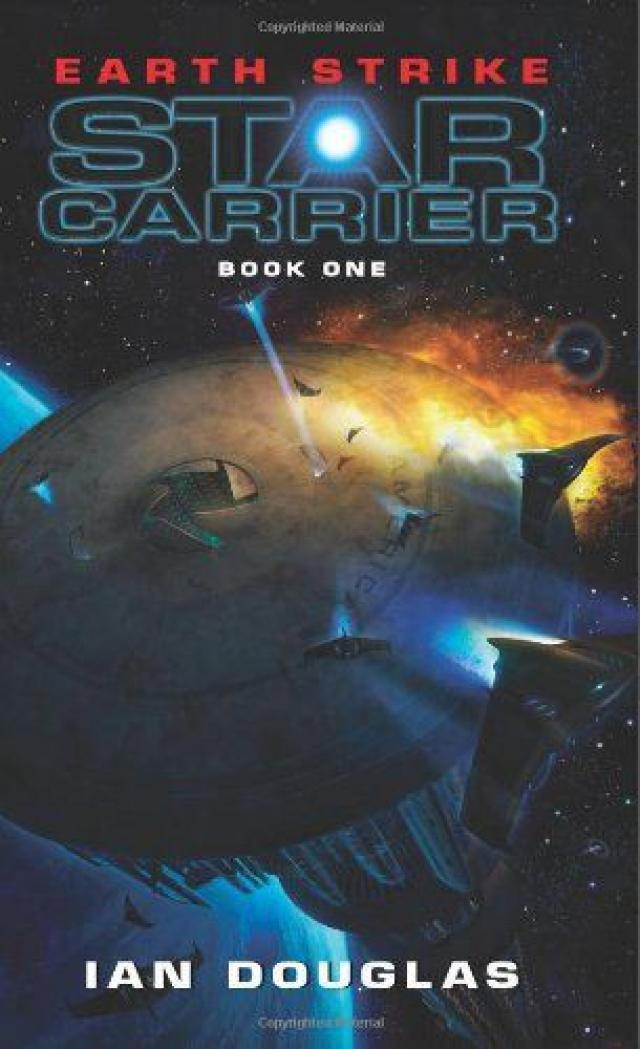


The other Starhawks were all there, still in the circle formation they’d adopted out in the system’s Kuiper Belt. The circle was opening now as the fighters applied lateral thrust and spread themselves apart. Other pilots were calling Fox One now, the code-phrase that meant they were firing smart missiles. More missiles flashed into the gulf ahead, tracking and dogging enemy warships, each accelerating at close to one thousand gravities.
His missile and two others were closing with the big green-and-black enemy warship-a Tango-class destroyer, under the standard Confederation nomenclature for enemy ships. The enemy was dumping sand-blasting clouds of tiny, refractive particles into space both to defeat laser targeting systems and to serve as a physical barrier against incoming kinetic-kill or high-velocity warheads.
One missile hit the expanding sand cloud and exploded, a ten-kiloton blast that pulsed in the darkness, but the other two missiles plunged through the hole vaporized in the Turusch ship’s defensive barrier, striking its magnetic shielding and detonating like a close pair of bright, savage novae.
Enemy shield technology was a bit better than the Confederation could manage yet. Neither nuke penetrated the envelope of twisted spacetime sheathing the destroyer, but enough of the double blast leaked through to crumple a portion of the warship’s aft hull. Atmosphere spilled into space as the ship slewed to one side, staggered by the hit.
Gray was already tracking another Turusch warship, however, a more distant one, a Juliet-class cruiser accelerating hard toward the planet.
“Omega Seven!” he called. “Target lock! Fox One…and Fox One!” Two Kraits streaked into darkness.
“Incoming, everyone,” Allyn warned. “Jink and pull gee!”
The half of the sky in the direction of planet and sun was filled now with red blips, the icons marking incoming enemy missiles. Turusch anti-ship missile technology was better than human systems, and their warshots packed bigger warheads.
This, Gray thought, is where things get interesting.
Chapter Three
25 September 2404
VFA-44 Dragonfires
Eta Boötis System
1251 hours, TFT
Throughout his gravfighter training back at SupraQuito, they’d hammered away at one essential lesson of space-fighter tactics: always, when an incoming warhead reached your position, be someplace else.
Gray had been in combat twice before, at Arcturus Station against the Turusch and at Everdawn against the Chinese, and knew the truth of that statement. There was no effective way to jam incoming warheads. The missiles used by both sides were piloted by brilliant if somewhat narrow-minded AIs, using a variety of sensor systems to track and home on an enemy target. No one set of standard countermeasures could blind all of an enemy’s sensors-heat, radar, mass, gravitometric, X-ray, neutrino, optical.
Nor was it possible to outrun them. Turusch anti-fighter missiles could accelerate faster than a Starhawk, at least for short bursts. They operated on the tactical assumption that if they couldn’t kill you outright, they could chase you out of town, forcing you into a straight-run boost out of battlespace to where you no longer posed a threat.
So when enemy missiles were hunting you down, the ancient aphorism about a best defense was decidedly true. You dodged, you weaved, you accelerated…but you also struck back.
A swarm of missiles approached from ahead, brilliant red pinpoints projected by the Starhawk’s display system against the stars. Gray’s AI picked out no fewer than six enemy missiles that, judging by their vectors, were homing in on him.
“Here comes the reception committee,” Allyn announced. “Independent maneuvering.”
“Copy that, Blue Omega Leader.”
He accelerated toward the oncoming missiles, hard, then threw his Starhawk into a low-port turn, as tight as he could manage at this velocity.
Vector changes in space-fighter combat were a lot trickier than for an atmospheric fighter; they were possible at all only because gravitic propulsive systems allowed the fighter to project a deep singularity above, below, or to one side or the other relative to the craft’s current attitude. Intense, projected gravity wells whipped the fighter around onto a new vector, bleeding off velocity to throw an extra burst of power to the inertial dampers that, theoretically at least, kept the pilot from being squashed by centripetal acceleration.
Enough gravities seeped through the straining damper field to press Gray back against the yielding nanofoam of his seat; stars blurred past his head.
“Six missiles still locked on and tracking,” the AI voice of his Starhawk told him with emotionless persistence. “Time to detonation nine seconds…eight…seven…”
At “three” Gray grav-jinked left, firing passive sand canisters. The enemy missiles were now a few thousand kilometers off his starboard side, using their own gravitics to attempt to match his turn. He kept pushing, kept turning into the oncoming warheads.
Blinding light blossomed from astern and to starboard…then again…and yet again as three missiles struck sand clouds and detonated. Three down, three to go. He punched up the Starhawk’s acceleration to 3,000 gravities, turning again to race toward the planet.
As always happened for Gray in combat, a rushing sense of speed, of acceleration washed through him, matching, it seemed the acceleration of his fighter.
He might not be able to outrun Trash missiles in a flat-out race, but in most combat situations, outrunning them wasn’t necessary. Most missiles held their acceleration down to a tiny fraction of their full capability. If they didn’t, they wouldn’t be able to match a low-G turn by their target, and they would wildly overshoot. So the remaining missiles on Gray’s tail were putting on just enough speed to slowly catch up with him.
“Two new missiles now locked on and tracking. Terminal intercept in twenty-four seconds.”
And that was the other half of the equation. Standard Turusch tactics were to fire whole swarms of missiles, sending them at him from all directions, until no maneuver he made could possibly jink past them all.
“Three missiles of original salvo still closing. Terminal intercept in eight seconds.”
Gray moved his hand through the control field and the Starhawk flipped end-for-end, bringing his particle accelerator to bear. The three closest missiles appeared as a triangle of red blips, the alphanumerics next to each flickering as range and time-to-impact swiftly dwindled.
His eyes held one, and a red square appeared around the blip at the triangle’s apex, signifying target lock. He moved his hand and a stream of neutrons turned the missile into an expanding cloud of plasma. He shifted his attention to a second blip, and watched it explode as well.
The third had vanished.
“Ship!” he said. “Confirm destruction of all three missiles!”
“Two anti-fighter missiles confirmed destroyed,” the AI’s voice said. “Negative confirmation on third missile. Two missiles of second salvo still locked on and closing. Terminal intercept in sixteen seconds. Third salvo fired, locked on and tracking. Terminal intercept in thirty-seven seconds….”
That was the way it worked in modern space-fighter combat…with more missiles fired, and more, and more. Worse, from his mission’s perspective, the more time he spent trying to dodge incoming missiles, the less able he would be to carry out his primary objective, which was to close with Turusch capital ships and destroy them.
He pulled the Starhawk around until it was again traveling straight for the planet ahead.
“This is Blue Omega Seven,” he called. “Request clearance for PCO launch on this vector.”
“Omagea Seven, Omega One,” Allyn’s voice came back. “You are clear for AMSO.”
“Firing PCO in three…two…one…Fox Two!”
In space-fighter combat, Fox One signaled the launch of any of a variety of all-aspect homing missiles, including the Krait. Fox Two, on the other hand, signaled a sandcaster launch-Anti-Missile Shield Ordnance, or AMSO. An AS-78 missile streaked from beneath his cockpit, accelerating at two thousand gravities. After five seconds, it was traveling one hundred kilometers per second faster than Gray’s Starhawk and, when it detonated, the individual grains of sand-actually sand-grain-sized spherules of matter-compressed lead-were released in an expanding cloud of grains, each traveling with the same velocity and in the same general direction. Sandcaster missiles were dumb weapons as opposed to smart; protocol required requesting clearance for launch, because a grain of sand striking a friendly fighter at several thousand kilometers per second could ruin the day for two pilots, him and his unintended target.
Over the tacnet, he could hear other Omega pilots calling Fox Two as they slammed sand at the oncoming missiles.
In a few more seconds, the sand cloud had dispersed to the point where it created a physical shield several kilometers across. His initial velocity after his turn-and-burn with the enemy ship-killers had been just over twelve thousand kilometers per second; he increased his speed now by an extra hundred kps, slipping up close and tucking in behind his sand wall and drifting at the same speed.
White light blossomed ahead and to starboard, dazzling even through the stepped-down optical filters of his fighter’s sensors.
A second nuclear blast, ahead and below…this one close enough that the shell of expanding plasma jolted his ship and sent hard radiation sleeting across the Starhawk’s electromagnetic shielding.
Gray decelerated, braking hard. Eta Boötis IV was rapidly swelling to an immense crescent just ahead, as thousands of brilliant stars flickered and flashed against the planet’s dark night side-sand grains striking atmosphere at high velocity and vaporizing in an instant. By now, the defensive cloud had either dispersed to ineffectiveness or been swept aside or vaporized by repeated nuclear detonations. But he’d run the gauntlet in close to the planet, and now he was within combat range of the majority of the Turusch fleet.
The near presence of the planet complicated things, but more for the defenders than for the Blue Omega Strike Force. The planet’s bulk now blocked the line of sight to a number of the Turusch warships in low orbit, provided the gravitational mass for free course changes, and in this world’s case even added an atmosphere that could be used either as a defensive screen or for simple delta-V.
The other fighters of Blue Omega were scattered across the sky now, each operating independently of the others. Gray could hear the cockpit chatter, but had to focus on his immediate situation. His wingman…where the hell was his wing?
There she was-Blue Omega Eight, two thousand kilometers aft and to starboard. Katie Tucker was engaging a big Turusch Echo Sierra-an electronic scanner vessel. That, at least, was what Intelligence thought those monsters might be, with their far-flung antennae and hundred-meter sensor dishes.
Confederation tactical doctrine suggested that pilots work together in wings for mutual protection, but standing orders didn’t require it. One Starhawk could kill a Turusch capital ship as easily as two, and a single one of those thermonukes they were tossing around could take out a pair of gravfighters if they were too close together.
“This is Blue Seven,” he reported. “I’m going to try to get in close to the objective.”
Objective meaning the Marine perimeter in Haris, Eta Boötis IV. It took him a moment to orient himself as his AI threw up the curving lines of longitude and latitude on the image of the planet. Haris was tipped at an extreme angle, with an axial tilt of nearly 90 degrees. At this point in its year, Eta Boötis was 30 degrees off the planet’s south pole, the Marine perimeter at 22 north.
There it was…a green triangle marking the Islamic base and the Marine expeditionary force sent to protect it, just now rotating into the local dawn. Turusch ships swarmed above and around it, or poured fire down from orbit. It was what carrier pilots liked to call “a target-rich environment.”
Gray loosed another half dozen missiles, then spotted a special target. Three thousand kilometers ahead, a Turusch fighter transport lumbered just above the planet’s cloud-choked atmosphere, fighters beginning to spill from her bays.
“Blue Omega Leader, Blue Seven,” he called, bringing the nose of his Starhawk around and accelerating. “I have a Fox Tango dropping Toads. Engaging….”
“I copy, Blue Seven. Blue Five! Blue Four! Get in there and give Blue Seven some backup!”
“Ah, copy, Blue Leader. On our way….”
The Turusch heavy fighters code-named “Toads” by Confed Military Intelligence were big, ugly brutes thirty meters in length and half that thick. Less maneuverable than their Confederation counterparts, they could accelerate faster, and individually, could take a hell of a lot more punishment in combat. As Gray swung onto an attack vector with the transport, the Toads already released had begun boosting into intercept courses.
“Fox One!” Gray shouted over the net as he released a Krait. “And Fox One…Fox One…Fox One!”
The red-and-black Toad transport was a prime target, easily worth the expenditure of four nuke-tipped Kraits. Confederation fighter pilots steadfastly refused to refer to Fox Tango transports as “carriers.” They insisted that the code name Fox Tango, in fact, was short for “Fat Target” rather than the more prosaic “Fighter Transport.”
Missiles released, Gray snapped out an artificial singularity to port and rolled left, breaking off the run. The enormous transport was throwing up a cloud of defensive fire-sand, gatling KKs, particle beams, and point-defense HELs.
The Toads already released by the transport were falling into echelon formation as they accelerated toward Gray’s fighter. There were five of them, and they were already so close they were beginning to loose missiles at him.
He plunged for atmosphere.
By now he’d bled off most of his velocity, and was dropping toward the planet’s night side at a relatively sedate eight hundred kilometers per second. Using full reverse thrust, he slowed still further as his Starhawk’s crescent shape flattened and elongated somewhat for atmospheric entry, growing aft stabilizers and a refractory keel. He was moving at nearly thirty kilometers per second, eight kps faster than the planet’s escape velocity.
He felt the shudder as his craft sliced through thin atmosphere, and used the aft singularity to slow him further still.
“Alert.” The ship’s computer voice somehow managed to convey the illusion of sharp emotion. “Shielded anti-ship missile closing from one-eight-zero, azimuth plus zero five! Impact in six…five…”
The lost missile, coming in from dead astern. There was no time for maneuvering, and no way to outrun the thing with the bulk of Eta Boötis dead ahead. Gray flipped the fighter end-for-end, searching for the telltale red star of the incoming warhead.
There! Twenty kilometers! Lock…and fire…
The warhead detonated in the same instant that he gave the fire command.
Seconds passed before Gray blinked back to full awareness. Motion-streaked stars alternated with blackness spinning past his field of view. “AI!” he cried out. “Situation!”
There was no immediate response. Possibly, events had momentarily overloaded it. He didn’t need a ship AI to tell him the situation was bad. He was in a tumble, power and drives were out, and he was falling through thin air toward Eta Boötis’s night side at an unknown but fairly high velocity.
Very soon, the Eta Boötean atmosphere would be getting thick enough that the friction would incinerate him.
He was still getting sensor feeds, but life support and other ship’s systems were out. IC was down, com was down, attitude control was down.
The SG-92 Starhawk had a robust and highly intelligent SRS, or self-repair system. Advanced nanotech modules allowed broken or burnt-out systems to literally regrow themselves, dissolving into the ship’s hull matrix, then reassembling. When he checked the details on the dead life-support system, it told him it was 75 percent repaired, and that number jumped to 80 as he watched it. Power and control systems, too, were moments from being back on-line.
He directed the system to give priority to power and flight control; there was enough air in his personal life support to last for quite a while, and the temperature inside the cockpit was not uncomfortable yet.
The operative word being yet. The external temperature was at five hundred Celsius, and rising quickly.
“Blue Omega Flight, this is Blue Seven,” he called, not with any real hope of establishing contact. Communications, according to his IHD, were also down, though there was always the possibility that it was his display or even the ship’s AI that was faulty rather than his lasercom. There was a set list of things to try in the event of catastrophic multiple-system failure, and attempting to reach the other members of the flight was high among the priorities.
As he expected, however, there was no response. He directed the repair systems to lower the priority of the com network in order to focus more of the available power to power and control.
Abruptly, the dizzying alternation of star streaks with planet night halted, the shock of acceleration jolting him hard. He had partial attitude control now, though the main gravs were still out and only a trickle of power was coming through from the zero-point modules. The fighter shuddered as the keel cut thickening atmosphere, shedding more and more velocity.
He searched the sky display for more missiles, but saw none. That didn’t mean they weren’t out there, closing on him. The warhead that had just blasted him into an uncontrolled planetary descent had been shielded and smart, using the sensor-blinding flash of a nuclear detonation to drop to a velocity just faster than the Starhawk without being seen. It had stalked him then, for long seconds, reappearing on his displays only when it began punching through atmosphere, growing hot and leaving a visible contrail.
Turusch anti-fighter missiles, it seemed, were getting smarter and smarter.
But he was deep in the planet’s atmosphere now, and if AFMs were tracking him in, he should be able to spot their ionization contrails. He decided to focus all of his attention on his fighter, and on surviving the next few minutes.