Earth Strike: Star Carrier: Book One sc-1, page 28
part #1 of Star Carrier Series


A number of things were not adding up.
The presumed initial destination of the enemy fleet, of course, was Neptune. The Confederation base on Triton had been destroyed five hours ago. By now, the High Guard ships that had helped pass the word of the initial attack would have reached Neptune; their report-if they survived to make one-would not reach Earth for another three and a half hours.
Until then, the presumption was that the enemy fleet was at Neptune…but it was a presumption that bothered Koenig.
For one thing, there were far too few ships out there. The Turusch had mustered more than fifty ships for the attack on Eta Boötis, and that was for the bombardment of a small and lightly defended base. They wouldn’t have known going in that the Marines were there waiting for them, or that Battlegroup America would show up three weeks later.
Now they were, presumably, launching an assault on the human homeworld, a star system certain to possess numerous bases, colonies, and planetary defense systems.
And they only sent thirty-three ships?
Something was very seriously wrong with the tactical picture.
“Admiral?” Buchanan’s voice asked, interrupting his thoughts. “All personnel are on board, except for a few who were taking liberty on Earth. We are ready to cast off.”
“Do it,” Koenig replied, distracted. He noted the time: 0308 hours.
“Aye, aye, sir. Helm! Maneuvering thrusters! Take us clear of the dock.”
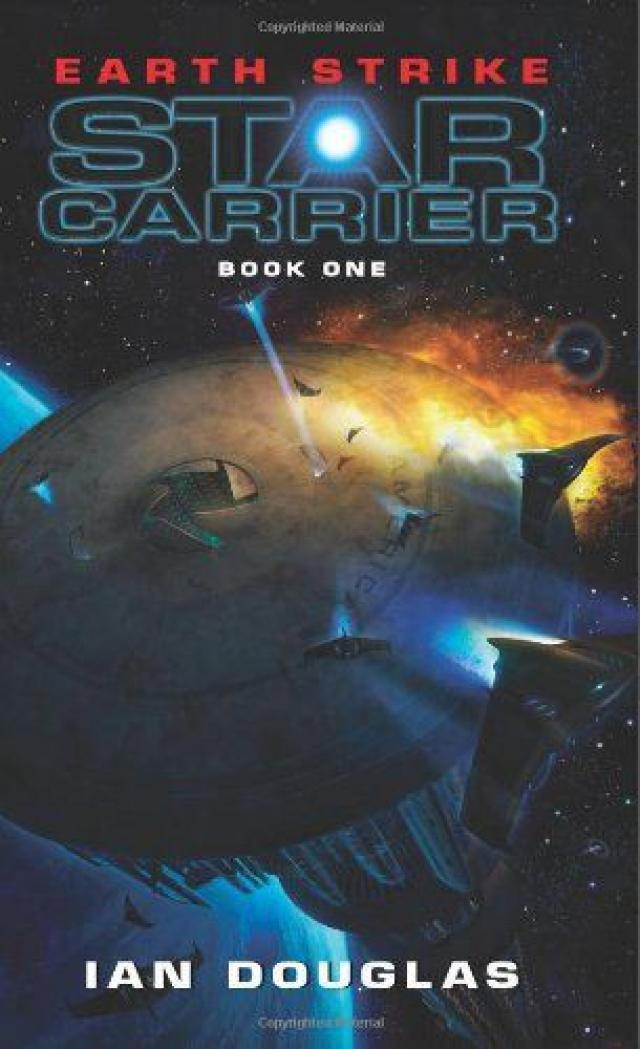
Koenig felt the faint shudder as magnetic grapples released. The microgravity of CIC was momentarily interrupted by a hard nudge-the maneuvering thrusters firing to ease the kilometer-long star carrier clear. The external view displayed across CIC’s curving bulkheads showed the close-knit crisscross of struts and girders in the space dock gantry that now were receding at twenty meters per second.
Only thirty-three ships. That didn’t make any sense whatsoever. When Koenig had been planning to launch an incursion to Alphekka, Crown Arrow, he’d been planning on one hundred ships, including four carriers. And Alphekka, young, raw, and hot, wasn’t the home system of the Turusch or anybody else. At most it was only a logistics base or military staging area.
The Turusch would have to be insane as a species even to consider taking on the home system of Humankind with thirty-three ships.
But thirty-three ships would make a good diversion.
Neptune was in the constellation Taurus, at a right ascension of four hours. The Turusch had emerged from metaspace in Pisces-around right ascension one hour. But if the Turusch were coming straight to Sol from either Eta Boötis or Alphekka, they would arrive first almost halfway around the sky-somewhere in the constellations of Boötis or Corona Borealis…say, somewhere around a right ascension of fifteen hours.
Did the Sh’daar empire completely surround Sol and the handful of star systems explored and colonized so far by men? Or had they sent those thirty-three ships on a long, round-about flank march, to have them approach Sol from Pisces, that part of the sky almost directly opposite Boötis and Corona Borealis?
Of one thing Koenig was certain. The enemy would not do such a thing for no reason…and right now the best reason Koenig could think of was that the Turusch wanted to focus the Confederation Navy’s attention on Taurus and Pisces right now.
Perhaps while the main fleet came in on a straight line from Eta Boötis or Alphekka. If they came fast enough, moved deep enough into the solar system before dropping out of metaspace, they might catch the majority of the Confederation fleet tens of AUs away from Earth…and accelerating in the wrong direction.
“God in heaven,” Koenig said softly.
“Is there a problem, Admiral?” Quintanilla asked. He was floating near the admiral’s couch.
“Yes, Mr. Quintanilla, there is. I think the Turusch are trying to pull a fast one on us.”
“Indeed?”
“Neptune is a diversion,” Koenig said. “They’re coming from the opposite side of the solar system.”
“And how do you figure that?”
“It’s what I would have done.”
“Admiral, the Joint Chiefs have given the matter considerable thought, and-”
“Comm!” Koenig barked, cutting Quintanilla off. “Put me through to Admiral Caruthers.”
He needed to discuss this with someone higher up in the command hierarchy.
And there wouldn’t be much time left.
Chapter Twenty
18 October 2404
CIC, TC/USNA CVS America
Mars Synchorbit, Sol System
0311 hours, TFT
“I think, Admiral,” Koenig said, “that Neptune is a trap.”
He was simlinked with Caruthers, standing in a virtual meeting space representing a conference room in Phobia. A holographic display of Neptune glowed in the center of the room, with dozens of straight white lines marking the planned trajectories of Confederation fleet elements. Triton was a small green-and-gray globe far off to one side.
“And just what do you suggest, Koenig?” Caruthers replied. He was an older, harassed-looking man, white-haired, with a perpetually worried expression. Koenig honestly couldn’t tell whether the icon he was interacting with represented the real Caruthers’ current appearance, or if he always looked this way, even when all hell wasn’t breaking loose.
Koenig manipulated the three dimensional map, pulling back to show the orbits of all eight planets. “Neptune and Triton,” he said, and a red symbol winked on at nine o’clock. “The Turusch emergence at Point Pisces,” and a second red light winked on at about ten o’clock. “And where the main enemy fleet will strike, if I’m right.” A red light came on all the way around on the far side of the sun, at two o’clock. “They may already have ships out there. We don’t have anything looking for them out that way. I would like to take my battlegroup out to this area-call it Point Libra. We launch a fighter strike ahead of us. They could be thirty AUs out in four hours, objective.”
“And how many ships in your battlegroup?”
“Twelve, sir. Not counting auxiliaries.” But they would be leaving the auxiliaries behind in any case.
“That’s twelve ships we’re going to need to defend Earth. If you’re wrong, Admiral, I’ll be crippling my defense.”
“Sir…we’ve detected thirty-three ships at Point Pisces. Thirty-three ships. You know what that means. Where are the rest of them?”
“I understand that. But why have the main fleet come in from that direction, just because it faces Boötis and Corona Borealis? Why come in on the solar ecliptic at all? Why not from the zenith, or the nadir?”
“Because they’ll want to keep open lines of retreat that don’t pass through our space.” He was remembering the Turusch retreat back at Eta Boötis. They’d pulled off in the direction of Alphekka-further confirmation that that star was their staging area. “I agree they’ll come in off-ecliptic. My guess is they’ll emerge somewhere in southern Boötis or Serpens Caput, not down in Libra.”
“We’d be better off keeping the entire fleet in close, waiting for them to come to us. From whatever direction.”
“Sir, I must disagree. That would put us in exactly the same tactical situation as the Turusch at Eta Boötis. You’ve seen the after-action?”
“I’ve read your report, Admiral, yes. And that’s the only reason I’m even listening to this.”
“The enemy may already have launched near-c impactors. They would be foolish not to. That would give them the chance to inflict damage on our fleet and planetary defense facilities before the ship action even begins.”
“If they’d launched impactors when they first emerged,” Caruthers pointed out, “we would have been hit around midnight. Three hours ago.”
“They’re scoping us out, Admiral. Identifying planets, population centers, military facilities, orbital manufactories, ship positions. And they need to watch all of those long enough to be able to predict orbits.”
“Which is why we’re moving our fleet elements, getting them out of the space docks.” He sounded impatient, and Koenig could guess just how busy he was right now, marshalling as many ships as possible for the defense of Earth.
“Of course. But we can’t change the orbits of Earth and Mars. Or move our major bases, like Phobia and SupraQuito.”
“I know…” Caruthers was silent for a long moment. “There’s been no warning from our High Guard automated probes out that way. Not since the original alert last night.”
“Agreed.” That was the one weak point in his reasoning, he knew. The probes had picked up Force Alpha. Why hadn’t they detected the hypothetical Force Bravo? “But if the enemy was aware of our detector net, they might have found a way to nullify it.”
“That’s a long string of suppositions,” Caruthers said. He hesitated again. “Admiral Koenig…I appreciate what you’re saying. But there’s just too much space to cover. I send you out to the area of Corona Borealis, and they pop in at Libra. Or, hell, Octans, or Ursa Minor. I’d be dividing my fleet in the face of the enemy, with a very good chance that you would never engage the enemy at all. And this time there’s just too much at stake. Damn it, we could be looking at the destruction of human civilization.”
“I understand, Admiral Caruthers. What I’m suggesting, though, is to launch four of America’s fighter squadrons. Divide them up into two-ship elements. We send one toward Boötis, one toward Libra, one toward Corona Borealis. Hell, one to Octans, if you insist…although I’m absolutely convinced they’re going to be coming through more or less on a straight line from the direction of either Eta Boötis or Alphekka, probably Alphekka. It will take them four hours to get out to the thirty-AU shell.
“Now look at this.” On the solar-system diagram, a straight red line drew itself from Neptune, at nine o’clock, across the solar system to Point Libra, at two. “Let’s call the thirty-three ships at Neptune Force Alpha. The real strike force, over here at Point Libra, is Force Bravo. Okay?”
Caruthers’ image nodded.
“Alpha has been gathering data on our Inner System for nine hours plus now, since they dropped out of metaspace at 1745 yesterday. My guess is that they started beaming that data from Pisces to Libra immediately. Force Alpha, or a part of it, then moved to Neptune-Triton, but they continued beaming updates to Libra. The Libra force is going to need the most recent data on our fleet deployment possible.”
“Okay…”
“Look here.” The image magnified, zooming in on the red line. At the chord’s midpoint, the line skimmed close to another icon, a small yellow point.
“What’s that?” Caruthers asked, even as he triggered the data block.
“A deep-space communications relay at 60558 Echeclus. Close to its aphelion right now, fifteen AUs from the sun. A Centaur…”
Centaurs were a type of asteroid or comet-they showed characteristics of both-first catalogued with the discovery of Chiron in 1977. Echeclus-pronounced “Eh-kek-les”-had been discovered more than two decades later, in 2000. In 2178 an automated communications relay had been built on it. Its thirty-five year orbit took it from just outside of Jupiter’s orbit to several AUs inside the orbit of Uranus. There wasn’t much to the thing-an 84-kilometer chunk of ice and rock. For a time, the High Guard had maintained a base there; the object’s orbit was unstable, and it would have been a good candidate for a deliberate nudge that would have threatened an Inner System world.
Now, though, the base was purely automated.
“It’s run by an AI named Echeclus,” Koenig said. “He’s smart and he’s curious. He’s also about six and a half light hours from Neptune. If Force Alpha started transmitting tight-beam updates to Point Libra as soon as they took over Neptune-Triton, he should be picking up the signal just about now. I would expect an AI of Echeclus’s caliber to rebroadcast the signal to us. At fifteen AUs out…that’s just two hours.”
“We could expect to get the transmission at around 0515, then.”
“Exactly. But it gets better. That transmission from Echeclus will be nondirectional, spreading through the solar system like an expanding bubble. Our fighter reconnaissance will be outbound one hour into their mission, assuming America launches at once, and they’ll encounter that bubble before we do. They’ll have comprehensive if-then orders: if they pick up the signal, it means I’m right and Force Bravo is out there, waiting for the signal from Neptune that they won’t get for another three and a quarter hours or so. If Echeclus reports no signal, they decelerate immediately, then boost back for the Inner System.”
“Damn, that’s complicated,” Caruthers complained.
“The joys of communications limited by c, Admiral. But it will work. It’ll let us deploy out toward Point Libra now, and maybe get the jump on the Turusch before they’re expecting us. If I’m wrong, if there’s no signal, the fighters will turn around and be back in the Inner System three hours later. Think of them as a tactical reserve.”
“And we have other squadrons,” Caruthers said, thoughtful. “Essex and Kennedy are all at full strength. I’m inclined to say yes, Admiral. There’s just one problem.”
“What’s that, sir?”
“The Senate. Specifically the Senate Military Directorate. I have a certain amount of freedom in how I deploy the fleet for the defense of Earth, but I know damned well they’re not going to authorize sending four fighter squadrons out on what they’ll be convinced is a wild goose chase. The request is going to get bounced back to Earth. That’s a time lag of twelve minutes right now. And twelve minutes more for the reply.”
“So we have twenty-four minutes before they say no. I suggest, sir, that you let me commence launching now.”
“Admiral…you’re still under something of a cloud with this Board of Inquiry. Technically, you shouldn’t even be in command of that battlegroup while you’re waiting for the Board’s decision.”
Koenig decided not to tell Caruthers that he already knew what the Board’s decision was. He suspected, though, that Caruthers already knew the outcome as well.
“I’ll take full responsibility for my decision, Admiral. Hell, tell them I boosted without orders, without consulting you. They can crucify me when I return.”
“You’re intending to take your battlegroup out toward Libra as well.”
“Of course. We won’t get there for sixteen hours, but my fighters will need to be recovered. If we start boosting behind America’s fighters immediately, we’ll still be in a position to turn around and return if we don’t hear from Echeclus in a reasonable time.”
“I’m going to authorize this, Koenig,” Caruthers said after a moment’s thought. “God help your career if you’re wrong.”
“God help us all if I’m right or wrong,” Koenig said.
He didn’t add that twelve capital ships and a few fighter squadrons would not last long against Force Bravo. He didn’t know how many ships the Turusch would be sending in their main force, but it would certainly be more than the thirty-three ships of Force Alpha. A lot more.
It was possible that the deployment of Battlegroup America would prove to be nothing more than a spoiling attack-a means of damaging and perhaps slowing down the enemy fleet before it reached Earth, but at the cost of America and her consorts.
“Either way, Admiral Koenig, good luck.”
The connection was broken, and Koenig was again in CIC, strapped in his recliner. “Commander Craig!”
“Yes, sir!”
“New orders to all ships in the battlegroup. Prepare for acceleration. Course fifteen-plus-fifteen.”
“Aye, aye, sir. New course fifteen hours right ascension, plus fifteen degrees declination.” She blinked, looked puzzled. “Sir?…”
“You have your orders, Commander.”
“Just a moment, Admiral,” Quintanilla said. “Those coordinates…that’s in almost the exact opposite direction from the enemy’s emergence point!”
“Almost,” Koenig replied easily.
“B-but…but you can’t do that!”
“Mister Quintanilla, you would be surprised at what I can do when I put my mind to it. Now strap yourself down and stop floating around my CIC, or I’ll have you ejected. Again. We are going to be doing some maneuvering in the next few moments, and I don’t want you crashing into the instrumentation.”
“All hands, prepare for maneuvering,” the voice of America’s helm officer announced. “Two gravities in fifteen seconds.”
The twelve vessels of the battlegroup would be jostling their way into formation now, using plasma thrusters to maneuver. The gantry of the Phobia dock facility continued dropping away, drifting now until it was off America’s stern quarter.
Quintanilla barely made it to a spare acceleration couch. When the ship was under grav acceleration, of course, CIC was in free fall, and couches were hardly a necessity. A two-G nudge from the main thrusters, though, could break bones if you weren’t prepared. They provided an added safety precaution as well for officers and crew who were working in simlinks, and unaware of their actual surroundings. Having everyone strapped down while they were linked kept them from blindly drifting into one another, or into the ship’s consoles or instrumentation.
The helm officer was speaking again. “And five…and four…and three…and two…plasma torch sequence initiated…fire!”
And Koenig, now, was committed to what might be his last deployment as a naval officer.
He opened another channel. “Commodore Dixon.”
“Yes, Admiral,” Captain Joseph Victor Dixon replied. Dixon was America’s CAG, the officer in command of all squadrons operating off of the carrier. The term was an ancient acronym, one standing for commander air group. The title had eventually been changed to commander air wing, and, still later, to commander space wing, but the original name had remained unchanged throughout four centuries, clearly preferable to suggested official alternatives such as CAW and COSPAW.
His naval rank was captain, but in formal conversation he was given the honorary title of commodore. There could be only one “captain” on board ship.