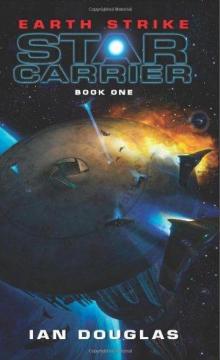
Earth Strike: Star Carrier: Book One sc-1, page 17
part #1 of Star Carrier Series


At this moment, the last of the Marines on the surface of Eta Boötis IV were on their way up from the planet, escorted by the five remaining Dragonfires. The surviving gravfighters from VFA-44 had succeeded in scattering the rioters in the Marine compound down on the planet’s surface, had escorted several more shuttles back up to the fleet, and now were seeing to the last of the evacuees.
The eleven gravfighters of VFA-51, the Black Lightnings, were still out there as well. Hours before, he’d sent them out on deep perimeter patrol, following the retreating enemy ships a full thirty light minutes out. If the Turusch did turn around and launch a counterstrike, the Black Lightnings would be America’s early warning net. They were returning now, but would not be back on board the carrier for another forty minutes.
“Admiral!” It was Commander Johanna Hughes, the tac evaluator. “Urgent from VFA-51! Enemy fighters inbound at near-c!”
Shit. The nightmare scenario.
“How many?”
“Unknown, sir. He says ‘a hell of a lot…at least fifty.’”
Koenig studied the tactical display. The enemy had retreated in that direction-roughly toward the star Epsilon Boötis…not that that star would necessarily have been their actual destination. He’d sent the Black Lightnings out line along the same path to watch for just this eventuality. Eleven Starhawk gravfighters against fifty Toads. Not good odds. Not good at all.
But the real urgency of the situation lay in the fact that the enemy fighters were coming in just behind the lasercommed message warning of their approach. The battlegroup’s rear guard might have mere seconds before the Turusch were among them.
“Make to all ships,” Koenig said. “Maneuvering, Code One. Initiate hivel-A defenses now!”
“Aye, aye, sir.”
Hivel-A was milspeak for high-velocity assault. Defenses included launching clouds of sand, firming up defensive shields, but most of all, moving. If there were laser bolts coming in at the speed of light, or plasma beam or other weapons skimming in just behind the light barrier, the best defense of all was to not be there when they arrived.
“Copy the tacsit to everyone within range,” Koenig added. He was thinking of the last Choctaw shuttle coming up from the surface, and the gravfighters and Nightshades escorting it. They needed to know what they were boosting into.
Slowly, ponderously, the remaining seven ships of the carrier battlegroup began to move.
Dragon One
Above Eta Boötis IV
1945 hours, TFT
Her Starhawk punched through the last cloud deck and Commander Allyn emerged into the clear, vast emptiness of the planet’s upper atmosphere, with stars gleaming down at her with hard and untwinkling brilliance. A moment later, the local sun exploded into view on the horizon, wiping out the stars, illuminating a scimitar’s edge of cloud cover dividing planetary night from space.
As the atmosphere rapidly thinned, she reshaped her Starhawk into its needle configuration. The other four fighters of VFA-44 were already doing the same, dragging straight-line contrails behind them as their drive singularities chewed through what was left of the air. The Choctaw, fat and bulbous, didn’t have a variable geometry hull, and began lagging behind. Allyn ordered the squadron to slow their ascent, matching their velocity to the transport shuttle. The four Nightshade gunships followed close in the Choctaw’s wake, like angular black insects pursuing an ungainly blue-painted cow.
“We are receiving an urgent tactical update from the fleet,” her AI told her, the voice a whisper in her mind. “Details follow….”
She watched the incoming data scroll through an open window in her consciousness. “Toads!” Allyn snapped as the data flooding through from the America registered. “Hivel-A, fifty-plus Toads.”
“Where?” Tucker demanded. “I don’t-”
White light blossomed on the night side of the planet directly astern, a searing illumination of the clouds that momentarily blocked out the glare of the bright-rising star. Her sensors picked up the wake of a high-G impactor that had just seared down out of the sky, passing the Confederation fighters and shuttle perhaps eighty kilometers abeam.
“What the-” Lieutenant Collins called over the squadron frequency.
Seconds later, two distinct shock waves struck, first from the ground thirty kilometers below, then a lesser one from the impactor’s more distant atmospheric wake, twin sledgehammer blows against her fighter’s hull. Had the air been any thicker, had they been any closer to the ground, any deeper inside Eta Boötis IV’s thick atmosphere, the shock waves, she knew, would have swatted them all from the sky.
The former Marine base had just been obliterated.
The knowledge stunned her. They’d lifted clear of the base landing pad scant minutes earlier as the rioting mobs had closed in on the loaded shuttle once again. There’d been no point in orchestrating another high-Mach passage over the base. The civilians who’d wanted to get out were getting out; the others had already made their choice.
But it was startling to see how swiftly the consequences of that choice had arrived-as a ten-kilo inert kinetic impactor traveling at just below the speed of light had slammed into the base and released thousands of megatons of energy in a single dazzling flash. As she scanned the planet, she saw a second flash, far up the curve of the northern horizon, and realized that a second impactor had just struck the Mufrid outpost at Kurban.
A third flash…that was probably Amal…and a fourth, more distant still, Lilistizkar.
The Marine base and the last three inhabited colony domes, all…all gone.
The suddenness, the sheer savagery of the attack was almost too much to grasp.
She shifted her scan forward, to the carrier battlegroup. Only seven ships remained in planetary orbit; the others had boosted moments before, were already accelerating hard out-system. Those seven, she saw with considerable relief, all were accelerating, breaking orbit, turning in toward the planet to use Haris’s gravity to their advantage.
The Turusch, of course, would have had precise targeting information for the planet, could accurately strike the colony outposts from light seconds out. Ships, however, could leave their predictable orbits and not be there when the beams or hivel projectiles arrived.
Collins’ scanner picked up numerous faint straight-line trails of ionization ahead, the traces of near-c impactors flashing through dust and stray molecules of atmosphere just ahead of where the fleet had been orbiting scant moments before.
The Confederation had tried exactly the same tactics against the Turusch fleet earlier, with considerably greater success. It appeared that the enemy had missed all seven human warships.
But the thought of what was happening on the planet astern still burned. Why?…
It made no sense. The Turusch had bombarded the Marine perimeter for over a week; at any time they could have accelerated a rock big enough to vaporize a continent, but they hadn’t. They’d been trying to capture the place, not obliterate it.
That strategy, evidently, had changed. The Turusch had just annihilated all human outposts remaining on the planet, killing some tens of thousands of civilians.
Why?
She shook the thought aside. Strategists, xenopsychologists, and admirals could worry about that later. Her problem now was the knowledge that there would be high-G fighters coming in immediately behind the near-c kinetic impactors.
There!
The Toads were coming in hot, decelerating hard in order to engage ship-to-ship. Among them were Confederation Starhawks-the gravfighters of Sandy Jorgenson’s Black Lightnings, following the leading wave of Toads in, trying to burn them down.
The battleship Spirit of Confederation opened up with her long-range fusion cannon, and a constellation of oncoming Turusch fighters smeared into tiny, brilliant novae. And then the enemy fighters were sweeping into the battlegroup like avenging angels of death.
CIC, TC/USNA CVS America
Haris Space, Eta Boötis System
1947 hours, TFT
“Enemy fighters at two-three-zero plus five-one, engaging!” Johanna Hughes announced.
Koenig watched the unfolding action on the tactical display-green icons representing Confederation vessels, red the enemy, with a vast, ghosted gray sphere showing the position of Eta Boötis IV.
More hivel impactors, launched at closer ranges, might still be out there, coming fast. If the carrier squadron could maneuver around behind the planet, use the planet as a shield, they might be able to delay acceleration long enough to take the remaining fighters on board.
That was the true hell of the tacsit. Right now, there were sixteen gravfighters out there, plus four Nightshade close-support gunships and one last, lumbering shuttle packed with civilians and Marines. If America boosted for c, the gravfighters, with their high accelerations, could catch up-assuming the Toads let them-but the shuttle and the gunships would be left behind.
And even the fighters were at risk. Trapping on board a carrier under acceleration was not for the fainthearted, nor was there a promise of success.
But the seven capital ships were vulnerable if they stayed put. They might hold the Toad fighters at bay for a time, but Koenig was willing to bet that Turusch capital ships were out there, lots of them, still undetected and burning in tight on the fighters’ wakes. If the squadron didn’t start boosting for c, they would be trapped here, pinned against the planet and annihilated one by one.
A gravfighter-one of the Lightnings-had burned out a Toad, but now two more Toads had dropped onto his tail. He listened to the voices of the cockpit chatter, relayed back to America’s CIC by the cloud of battlespace drones serving as comm relays and unmanned intel platforms.
“Lightning, Lightning Five! I got two on my tail!”
“Five, One! Break left, break left!”
“Copy One, breaking left!..they’re still-”
One of the green pinpoints in the tac display winked out. A tight formation of Turusch fighters were closing on the knot of Starhawks, slashing at them with beam weapons.
“Comm! Make to the Spirit,” Koenig ordered. “Break up those Toad clusters! Get them off our people!”
“Aye, sir.”
The Spirit of Confederation had the most accurate of long-range weapons in the formation, with railguns and fusion beams that could pop something as small as a fighter at a range of over one light second.
Of course, she still needed a good idea of where the target would be one second after firing-that was the single major limiting factor in space combat. But so long as the target held course and speed-or a constant rate of acceleration-for more than a second, her targeting computers gave her uncanny accuracy.
Another of the Black Lightnings vanished in a white flare of incandescence.
“Make to all fighters,” Koenig told the communications officer. “Break off and rejoin the battlegroup. Prepare for underway trap.”
“Aye, aye, sir!”
He looked into the tac display again. Five fighters, a shuttle, and four gunships still coming up from the surface…and ten gravfighters of the Black Lightnings tangled in a fur ball with the Trash. Damn. They needed to get that transport aboard. The display readout showed 214 people packed on board-God! They must be sitting in one another’s laps! UC-154s were rated for about 180 at most.
He juggled with the possibility of launching another fighter squadron, then decided against it. More fighters might help the long odds against those Toads, but the rest of the Turusch fleet would be along very shortly, of that he was certain. He already stood to loose seventeen good gravfighter pilots out there. He didn’t want the number to rise to twenty-nine.
If the capital ships could hold off that swarm of incoming Toads with their point-defense weapons, maybe they could bring the fighters and the shuttle on board as well.
But it was going to be damned tight.
Dragon One
Above Eta Boötis IV
1948 hours, TFT
Allyn heard the orders come down from America’s CIC-rendevous with the carrier. Prepare for underway trap.
But she saw a tactical opportunity.
As the fighters continued to climb up out of Eta Boötis IV’s gravity well, she saw that the enemy fighters, closing with America and her escorts, would be passing almost directly above the five hard-boosting Dragonfires. Better yet, the planet’s surface directly astern, directly below them, was a flaring, savage glare of white in the middle of a broader swath of red-orange light. Above the light, a fast-swelling, red-lit mushroom cloud was spreading out rapidly above the apocalypse of lava and erupting volcanoes marking the vast, molten crater vaporized by the near-c impactor.
There was enough heat and light glaring from that scar, she thought, to mask the fighters from enemy sensors, from some of them, at least. The Starhawks might be tagged by radar-though their hull configuration was already shifting to stealth mode to hide them. And the Toad pilots wouldn’t be watching the eruptions on the planet. They would be focused on America and the other capital ships ahead.
The Choctaw shuttle and the four gunships were already angling off in another direction, racing for the distant star carrier.
“Dragonfires!” she called. “Stick close! We’re going to give those bastards one hell of a surprise!”
CIC, TC/USNA CVS America
Haris Space, Eta Boötis System
1948 hours, TFT
“Dragonfires have acknowledged, sir,” the comm officer announced.
“Then what the hell are they doing?” Koenig asked. The shuttle and its Nightshade escort was breaking for the carrier, but the five fighters were maintaining their course, straight-line from the planet’s surface into space.
“Analyses of their vector suggests they’re performing a pop-up, sir,” Hughes told him.
A pop-up-an ambush by fighters lurking within the atmosphere of a planet, then “popping up” out of the atmosphere to attack. Usually, the relative positions within a local gravity well dictated that the force farther from the planet held the gravitational advantage. Even with drive singularities, it took a lot of energy to fight up out of the bottom of a planetary well. But in some cases, surprise could outweigh the disadvantages, especially if the enemy wasn’t paying attention.
And this time, the enemy appeared to be completely focused on the carrier battlegroup. The question was whether five gravfighters could make any difference at all in a scrap against ten times their number.
“God help them,” he murmured.
Dragon One
Haris Space, Eta Boötis System
1949 hours, TFT
Allyn cut her drive singularity as she flashed into the path of the oncoming Turusch fighter swarm, targeting the nearest Toad and cutting loose with her RFK-90 KK Gatling at a range of less than ten thousand kilometers. Her AI pivoted her ship as she moved, twisting it to keep the Gatling aligned with the enemy fighter. A stream of magnetic-ceramic-jacketed slugs of depleted uranium, each massing half a kilo, snapped out with a cyclic rate of twelve per second.
With a launch tube five meters long and an acceleration of three hundred gravities, those slugs were traveling at 175 meters per second when they left the Starhawk’s prow. The impact of that stream carried the punch of a fair-sized tactical nuke; the Toad’s shields went down as the hull opened up with a zipper effect, ripping out its guts and sending molten chunks of debris tumbling through space.
“Dragon One, scratch one!” she cried over the com link.
The other Dragonfires were scoring as well. Lieutenant Tucker was using her PBP-2 in short, controlled bursts, flipping her Starhawk this way and that, acquiring targets, locking on, firing. Collins and Spaas were tucked in close together with a separation of only a few hundred kilometers, their battle AIs linked as they concentrated their fire, one using KK slugs, the other particle-beam bursts to maximize their combined effect. Sandoval was firing his Kraits…serious overkill for a Toad, but the results were dramatic enough as white nuclear blossoms swelled and faded against black space, silent and devastating.
“Sandoval!” Allyn called. “Save the Kraits for the big boys! You’ll need ’em later!”
“Is there gonna be a later?” he shot back, but he switched to his KK Gatling.
The sudden appearance of the five new Starhawks appeared to have thrown the Toad formation off balance. Intertwined with the Black Lightnings, they’d been focusing their attention, it had seemed, on closing with the remnant of the carrier battlegroup. Now, however, they were faltering, breaking sharply, accelerating in different directions, trying to put distance between themselves and their tormentors.
Turusch fighters were designed to put down heavy fire on capital ships, and they tended to work best at distances of from five to fifty thousand kilometers from their targets-medium range in space combat. They were not as maneuverable as Starhawks, and weren’t good dogfighters.
Starhawks, on the other hand, were designed for close-in knife fights, getting in to within a thousand kilometers or less of the target, outmaneuvering it, and taking it down with concentrated KK and PBP fire. If they could get close enough to a Toad, they enjoyed a considerable advantage ship-to-ship…but at medium range the Toads’ advantage in heavy weaponry could be devastating.
Sandoval twisted in toward a Toad already exchanging fire with one of the Black Lightnings. The Lightning was pacing the Turusch fighter, working to drop squarely onto its tail at a range of less than a hundred kilometers.
At the last moment, the Toad spun end-for-end, hammering at the Black Lightning, which rolled to port, using its drive singularity to jink randomly back and forth, making itself a difficult target. Sandoval was farther out, almost three thousand kilometers, and at that range the Turusch particle beams had bloomed, becoming far wider, far more likely to hit, than when they were fired close-in.