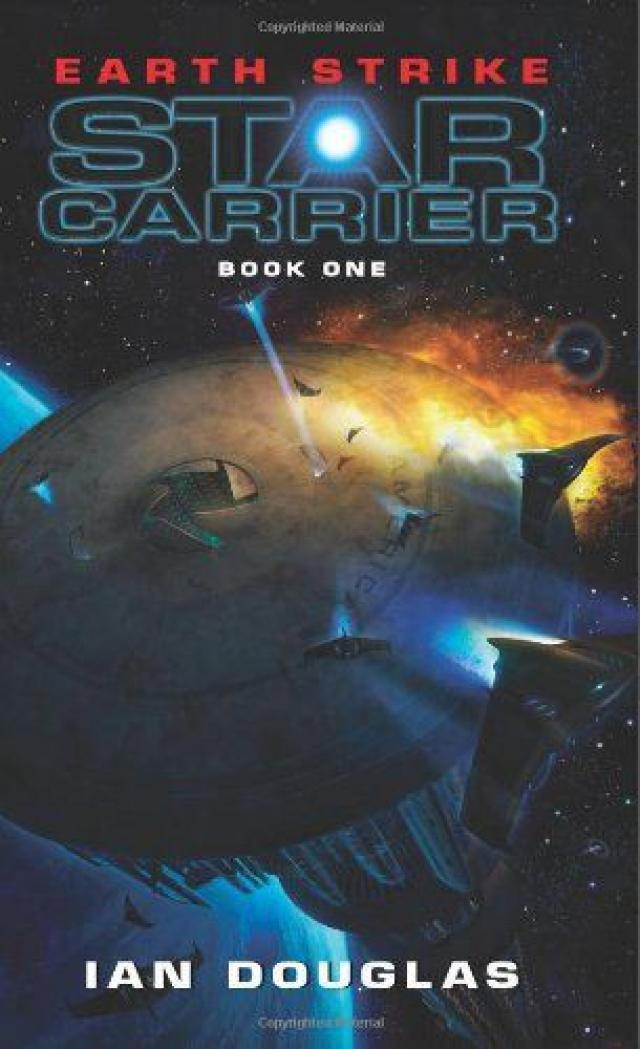
Earth Strike: Star Carrier: Book One sc-1, page 24
part #1 of Star Carrier Series


Kennedy sipped his coffee and decided yet again that his all-too-brief evening with Admiral Brewer’s daughter had not been worth it. Being assigned to this frozen ice ball in the solar system’s boondocks was about as close to terminal as his career could come. He’d been here for three months now, and could look forward to another nine months of utter boredom and frigid vistas in the wan light of a sun thirty astronomical units distant.
“Class One alert,” Sparky announced without preamble. “Data incoming. Our remote Kuiper probes are detecting the emergence of starships almost four light hours out.”
Kennedy choked on his coffee, his feet swinging off the console and hitting the deck with a slap. Surface gravity on Triton was just under two tenths of a G, and the droplets of hot spilled liquid cascaded across his face and uniform in slow motion.
“Shit!” Then the pain of coffee scalding his chin registered. “Ow!” Mopping at his face, he set the cup down. “Where, damn it?”
A chart opened in his mind, showing the relative positions in three dimensions of Neptune and Triton, the distant sun, and the incoming ships. Data were coming in now from a total of four unmanned probes at the forty-AU shell, highlighted as blinking white pinpoints, some ten astronomical units beyond the orbit of Neptune. The intruders were beyond that shell, off to one side and 10 degrees above the ecliptic, some twenty-two astronomical units away from Triton, forty-five AUs from Sol.
As Kennedy studied the data, he realized that a better question would have been when. Those blips, obviously, were starships emerging from the enemy’s equivalent of Alcubierre Drive, detected by the pulses of photons released by their emergence into normal space. They would have been moving in the hour since their detection…and would have moved further still in the three subsequent hours as the alert was transmitted down to Triton. Those ships could be almost anywhere now…including bearing down on Triton at just under the speed of light.
“How many?” he asked the AI.
“We are picking up multiple emergence events,” Sparky continued. “Fifteen vessels of various masses and configurations so far.”
“Can you identify the configurations?”
There was the briefest of pauses as data was correlated and confirmed. “Affirmative. Configurations match those of several known Turusch warships.”
Trash ships! Here! “Launch ready courier. Now!”
One hundred kilometers above the methane-ice plains of Triton, an orbital laser-communications antenna shifted slightly, taking aim at an unseen point among the stars just to one side of the brightest of those stars-Mars, its light lost in the glare of Sol. Sparky would continue transmitting updates to that data for as long as possible.
“Give me positions on the nearest naval vessels,” he said.
“One High Guard destroyer is at fifty-five light minutes’ range,” Sparky told him. “USNA Gallagher.”
“Send out a general fleet alert,” Kennedy said. His primary orders-getting the warning back to the inner system as quickly as possible-had been accomplished. Beyond that, he could warn any naval vessels in the general vicinity of Neptune…and not much else.
The listening post was not armed.
Kennedy watched the incoming blips and decided that, just maybe, boredom wasn’t such a bad thing after all.
Minutes later, a false dawn illuminated the ice plains of Triton as the lasercom antenna vanished in a near-c impact.
Lieutenant Kennedy and his tiny command died fifteen seconds later, as a city-sized chunk of Triton’s surface vaporized, and the naval listening post and most of the human structures located on the frozen worldlet were transformed into superheated plasma expanding silently into space.
Columbia Arcology
Morningside Heights
New City, USNA
1630 hours, local time
“You want to go where?”
Trevor Gray drew himself up straighter. He was wearing his Navy dress black uniform, and hoped it was suitably impressive to the local civilian Authority.
“I’m…visiting friends in the Ruins,” he told the disbelieving peaceforcer captain. “That’s not illegal, is it?”
“Illegal?” The man scratched his bald head behind one extravagant ear. He’d taken on a genetic prosthesis that had let him grow pointed elfin ears and golden eyes with the slit pupils of a cat. The overall effect, together with the man’s hairless scalp, gave him a faintly demonic look. “Not that I know of, no. But why in hell would anyone want to go down there? Much less a naval officer!”
Gray wondered what the man would say if he told him he’d been a denizen of the Ruins just five years before. That fact, he decided, would not help his case.
“Let’s just say I have business there. With some friends in the TriBeCa Tower.”
“What friends?”
Gray smiled. “Would their names really mean anything to you?”
“No.” He grinned. “No they wouldn’t. To tell the truth, we don’t have the faintest idea what’s going on in there. And we don’t want to, either. As long as the squatties stay out in the Ruins, as long as they don’t cross the line and come up here, bothering decent folks here in the meg”-he shrugged-“then they can have the place, so far as I’m concerned.”
Which was the attitude Gray had long since come to expect of the Authority. Of course, the idea of one side not bothering the other only applied to the squatties staying out of the New City megalopolis. There were the hassles and the raids by Authority personnel, the periodic attempts to clear out sections of the Ruins-why, Gray had never been sure. Simple abuse of power, a flexing of Authority muscles just because they had the power to use them? Or a misguided attempt to help people who didn’t want to be helped?
It didn’t matter. The “decent folks” didn’t care.
“Then there should be no problem letting me go see my friends,” Gray said.
His internal time read just past 2130 hours shipboard time, about 1630 local. It hadn’t taken him long to process through SupraQuito and take the high-velocity elevator straight down-cable to Quito. When the space elevator was first built in the early twenty-second century, that trip would have been a two-day journey; with grav thrusters the 36,000 kilometer drop from synchorbit only took a couple of hours now.
Quito had been much the same as he remembered it from his first trip up-cable after joining the Navy-big, sprawling, crowded, and impossibly busy, one of the three major port megalopoli, the Equatorial Jewels, the biggest and richest cities on Earth.
From Quito’s elaborately decorated Estación Grande Central de la Tierra he’d taken a subsurface shuttle for the 4500-kilometer leg north to new New York, hurtling in silence through the vacuum gravtube that, at midpoint, passed nearly four hundred kilometers beneath what was left of the West Indies, a straight-line chord running point-to-point beneath the curving arc of the surface. Gray knew that titanic energies had been mustered to keep the deepest tubes stable as they passed through the Earth’s upper mantle, and that the temperature of the mantle rocks surrounding the tube approached 900 degrees Celsius. He could see none of it directly, however, for the shuttle had no external monitors. His choices were watching a mindless romance on the simfeed, striking up a conversation with other shuttle passengers, or sleeping. Like military personnel the world over and since time immemorial, he’d chosen sleep.
The passage, in any case, only lasted forty-five minutes. He’d arrived in Morningside Heights at 1320 local, 1820 ship time. Three hours he’d been here, waiting in waiting areas, talking to bored bureaucrats and minor officials, being sent down brightly lit passageways to see other bored bureaucrats and minor officials. It was actually taking him longer to get from the Columbia Arcology to TriBeCa, just eleven kilometers away, than it had taken him to travel 36,000 kilometers down-cable from SupraQuito, and 4500 kilometers more from Quito to the New City.
“Look, Lieutenant,” the Authority captain told him, shaking his head. “I’d like to help you. I really would. But I gotta put down a reason for your visit. Who the hell do you need to see in the Ruins, fer chrissake?”
A good question.
What, he wondered, was he looking for? Why had he come?
Oh, he knew why Fifer had wanted him to come. He needed to face his fears, needed to face directly the fact that, if he didn’t belong in the Navy, he no longer belonged here either.
He decided to risk telling the man the truth.
“My family.”
The man’s eyes widened slightly, then he nodded. “Oh. Sorry.” Gray couldn’t tell if he was apologizing for forcing the admission, or showing sympathy at Gray’s origins.
“Family…business…” the peaceforcer said, making an entry. “Palm me.”
“Pardon?”
“Give me your hand.”
He pressed the network of circuitry exposed against the heel of Gray’s right palm against a data feed. Gray felt the inner flag go up that told him he’d just received new data.
“What was that?”
“Your pass. If a monitor or an Authority ship or anybody else pings you, that’ll flash back your ID and my personal seal of approval on you bein’ there. You won’t be bothered.”
“Then I can go?”
“You got transport?”
“I’ve already lined up a broom.” There’d been a gravcycle rental shop outside the Authority Center.
“Then you can go.”
“Thanks.”
“Just one thing, though, Lieutenant.”
“Yeah?”
“You’ll be on your own in there. There’s no Net-Cloud in there, so you won’t be able to call for help. And things can get rough in the Ruins, know what I mean?”
“I lived there for most of my life, Captain. Remember?”
“Well, there’ve been some changes. They’ve been killing each other a lot more enthusiastically lately. Migrations. Political fighting. That sort of thing.”
“I think I can handle myself, Captain.”
“On your own head be it, then.” The peaceforcer went back to his console, effectively dismissing Gray.
But as he walked out, he distinctly heard the man mutter, “Damned squatties.”
Koenig’s Office
TC/USNA CVS America
Mars Synchorbital, Sol System
2148 hours, TFT
Koenig came to what passed for attention in his office chair as the inner commconnect came through. He’d been working on a request for two new fighter squadrons-replacements for the fighters and pilots lost at Eta Boötis-when his personal AI had announced a call from the Senate Military Directorate.
He’d half been expecting it.
“Sir.”
“Relax, Alex,” Rear Admiral Karyn Mendelson said, her image appearing on a newly opened in-head display window. “It’s just me.”
“Well?”
“Well what?”
“Damn it, Karyn-”
She laughed. “Simmer down. The vote is in and you’re okay.”
“‘Okay.’ You mean…?”
“‘It has been determined by this Board of Inquiry that Rear Admiral Alexander Koenig has consistently and honorably served in the best traditions of the service,’” she quoted. “Or legal gobbledygook to that effect. You’re free and clear.”
“And still in command of the battlegroup?”
“Abso-damn-lutely.”
Koenig felt himself begin to relax. He’d been sure the board would clear him. And yet…
“I figured you would be getting an earful from Quintanilla.”
“That’s why things ran this late,” she told him. “Did you really throw him out of CIC?”
“Yes I did. You saw the command logs, didn’t you?” Everything that happened on the bridge and the CIC was recorded, optical and audio. Normally those records were kept sealed by the AI that collected them, but they could be retrieved for boards of inquiry, promotion boards, courts martial, and other legal proceedings.
She grinned in his mind. “Yes, but it still was a little hard to believe.” Her face grew more serious. “I’m afraid you’ve made some enemies in the Senate, Alex.”
“Already had ’em. A few more won’t hurt.”
“We were right about Noranaga. He was the one dissenting vote, by the way. He’s giving a deposition to a Senate probe tomorrow.”
“What probe?”
“Command attenuation.”
“I haven’t heard about that one.”
“It’s new. There was some agitation for hearings along those lines when we got kicked out of Arcturus last year. Your…um…independence at Eta Boötis kind of brought things to a head.”
While Koenig hadn’t heard of a specific Senate probe into the topic, he knew well what command attenuation was. The basic theory was taught at the Academy and accepted as holy writ throughout the hierarchy of naval command. It stated, essentially, that the limitations imposed on communications by the speed of light severely restricted the ability of the highest command levels-the Senate in Columbus and the Supreme Military Command Staff on Mars-to manage both strategy and diplomacy through the Fleet. It took three weeks under Alcubierre Drive to reach Eta Boötis, another three weeks to return. There were special high-velocity courier ships that could make the voyage faster-a week or two, perhaps-but the fact remained that by the time the Senate had learned of a threat at Eta Boötis and dispatched a carrier battlegroup to deal with it, the 1MEF had been pinned down and was under siege. Armchair strategists on Earth or Mars had no chance of managing a battle light years distant, and word of defeats or victories by Earth forces could take weeks or months to get back home.
The Navy had accepted command attenuation as a fact of life, and trained its command officers to operate with a high degree of autonomy, making both military and political decisions that could easily have a strong effect on life and politics back in the solar system. The problem was that, by long tradition, the military was supposed to be subservient to the civilian government. If the military became too independent in its thinking and operation, civilian oversight and control would be lost. The farther away a fleet or battlegroup was operating, the less control the Senate Military Directorate had over it-command attenuation in action.
Political liaisons like John Quintanilla were the Senate’s answer to the problem, an attempt to put someone into the fleet command structure who represented the political interests of the Senate. Deployed fleet commanders like Koenig despised the idea; political liaisons by their very nature complicated already complex missions, and that could translate as higher losses, quite possibly defeat. Political liaisons rarely had the military training that let them see a developing situation through the strategic and tactical training and experience of a command officer.
“You’re telling me I haven’t heard the last of this,” Koenig said after a moment’s thought.
“Good God! Of course you haven’t! As long as we’re saddled with PLs, there’s going to be friction. The PL insisting on doing things his way so the civilians stay in charge, the CO insisting that doing it that way will lose the battle.”
“So what’s going to happen?”
“Nothing for a long time. That’s the problem with political assemblies…or maybe it’s a blessing. They take forever to decide something. And by the time they do, their decision may no longer have anything to do with the problem.” She hesitated. “Quintanilla mentioned something in passing this afternoon. He said your deep-strike plan is being reviewed again. He’s against it, of course…but he mentioned that if the Senate approved it, it was tantamount to cutting you off from any Senate oversight whatsoever.”
“Operation Crown Arrow? It’s back on the table?”
“Exactly.”
Operation Crown Arrow had been conceived a year ago, shortly after the twin defeats at Arcturus Station and at Yong Yuan Dan, the Battle of Everdawn. The WHISPERS deep space listening posts on Pluto, Eris, Orca, and distant Sedna had tentatively identified a major Turusch base or supply depot at Alphekka, seventy-two light years from Earth, forty-two light years from Arcturus, forty-four from Eta Boötis.
Intelligence believed Alphekka-Alpha Corona Borealis-might be the Sh’daar/Turusch staging area for operations into human space. Humans had not been out that far, but it was thought that the Turusch homeworlds lay somewhere in that direction. Operation Crown Arrow-Crown was a reference to the constellation Corona Borealis, the “Northern Crown,” lying just to the east of Boötis in Earth’s night sky-had been a proposed long-range carrier strike against the presumed base.
The original idea for Crown Arrow had been Koenig’s, first described in a proposal submitted to the Senate Military Directorate eight months ago. The America carrier battlegroup would have been the heart of the strike force, which Koenig thought should number at least three carriers and one hundred supporting vessels.
The Directorate, perhaps predictably, had balked. One hundred ships represented about 20 percent of the total Confederation naval force; half of those ships would be logistical and supply vessels, and sending them out beyond the edge of Humankind space would put a serious strain on the Navy’s ability to keep the stay-at-home fleet elements and some hundreds of outposts and colonies supplied.
“So why are they reconsidering Crown Arrow now?” Koenig asked.
Mendelson shrugged. “Possibly because it makes sense. Even if Alphekka isn’t an invasion staging point, WHISPERS has picked up enough traffic out in that region to suggest something is going on. Our most serious weakness right now is that we don’t know our enemy. We know nothing about them, their homeworlds, the extent of their empires, or even what they want.”
“We know what they want. We become a part of the empire of the ‘Galactic Masters.’ Humankind va Sh’daar. And we give up our right to continue making our own technological advances. They were pretty clear about that much, at least.”
“A long-range strike like the one you propose might let us learn a lot more about their technological level, their deployment, their political structure, their plans. We’re fighting them blindfolded if we don’t. Anyway…there’s a faction within the Directorate that wants to deploy a battlegroup out into Alphekkan space. It won’t be a hundred ships. It might just be America’s battlegroup. But it will be something. And if you’re out there, the Senate’s going to have a tough time calling you on the carpet to answer for Eta Boötis.”