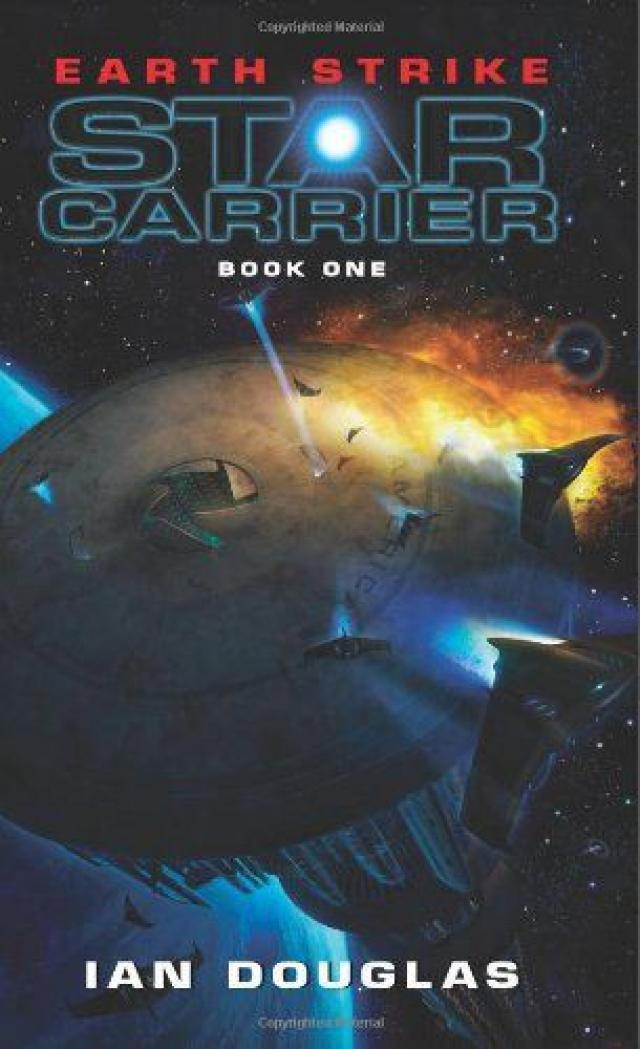
Earth Strike: Star Carrier: Book One sc-1, page 18
part #1 of Star Carrier Series


The beam caught his Starhawk aft, slashing through shields, vaporizing critical portions of the gravfighter’s projection bootstrappers.
Fighters under drive fell toward an artificial gravitational singularity projected in the desired direction of acceleration; bootstrapper was the slang term for the electronics that continually refocused the singularity ahead of the ship from picosecond to picosecond. With the bootstrapper disabled and the singularity still powered, Sandoval’s Starhawk fell into its own drive field, its nose crumpling as the fighter began whipping around the pinpoint singularity in a high-velocity blur. In another instant, about a quarter of the fighter was consumed, smashed down into subatomic debris at the singularity’s event horizon. The rest sprayed into surrounding space, most of the mass transformed into a blinding flash of energy.
The remaining four members of the Dragonfires continued the attack.
Squadron Ready Room
TC/USNA CVS America
Haris Space, Eta Boötis System
1950 hours, TFT
To the uninitiated, the squadron ready room looked like a place for Dragonfire personnel on board the carrier to relax between missions, a lounge with comfortable recliners, indirect lighting, and soft-padded decks. In fact, it was the nerve center for the pilots of VFA-44, the place where they were briefed before each mission, where they debriefed with the carrier’s combat intelligence officer afterward, and where they waited out the hours of a ready alert, waiting for the order to strap on their fighters.
The overhead, vaulted like a planetarium dome, could be set to project maps or combat plots. At the moment, it was set to display an exterior view of space as relayed back by hundreds of drone surveillance modules scattered through battlespace. Lieutenant Gray was alone in the compartment, stretched out on a recliner and watching the battle unfold.
It was a strange and unsettling feeling to be here, knowing that the rest of his squadron-what was left of it-was out there, facing the oncoming enemy in a desperate bid to save the heart of the battlegroup.
Gray had not yet been signed off for flight-ready status. He felt…alone. Alone and helpless. He saw Sandoval’s gravfighter hit, saw its spectacular end. Flashpoint, the phenomenon was called in the milspeak slang of fighter pilots, when a gravfighter and its pilot were both devoured by its own drive singularity.
The Toad Sandoval had been stalking exploded as the Black Lightning pilot savaged it from point-blank range with KK fire.
The sky projected across the ready room dome was sliding smoothly now from one side to the other as the America continued to accelerate. The black bulk of Haris, the planet, shifted with it, blotting out the sun with an artificial sunset. The battlegroup, Gray knew, must be trying to swing around behind the planet, using its bulk as a shield.
He wondered if the fighters still rough-and-tumbling it with the Toads out there would be able to trap.
The Draghonfires’ chatter was coming through over the ready room’s link from CIC, faint voices, adrenaline-shrill with excitement and fear.
“This is Dragon Two! Dragon Two! Got one on my tail!
“Hold on, Two, I’m on him!
“Shit! I’m hit! I’m hit!”
“On him, Two! On my mark, break high and right! Ready…mark!”
Another Toad exploded in white silence. But Dragon Two had been hit, his telemetry showing serious damage to his ship.
Gray’s fists clenched at his sides.
Back on Earth, back in the Manhattan Ruins, you survived by watching out for the others in your extended clan, watching their backs. It was a psychology that translated easily to the military culture, and particularly to the men and women of your own gravfighter squadron. With few exceptions, he hated the others in VFA-44. Sandoval was a stuck-up prig. Spaas, especially, and his partner Collins, were always there riding him about his being a prim, telling him he wasn’t good enough to be a part of their elite.
But they were still a part of his new clan. Family.
And they were dying out there, all of them, and there wasn’t a damned thing he could do about it.
Chapter Thirteen
26 September 2404
CIC, TC/USNA CVS America
Haris Orbit, Eta Boötis System
2015 hours, TFT
“Captain Buchanan?” Koenig said. “Bring those fighters aboard!”
“Aye, aye, sir.”
Under savage, close assault by the Confederation Starhawks, supported by the deadly and accurate batteries on the Spirit of Confederation, the Kinkaid, and the other vessels of the shrunken battlegroup, the Turusch fighters, what was left of them, had broken off the attack. America, after swinging behind the planet, had aligned with distant Sol but not yet begun accelerating.
The Choctaw shuttle and its Nightshade escorts were rendezvousing with the America now, gliding in from astern, aligning their approach vector with the opening at the aft end of the rotating Number Two docking bay. At the last possible moment, they gave a final, brief burst of acceleration before killing their drive singularities and drifting dead-stick into the swinging maw of the docking bay, entering a tangleweb field that slowed them abruptly for the final fifty meters of their approach.
“CIC, PriFly,” sounded in Koenig’s head. “The shuttle is aboard.”
“Thank you, PriFly. I saw.”
He had a screen at his CIC station set as a repeater off of PriFly’s main board. He’d watched the Choctaw enter the gaping opening, could see the gunships coming in through the entrance now, in staggered formation to match the docking bay’s rotation, one after the other. Nightshades were essentially large, two-man fighters, but slower and less maneuverable than Starhawks or War Eagles, with a maximum acceleration of only twelve Gs. That made them good for chewing up ground targets and serving as close-support for the infantry, but not of much use in a gravfighter fur ball.
Koenig turned his attention to the fighters-four from VFA-44 and eight from VFA-51. They were eighty thousand kilometers astern of the America now, but catching up fast.
“Admiral?” Buchanan’s voice said in his head. “Permission to begin accelerating the America.”
“Granted,” Koenig told him. The slow movers were safely on board now. The fighters easily had the acceleration necessary to match velocities with a capital ship. The sooner the last seven capital ships of the battlegroup were pushing c, the better. Koenig still expected Turusch warships to be coming in on the tails of those fighters; they could appear on feeds from the more remote battlespace drones at any moment.
On the tactical display, the ships of the battlegroup began moving faster, as data readouts showed the vector change. The fighters were already going all out, the distance between them and America dwindling rapidly.
Come on, he thought, the words fierce. Get your butts in here….
Dragon One
Eta Boötis IV
2020 hours, TFT
“Okay, chicks,” Allyn said. “Final correction is coming up. Lose the dust balls.”
At her command, each pilot switched off his or her forward singularity and decelerated, sending the atom-sized collections of dust and debris hurtling into the void. The maneuver was vital; those submicroscopic specks could wreak untold havoc with America’s internal spaces if they struck the carrier.
They hadn’t been in flight for long, and the dust masses were so minute they likely would have caused no damage. On the other hand, they were traveling slowly enough that the specks might not pass all the way through the carrier. They could become imbedded in her hull, where they would continue to feed and grow.
There were horror stories still told in the service from the earliest days of gravitic engineering, of ships infested with neutron-sized black holes, of ships and their crews dying slowly.
One by one, the fighters dropped into staggered approach vectors.
“Howie!” she called. “What’s your sit?”
“Doing okay, Skipper.” He sounded scared. Medical telemetry showed his heart rate, breathing, and blood pressure all significantly elevated. “VG is out. So are half my thrusters and some of my sensors. AI off-line. It’s gonna be a dead catch.”
“Stay with us,” she told him. “We’re almost home.”
Spaas’s Starhawk was badly mangled, still flying, but only just. That Toad particle beam had grazed his starboard side, killing both his variable geometry controls, his “VG,” and it had knocked out half of his control thrusters and some critical instrumentation, including his onboard computer. “Dead catch” meant he was going to hit the tangleweb as a dead chunk of metal, with no way of fine-tuning the last second of the approach.
His setup for trap would have to be bang-on perfect.
If America wasn’t in the middle of getting the hell out of Dodge, the likeliest scenario would have been to have Spaas match course and velocity with the carrier, then punch out, allowing SAR tugs from the America to come out and pick him up and recover the inert fighter. But they didn’t have the luxury of time now, and having the America maintain a steady velocity on a constant course for more than a few minutes would invite a barrage of hivel KK rounds that could reduce the carrier to half-molten fragments in seconds.
So they had to do it the hard way-with Spaas landing his crippled Starhawk on America’s rotating deck.
Howard Spaas wasn’t the best Starhawk driver Allyn had ever known, but he was good. He could be arrogant and elitist at times-he made a game of picking on the nuggets, the new pilots in the squadron-and he’d been written up more than once for disciplinary problems.
But he was part of the Dragonfire’s tight-knit family, and she didn’t want to lose him.
“Dragon One, Dragon Three.” That was Collins.
Here it comes. “Go ahead, Three.”
“Request permission to ride Dragon Two in.”
Collins wanted to make the trap side-by-side with Spaas. With her ship coming in just off Spaas’s forward quarter, he could check his alignment and vector by eye, and not have to rely so much on possibly malfunctioning sensors. Experienced pilots sometimes rode in with nuggets, or with other pilots experiencing instrumentation or thruster problems.
“Negative, Two.” Allyn switched to a private channel, so Spaas wouldn’t hear. “Damn it, Collie-dog, I don’t want to lose both of you if this goes bad.”
“Acknowledged.” Collins’ voice was tight, the word bitten off and hard.
Allyn switched back to the squadron channel. “Final turn, people. Let’s do it by the book.”
The America was still invisibly distant, some eight thousand kilometers up ahead. Their dustcatchers jettisoned, the fighters used brief applications of their singularities to align themselves precisely with the ship, then switched them off. The carrier was traveling directly away from them at ten kilometers per second, accelerating at fifty gravities, which increased its velocity by half a kilometer per second every second. The fighters were coming in faster, but slowing; by the time they were a hundred kilometers off America’s tail, they would be moving just three hundred meters per second faster than the carrier.
“VFA-44, you are cleared for trap. Landing Bay Two.”
“Dragon One. Copy.”
“Switch to AI approach,” she said.
“Confirmed,” her computer said. “AI in control of final approach.”
When everything was working right, the computer network between fighter and carrier did a much better job of nudging the ship into the aft opening of a rotating landing bay.
The AI triggered a five hundred grav singularity aft, braking her sharply, just as the America appeared ahead, rapidly swelling in apparent size. The singularity snapped off when she was moving just three hundred meters per second relative to the America.
The carrier looked so damned tiny, a hard-edged toy almost lost among stars and empty night.
And then the carrier’s aft end swelled to fill half the sky and she was into her trap.
Moments before, the carrier had switched off her own grav drive, simplifying the complex ballet balancing velocity and distance. Though conventions like up and down and above and below didn’t exist in free fall, the fighter’s attitude on final suggested that she was skimming in just beneath the vessel’s huge, aft quantum tap power module, the dark, silver-gray metal of the hull blurring past just above her head. Ahead, Landing Bay Two slowly swung in from the right.
The carrier’s hab modules were stacked around America’s spine, like layers in a cake, bent into a disk nestled in behind the mushroom-cap shield. The modules were in constant rotation, creating a steady out-is-down artificial gravity. A rotation of 2.11 turns per minute created the feeling of half a G at the outer rim, one hundred meters from the ship’s spine. A point on the outside rim was moving at twenty-two meters per second, or nearly fifty miles per hour.
The carrier could stop the module rotation, but that created chaos on board, as every crew member, every tool or coffee cup or personal item not fastened down drifted away, weightless. And there was an easier solution.
The landing bay was at the bottom of the stack, closest to the ship’s spine. The rotation of 2.11 turns per minute with a radius of just thirty meters created an apparent gravity of just.15 G-a shade less than the surface gravity of Earth’s moon-but it meant that the turning landing bay was moving at less than seven meters per second.
At the last instant, the AI fired the fighter’s starboard-side thrusters, giving Allyn’s Starhawk a sideways kick to its vector of seven meters per second. For just an instant, the broad landing bay opening appeared to freeze motionless ahead…and then Allyn flashed past the lines of acquisition lights and into the opening.
Where gravitational acceleration or deceleration acted uniformly on both fighter and pilot, making maneuvers feel like free fall, this was altogether different. The tangleweb field invisibly enmeshed the incoming fighter and dragged it down from a relative 300 meters per second to a relative velocity of zero in the space of three hundred fifty meters.
The Starhawk came to rest, and Allyn sagged back against her seat, her vision slowly swimming back to normal after the brutal seven-G decel. Magnetic grapnels unfolded from the overhead, moving her forward and out of the way of the next incoming Starhawk, thirty seconds behind her. They moved her to one of a dozen deck hatches covered over by the liquid-looking black of an atmospheric nanoseal, lowering her smoothly through the clinging seal and into the air and light of the fighter recovery deck. The grapnels deposited her atop an elevator column and released; the column began sinking into the deck, lowering her to the fifty-meter radius level. As she descended, the hab’s spin gravity steadily rose from fifteen hundredths of a G to a more respectable one-quarter gravity.
By the time the elevator column sank into the deck and the cockpit of her fighter melted open around her, Tucker had already trapped and was beginning her descent to the recovery deck, while Collins was in the last ten seconds of her approach.
And Spaas was inbound on final, thirty seconds behind her.
Allyn climbed out of the cockpit and down to the deck, her knees unsteady after seven Gs. “Welcome home, Commander!” a crew chief told her. She nodded and walked aft, unsealing her bubble helmet and tucking it beneath her arm.
An enormous repeater viewall filled much of the aft bulkhead of the recovery deck, large enough to be seen from any part of the cavernous compartment. It showed a camera view looking aft from inside the landing bay, the wide entrance curving upward slightly in a gentle smile, the aft end of the carrier extending back into space from overhead, the stars beyond gently swinging in a slow circle around the carrier’s vanishing point as the hab module continued to rotate. Numbers at the top left of the screen, in green, showed Collins’ approach velocity-282 mps. A second number counted down the seconds to trap: six…five…four…
And then Collins’ gravfighter was there, appearing out of the night as if by magic, hurtling through the landing deck’s maw and slowing abruptly as it entered the compartment’s tangleweb field. The fighter vanished off the side of the screen almost immediately, but a green light winked on above the viewall, signaling a successful trap.
Thirty seconds more to Spaas’ arrival.
She could hear the voice of America’s LSO-AI, a machine intelligence tasked with coordinating incoming fighters with the moving landing deck. LSO was an ancient term going back to the era of seaborne aircraft carriers four centuries before-an acronym for landing signals officer. The job was no longer held by humans; machines were far faster and more precise. Since the LSO-AI was actually handling the incoming gravfighter’s controls, the voice was for the benefit of human observers.
“Vector left…vector left…stabilize…vector left…”
The “vector left” was the LSO attempting to fire the fighter’s starboard thrusters, to match its incoming vector with the seven-meter-per-second rotation of the landing bay. The numerals on the screen were red, showing an approach velocity of 348 mps, too fast, too fast, as the countdown dwindled from seven…to six…
“Gravfighter outside safe approach parameters,” the LSO announced, the voice cold and unemotional. The green light above the opening flashed red.
Allyn’s heart was pounding. Oh, God, no…
“Abort,” the LSO voice continued, impassive, “abort…abort…”
Spaas’ Starhawk appeared, but too far to the left, much too far to the left, and coming in too fast. His ship was dead; he couldn’t abort, couldn’t fire a ventral singularity to warp his course into a vector that would miss the rotating landing bay and the underside of America’s huge cap beyond.
The incoming fighter almost made it….
Spaas’ gravfighter clipped the trailing edge of the entranceway. Sparks erupted, and then the Starhawk’s starboard side disintegrated in peeling, fragmenting metal. The port side flipped into an out-of-control tumble, vanishing off the right side of the screen. The light above the bay flashed red.