Earth Strike: Star Carrier: Book One sc-1, page 16
part #1 of Star Carrier Series


“Dragon Three,” Lieutenant Jen Collins added. “Let’s go!”
“Dragon Four,” Lieutenant Katie Tucker said. “Ready for launch!”
“Dragon Five,” Lieutenant Gene Sandoval said. “Good to go.”
Five Starhawks…with the exception of Prim, down on the planet somewhere, all that was left of the Dragonfires.
“We show all Dragons on-line, at full power, boards green and ready for launch,” PriFly said. “Droplaunch coming up in twenty-seven seconds.”
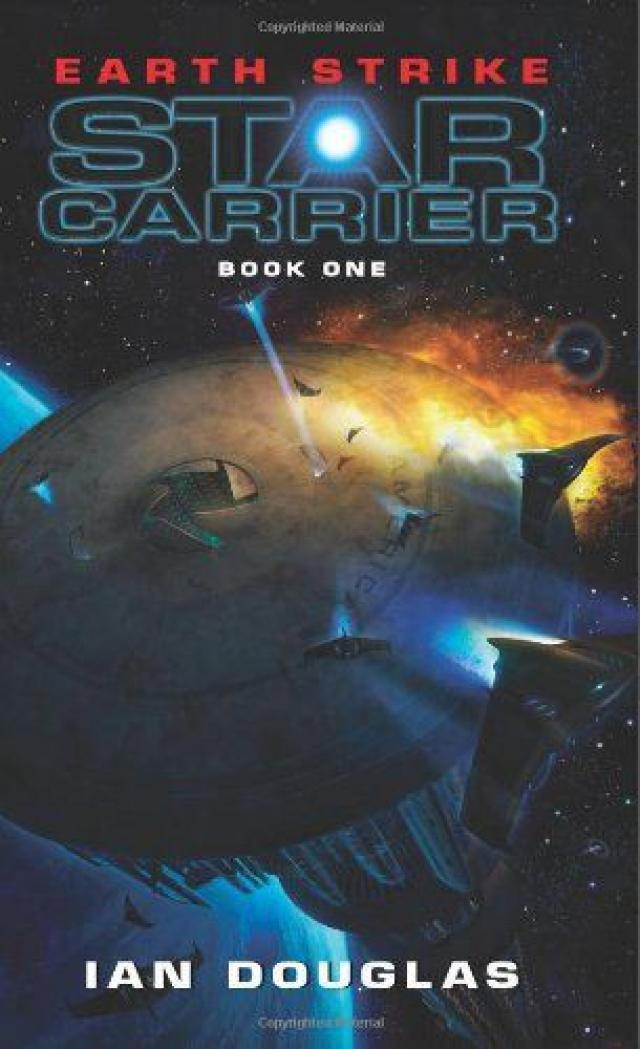
There were three ways to get fighters off of a modern star carrier. Most dramatic, of course, was to fire them out at high-G boost along one of the long twin launch tubes extending up the carrier’s spine and all the way through the huge, water-filled shield cap forward. They could also be simply flown off the launch deck like a Choctaw or any of the other auxiliary spacecraft carried on board the America.
But the third method-the primary means of launching fighters until the development of high-G boost tubes forty years earlier-took advantage of the fact that the carrier’s hab modules were rotating about the ship’s long axis, completing one circuit every twenty-eight seconds to create an artificial, out-is-down spin gravity of half a G-about five meters per second per second.
With a jolt, Allyn’s Starhawk dropped through a sudden, yawning hatch beneath its keel in the launch deck, coming to rest in a small, steel-walled compartment. The hatch overhead slid shut, and she could hear the air in the small chamber bleeding off as the seconds ticked away. The actual launch had to wait until the drop chamber’s outer hatch was properly aligned, to give the fighters the correct vector.
With the compartment in hard vacuum, the lower hatch, the hatch in the launch deck’s outer shell, slid silently open. The fighter rotated in its hanger, facing nose down and out. On Allyn’s in-head display, from her forward optics, she could see stars drifting across the narrow rectangle of her view ahead…a bright orange star-Arcturus, she thought-and a thick scattering of other, less brilliant but diamond-hard pinpoints of light.
And then a piece of the slender orange-and-white crescent of Haris swept into view, as the last few seconds trickled away.
“…and four,” the launch control officer in PriFly announced. “And three…and two…and one…and launch!”
And abruptly, Allyn was in free fall, her fighter sliding off the magnetic grapples and falling out through the open hatch below. As soon as she was clear of the carrier, she switched on her forward singularity, spooling it up to five hundred gravities as she fell away from the America, moving more and more swiftly.
The other four Starhawks fell with her, in picture-perfect formation.
In moments, they were slicing through the tenuous upper levels of the planet’s atmosphere.
MEF HQ
Main Mess Hall
Eta Boötis IV
1852 hours, TFT
For the past forty minutes, Gray, Corporal Anderson, and Mohammed Baqr had been squeezed back into one of the buildings that encircled the base landing pad, filling the base mess hall and several adjacent compartments. The high steel double door leading out onto the landing strip had been sealed shut.
They could see outside on the deck-to-overhead viewall, however. The short local day had just ended, and beneath the sullen and overcast sky, the Marine base had been swiftly plunged into darkness relieved only by the glare from external spotlights on the buildings and from a few glowglobes adrift in the still air. The mob had surged out onto the landing field and was out there still, packed in shoulder to shoulder, some with laser weapons seized from a militia arms locker. During the retreat into the mess hall, shots fired by several of the Marines had kept them back, kept them cautious, but their chants and shouts, muffled at first by their suits, were growing louder, more agitated.
They’d been chanting Allahu akbar more or less nonstop since the riot had begun. Now, though, they’d taken up a new cry. “Death! Death to the great Shaitan! Death!”
Gray couldn’t tell if by Shaitan they meant the Turusch, the Confed military personnel remaining in the base, or the Confederation itself.
Baqr shrugged when Gray asked him about it. “I doubt that they know.”
“Why aren’t you out there with them?” Gray asked.
Baqr made a sour face. “Not all Muslims are fanatics, Lieutenant,” he said. He sounded offended. “Not all are jihadists…or terrorists…or suicide bombers. And not all try to get their own way through juvenile demonstrations like this one.”
“My apologies,” Gray said. “They seem to be putting up a pretty solid front now, though.”
Baqr sighed. “They’re scared. And for most of them, the only comfort they have when they’re afraid is their religion, submission to God, and knowing where you fit into God’s plan. If they think you’re trying to take that away from them, that you’re threatening their belief, somehow, they can get…agitated.”
“Are you afraid?” Corporal Anderson asked.
“Hell, yeah! Right now I don’t know what scares me most…the Turusch, the thought of being left behind on this toxic rock, or them.” He jerked a thumb at the rioters outside. “But damn it, I swore an oath before God to serve with the colonial militia and to support the Confederation. So…here I am.”
Gray clapped him on his shoulder. “And we’re glad you are.” He caught movement in the sky and leaned forward, peering up at the viewall. “Shit. What’s that?”
It was only a shadow for a moment, but then it broke through the overcast, another Choctaw shuttle slowly drifting out of the sky, its belly gleaming in the lights from the base.
The mob had seen the shuttle as well. Several lasers fired, the beams invisible, but the flash where they hit brilliant in the darkness.
And then the Starhawks appeared, dropping down out of the clouds. And Gray and several hundred Marines nearby started cheering.
Dragon One
Above MEF Perimeter
Eta Boötis IV
1855 hours, TFT
Commander Allyn glanced down, her gravfighter’s optics projecting a view of the Marine base into her in-head display that shifted as she moved her head. She could see the lights, could see the crowd filling the landing field two hundred meters below her keel, thousands of upturned and angry faces.
Starhawks could hover on gravs, but they were awkward at it. She’d been considering at first bringing her craft all the way down to just above the landing field, using the Starhawk itself as an intimidating show of force to force the crowd to disperse.
But the gravitational singularities her Starhawk used to maneuver were dangerous in close proximity to unshielded humans. They would be radiating X-rays and soft gamma as they sucked down molecules of this thick atmosphere, and a careless move at too close a distance might suck down a few dozen rioters as well. She might as well open up on the crowd with her Gatling cannon.
“Hey, Skipper,” Spaas called. “I’ve got a bead on the guy stirring up the crowd down there. How’s about we pop him?”
Her tracking system highlighted the target as Spaas pointed him out electronically. She engaged the optical zoom for a closer look, saw a bearded man in a gold-colored e-suit standing on a balcony overlooking the landing field. He had a couple of assistants or bodyguards in black suits behind him, and he was gesticulating angrily, screaming something at the mob.
It was tempting…but she wasn’t going to open fire on the crowd unless she absolutely saw no other way.
And there might be another option. “Negative, Dragon Two,” she said. She shifted to the general combat frequency. “Choctaw One-two-five,” she called, addressing the shuttle hovering overhead. “This is Dragon One, do you copy?”
“Dragon One. Choctaw One-two-five. I copy.”
“Recommend you go plus-zee at least three thousand meters, over.”
“God, Dragon One. What are you going to do?”
“It’s called finesse, One-two-five. Just stay out of our way for a moment.” Shifting frequencies again, she called to the other Dragonfires. “Okay, Dragons. Stay on me!”
She nudged the virtual controls, sending her Starhawk forward, flattening the ship out into a knife-edged and elongated disc, extending back-swept wings, reshaping her airfoils to bank steeply to the left. One by one, the other four Starhawks dropped into her wake and followed. The Choctaw shuttle, after a moment’s hesitation, began gaining altitude once more, slipping back up into the sheltering murk of the cloud deck.
Accelerating quickly now, Allyn swung wide out across the barren desert surrounding the Marine base, hurtling through the night. Her forward singularity glowed white-hot just ahead, an intense, arc-brilliant pinpoint radiating furiously as it chewed through atmosphere, dragging the Starhawk along in its wake.
As she turned, she showed her Starhawk’s AI what she had in mind, felt the shifting, inner harmonics as her brain and the computer running the Starhawk worked together, crunching equations and unfolding an optimal flight path in her mind. She studied a computer-generated model of the Marine base, rotating it, judging the clifflike loom of the taller buildings, the openings in between. It was going to be tight….
The Choctaw was hovering well out of the way now, three kilometers above the base. She leveled off into straight flight, hurtling across the invisible surface of the desert at an altitude of scarcely eighty meters, accelerating hard.
She went hypersonic.
How fast sound travels depends on the density of the medium through which it is moving. On Earth, at sea level and at a temperature of 20 degrees Celsius, sound travels at 343 meters per second; in water, a much denser medium than air, the speed of sound is around 1500 meters per second.
The gas mix that constituted the atmosphere of Eta Boötis IV was 1.7 times denser than air at Earth’s surface, and the molecules of that atmosphere-predominantly carbon dioxide, sulfur dioxide, sulfur trioxide, ammonia, and carbonyl sulfide-all were larger, heavier molecules than the primary constituents of Earth’s atmosphere, O2 and N2.
At the surface of Eta Boötis, the speed of sound was very nearly 700 meters per second-about 2500 kilometers per hour. As Allyn boosted her Starhawk’s acceleration, she was flashing across the desert at nearly 4 kilometers per second, better than Mach 5 for these conditions. Her Starhawk’s computer gently increased her altitude slightly, compensating for the height of the ridgetop on which the Marine base was situated.
Twenty kilometers out-five seconds’ flight time-she fired her PBP-2.
MEF HQ
Main Mess Hall
Eta Boötis IV
1854 hours, TFT
Gray and the others had felt a sudden letdown, a surge of disappointment and even anger as first the Choctaw had lifted itself back up into the clouds, and then as the five Starhawk fighters had streaked off into the night. “The bastards are leaving us!” one Marine had screamed. “The fucking Navy zorchie bastards are leaving us!”
Outside, the crowd was jubilant, shouting and laughing and jumping up and down. Some were firing their lasers uselessly into the sky, in celebration or in an empty gesture of defiance, or both.
Gray had spotted something, though. As the line of black Starhawks had begun slipping away out of the glare of the lights below, he’d noticed that they were flattening out, and that they were growing black, swept-back wings. If those fighters had given up, if they were boosting for space and a return to the carrier, they would have adopted a more rounded, teardrop shape. Wings, however, meant they were planning on maneuvering in the atmosphere, probably at low altitude.
And he thought he knew what they were going to do.
“They’re not leaving, everybody!” he yelled, boosting the volume on his e-suit speakers to make sure he got everyone’s attention. “Everyone get down! Marines…stand ready to move out and secure the landing field!”
He bellowed the orders, putting all of the authority and power he could into the words. Across the room, he caught a Marine major staring at him. A major outranked a Navy lieutenant by one pay grade, the equivalent of a Navy lieutenant commander, and, in any case, a stranded Navy pilot normally had no business giving orders to Marines.
“Do it!” the major barked. “You! You! You! And you! Over by this door!”
And then the sky outside lit up with lightning.
Gray recognized the signature flash of a heavy particle beam. Navy Starhawks mounted StellarDyne Blue Lightning PBP-2 particle beam projectors which could project a bolt of protons with a yield of around a gigajoule in one tenth of a second. The total energy was about one thousandth that of a typical natural lightning bolt, but at close range, the pulse lit up the sky as the air ionized along a straight-line path.
An instant later, the first Starhawk zorched overhead, traveling so low, so fast, that Gray was aware of a flicker of motion but nothing more.
The sonic boom that followed shook the walls of the mess hall, deafening and shrill. It was followed a moment later by a second…a third…a fourth…a fifth, the hyper sonic booms coming in a rapid succession of deafening, high-pitched thunderclaps. Outside, the rioters appeared to crumble in a mass, dropping to their knees or full-length on the ferocrete landing pad, bringing gloved hands up against their helmets as they instinctively tried to cover their ears.
When the Marines and the civilian women and children had fallen back to the mess hall, they’d come in through a large doorway blocked by a nanoseal, the same black, liquid substance used to prevent pressure loss on America’s hangar deck when spacecraft were brought in from the vacuum outside. As the mob had surged after them, a Marine had switched on the seal freeze, turning the suspended nanoparticles into a rigid structure, a barrier stronger than plasteel.
Now, the seal freeze was released, and the first four Marines charged outside, weapons at the ready, followed closer by more Marines, and a scattering of Mufrid militia.
“Come on,” Gray said to Corporal Anderson. “Let’s get out there!”
It took several minutes to elbow through the panicked, milling crowd, but Gray made it to the nanoseal lock and stepped through, pushing against the liquid’s yielding resistance and out onto the landing field. The rioting mob had been effectively neutralized, reduced to stunned and disoriented individuals as the Marines began to shove and push unresisting rioters back off the field. He looked up at the balcony overlooking the field nearby, and saw more Marines grabbing the agitator and hauling him back into the building.
All of the floating glowglobes had been swept away by the shock waves, and many of the remaining lights mounted on the buildings had been shattered. The few lighting panels that remained cast eerie, pitch-black shadows across the field, lending a nightmare aura to the scene.
“Get the field clear!” the Marine major was shouting. “Get it the hell clear!”
Overhead, the Choctaw had reappeared, running lights pulsing, the black, UC-154 shuttle slowly drifting down for a landing.
Chapter Twelve
26 September 2404
CIC, TC/USNA CVS America
Haris Orbit, Eta Boötis System
1945 hours, TFT
With the exception of the Dragonfires, the last of the fighters were recovering on board the carrier, drifting in toward the aft end of the landing deck stretched out along the ship’s spine, killing their grav singularities at the last moment possible, then hitting the tangleweb field to kill the last of their forward velocity. As each Starhawk came to a halt, robotic arms snagged the ship and dragged it forward, out of the way of the next incoming ship, then swung it up into nanosealed ports in the deck above, lifting it up into the hangar deck.
The battlegroup was preparing to accelerate, each individual ship slowly swinging around until its broad, hemispherical forward shield faced a nondescript patch of relatively empty sky midway between the beacons of Canopus and Rigel. Earth’s sun lay there, somewhere in the emptiness. At thirty-seven light years’ distance, Sol was just barely too dim to be seen with the naked eye. On every ship in the fleet, however, the sun’s location was marked by a bright green circle.
Home…
Admiral Koenig sat at his CIC workstation, reports from all twenty-four ships of the carrier battlegroup flooding through the America’s communications suite.
All things considered, the battlegroup had come through in superb shape, much better than he’d hoped. The Farragut and the destroyer Carter both had been destroyed; three more ships had suffered serious damage in the battle, and one of those, the frigate Abramson, had been so badly shot up that her crew was now being transferred to other vessels, including the America. With Mufrid refugees already packed into every available ship, crammed onto mess decks and into passageways and storage bays, it was going to be a tight fit getting everyone on board.
It had been the fighters, Koenig knew, who’d tipped the balance, who’d made the lopsided victory possible. Turusch ships heavily outgunned and out-teched equivalent Confederation vessels, and tended to be much tougher, much more powerful than human ships…especially when you found yourself up against converted asteroids like that command ship.
“Admiral?” Commander Reigh called from the Controller’s workstation. “The Conestogas and their escorts report readiness for acceleration. They’re requesting clearance.”
“Very well. They are clear for boost.”
“Captain Vanderkamp has acknowledged.”
On the tac display, the eight converted Conestoga troopships and four escorting destroyers began to move, falling toward a distant, invisible Sol at one hundred gravities. Captain Vanderkamp, on the destroyer Symmons, would command the detachment, would get them safely back to Sol.
“Clear the auxiliaries for boost,” Koenig ordered.
“Order acknowledged, Admiral.”
Five more vessels-fleet auxiliaries: three supply vessels and two repair tenders-began accelerating as well, falling away from the fast-dwindling battlegroup.
Koenig’s greatest concern at this point was that the Turusch would counterattack, would hit the battlegroup with its fighter screen on board the carrier. With that in mind, he was sending the troopship and unarmed auxilliaries on ahead, with the remaining seven ships-the America, the Spirit of Confederation, and five others-holding position as the last of the fighters and shuttles recovered on board.