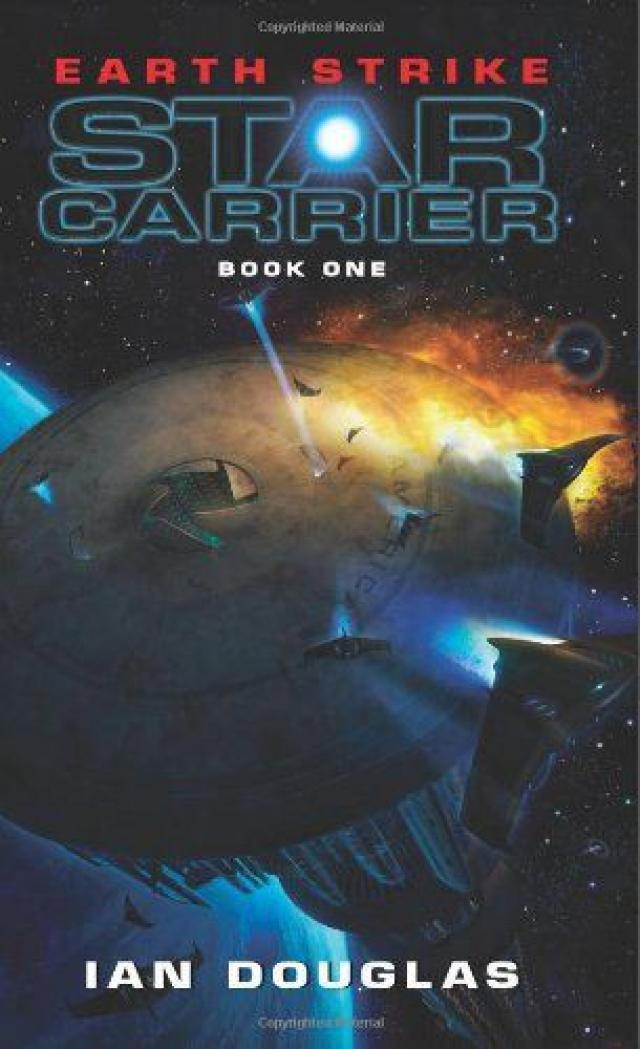
Earth Strike: Star Carrier: Book One sc-1, page 23
part #1 of Star Carrier Series


Abruptly, both turned away from the robot, buzzing at each other.
“Why isn’t there a translation of what they’re saying now?” Mendelson asked.
“The xenopsych people think they’re speaking their own language there,” Koenig told her. “Keep in mind that our translations of their speech are based on an artificial language-LG-which we learned from the Spiders. We don’t have a clue as to how to break the original Turusch language.”
The recording ended, and Koenig again faced the members of the preliminary board across the empty table.
“Transcendence,” Admiral Barry said. “That seems to be an ongoing theme with these creatures.”
“Yes, sir. In particular, we think they’re talking about the GRIN Singularity.”
Since the twentieth century-some would say earlier-human technology had been advancing in exponential leaps, each advance in science spawning new advances in dizzying and fast-accelerating profusion. It wasn’t just the technology that had been growing; it was the pace of that growth, the ever-increasing speed of technological innovation and development. Just five centuries ago, humans had made their first successful heavier-than-air flight in a fabric-and-spruce glider powered by a gasoline engine, a voyage lasting all of twelve seconds and covering 120 feet. Thirty years later, aviator Wiley Post flew a Lockheed Vega monoplane around the world, the first man to do so solo, making eleven stops along the way and logging the total time in the air at 115 hours, 36 minutes.
And thirty years after that, humans were riding rockets into low Earth orbit, circling the globe in ninety minutes, and were just six short years from walking on the Moon.
In the late twentieth century, a science fiction writer, math professor, and computer scientist named Vernor Vinge had pointed out that if the rate of technological change was graphed against time, the slope representing that change was fast approaching a vertical line-what he called the “technological singularity” in an essay written in 1993. Human life and civilization, he’d pointed out, would very quickly become unrecognizable, assuming that humans weren’t replaced entirely by their technological offspring within the next few decades.
Other writers of the era had pointed out that there were four principle drivers of this exponential increase in high-tech wizardry: genetics, robotics, infotechnology, and nanotechnology, hence the acronym “GRIN.” The GRIN Singularity became a catchphrase for the next four centuries of human technological progress.
“GRIN wasn’t quite the apotheosis people thought it would be,” Noranaga pointed out.
“That’s kind of a strange statement coming from a guy who breathes with gills and can outswim a dolphin,” Barry pointed out.
“He’s right, though,” Mendelson said. “The way the pace of things was picking up in the twenty-first century, it looked like humans would become super-sentient god-machines before the twenty-second. The surprise is that we didn’t.”
“Well,” Koenig said, “we did kind of get distracted along the way.”
As Mendelson had pointed out, the only surprising thing about any of this was that the rate of increase hadn’t already rocketed into the singularity sometime in the late twenty-first century. Various factors were to blame-the Islamic Wars, two nasty wars with the Chinese Hegemony culminating in an asteroid strike in the Atlantic, the ongoing struggle with Earth’s fast-changing climate and the loss of most of Earth’s coastal cities, the collapse of the global currency and the subsequent World Depression. The Blood Death of the early twenty-second century had brought about startling advances in nanomedicine…but it had also killed one and a half billion people and brought about a major collapse of civilization in Southern Asia and Africa.
Those challenges and others had helped spur technological advances, certainly, but at the same time they’d slowed social change, redirected human creativity and innovation into less productive avenues, and siphoned off trillions of creds that otherwise would have financed both technological and social change. Human technological advance, it seemed, came more in fits and starts than in sweeping asymptotic curves.
Admiral Barry shrugged. “There are those who still claim that the exponential increase in technological growth can’t be sustained indefinitely, that the rate of growth has actually been slowing over the past three centuries. They say that eventually, things will level off onto a mathematically stable plateau.”
While Koenig was aware of the arguments-he had to be, to keep track of the rapid-fire advances in military technology-he had no opinion one way or the other. Technology simply was; you lived with it, grew up with it, depended upon it to integrate with the modern world. From virtual conferences such as this one to interfacing with the NTE robots in America’s research facility to Noranaga’s genetic prostheses to the nanufacture techniques used to construct Phobia, GRIN technologies were a part of each and every aspect of modern life.
Of course, the big question was what the technological singularity actually meant. How would life become unrecognizable? Modern commentators frequently used the word transcendence, without explaining what that might mean. The suggestion was that Humankind would turn into something else. But what?
“I wonder, though,” Koenig said, “if what the Sh’daar are worried about is the technological transcendence of humanity. If we did become half-machine, half-god hybrids, we might pose a threat to them.”
“Maybe,” Mendelson said. She didn’t sound convinced. “But if we had truly godlike technologies, why would we want to fight or conquer anyone?”
“Well, we have one clue staring us right in the face,” Koenig said. “From what we learned through the Agletsch, the Sh’daar have been around for a long time. If anyone should be technological supermen-superbeings, rather-it would be them, right?”
Barry nodded. “Our best information on the Sh’daar suggests that they began moving out into interstellar space from their home planet sometime during the late Ordovician…say four hundred fifty million years ago. That’s a long time.”
“Most xenosophontologists think we don’t understand Agletsch dating systems,” Noranaga pointed out. “A sentient species that exists for almost half a billion years? It’s not possible.”
“Bullshit, Admiral,” Mendelson said. “We don’t know yet what’s possible and what’s not. It they reached a point of perfect stability…either no growth or very little, with control over their own genome so they didn’t evolve into something else, why not?”
“The point is,” Koenig said, “a race that’s been around for half a billion years or so ought to be so far beyond us that there’s no way we could fight them, no more than clams could stop people from building an arcology on their beach.”
“True,” Mendelson said. “Even if they’re only a half million years ahead of us technologically, they’d be like gods from our vantage point, and their technology would look like magic. We wouldn’t stand a chance.”
“Well, we haven’t been fighting the Sh’daar directly,” Noranaga said. “All we’ve seen are their front men…the Agletsch and the Turusch.”
“And why even bother with the likes of them,” Mendelson said, “if the Sh’daar could just wave whatever it is they use for hands and make us vanish? Poof! Problem solved.”
“We can’t really speculate about their reasoning,” Admiral Barry said. “It is, after all, alien.”
“But that reasoning is still rooted in the real world,” Koenig said. “At least…in the real world as they perceive it. If we can understand that reasoning, we might have a chance to come to an agreement with them. To understand them.”
“All of which is for the xenosoph people to figure out,” Barry said, leaning back in his virtual chair. “While interesting, speculation about alien motivations is not germane to this Board of Inquiry. Admiral Koenig, did you have a particular reason for bringing all of this to our attention?”
“Only insofar as it might have a bearing on this hearing,” Koenig replied. “Unofficially, at least, my battlegroup’s primary orders were to go to Eta Boötis and retrieve those Turusch prisoners, bring them back to Mars. That part of the mission, at least, failed. That fact could have a bearing on these proceedings.”
“Hm.” Barry gave the faint shadow of a smile. “And what does your legal AI have to say about this?”
“It advised me to say nothing about the Turusch killing each other, that I should focus on the fact that we did get the aliens and Gorman’s Marines, plus several thousand civilians who otherwise would have been killed, back to human space.”
“You don’t believe in listening to legal counsel?”
“Only when I believe that counsel is the right thing to do. Sir.”
“I see. Well…I declare this hearing into the conduct of Rear Admiral Alexander Koenig during the recent operational deployment of the America battlegroup open. Let’s begin by reviewing the operational orders for Carrier Battlegroup America from the time when they were issued…beginning on 6 September, 2404…”
Intrasystem High-G Transport Kelvin
Approaching SupraQuito
Earth Synchorbit, Sol System
1610 hours, TFT
Lieutenant Gray watched the Earth swelling to blue-white glory just ahead. Within his passenger pod nestled inside the stubby IHG transport, the feed from external optical pickups had rendered the craft itself invisible. It seemed to Gray that he was leaning back in his recliner, completely open to empty space, surrounded by a panoply of stars, the sun brilliant off to one side, and Earth and Earth’s moon as an unlikely and mismatched pair before him.
Ten hours had passed since he’d boarded the Interplanetary Direct transport back at Phobia. Accelerating at one hundred gravities, the Kelvin had reached a midpoint velocity of.06 c, almost nineteen thousand kilometers per second, then flipped its drive singularity astern to decelerate for the rest of the flight to its destination.
The trip back to Earth was Fifer’s idea…an opportunity, the psych officer had told him, to take another look at his roots. In particular, Fifer wanted Gray to see if he still fit in with the tribes of the Manhattan Ruins. He’d boarded the shuttle at 0800 hours that morning, signing out at America’s quarterdeck and boarding the Kelvin at her embarkation dock with fifteen enlisted members of America’s crew heading for Earth on liberty. He’d chatted with one of them, an armaments tech, second class, while waiting to board the Kelvin. Usually, enlisted liberty was short-from twelve to forty-eight hours-but twenty hours of travel time between Mars and Earth cut into that time sharply. The tech told him that she’d been granted a seventy-two, as had the others going to Earth. Scuttlebutt had it that America would be redeploying to Earth Synchorbital within the next day or two; if that happened, she’d rejoin the ship there-and get an extra ten hours visiting her parents in Columbus, DC.
As an officer, Gray didn’t need to worry about liberty. He’d simply signed out after receiving permission from the CAG office to go Earthside for seventy-two hours. Plenty of time to do what he needed to do in Manhattan and get back to the ship, whether she was still at Mars or docked at SupraQuito.
He found himself thinking about Rissa Schiff, the cute ensign from the avionics department he’d met last time he’d been at SupraQuito. He’d found her fun and engaging, had been wondering about taking things further with her…at least until Collins and Spaas had busted up the party. The pairing probably wouldn’t have worked; he was still looking for something permanent in a relationship. Schiffie had been looking for fun-one night or many, but nothing lasting.
God, he missed Angela.
The moon appeared to be slowly drifting off to one side, turning from nearly full to a crescent as the Kelvin slipped past it and into circumlunar space. The lights of cities appeared scattered across those parts of the moon in darkness, tight clusters marking the cities at Crisium, Tranquility, Apennine Vista, Tsiolkovsky, and the others, all woven together by a slender webwork of glowing threads marking the surface gravtubes.
Earth grew larger, the rate of growth slowing with Kelvin’s continuing deceleration. Eventually, Gray could make out what appeared to be strings of minute stars drawn out in slender arcs around the planet. After three centuries, Earth Synchorbital had become the preferred location for the vast majority of the planet’s off-world manufactories, power production, shipyards, and orbital habitats. Several million people lived in orbit now, the number growing daily. Like Mars, Earth was served by three space elevators-one at Quito, one on the northern slope of Mt. Kenya, and one on the island of Pulau Lingga, on the southern edge of the Port Singapore megalopolis. The habs and orbital factories at Synchorbital didn’t extend all the way around the planet yet; it would be centuries more before Earth had a genuine system of rings 36,000 kilometers above its equator. Even so, it was remarkable to see how the hand of man had so touched the world of his birth and that world’s moon that evidence of his technology could be seen from this far out in the Void.
Still decelerating, the Kelvin continued to close with the nexus of gleaming habs and solar panels at SupraQuito. Gray could see the elevator itself now, a gossamer-thin strand of light stretched taut between a mountaintop in Ecuador and a small planetoid anchor twenty thousand kilometers above synchronous orbit. The Kelvin’s launch from Phobia had been timed to arrive at SupraQuito precisely as the receiving facility orbited into position. The Kelvin’s onboard AI made a rapid series of final corrections using the drive singularity astern, then switched off the drive and drifted into the tangleweb field at less than a hundred meters per second. Gray felt the surge of deceleration, startling after ten and a half hours of zero-G under gravitic drive.
His travel pod melted away around him as an AI voice thanked him for choosing Interplanetary Direct for his travel needs. Eighty creds had been deducted from his account on board the America to pay for the flight.
The receiving bay was in microgravity, of course. Robots hovered nearby, waiting to assist passengers unused to moving in zero-G, but Gray grabbed a handrail and pulled himself along with more or less practiced ease. The local hab section would be rotating, like the crew modules on board America, but he needed to enter it at the hub and ride an elevator out and down to the main deck. Hauling himself hand over hand, he followed glowing arrows projected on the bulkhead toward customs. His baggage-a single small satchel-would be forwarded directly down to Quito.
The local time, he noted, was 1125 hours-five hours off of shipboard time, which was set to GMT. And Quito was in the same global time zone as Manhattan.
He would be there, he thought, by late that afternoon.
Solar Kuiper Belt
5.5 light hours from Earth
1830 hours, TFT
High Guard Watch Station 8734 was tiny-a spherical object the size of a woman’s fist-and most of its mass consisted of foam insulation against the ambient 50-degree Kelvin temperatures so far from a wan and distant sun. It was one of some hundreds of thousands of AI detector probes scattered across the surface of an immense sphere, with a radius of five and a half light hours, centered on Sol.
The automated High Guard Watch had begun late in the twenty-first century, as the first automated probes were placed in solar orbit roughly at the mean distance of Pluto. Tiny onboard cameras and mass detectors the size of BBs kept a constant watch on the surrounding sky, recording mass and movement, the data spreading across large networks of the probes for correlation and tracking. The idea had been to spot comets or asteroids falling in out of the Kuiper Belt, objects that in future epochs might threaten Earth or Earth’s solar colonies. The sooner such objects were detected, the easier it would be to nudge them into new orbits that would never threaten human habitats.
Later, they were programmed for another task-watching for the flash of photons released by starships as they dropped out of Alcubierre Drive. They served as a navigational net, tracking incoming and outgoing ships by their photon release.
And since the Sh’daar Ultimatum, in 2367, they’d watched for the arrival of alien ships that might pose a threat to humankind.
The network was stretched painfully thin. Even half a million probes are few and far between when they’re scattered over the surface of a sphere eleven light hours across. The nearest probe to 8734’s current position was 3683, now thirty light seconds distant, twenty times the distance between Earth and Earth’s moon.
A burst of high-energy photons captured 8734’s electronic attention. Twin cameras focused on the disturbance, estimating the distance at nearly one light hour out, deeper into the Kuiper Belt; probe 3683 recorded the flash twelve seconds later, allowing a more perfect triangulation and target lock. The arriving ship was large-enormous, in fact, a small planetoid converted into a starship of alien configuration.
The closest human presence was a Navy listening post on Triton, a moon of Neptune, now 2.9 light hours distant. High Guard Probe 8734 duly transmitted its data and continued to monitor the movement of the intruder vessel…as around it more and more new targets began to flash into realspace existence.
Chapter Seventeen
17 October 2404
Triton Naval Listening Post, Sol System
2125 hours, TFT
Hostile warships were arriving at the outskirts of Earth’s solar system, but it took precious time to get word of the event to Mars. Two hours, fifty-five minutes passed before data arrived at Triton from the first probe to detect the incoming fleet, and the data were already an hour old even before the transmission had begun.
Things tend to happen slowly at the thin, cold edge of the solar system.
Lieutenant Charles Kennedy was the commanding officer of the Navy’s Triton listening post, a tiny base housing twelve Navy personnel, a handful of civilian researchers and base technicians, and a modest AI named Sparks. A few kilometers distant, mobile mining platforms the size of battleships crept across the frozen landscape, extracting nitrogen from the surface, pressurizing it, bottling it, and magnetically launching it into the long trajectory sunward for use in the Martian terraforming project.