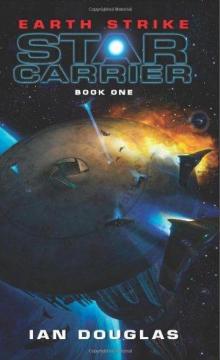
Earth Strike: Star Carrier: Book One sc-1, page 26
part #1 of Star Carrier Series


“Aye, aye, sir. Give me a moment here….”
Five aging frigates and destroyers against at least thirty Turusch warships…probably more by now, probably a lot more.
The odds, he thought, were not at all good.
Manhattan Ruins
North American Periphery
2009 hours, local time
“Hello! Anyone here?”
Gray’s voice echoed back at him from empty passageways and silent chambers. It seemed impossible that TriBeCa Arcology could be vacant…but he’d been searching through its halls for over an hour now, and he had yet to see any other humans.
He walked down the passageway leading to the suite of rooms he’d lived in with Angela, carrying the rented gravcycle over his shoulder. The broom was his ticket out of this place, and he knew that had he left it up on the roof where he’d landed, it would have been gone by the time he returned.
And that had been an odd point, too, now that he thought about it. His family had always maintained a watch up on the arc roof, but there’d been no one there when he’d landed. What in hell was going on?
“It’s Trevor! Trevor Gray!” he yelled. He thought he heard a scuttling sound in the distance, the scrape of shoes on floor tiles. He wasn’t certain. It might have been rats. “I’m looking for the TriBeCan Eagles! Is anyone here?”
The sun had set some time ago, and it was dark. Gray was wearing a small but powerful wristlight that illuminated the passageway ahead, but he was beginning to worry about getting lost in this maze.
He thought this was the way….
Yes! That was the entrance to the rooms he’d shared with Angela!
Of course his old quarters had long since been occupied by someone else. Ragged curtains had been hung to divide large spaces into smaller, private areas. Mattresses and blankets lay on the floors. The remains of a cook fire, the ashes still warm to the touch, had blackened a patch on what once had been the floor of a sunken living room. None of this stuff was his, however. Others had moved in after he and Angela had gone.
Which was only to be expected. But…surely they would remember him? It had only been five years, after all.
“Chiseler!” he shouted, almost screaming the name.
He walked over to the living-room window, what once had been an actual wall-sized picture window and sliding door with a balcony outside. When he and Angela had lived here, the balcony had been long gone, crumbled away a century before, but the window had still been solid, a sheet of scratched and sun-clouded plasglas extending from floor to ceiling. The plasglas was gone now, the opening admitting a steady spray of cold mist from the ongoing drizzle outside.
Carefully, he put a hand out to one frame of the vanished door and looked down, four hundred meters to the water, the depths between island-buildings lost in the growing darkness below, though there was still pale light in the sky. Vines growing on the outside surface of the arcology were curling in through the missing window, and beginning to flourish on the inside.
So why hadn’t the Authority reclaimed the Ruins? The largest buildings, like TriBeCa, were still sound. There’d been plans to rebuild the Old City out over the water using structures like the TriBeCa Arcology as pylons, he knew, for two centuries or more. It was technically feasible, at least.
There’d been no money for such projects after the Crash in the late twenty-second century, when nanotech had overthrown the old economic models. But things were prosperous enough now. At least for the rest of the Confederation.
Maybe people just got used to things the way they were. So far as that peaceforcer up in Morningside Heights was concerned, the squatties had always been here, the Ruins always a place of danger and primitive discomfort.
It hadn’t always been so, though. He and Angela had often stood on this spot, trying to imagine what life had been like when the Old City had been alive, vibrant with power and life, the first and greatest of the modern megalopoli. He’d seen old memory clips of the city before the first evacuations in the twenty-first century. Primitive…but astonishing, breathtaking, and miraculous in scope and in audacity, nonetheless.
He sensed, rather than heard, the movement at his back.
Gray spun, the gravcycle snapping down off his shoulder and into a port-arms position. The squattie was halfway across the sunken floor, short, black-haired, clad in stinking rags. He was holding a spear made from a lightweight metal rod with a kitchen knife taped to the end.
The man was rushing him, clearly intent on either stabbing Gray in the back or knocking him forward through the window, and into a four-hundred meter drop to the water below. Gray snapped out with the back end of the gravcycle, using it like a quarterstaff, blocking the man’s lunge and sharply bending the light metal rod of his improvised spear.
“Stop!” Gray shouted. “I’m not your enemy!”
His attacker barked something in an unknown language, and Gray’s eyes widened at a sudden realization. His attacker was Asian.
But that wasn’t possible.
Tens of thousands of individual families had made up the fabric of squattie life and culture within the Manhattan Ruins, but above the family level-individual groups of twenty to fifty people-there’d been hierarchies of tribe and race-divisions along racial lines, for the most part, though there were plenty of tribal groupings based on nations of origin as well. Blacks. Whites. Latinos. Hindi. Paks. Thais. Viets. Chinese. Khmers. Russians. All of these were represented within the Ruins, and many, many more. Though families might raid and forage across most of the Ruins, from the Battery to the Bronx, they did so by trespassing on the turf of other tribes…and that was what made life in the Ruins so dangerous. Chinatown, just to the east of TriBeCa, remained an Asian enclave that stubbornly resisted the influx of other ethnic groups; when he and Angela had lived here, an agreement of sorts had existed between the TriBeCa families and Chinatown, to the effect that each stayed out of the other’s turf, maintaining a wary truce. The islands beyond Broadway Canyon and south of the Canal were deadly to non-ethnic Chinese.
Gray couldn’t decide if the man in front of him was North Chinese, Korean, or Japanese. The language had sounded more like Japanese-explosive and guttural-rather than like the more musical Mandarin or Cantonese. His rags included a fairly new-looking smartsuit jacket, presumably scavenged from the ruins of some clothing store, but the indicator light at the collar wasn’t on, so it wasn’t powered. Most smartsuits could maintain a comfortable temperature, interface with local Net-Clouds in order to pull down weather reports and other data, or serve as communications centers…but some used biofeedback to enhance significantly the wearer’s speed and strength. If Gray had to face someone hand-to-hand, he didn’t want them wearing one of those things.
“Take it easy!” Gray said, motioning with his hand. His mind was racing. If Asians were here in TriBeCa, it could only mean the old families, including Gray’s family, the Eagles, had left, driven out, perhaps, when the truce had failed. “Do you understand me?”
The man barked something again, the words unintelligible, then lunged again with his bent spear. Gray sidestepped the thrust, snapped his broom up and around, knocking the man flat on his back.
Shit. The peaceforcer had said there’d been changes in the Ruins. And something about the inhabitants killing each other even more enthusiastically than usual.
If the truce had failed, if the Chinese had moved in on TriBeCa, there was no telling where the rest of his family was now. Hell, it hadn’t been that long since captured enemies had been skinned and suspended still living from building walls as no-trespass warnings to marauders, and there were still occasional stories, whispered and wildly embellished, of cannibalism and mass murder among the crumbling islands. Life in the Manhattan Ruins had never been easy, but at times it got downright interesting. Hellishly so.
His family might have migrated to another part of the Ruins, moving in with allies, possibly, or taking away some other group’s hab space to replace the hab stolen from them. That was the way of life in the Ruins.
Or the Eagles might all have been butchered. That, too, was life-and death-in the Old City.
It was strange…and a bit unnerving. Just five years ago, Gray had been a squattie, a life he didn’t particularly like, but which he accepted, and which he’d been convinced was better than life under the Authority.
But now…
The man on the floor groaned and stirred. There was no point in interrogating him; Gray doubted that he spoke English. Once the Authority had withdrawn from the Ruins, individual families and tribes had pretty much fallen back on the customs and languages of their individual ethnicities, and English was a second language, if it was even known at all.
He set his broom on the floor, stretched out on the seat and let the safety harness engage, then gave it a boost and rolled for the open window. Cold, wet air engulfed him as he fell…and then he was feeding in power and leveling off, flying toward the south.
He wasn’t at all certain where he was going now.
Admiral Karyn Mendelson’s Quarters
Mars Synchorbit, Sol System
0234 hours, TFT
Alex Koenig and Karyn Mendelson both snapped awake at the same instant, the Priority One alert sounding within both of their minds, yanking them from a deep, sex-induced slumber. They were still entangled with each other, holding each other, staring into each other’s eyes from just a few centimeters apart.
“Lights!” Mendelson called, and the bedroom lights came up. Rolling out of opposite sides of the bed, they began reaching for articles of clothing scattered on the deck a few hours earlier.
“P-A!” Koenig called, summoning his Personal Assistant out of the Net-Cloud as he stepped into his underpants. “What the fuck is going on?”
“A Priority One defense alert has just been issued by the Military Directorate,” his AI replied. “An announcement follows.”
He and Mendelson exchanged glances as they continued getting dressed. She’d evidently gotten the same news from her AI.
“To all military personnel within range of this Net-Cloud. This is Admiral John C. Carruthers of the Confederation Joint Command Staff.” Carruthers was the five-star admiral on the Joint Chiefs, the senior military officer, under the civilian secretary of defense, of the Confederation Navy. “At approximately seventeen hundred forty-five hours Fleet Time yesterday, a large Turusch battle fleet began dropping into normal space, forty-five astronomical units from Sol, roughly on a line between Earth and the constellation Boötis. The photon release of that emergence was detected by our automated systems roughly three hours later, and a warning broadcasted to our listening post on Triton. One hour after that, contact with Triton was lost. We must now assume that Turusch fleet elements have destroyed that base.
“High Guard elements are seeking to close with the intruders in order to gather more intelligence. We do not expect them to materially hamper the enemy’s operations.
“The Senate president and the secretary of defense have authorized me to declare an immediate crimson alert, and to scramble all, repeat all available military and High Guard vessels for the defense of the Inner System. We do not at this time know how much time we have or whether the enemy has launched a high-velocity preemptive strike against Inner System targets. In light of this latter possibility, it is imperative that all ships launch in the shortest possible time.
“Repeating. To all military personnel…”
Having heard and acknowledged the alert, Koenig and Mendelson were able to switch it off. Koenig finished pulling on his uniform jacket as Mendelson shrugged into a military smartsuit. “Where are you going?” he asked.
“My duty station,” she replied. “Phobia’s CIC. I’m on Admiral Henderson’s command staff. You’re headed for the America.” It wasn’t a question.
“If I get there in time.” He gave a wan grin. “Buchanan’s still aboard. He’ll be readying her for boost by now.”
“Good luck, Alex.”
“And you, Karyn. Stay…” He stopped. He’d been about to say “Stay safe,” but that wasn’t an option for naval personnel, who by long tradition went into harm’s way. “Stay out of trouble,” he finished lamely. “I’ll see you when we get back.”
He didn’t add that there was a distinct possibility that the promised meeting would never happen.
Liberty Column
North American Periphery
2134 hours, local time
Trevor Gray sat alone atop the crown of the ancient Statue of Liberty.
Once, Lady Liberty had stood at a much lower elevation, the statue and its pedestal and foundation rising some 93 meters from an irregular, eleven-pointed star-shaped base. In the late twenty-first century, as rising sea levels had repeatedly threatened New York City and promised to completely drown little Liberty Island, the old pedestal had been replaced by a new, taller column. That column now thrust up out of the black waters submerging Liberty Island, supporting the 40-meter copper statue some 120 meters above the new sea level.
Technically, the Statue of Liberty still belonged to the old U.S. government, by way of the National Park Service and under the provisions of the Confederation Charter. She had fallen on hard times lately, however. Low-voltage electrical charges, generated by the interaction of salt water and corroding copper, were slowly loosening the Lady’s rivets. The upper six meters of her arm had broken off and fallen into the sea long ago. Like plans to reclaim Manhattan, the ancient icon of liberty was being forgotten, the statue allowed to collapse into ruin.
You could see her from the southern and western windows of TriBeCa, though, at least when the weather was clear, and she’d always been a powerful and deeply moving symbol for Gray. Life in the Ruins, even when it was brutish and short, was supposed to be about liberty.
He sat on Lady Liberty’s hairline immediately in front of the gaping windows lining the front of her crown, his legs dangling over the side. In the darkness off to his left, to the north, the Ruins loomed across New York Harbor, the hundreds of individual green-cloaked islands merging into shadows upon shadows. The tallest islands were marked by strobing navigational beacons, warning off low-flying aircraft or personal fliers. Beyond, the New City gave off a glow as intense as a false dawn, backlighting the darkened islands.
The rain had ended an hour ago, and the sky was clearing. To the south, out over the ocean, he could see the faint, inline stars of SupraQuito twinkling some 50 degrees above the horizon.
Gray was feeling torn, torn between past and present, between what he’d been and what he’d become. Given time, he thought he could track down the Eagle family, if there were any left alive. Once daybreak illuminated the Ruins, he could fly in, spot a scavenger or, better, a hunting party, and question them.
Just so long as the Chinese hadn’t taken over the entire mass of islands.
But that was impossible. Unless they’d gotten hold of a cache of military weaponry, they couldn’t possibly take over the entire expanse of Manhattan. They simply didn’t have the numbers.
He was still coming to grips with the fact that the place he’d thought of as home for all these years, including his years in the Navy, was gone. It left him feeling adrift in a way he’d never felt during his five years of military service.
It felt like he no longer had a home to come home to.
Worse, it felt like home was now shipboard. His berth aboard the America. The thought was unsettling, and left him depressed and bitter. What was left for him…going back to the Navy and serving out a twenty-year career? Then what?
He wondered if he dared fly back up to Morningside Heights and see if he could see Angela. She’d seemed pretty definite about not wanting to see him anymore, but she could have changed.
It was possible, at least….
The shrill bleat of an in-head warning signal so startled him he nearly fell off of his precarious perch. Damn it! How was it possible? There was no Net-Cloud here, the peaceforcer had told him. The signal must be being punched through at extraordinarily high power from synchorbit itself, bypassing the local Net-Cloud nodes and transmitting directly to individual in-head units.
“To all military personnel within range of this Net-Cloud,” a voice announced, sharp in his head. “This is Admiral John C. Carruthers of the Confederation Joint Command Staff….”
And suddenly things were very much more serious indeed.
Chapter Nineteen
18 October 2404
USNA Gallagher
Neptune Space, Sol System
0250 hours, TFT
The IP had come up empty.
The five High Guard vessels had rendezvoused in a high-velocity pass-through, but there’d been nothing there within range of their scanners. Captain Lederer had ordered the release of a dozen battlespace drones, set to disperse through local space and transmit anything they detected both to the Gallagher and to the Inner System. However, the good news for the moment was that the Turusch fleet was not in a hurry to reach Earth.
A careful scan of ambient space for the ionization trails left by near-c impactors or high-V fighters turned up nothing as well. Local space was thin-no more than a hydrogen atom or two per cubic centimeter, but the passage of anything traveling at a generous percentage of the speed of light swept up some of those atoms and ionized others, leaving a faint but detectable trail. The lack of such trails suggested that the enemy had not started bombarding the Inner System.
All very good news.
But that left the question of just where they were and what they were doing. That they would eventually head in-system was patently obvious. If they waited too long, the tactical advantage would pass to the Confederation.
So where in this hell of frozen emptiness were they?
Following the op plan drawn up by Gallagher’s navigational team, Lederer had ordered the tiny flotilla to apply side thrust, slightly changing their vector, until they were on a course taking them directly into the Neptune system. Neptune was ahead of the High Guard flotilla in its orbit and, at the moment, its moon Triton was located on the far side of the planet from the approaching ships. The alignment offered Lederer and the other High Guard captains a unique tactical advantage.