Earth Strike: Star Carrier: Book One sc-1, page 34
part #1 of Star Carrier Series
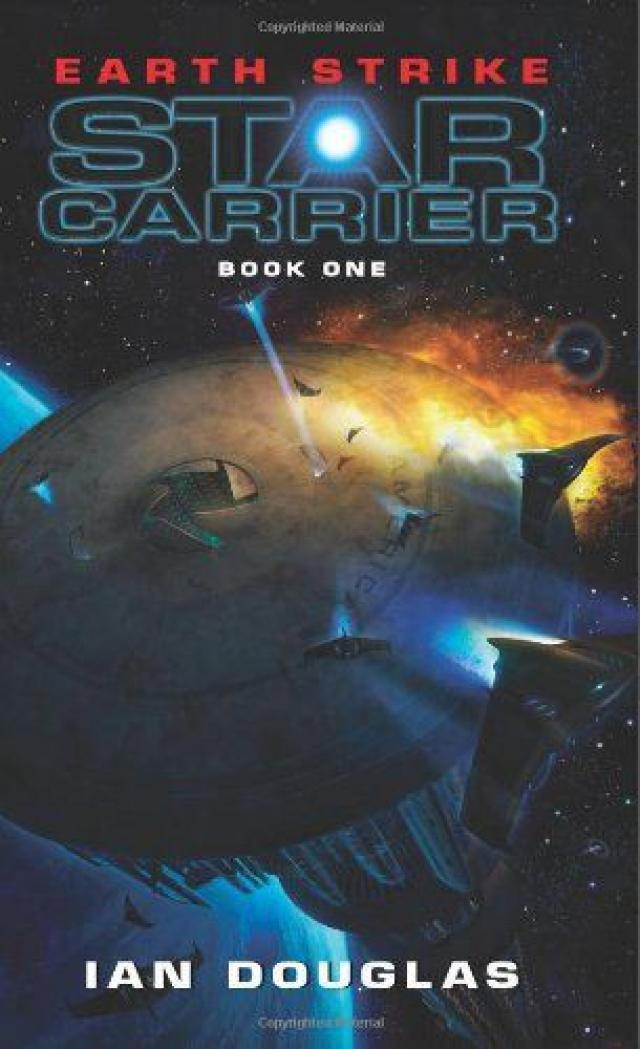


The idea was hardly a new one. As Gray had mentioned, the A-7 strike package used for long-range planetary or fleet bombardment used the same concept. The twist was using AMSO defensive fire as an offensive weapon-a weapon of decidedly mass destruction.
“Group two, ready…fire!”
Twelve more AS-78 missiles slipped from Starhawk missile bays and engaged their drives, vanishing into the twisted strangeness of near-c space. “Fox Two!”
“Group three, ready…fire!”
The missiles had been reprogrammed. They would not automatically detonate, scattering their matter-compressed lead-grain warloads a few seconds after firing. Instead, they would detonate when their onboard radars picked up the first enemy ships ten light seconds ahead. The sand clouds should still be fairly tightly packed in that distance, still carry a staggering kinetic punch.
Gray knew there’d been experiments with using sandcasters as offensive weapons. The idea had been dropped years ago, primarily because it was such a blind, area-effect, deadly weapon; fire one of the things at near-c in the general direction of Earth, and you might find you’d accidentally scoured away the continent of Africa, and wrecked the planet’s weather patterns for the next couple of centuries.
But in this particular tactical setup…why not? The only thing in that direction was the star Alphekka. Maybe a few grains of sand or hot plasma would sizzle into that star system seventy-five years or so from now, still traveling at 99.7 percent c, and maybe by then the interstellar medium would wear the individual grains down to nothing and absorb the plasma’s kinetic energy.
“Group four, fire!”
He felt his own Starhawk lurch as his missiles slid off the launch rails. “Fox Two!” he called, adding his cry to the fox calls of the others.
In the meantime, seventy-two AMSO missiles packed with sand-sized lead BBs were going to burn their way through the oncoming Turusch fleet. Their shields would stop a lot of the attack…but this was a lot of mass traveling at relativistic velocities.
Handfuls of sand, turned into weapons of mass destruction.
Relativistic shotgun blasts.
Gray prayed that he hadn’t just made a cataclysmic error in judgment.
Red Bravo Flight
America Deep Recon
Inbound, Sol System
1031 hours, TFT
Marissa Allyn was shaking. It was happening again, her entire unit, wiped out.
The surviving Confederation fighters were breaking away from the Turusch fleet now, individual ships spreading out in all directions. Their best efforts had worn away at the massive, inbound enemy force, but the remaining Turusch warships still outnumbered the fleet waiting for them in the Inner System, vastly outnumbered the handful of ships in the America battlegroup, and had just fired salvo after salvo of high-G impactor warheads. Accelerating at two thousand gravities, those kinetic-kill projectiles would reach near-c velocity in just over three hours, and the vicinity of Earth and Mars less than three hours later.
How accurate that hivel bombardment would be was anyone’s guess. The Turusch had spent a lot of time out at the thirty-AU shell and beyond, and would have been gathering volumes of data on the orbital velocities of the planets, the locations and vectors of ships, even the precise positions and orbital details of factories, shipyards, military bases, deep-space habitats, and other large facilities, both those circling planets and those in solar orbit.
The infalling salvo could well devastate the technological infrastructure throughout the Inner System, could leave the cities of both Earth and Mars in smoldering ruins.
And the handful of America’s fighters hadn’t been able to do a thing to stop it.
“Regroup!” Captain Dixon was yelling over the tactical channel. “All fighters, regroup!”
What the hell was the point? They, all of humankind, had lost….
On her tactical display, she saw red pinpoints, clouds of them, sweeping out from the Turusch warfleet, Toad fighters in pursuit of the fleeing Confederation fighters.
Allyn struggled to stop the shaking. Those Toads were relentlessly hunting down individual fleeing Confederation fighters, trying to sweep them from the sky. There were only twenty-three fighters left now, twenty-three out of the initial fifty-seven.
A pair of Toads was dropping onto Dixon’s six, dogging him, closing on him…
“I’ve got two on my tail!” Dixon called.
Allyn threw her Starhawk into a sharp one-eighty, as tight a turn as she could manage as the tidal forces generated by her drive singularity threatened to pull her and her ship to pieces. Then she was hurtling back the way she’d come, heading straight for the CAG and the Turusch fighter now five hundred kilometers behind him.
“Hold your vector, CAG!” she called. She didn’t want him pulling a sudden maneuver and crashing into her. She lined up on the nearest Toad and triggered a long burst from her KK cannon, sending a stream of compressed, depleted uranium slugs slamming past Dixon’s fighter and into the enemy ship. The Toad had dropped its forward shields to get a clear shot at the CAG, and the impact opened the enemy craft as if it had been unzipped.
And then her weapon ran dry, the last of her KK projectiles gone. She targeted the second Toad as she flashed past Dixon…but in the instant she fired, the Toad fired its particle beams at the CAG’s ship.
She hurtled past the Toad at a relative velocity of some hundreds of kilometers per second, too fast to see if she’d hurt it. On her display, however, Captain Dixon’s Starhawk flared up in a brilliant fireball, then faded out.
“CAG! CAG, do you copy?”
Maybe his transponder was out. Maybe…maybe…
“CAG, do you copy?” There was no reply.
And a new thought struck Allyn, struck her and shook her and left a hard, cold knot behind her breastbone. The CAG was dead…and so was Commander Jacelyn, the skipper of the Impactors and the wing’s deputy CAG.
Commander Fremont, CO of the Death Rattlers…dead.
Commander Murcheson, skipper of the Star Tigers…dead.
Commander Burnham, CO of the Nighthawks…out of control, missing, presumed dead.
Marissa Allyn was the last squadron commander left, even if she no longer had a squadron…and her rank had just put her in command of the surviving fighters.
And somehow she was going to have to bring them out of this.
Between the Squadrons
Sol System
1032 hours, TFT
AS-78 Anti-Missile Shield Ordnance, or AMSO missiles, accelerated at two thousand gravities. Normally they popped-scattering their warload of compressed, depleted uranium micropellets-a few thousand meters ahead of the firing ship, dispersing the sand in a fast-moving and expanding cloud that could refract incoming lasers, absorb particle beams, and explode or ablate missiles, creating a cheap, simple, and reasonably effective defensive shield.
They had to be used selectively and with tactical precision, of course. If the firing ship changed course, the sand cloud kept moving on the original vector, vanishing uselessly into space. And explosions and particle-beam hits tended to disperse the cloud, or transform much of it into expanding plasma, so a few incoming shots rendered it ineffective.
By reprogramming the missile guidance, Gray had set them to proximity detonation-“proximity” in this case being a rather broad term that included ten light seconds, approximately three million kilometers. Radar signals transmitted when the warhead was twenty seconds from the target took only ten to make the trip back, since the warhead itself was also traveling at very close to the speed of light.
The missiles had been accelerating at two thousand gravities the entire time. Without Alcubierre capabilities, however, the extra acceleration nudged the projectiles a bit closer to the speed of light, but essentially only added to the warhead’s relativistic mass.
Five and a quarter AUs out from Green Squadron, some sixty minutes after launch, the lead AS-78 salvo picked up a return within ten light seconds and detonated. What Gray had not allowed for was the possibility that the target itself would be traveling close to light speed, and was approaching the AMSO warheads just behind the reflected radar signals that triggered the sandcaster firing. Six missiles exploded. Five missed, the sand clouds still tightly packed as they streaked past the oncoming KK impactor rounds fired by the Turusch fleet.
One sand cloud caught one impactor, however, and the results were…spectacular. Grains of sand-perhaps as much as one gram out of the ten kilograms in the missile’s warhead-traveling at close to c hit a one-ton projectile traveling in the opposite direction at close to c. The combined velocity of that impact, of course, was not twice the speed of light, not if Einstein knew what he was talking about, but it did release a nontrivial flash of energy.
A lot of energy.
The alignment of the two converging salvos of impactor warheads and sandcaster rounds was not perfect; all of the AS-78s detonated as they passed within three million kilometers of the Turusch impactors, but the fast-moving sand clouds were gone, hurtling on at.998 c, long before the blast front reached them. And the Turusch impactors, an hour after launch, were scattered enough that not all were caught in the sudden, supernova flare of released kinetic energy.
But many were.
And the flash of that one impact burned for long seconds in the darkness of the Outer System, the wave front spreading out in all directions at the speed of light.
Red Bravo Flight
America Deep Recon
Inbound, Sol System
1115 hours, TFT
“Incoming transmission,” Allyn’s AI told her. “Source, Green Squadron.”
“What the hell is Green Squadron?” she asked…but just the possibility that reinforcements were on the way out from Earth made her immediately accept the signal.
Help was on the way…twenty-four more Starhawks straight from Oceana, and under the command of Lieutenant Trevor Gray. And they had launched…great God in heaven!
“All fighters!” she yelled over the tactical channel. “All fighters! We have near-c incoming! Clear the battlespace!”
And a moment later, a flash appeared, briefly outshining the sun.
The survivors of America’s five-squadron deployment had already begun clustering together, ahead of and several thousand kilometers off the line of the Turusch fleet’s advance. By forming up together, they could better protect one another from attack runs by Turusch Toads; for some time now, however, the enemy had seemed content to leave the Confederation fighters alone, to watch them, to match their course with a group of Toads pacing them from a few thousand kilometers away.
Perhaps the Turusch had been hurt more badly than Allyn’s wing had realized. Perhaps they were sick of the blood-letting as well.
Or perhaps the handful of remaining Confederation fighters simply didn’t matter any longer.
“My God!” Collins said over the tac channel as the light flash grew brighter, grew larger. “What the hell is that?”
“At a guess…it’s sandcaster rounds hitting the Trash impactors. Hivel kinetic release.” Allyn didn’t trust herself to even guess at how much energy was represented by that brilliant star. It had appeared on their inbound flight path, and was shining within a few degrees of the distant sun. It wasn’t more than a star, a pinpoint of light, but it hurt to look at it with unshielded optics, and for a moment or two, Sol was blotted out by its glare.
Together, the fighters began accelerating away from the Turusch fleet. Gray’s warning had been specific; near-c sand clouds were coming in close behind the warning itself, and any fighters close to the enemy fleet might be hit. Maybe none of the outbound AMSO rounds had made it past that first, far-off detonation. But if any had-
A Turusch Juliet-class cruiser near the enemy’s van began sparkling…or the forward gravitic shields of the vessel did, at any rate. Each flash was dazzlingly bright but very tiny, a single flash by itself too small to cause major damage…but as flash followed flash the enemy’s gravitic shields collapsed, and then a storm of strobing detonations began eating through the enemy warship’s bow cap.
Allyn watched, transfixed, as the Turusch cruiser began coming apart, shields smashed down, hull devoured bite by bite, as internal structure began showing through the missing gaps in hullo plate and armor, as the ship’s interior began glowing white-hot.
The same was happening to other ships in the Turusch fleet as well.
“I’m being hit!” Lieutenant Wellesly cried. His was one of the last of the Star Tigers’ War Eagles, and he was struggling to bring up the rear of the retreating Confederation fighters. His grav shields were sparkling and flashing like those of the Turusch warships.
Then Lieutenant Cavanaugh’s Starhawk was being hit…and Lieutenant Dolermann’s ship, one by one, working from the back of the flight toward the front. Allyn was registering impacts on her fighter’s shielding now, isolated, individual hits by pellets each massing less than a tenth of a gram, but traveling at a fraction less than the speed of light. Her shields shrugged off one hit…a second…a third…but the rate of impacts was increasing, and her shields threatened to fall.
More and more of the Turusch vessels were being hit. Five had been destroyed outright, beginning with the Juliet. Eight more…ten more…fifteen more were badly damaged, their shields down, gaping, white-hot craters glowing against their outer hulls. Many of the enemy warships vanished as their gravitic shields went up full…but the impacts continued until the shields failed, exposing the naked hulls of the huge vessels within.
Numerous projectiles were striking the tight-wrapped knots of folded spacetime ahead of each Turusch vessel, the drive singularities pulling them onward at five hundred gravities. Since those singularities, by definition, had escape velocities greater than the speed of light, the incoming sand grains couldn’t pass through, but were trapped…and by becoming trapped, they each yielded very large amounts of energy.
Some of the enemy vessels began releasing their dust balls, switching off their forward drives. Some switched off the forward drives and flipped them astern, decelerating. Others threw out drive singularities to port or starboard, up or down, attempting to turn, to get out of the way of that incoming shotgun cloud of destruction.
Like a shotgun blast, the individual grains had been scattered across a very large area of sky, but the cloud was still thickest in the vicinity of the Turusch fleet, while Allyn and her fighters were accelerating out and away through the cloud’s ragged, outer fringes. Wellesly’s War Eagle suddenly exploded as his shields fell, and the fighter’s hull succumbed to that thin, deadly sleet of sand. Cavanaugh’s shields were down…and Collins’ shields as well…and Raynell’s and Donovan’s and Tucker’s as well.
Without orders, several of the Confederation pilots began cutting their acceleration somewhat, dropping back in the pack to put their fighters between those pilots whose shields had failed, and the incoming sleet.
And then, hurtling outward at half the speed of light, the surviving fighters cleared the vast, cone-shaped cloud of high-velocity sand.
Or, perhaps, the storm of sand had simply passed. Once she was sure the impacts had stopped, Allyn ordered the remaining fighters to decelerate, to turn, to again close with the enemy fleet.
Half of the enemy fighters that had been pacing them had been destroyed. Most of the rest were drifting, battered hulks, their shields down, their armor all but stripped away. The Confederation pilots burned past the enemy craft, hitting them with PBPs and a few remaining KK rounds. Those Turusch fighters that could scattered, some engaging, some fleeing. The battle broke up after a few seconds; both sides appeared shocked into a kind of fugue by the devastation. It was hard to think, hard to act.
But for the moment, the Confederation pilots held the advantage.
The Turusch battlefleet was in complete disarray. A cruiser turning one way had collided with a battleship turning another, filling the sky with broken fragments. Some of those fragments, tumbling outward at high speed, had struck other enemy warships, adding to the devastation.
The Confederation fighters made one high-speed run through the Turusch fleet, burning and killing wherever they could find targets of opportunity. Clouds of white-hot plasma and jagged, tumbling fragments of wreckage continued to drift with the fleet, however, and Allyn ordered the attack to break off before she lost any more pilots.
Some of the Turusch vessels were firing back, were still deadly adversaries.
“All fighters,” she called over the tactical channel. “Regroup and reform on my position. We’re going to stay clear of the battlespace for a while.”
There might be further sandcaster volleys on the way out from Green Squadron. At this point, it was more important to track the enemy, to see what he intended to do….
…and to await reinforcements. Green Squadron would be here soon.
“I’m not sure, people,” Allyn transmitted to the others, “but I think we may have just won the battle.”
Tactician Emphatic Blossom at Dawn
Enforcer Radiant Severing
1117 hours, TFT
Emphatic Blossom at Dawn knew the Turusch warfleet had lost.
It had begun having doubts about the practicality of this operation some g’nya before, as the ferocity, the sheer determination, the astonishing dedication of the defenders’ attacks had become apparent. The humans had continued to assault a vastly superior Turusch battlefleet, arriving in twos and threes from all over the sky, hurling themselves at warships like tiny d’cha swarming around a behemoth grolludh. Even a grolludh’s massive gasbag could be punctured if enough of the mites attacked for long enough, if they wanted nothing other than the grolludh floater’s death, if they didn’t care how many of their number died.
“We must withdraw,” Blossom’s twin said, “while yet we can.”
“This defeat will be…difficult to explain to the Sh’daar Seed.”