Earth Strike: Star Carrier: Book One sc-1, page 10
part #1 of Star Carrier Series


“Escort Farragut moving to intercept,” Craig reported.
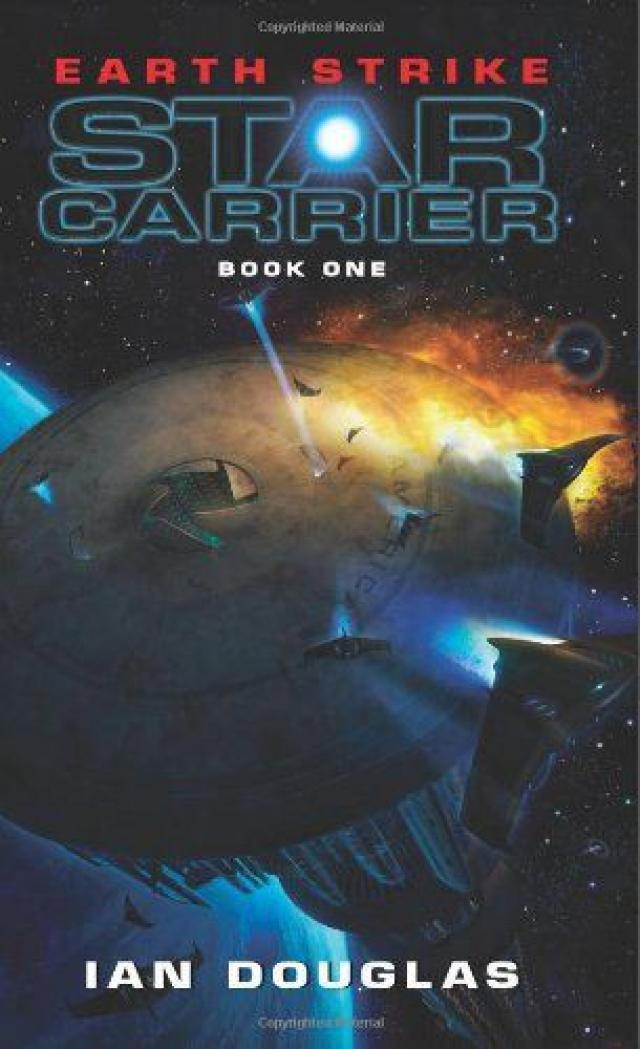
Koenig watched the battle developing. The enemy had more ships than the Confederation battlegroup, and a slight technological lead in such areas as gravitics, shields, and beam weaponry, but they’d been bloodied by the fighter strike earlier and were acting in an uncoordinated, almost sluggish manner.
The large vessel ahead-an asteroid, it appeared, partially hollowed out, given massive gravitic drives and mounted with weapons-was probably the enemy command ship. With more and more of the battlegroup’s weaponry concentrating on that one giant ship, it was possible that they were having trouble coordinating their fleet.
Gravitic shields blocked radio waves and lasercom beams. Typically, ships coordinated with one another in combat by flickering one section of their shields off and on while transmitting tightly packaged comm bursts precisely timed with the shield openings. Pile on enough firepower to keep the enemy’s shields up, and you kept him from communicating with other ships as well.
The Turusch fleet was attempting to rush the America…the largest vessel in the Confederation fleet. That’s what I would do, Koenig told himself. As more and more beams and missiles slammed against the Turusch command vessel’s shields, the enemy’s fleet organization became looser, less coherent.
But the enemy ships kept moving forward, sending waves of nuke-tipped missiles and Toad fighters out ahead of the lumbering capital ships.
Even disorganized, that swarm of Turusch ships would be able to overwhelm America’s defenses in fairly short order.
Koenig looked around, momentarily expecting Quintanilla to be there watching, criticizing. The operational orders issued by the Senate Military Directorate while the battlefleet was still gathering off Mars-several hundred megabytes’ worth of detailed instructions-had been very explicit. Koenig was not to risk the star carrier America. She was one of only six ships of her class, and the Military Directorate wanted to minimize the chances of her being lost or badly damaged. Those orders had directed Koenig, if the tactical situation warranted it, to take the America no closer than fifty AUs to Eta Boötis IV, and to direct the battle from there. At all costs, the America was to avoid direct ship-to-ship combat.
Sheer nonsense, of course, the appraisal of armchair admirals and politicians considering the possible course of a naval engagement from the comfort and security of their offices and conference rooms thirty-seven light years away. You could not direct a battle from four hundred light minutes away, not when the situation was over six and a half hours old by the time you received a status update transmission from the rest of the fleet, and with six and a half hours more before your orders crawled back to the fleet. Even worse, Koenig would actually have had to split his small fleet to ensure that America had combat support. If the Turusch detected America, caught her traveling alone, they could launch a long-range fighter strike or send a small detachment of warships to attack the lurking carrier.
Unsupported, the carrier wouldn’t have a chance in ten of survival.
And so Koenig had deliberately violated his orders. The phrase “if the tactical situation warranted” was his loophole, his way out. So far as Koenig was concerned, the tactical situation did not warrant either splitting his fleet or trying to run the show from over six light hours away. The phrase was, in fact, a cover-your-ass clause for the politicians; if America and her battlefleet were destroyed or suffered serious damage, the admirals and the Directorate senators could shrug and say, “Well, it wasn’t our fault. Koenig disobeyed orders.”
Pretty standard stuff. If the Confederation won and the Marines were successfully evacuated, the breach of orders would be quietly ignored. Otherwise…
Three hundred kilometers ahead, the escort Farragut had changed course, moving across America’s path to help shield the carrier from oncoming missile volleys. Two Turusch missiles struck the escort’s shields, the twin, silent flashes minute but dazzling on the CIC display screens.
But Confederation fire was hammering home among the Turusch ships as well. The Kinkaid continued to slam high-velocity kinetic-kill projectiles into the suspected enemy command-control ship. America was cycling her spinal mount weapon as quickly as possible-firing about once each fifteen seconds-targeting the same Turusch asteroid ship. If they could just keep up the pressure, if they could keep the enemy command ship’s shields up…
“Farragut reports heavy damage,” Hughes reported. “She’s falling out of the fight.”
Koenig turned in his seat to check one of the monitors relaying visuals from a battlespace drone out ahead of the carrier. Farragut was a missile escort, small and fast with a bundle of twenty-four mamba launch tubes tunneling through the center of her forward shield cap, massing 2200 tons and carrying a crew of 190 men and 15 officers. The ugly little missile boats were designed to dash in close, loose a swarm of high-yield smart missiles in the merge with the enemy formation, and accelerate clear under high-G boost. On the display, the Farragut was barely making way, her drive fields dead; he could actually see her on the screen, which meant her gravitic shields were down or intermittent only, and a portion of her aft drive structure was a tangled mass of wreckage, glowing white-hot and trailing a stream of half-molten debris like streaming sparks in the night. Another missile struck the craft, the flash lighting up the display, a dazzling, single pulse of light, and as the glare faded, the Farragut reappeared, her drive section gone, the forward stem and shield cap tumbling end-over-end. Radiation scanners aboard the drone were pegging the readouts in CIC off the scale.
There was no sign of escape pods evacuating the hulk. Two hundred five men and women…
The missile boat’s skipper, Maria Hernandez, had been America’s Operations officer until she’d been promoted to captain and given command of the Farragut.
She’d also been a friend.
“Controller,” Koenig said.
“Yes, sir.” The controller was Commander Vincent Reigh, and he was responsible for directing all fighters and other secondary spacecraft operating in America’s battlespace-the voice who directed the fighters to their targets and who passed new orders to the fighter squadrons as the combat situation changed.
“Have all fighters concentrate on target…” He paused to read the code group off the tac display. “Target Charlie-Papa One.” Charlie because it was the probable enemy command ship, Papa for a planetoid converted into a warship, and One because it was the most massive vessel so far spotted within the enemy fleet.
“All fighters to target Charlie-Papa One, aye, aye, Admiral.”
Right now, most of America’s fighters had merged with the enemy fleet and passed through to the other side. There, they would decelerate, reform, and begin accelerating back through the enemy fleet, joining the five fighters coming out from Eta Boötis’s night side.
Silent detonations continued to pulse and strobe throughout the Turusch fleet, but more and more were concentrating on the enemy command vessel. So damned little was known about Turisch combat psychology, even after the disasters at Arcturus Station and Everdawn. If the carrier group could decapitate the enemy by taking out that Charlie-Papa…would that be enough to send the rest of them running?
White light filled heaven outside America’s shields, and the combat display broke up momentarily in static. “What’s our Trapper?”
“Transmission percentage at sixty-one percent, Admiral.”
As the Confederation fleet attempted to interfere with the enemy command vessel’s ability to transmit orders to other Turusch vessels, the Turusch were attempting to do the same, blasting away at America’s shields to force them to stay up, blocking radio and lasercom signals to the other battlegroup ships. Transmission percentage-“Trapper”-was a measure of the clarity of ship-to-ship communications during combat. The harder the enemy hammered at America’s shields, the harder it would be to transmit orders to the rest of the battlegroup, or receive tactical updates and requests. Sixty-one percent was actually pretty good. It meant America’s shields were open and signals were getting through almost two thirds of the time.
But that was changing quickly as the two fleets moved toward the merge…
SAR Red-Delta
90 km south of Red-Mike HQ
Eta Boötis IV
0015 hours, TFT
“There! To the left!”
“God be praised! I see him.”
The UT-84 battlefield hopper, a stubby, blunt-nosed tri-wing, canted sharply to port and descended. Its outer hull nanoflage shifted to reflect the murky night, the utility craft’s gravs howling as they bit through the thick atmosphere. Powerful spotlights stabbed down through the gloom, centering on a lone figure struggling atop a low rock outcropping. The guy appeared to be nearly smothered beneath a shifting, oozing mass of darkness.
“Shit! What are those things?”
“We call them shadow swarmers. His e-suit should protect him, God willing, if they’ve not been swarming him for too long….”
Lieutenant Charles Ostend gave his passenger a sidelong glance, then shook his head. God willing? Muhammad Baqr was okay as collies went, but he shared the religious passion of all of the other Mufrids. The God-shouting fundy colonists on this miserable rock were utterly beyond his comprehension with their conviction that everything, including their very survival, depended solely upon God’s will.
Hell, why anyone would voluntarily choose to live in such a place in the first place was a question Ostend and his buddies in the 4th SAR/Recon Group had discussed endlessly in after-hours bull sessions ever since the Marines had landed and set up the perimeter. That had been…what? Five weeks ago? He checked his internal calendar. Yeah. Thirty-seven days. Earth days, not the crazy-short daylight cycles they had here.
Shadow swarmers? He’d not heard the term before, but it made as much sense as anything else on Ate a Boot. They’d homed in on a military distress transmission-a rescue beacon in a downed flier’s e-suit. They’d found him…but the guy was almost smothered by a mass of dark gray, leaf-shaped things. Ostend had the impression of millions of cockroaches, each bigger than a man’s outstretched hand and fingers.
He shuddered as he brought the SAR hopper’s nose high and gentled toward bare rock. He hated roaches, had an almost phobic fear of the things, and he didn’t want to think about what was going through that downed pilot’s mind right now.
The guy was alive, at least. Ostend could see arms and legs weakly thrashing about as he tried to pull, scrape, or kick the verminous creatures off of him.
“Okay,” Ostend said, uncertain. “How do we get to him?”
“We pull him inside,” Baqr told him. “The local life forms cannot tolerate high concentrations of oxygen.”
“Hey, Doc!” he called over the craft’s intercom. “We’ve got him in sight! But there’s a bit of a complication!”
“Doc” was a Navy corpsman, HMC Anthony McMillan, riding on the hopper’s cargo deck aft.
“What complication, Lieutenant?” McMillan replied.
“He’s covered with local crawlies. We need to pull him out of there. Mohammed says the oxygen in our air mix’ll kill them.”
“We’ll get him,” McMillan said. “Just get us there.”
The hopper’s two angled ventral wings folded up and rotated back out of the way as landing skids extended, and the craft gentled down ten meters from the writhing mass of swarmers. The port-side cargo-bay door irised open, and two men in Marine utility e-suits and armor jumped out, jogging toward the downed man, the spiders strapped to their backs flexing and working against the planet’s gravity. As they moved through the spotlight beams ahead of the hopper, exaggerated shadows shifted and flickered through dust-illumined shafts of light.
Ostend and Baqr watched from the hopper’s cockpit, keeping the external lights centered on the writhing figure atop the low rock outcrop. One of the corpsmen began pulling swarmers off the man’s suit, peeling them off by the fistful and flinging them away into the darkness. The other was plugging something into the pilot’s helmet.
“What are those swarmer things doing to him, anyway?” Ostend asked.
“Trying to eat him, of course,” Baqr said with a shrug. “Or, rather, trying to eat his e-suit. They must have become sensitized to the carbon in his e-suit.”
“They eat carbon?”
Baqr gave him a mild look. “So do you and I. The life on Eta Boötis is carbon-based, as is the life on Earth. And carbon-based life requires sources of carbon for growth and metabolism. Most of the mobile life forms here get the carbon from carbonaceous mineral deposits-they are lithovores. The sessile forms get it from the carbon dioxide in the atmosphere-lithoautotrophs.”
“So, just like plants and animals on Earth.”
“Only by very rough analogy. The mobile forms, the swarmers, are more like Earth’s plants, actually, getting what they need from the soil. Very active plants. They can be so here, with the abundance of energy available on this world.”
Mohammed Baqr, Ostend knew, was a xenobiologist, one of the senior scientists in the Mufrid colony on Haris, so he must know what he was talking about. It sounded crazy, though-plants moving and swarming like hungry piranhas.
“Can they get through his suit?”
“Eventually. Swarmers possess grinding plates within their ventral orifices, very hard, like organic diamond. The carbon nanoweave fiber of our e-suits is extremely tough, but eventually the grinding will wear through, yes. We’ve lost several of our people to the swarms.”
The two corpsmen were unfolding a collapsible stretcher and were strapping the pilot onto it. Swarmers continued to flit through the shadows, circling, moving closer.
“Those things can’t be plants.”
“The analogy is inexact,” Baqr told him. “Remember, this is an alien world, with an alien biosphere. We use words like “plant” and “animal” because these are the only words we have, and they come with meanings shaped by our experiences on Earth. The reality is…different. Much different.”
“Yeah, but look at them! Those things are tracking our people!”
“Technically, the individual swarmers all are part of a single organism. It…disperses itself across hundreds of square kilometers in order to locate widely scattered deposits of accessible minerals. When one…leaf finds a source of easily ingested carbon, we believe it communicates with the others through low-frequency sound waves transmitted through this dense atmosphere. And they begin to swarm. More and more of them, drawn from farther and farther away.”
“So we’re dealing with walking, meat-eating trees,” Ostend said.
“Ah…no. The swarmers are not plants, really.”
“Then they’re animals that act like plants…except they eat meat and move?”
“They are neither plants nor animals,” Baqr said, a touch of exasperation edging his voice, “not in the sense you mean.”
Ostend was about to reply to that, but he saw that the two corpsmen were approaching the hopper, carrying the stretcher between them. So far as he was concerned, the Marines would be getting off of this rock soon and he wouldn’t have to worry about swarmers, whatever the hell they truly were, ever again.
“How’s the patient?” he called over the comm net.
“Alive, Lieutenant,” was McMillan’s response. “But that’s about all. Cargo deck hatch is closed and sealed.”
“Here’s some fresh air, then,” Ostend said, passing his hand through a virtual control. “Don’t try breathing it yet, though.” Pure nitrogen began flowing into the pressure-tight cargo deck, forcing out the native atmosphere-nitrogen because the higher oxygen content of a terrestrial atmosphere might react unpleasantly with the methane and other compounds in the Haris gas mix. He brought the cargo deck pressure up to two and a half atmospheres, then began bleeding off the overpressure and adjusting the gas mix to Earth standard.
By that time, the hopper had lifted from that desolate, scorched-rock plain and was streaking north, back toward the Marine perimeter.
To Ostend’s way of thinking, in fact, they couldn’t leave Haris soon enough. The collie they’d assigned as his friendly native guide could have the place and its weird biology.
Blue Omega One
VFA-44 Dragonfires
Battlespace Eta Boötis IV
0022 hours, TFT
“Form on me, Blue Omegas,” Allyn called. “Staggered right echelon. Make it count!”
The Dragonfires, what was left of them, were well into the merge, hurtling through the rear zone of the Turusch fleet. Enemy vessels were pinging her Starhawk’s sensors from every side now. A brilliant flash close aboard marked the detonation of an enemy nuke striking a sandfield.
She knew she was rewriting the book on gravfighter tactics. The question was whether she’d be around later to autograph copies.
Five ships, the tattered remnant of Blue Omega, had continued to close with the Turusch battlefleet. Moments before, dozens of Starhawk fighters-the other strike squadrons off the America-had merged with the enemy ships dead ahead, then passed through, leaving a trail of silent, blossoming explosions in their wake. Decelerating swiftly, the other Starhawks had swarmed past the oncoming Blue Omega fighters, heading back toward the planet, slowed to a halt, then begun accelerating back the other way, slowly coming up behind the five Dragonfires.
Blue Omega continued to accelerate, approaching the enemy fleet from behind, well in the lead of the rest of America’s gravfighters.
She was angling toward one Turusch ship in particular, a gigantic target identifiable only by its enormous mass. The thing was almost certainly a PC-a planetoid converted to a command ship, with a mass registering in the billions of tons and a shield signature five kilometers long. Allyn couldn’t see the ship itself. It was still a long way off, almost two thousand kilometers, and its shields were so hard-driven by Confederation fire right now that they were almost constantly up, rendering the flying mountain all but invisible. As she neared it, though, she could see the strobing pulse and flash of Confederation warheads detonating against those shields, a steady, flickering, coruscating volley as incoming beams, nuclear warheads, and KK projectiles were twisted back by the Turusch gravitic shields in raw sprays of radiation.
Koenig watched the battle developing. The enemy had more ships than the Confederation battlegroup, and a slight technological lead in such areas as gravitics, shields, and beam weaponry, but they’d been bloodied by the fighter strike earlier and were acting in an uncoordinated, almost sluggish manner.
The large vessel ahead-an asteroid, it appeared, partially hollowed out, given massive gravitic drives and mounted with weapons-was probably the enemy command ship. With more and more of the battlegroup’s weaponry concentrating on that one giant ship, it was possible that they were having trouble coordinating their fleet.
Gravitic shields blocked radio waves and lasercom beams. Typically, ships coordinated with one another in combat by flickering one section of their shields off and on while transmitting tightly packaged comm bursts precisely timed with the shield openings. Pile on enough firepower to keep the enemy’s shields up, and you kept him from communicating with other ships as well.
The Turusch fleet was attempting to rush the America…the largest vessel in the Confederation fleet. That’s what I would do, Koenig told himself. As more and more beams and missiles slammed against the Turusch command vessel’s shields, the enemy’s fleet organization became looser, less coherent.
But the enemy ships kept moving forward, sending waves of nuke-tipped missiles and Toad fighters out ahead of the lumbering capital ships.
Even disorganized, that swarm of Turusch ships would be able to overwhelm America’s defenses in fairly short order.
Koenig looked around, momentarily expecting Quintanilla to be there watching, criticizing. The operational orders issued by the Senate Military Directorate while the battlefleet was still gathering off Mars-several hundred megabytes’ worth of detailed instructions-had been very explicit. Koenig was not to risk the star carrier America. She was one of only six ships of her class, and the Military Directorate wanted to minimize the chances of her being lost or badly damaged. Those orders had directed Koenig, if the tactical situation warranted it, to take the America no closer than fifty AUs to Eta Boötis IV, and to direct the battle from there. At all costs, the America was to avoid direct ship-to-ship combat.
Sheer nonsense, of course, the appraisal of armchair admirals and politicians considering the possible course of a naval engagement from the comfort and security of their offices and conference rooms thirty-seven light years away. You could not direct a battle from four hundred light minutes away, not when the situation was over six and a half hours old by the time you received a status update transmission from the rest of the fleet, and with six and a half hours more before your orders crawled back to the fleet. Even worse, Koenig would actually have had to split his small fleet to ensure that America had combat support. If the Turusch detected America, caught her traveling alone, they could launch a long-range fighter strike or send a small detachment of warships to attack the lurking carrier.
Unsupported, the carrier wouldn’t have a chance in ten of survival.
And so Koenig had deliberately violated his orders. The phrase “if the tactical situation warranted” was his loophole, his way out. So far as Koenig was concerned, the tactical situation did not warrant either splitting his fleet or trying to run the show from over six light hours away. The phrase was, in fact, a cover-your-ass clause for the politicians; if America and her battlefleet were destroyed or suffered serious damage, the admirals and the Directorate senators could shrug and say, “Well, it wasn’t our fault. Koenig disobeyed orders.”
Pretty standard stuff. If the Confederation won and the Marines were successfully evacuated, the breach of orders would be quietly ignored. Otherwise…
Three hundred kilometers ahead, the escort Farragut had changed course, moving across America’s path to help shield the carrier from oncoming missile volleys. Two Turusch missiles struck the escort’s shields, the twin, silent flashes minute but dazzling on the CIC display screens.
But Confederation fire was hammering home among the Turusch ships as well. The Kinkaid continued to slam high-velocity kinetic-kill projectiles into the suspected enemy command-control ship. America was cycling her spinal mount weapon as quickly as possible-firing about once each fifteen seconds-targeting the same Turusch asteroid ship. If they could just keep up the pressure, if they could keep the enemy command ship’s shields up…
“Farragut reports heavy damage,” Hughes reported. “She’s falling out of the fight.”
Koenig turned in his seat to check one of the monitors relaying visuals from a battlespace drone out ahead of the carrier. Farragut was a missile escort, small and fast with a bundle of twenty-four mamba launch tubes tunneling through the center of her forward shield cap, massing 2200 tons and carrying a crew of 190 men and 15 officers. The ugly little missile boats were designed to dash in close, loose a swarm of high-yield smart missiles in the merge with the enemy formation, and accelerate clear under high-G boost. On the display, the Farragut was barely making way, her drive fields dead; he could actually see her on the screen, which meant her gravitic shields were down or intermittent only, and a portion of her aft drive structure was a tangled mass of wreckage, glowing white-hot and trailing a stream of half-molten debris like streaming sparks in the night. Another missile struck the craft, the flash lighting up the display, a dazzling, single pulse of light, and as the glare faded, the Farragut reappeared, her drive section gone, the forward stem and shield cap tumbling end-over-end. Radiation scanners aboard the drone were pegging the readouts in CIC off the scale.
There was no sign of escape pods evacuating the hulk. Two hundred five men and women…
The missile boat’s skipper, Maria Hernandez, had been America’s Operations officer until she’d been promoted to captain and given command of the Farragut.
She’d also been a friend.
“Controller,” Koenig said.
“Yes, sir.” The controller was Commander Vincent Reigh, and he was responsible for directing all fighters and other secondary spacecraft operating in America’s battlespace-the voice who directed the fighters to their targets and who passed new orders to the fighter squadrons as the combat situation changed.
“Have all fighters concentrate on target…” He paused to read the code group off the tac display. “Target Charlie-Papa One.” Charlie because it was the probable enemy command ship, Papa for a planetoid converted into a warship, and One because it was the most massive vessel so far spotted within the enemy fleet.
“All fighters to target Charlie-Papa One, aye, aye, Admiral.”
Right now, most of America’s fighters had merged with the enemy fleet and passed through to the other side. There, they would decelerate, reform, and begin accelerating back through the enemy fleet, joining the five fighters coming out from Eta Boötis’s night side.
Silent detonations continued to pulse and strobe throughout the Turusch fleet, but more and more were concentrating on the enemy command vessel. So damned little was known about Turisch combat psychology, even after the disasters at Arcturus Station and Everdawn. If the carrier group could decapitate the enemy by taking out that Charlie-Papa…would that be enough to send the rest of them running?
White light filled heaven outside America’s shields, and the combat display broke up momentarily in static. “What’s our Trapper?”
“Transmission percentage at sixty-one percent, Admiral.”
As the Confederation fleet attempted to interfere with the enemy command vessel’s ability to transmit orders to other Turusch vessels, the Turusch were attempting to do the same, blasting away at America’s shields to force them to stay up, blocking radio and lasercom signals to the other battlegroup ships. Transmission percentage-“Trapper”-was a measure of the clarity of ship-to-ship communications during combat. The harder the enemy hammered at America’s shields, the harder it would be to transmit orders to the rest of the battlegroup, or receive tactical updates and requests. Sixty-one percent was actually pretty good. It meant America’s shields were open and signals were getting through almost two thirds of the time.
But that was changing quickly as the two fleets moved toward the merge…
SAR Red-Delta
90 km south of Red-Mike HQ
Eta Boötis IV
0015 hours, TFT
“There! To the left!”
“God be praised! I see him.”
The UT-84 battlefield hopper, a stubby, blunt-nosed tri-wing, canted sharply to port and descended. Its outer hull nanoflage shifted to reflect the murky night, the utility craft’s gravs howling as they bit through the thick atmosphere. Powerful spotlights stabbed down through the gloom, centering on a lone figure struggling atop a low rock outcropping. The guy appeared to be nearly smothered beneath a shifting, oozing mass of darkness.
“Shit! What are those things?”
“We call them shadow swarmers. His e-suit should protect him, God willing, if they’ve not been swarming him for too long….”
Lieutenant Charles Ostend gave his passenger a sidelong glance, then shook his head. God willing? Muhammad Baqr was okay as collies went, but he shared the religious passion of all of the other Mufrids. The God-shouting fundy colonists on this miserable rock were utterly beyond his comprehension with their conviction that everything, including their very survival, depended solely upon God’s will.
Hell, why anyone would voluntarily choose to live in such a place in the first place was a question Ostend and his buddies in the 4th SAR/Recon Group had discussed endlessly in after-hours bull sessions ever since the Marines had landed and set up the perimeter. That had been…what? Five weeks ago? He checked his internal calendar. Yeah. Thirty-seven days. Earth days, not the crazy-short daylight cycles they had here.
Shadow swarmers? He’d not heard the term before, but it made as much sense as anything else on Ate a Boot. They’d homed in on a military distress transmission-a rescue beacon in a downed flier’s e-suit. They’d found him…but the guy was almost smothered by a mass of dark gray, leaf-shaped things. Ostend had the impression of millions of cockroaches, each bigger than a man’s outstretched hand and fingers.
He shuddered as he brought the SAR hopper’s nose high and gentled toward bare rock. He hated roaches, had an almost phobic fear of the things, and he didn’t want to think about what was going through that downed pilot’s mind right now.
The guy was alive, at least. Ostend could see arms and legs weakly thrashing about as he tried to pull, scrape, or kick the verminous creatures off of him.
“Okay,” Ostend said, uncertain. “How do we get to him?”
“We pull him inside,” Baqr told him. “The local life forms cannot tolerate high concentrations of oxygen.”
“Hey, Doc!” he called over the craft’s intercom. “We’ve got him in sight! But there’s a bit of a complication!”
“Doc” was a Navy corpsman, HMC Anthony McMillan, riding on the hopper’s cargo deck aft.
“What complication, Lieutenant?” McMillan replied.
“He’s covered with local crawlies. We need to pull him out of there. Mohammed says the oxygen in our air mix’ll kill them.”
“We’ll get him,” McMillan said. “Just get us there.”
The hopper’s two angled ventral wings folded up and rotated back out of the way as landing skids extended, and the craft gentled down ten meters from the writhing mass of swarmers. The port-side cargo-bay door irised open, and two men in Marine utility e-suits and armor jumped out, jogging toward the downed man, the spiders strapped to their backs flexing and working against the planet’s gravity. As they moved through the spotlight beams ahead of the hopper, exaggerated shadows shifted and flickered through dust-illumined shafts of light.
Ostend and Baqr watched from the hopper’s cockpit, keeping the external lights centered on the writhing figure atop the low rock outcrop. One of the corpsmen began pulling swarmers off the man’s suit, peeling them off by the fistful and flinging them away into the darkness. The other was plugging something into the pilot’s helmet.
“What are those swarmer things doing to him, anyway?” Ostend asked.
“Trying to eat him, of course,” Baqr said with a shrug. “Or, rather, trying to eat his e-suit. They must have become sensitized to the carbon in his e-suit.”
“They eat carbon?”
Baqr gave him a mild look. “So do you and I. The life on Eta Boötis is carbon-based, as is the life on Earth. And carbon-based life requires sources of carbon for growth and metabolism. Most of the mobile life forms here get the carbon from carbonaceous mineral deposits-they are lithovores. The sessile forms get it from the carbon dioxide in the atmosphere-lithoautotrophs.”
“So, just like plants and animals on Earth.”
“Only by very rough analogy. The mobile forms, the swarmers, are more like Earth’s plants, actually, getting what they need from the soil. Very active plants. They can be so here, with the abundance of energy available on this world.”
Mohammed Baqr, Ostend knew, was a xenobiologist, one of the senior scientists in the Mufrid colony on Haris, so he must know what he was talking about. It sounded crazy, though-plants moving and swarming like hungry piranhas.
“Can they get through his suit?”
“Eventually. Swarmers possess grinding plates within their ventral orifices, very hard, like organic diamond. The carbon nanoweave fiber of our e-suits is extremely tough, but eventually the grinding will wear through, yes. We’ve lost several of our people to the swarms.”
The two corpsmen were unfolding a collapsible stretcher and were strapping the pilot onto it. Swarmers continued to flit through the shadows, circling, moving closer.
“Those things can’t be plants.”
“The analogy is inexact,” Baqr told him. “Remember, this is an alien world, with an alien biosphere. We use words like “plant” and “animal” because these are the only words we have, and they come with meanings shaped by our experiences on Earth. The reality is…different. Much different.”
“Yeah, but look at them! Those things are tracking our people!”
“Technically, the individual swarmers all are part of a single organism. It…disperses itself across hundreds of square kilometers in order to locate widely scattered deposits of accessible minerals. When one…leaf finds a source of easily ingested carbon, we believe it communicates with the others through low-frequency sound waves transmitted through this dense atmosphere. And they begin to swarm. More and more of them, drawn from farther and farther away.”
“So we’re dealing with walking, meat-eating trees,” Ostend said.
“Ah…no. The swarmers are not plants, really.”
“Then they’re animals that act like plants…except they eat meat and move?”
“They are neither plants nor animals,” Baqr said, a touch of exasperation edging his voice, “not in the sense you mean.”
Ostend was about to reply to that, but he saw that the two corpsmen were approaching the hopper, carrying the stretcher between them. So far as he was concerned, the Marines would be getting off of this rock soon and he wouldn’t have to worry about swarmers, whatever the hell they truly were, ever again.
“How’s the patient?” he called over the comm net.
“Alive, Lieutenant,” was McMillan’s response. “But that’s about all. Cargo deck hatch is closed and sealed.”
“Here’s some fresh air, then,” Ostend said, passing his hand through a virtual control. “Don’t try breathing it yet, though.” Pure nitrogen began flowing into the pressure-tight cargo deck, forcing out the native atmosphere-nitrogen because the higher oxygen content of a terrestrial atmosphere might react unpleasantly with the methane and other compounds in the Haris gas mix. He brought the cargo deck pressure up to two and a half atmospheres, then began bleeding off the overpressure and adjusting the gas mix to Earth standard.
By that time, the hopper had lifted from that desolate, scorched-rock plain and was streaking north, back toward the Marine perimeter.
To Ostend’s way of thinking, in fact, they couldn’t leave Haris soon enough. The collie they’d assigned as his friendly native guide could have the place and its weird biology.
Blue Omega One
VFA-44 Dragonfires
Battlespace Eta Boötis IV
0022 hours, TFT
“Form on me, Blue Omegas,” Allyn called. “Staggered right echelon. Make it count!”
The Dragonfires, what was left of them, were well into the merge, hurtling through the rear zone of the Turusch fleet. Enemy vessels were pinging her Starhawk’s sensors from every side now. A brilliant flash close aboard marked the detonation of an enemy nuke striking a sandfield.
She knew she was rewriting the book on gravfighter tactics. The question was whether she’d be around later to autograph copies.
Five ships, the tattered remnant of Blue Omega, had continued to close with the Turusch battlefleet. Moments before, dozens of Starhawk fighters-the other strike squadrons off the America-had merged with the enemy ships dead ahead, then passed through, leaving a trail of silent, blossoming explosions in their wake. Decelerating swiftly, the other Starhawks had swarmed past the oncoming Blue Omega fighters, heading back toward the planet, slowed to a halt, then begun accelerating back the other way, slowly coming up behind the five Dragonfires.
Blue Omega continued to accelerate, approaching the enemy fleet from behind, well in the lead of the rest of America’s gravfighters.
She was angling toward one Turusch ship in particular, a gigantic target identifiable only by its enormous mass. The thing was almost certainly a PC-a planetoid converted to a command ship, with a mass registering in the billions of tons and a shield signature five kilometers long. Allyn couldn’t see the ship itself. It was still a long way off, almost two thousand kilometers, and its shields were so hard-driven by Confederation fire right now that they were almost constantly up, rendering the flying mountain all but invisible. As she neared it, though, she could see the strobing pulse and flash of Confederation warheads detonating against those shields, a steady, flickering, coruscating volley as incoming beams, nuclear warheads, and KK projectiles were twisted back by the Turusch gravitic shields in raw sprays of radiation.